
Zhong Guo Qi Che Bao Wang

Search documents
场景创新的边界与极限
Zhong Guo Qi Che Bao Wang· 2025-12-16 06:41
Core Insights - The automotive industry is transitioning from merely providing vehicles to offering intelligent spaces that cater to diverse needs such as work, entertainment, and outdoor adventures, driven by a shift in user demands from functional satisfaction to emotional resonance [2] - The concept of "definition power" is shifting from engineers to users and life scenarios, leading to new categories of innovation in vehicle design [3] Group 1: Industry Transformation - The automotive sector is evolving into a provider of specific scenario solutions, with a focus on creating integrated experiences rather than just stacking features [4] - New vehicle categories are emerging, such as high-end MPVs designed for business receptions and off-road vehicles tailored for adventure, indicating a shift towards specialized market segments [3] - Companies are integrating technology ecosystems, as seen with Huawei's Harmony cockpit, which connects various devices to enhance the in-car experience [4] Group 2: Emotional Experience - Emotional design is becoming crucial as consumer expectations evolve from merely solving problems to creating enjoyable and ritualistic experiences [6] - Innovations like children's modes in vehicles that provide AI companionship and calming features reflect a deeper understanding of user needs [6] - The creation of unique experiences, such as personalized welcome lights and panoramic sunroofs, aims to establish emotional connections with users in a market characterized by hardware homogeneity [6] Group 3: Challenges and Boundaries - The industry faces challenges in maintaining a balance between innovative scenario creation and practical user needs, with a warning against over-investing in low-frequency features [9][10] - There is a growing concern about the reliability of new technologies, as many innovative concepts depend on unproven advancements, which could lead to safety issues [10] - The need for sustainable business ecosystems is highlighted, emphasizing the importance of transitioning from one-time hardware sales to lifelong service models to retain customer loyalty [11] Group 4: Market Dynamics - The market is witnessing a trend of reverting to simpler, more reliable designs as companies respond to user feedback regarding overly complex features [10] - Differentiation in a crowded market, where many vehicles offer similar camping modes, will depend on unique interpretations based on technological capabilities and brand identity [11] - The ongoing exploration of boundaries in automotive innovation is redefining the value of vehicles, positioning them as integral to daily life rather than just transportation tools [11]


大众集团首次关停德国本土工厂
Zhong Guo Qi Che Bao Wang· 2025-12-16 06:04
Core Viewpoint - Volkswagen Group has officially ceased vehicle production at its Dresden plant starting December 16, marking the first time in its 88-year history that it has shut down a factory in Germany due to declining demand in China and Europe, as well as the impact of U.S. tariffs [2] Group 1: Factory Overview - The Dresden plant, known as the "Transparent Factory," was established in 2002 and became a landmark for its visual production process, initially dedicated to the luxury Phaeton model [3] - The factory was built at a cost of €187 million and was designed without body manufacturing, painting, or stamping facilities, focusing solely on final assembly [3] - Despite its innovative design, the Phaeton model failed to meet sales expectations, leading to its discontinuation in 2016 after incurring losses of €2 billion for the company [5] Group 2: Transition and Production Changes - After the Phaeton's discontinuation, Volkswagen invested €20 million to modify the Dresden plant, which began producing the electric e-Golf in 2017 [6] - The plant transitioned to producing the ID.3 model, but its output remained low, with only 6,500 units produced in 2022, leading to plans to cease ID.3 production by 2023 [6] - The factory's cumulative production over 22 years was less than 200,000 vehicles, hindered by high operational costs in Germany [6] Group 3: Financial Pressures and Future Plans - The closure of the Dresden plant is part of a broader capacity reduction plan by Volkswagen, which aims to cut costs amid high manufacturing expenses and low productivity [8] - In December 2024, Volkswagen reached an agreement with labor unions to maintain operations in Germany while planning to reduce production capacity by over 70,000 units and cut 35,000 jobs by 2030 [8] - The Dresden site will be repurposed into a research park focusing on artificial intelligence, robotics, and chip development, while remaining open to the public as a tourist attraction [8][9] - Volkswagen reported a net loss of €1.072 billion in Q3 2025, marking its first quarterly loss in five years, and has lowered its profit expectations for 2025 due to pressures from declining sales in China and Europe, as well as U.S. tariffs [9]

不止于车更是一种精神 一汽解放与万千卡友休戚与共
Zhong Guo Qi Che Bao Wang· 2025-12-16 04:10
从第一辆解放牌卡车CA10的诞生,实现新中国汽车从无到有的重大转折,到高端重卡比肩世界一流水平,解放凭借七代产品的积淀和900万辆的跨越式 发展,依托"四国九地"的研发布局,铸就了中国商用车的领航地位,成为民族品牌中一面熠熠生辉的旗帜。 解放不仅仅是一辆卡车,更是一种精神、一种信念。12月14日,一汽解放2026全球合作伙伴大会在成都开幕,当日上午,以"以爱筑梦 价值共 赢"主题的第三届梦想合伙人大会率先召开。 01 与百万卡友休戚与共 "昨天(12月13日),我看到几十辆由卡友自驾而来的车辆陈列在会场,这些车辆满载着感动与故事。它们承载着大家奔波四方的汗水,镌刻着奋斗拼 搏的足迹,见证了你们与解放风雨同舟的深厚情谊。千里赴会的驰骋,不离不弃的相守,正是梦想合伙人最珍贵的精神内核,也是我们携手前行的不竭动 力。"活动现场,一汽解放党委书记、董事长李胜在致辞中表示,一汽解放作为中国商用车行业领航者,七十余载栉风沐雨、薪火相传,始终与国家脉搏同 频共振,与百万卡友休戚与共。 今年,一汽解放销售量将突破28万辆,中重卡市场份额稳居国内第一,海外出口实现6年增长10倍,新能源业务连续3年翻倍增长。一汽解放的品牌价值 ...


AI技术爆发 汽车业迎智能化革命
Zhong Guo Qi Che Bao Wang· 2025-12-16 02:25
Core Insights - The automotive industry is entering an era of universal intelligent driving by 2025, with AI technology deeply integrated into smart cockpits and autonomous driving, marking a significant transformation in the sector [2][3] Group 1: Intelligent Driving and AI Integration - "Intelligent driving equity" has emerged as a key theme, with traditional automakers and new players racing to adopt advanced driving systems, leading to the prediction of 2025 as the "year of universal intelligent driving" [3] - BYD has launched its self-developed "Tianshen Eye" advanced driving system, enhancing the driving experience across its entire model range and supporting sales growth [3] - The overall cost of intelligent driving has significantly decreased due to technological advancements, enabling systems to be integrated into vehicles priced around 100,000 yuan or lower [3][6] Group 2: VLA Model and Its Advantages - The introduction of VLA (Visual Language Action) models by various automakers signifies a trend in intelligent driving, addressing the unpredictability of traditional end-to-end models [4][5] - VLA models enhance the ability to handle complex scenarios and provide interpretability in decision-making, mimicking human driving logic [5] - Companies like Li Auto have upgraded their systems to VLA architecture, improving spatial understanding and communication capabilities [5] Group 3: Robotaxi Commercialization - The commercial application of L4-level autonomous taxis (Robotaxi) is accelerating, with cities like Shanghai seeing the deployment of driverless vehicles [7] - The Robotaxi market in China is projected to grow from $54 million in 2025 to $47 billion by 2035, with over 50,000 Robotaxis expected to operate in more than 10 cities by 2030 [8] - Companies like Xiaoma Zhixing and Wenyan Zhixing reported significant revenue growth in their Robotaxi businesses, indicating a rapid commercialization trend [9][10] Group 4: Emerging Technologies and Opportunities - The automotive industry is also focusing on embodied intelligence, flying cars, and humanoid robots as new opportunities for growth by 2025 [11][12] - The development of flying cars is seen as a transformative innovation in transportation, with companies targeting 2026 for mass production [12] - The integration of industrial internet technologies in automotive manufacturing is redefining production processes and driving the shift towards intelligent manufacturing [12][13]
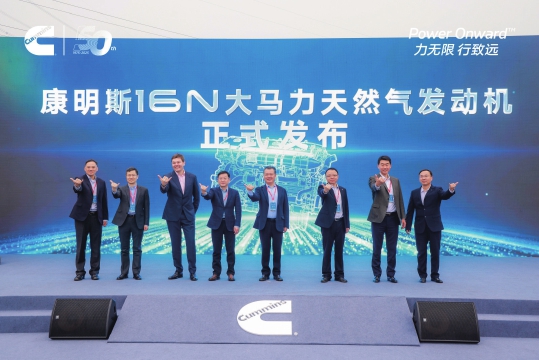
发布16N旗舰级天然气发动机 康明斯打造天然气动力六边形战士
Zhong Guo Qi Che Bao Wang· 2025-12-16 02:18
Core Insights - Cummins launched its new flagship natural gas engine, the 16N, at a logistics park in Chengdu, signaling a strategic focus on the southwestern and northwestern regions of China for high-power natural gas engine applications [2][3] - The development of the 16N engine is based on extensive data analysis from over 80,000 connected vehicles, highlighting the need for improved performance in challenging road conditions [3] Group 1: Product Features - The 16N engine boasts a maximum power of 720 horsepower (approximately 529 kW) and a torque of 3600 N·m, allowing for better efficiency and performance in logistics operations [3] - It is designed with six core capabilities: strong, efficient, reliable, intelligent, safe, and protective, all supported by robust technological innovations [4] - The engine features a newly designed turbocharger with a dual-channel structure to enhance boost efficiency and reliability under high-load conditions [4] Group 2: Efficiency and Reliability - The 16N engine incorporates a new strong swirl combustion system, achieving a 4% fuel efficiency improvement over the previous generation, with an overall potential fuel savings of 6% through integrated smart systems [5] - It has undergone over 40,000 hours of bench testing and 5 million kilometers of road validation, ensuring high reliability with components designed for a lifespan of over 1.2 million kilometers [5] Group 3: Safety and Maintenance - The engine includes advanced braking technology providing up to 400 kW of braking power and features a hydraulic automatic valve clearance adjustment for maintenance intervals of up to 300,000 kilometers [6] - A predictive maintenance system aims to transition from reactive to proactive service, enhancing operational efficiency and reducing downtime [6] Group 4: Real-World Testing - Prior to the official launch, Cummins conducted real-world testing in challenging environments, demonstrating the engine's strong performance and fuel efficiency under various conditions [7] - The engine's NVH (noise, vibration, and harshness) performance has significantly improved based on user feedback, addressing reliability issues in extreme cold conditions [8] Group 5: Customer Engagement - The launch event included the delivery of the first batch of 16N engines to key users, marking the beginning of a collaborative journey towards efficient green logistics [8]

“车-桩-运”一体化解决方案激活千亿绿色运力新赛道
Zhong Guo Qi Che Bao Wang· 2025-12-16 02:05
Core Insights - The transition from traditional fuel heavy trucks to new energy heavy trucks is accelerating under the influence of "dual carbon" goals and ongoing environmental policies [1] - The total cost of ownership (TCO) for new energy heavy trucks has become advantageous in high-frequency operational scenarios such as port short-haul, mining transportation, and urban construction waste [1] Group 1: Strategic Partnerships - Zhejiang Yixiang Internet Technology Co., Ltd. has signed a strategic cooperation agreement with charging service provider TLE Electric to enhance the development of the new energy heavy truck industry [3] - The collaboration aims to build an integrated "vehicle-charging-operation" solution, marking a significant step from single leasing services to a systematic ecological construction [3] Group 2: Operational Model - Zhejiang Yixiang's operational model focuses on relieving users from complex asset management and technology iteration risks, providing predictable and stable green logistics through a platform-based approach [3] - The model not only aids logistics companies in achieving a light asset transformation but also addresses concerns regarding technology obsolescence and asset depreciation through professional vehicle scheduling, battery management, and residual value operations [3] Group 3: Market Impact - The partnership with TLE Electric strengthens the foundation of the operational model by ensuring stable, efficient, and low-cost charging, which is crucial for the large-scale operation of new energy heavy trucks [3] - The collaboration is expected to enhance fleet operation certainty and cost control, while creating a data loop for route optimization, energy consumption management, battery health assessment, and asset value management [3][4] - This integrated model is seen as a systemic reconstruction of the green logistics system, potentially leading to the commercialization and widespread adoption of new energy heavy trucks, thus providing a replicable ecological example for low-carbon transition in the transportation sector [4]

AI技术爆发,汽车业迎智能化革命
Zhong Guo Qi Che Bao Wang· 2025-12-16 01:41
Core Insights - The automotive industry is entering an era of universal intelligent driving by 2025, with AI technology deeply integrated into smart cockpits and autonomous driving, marking a significant transformation in the industry [2][3] - "Intelligent driving equity" has emerged as a key theme, with traditional automakers and new players racing to adopt advanced driving systems, indicating a shift towards a more accessible intelligent driving experience for consumers [3][4] Industry Trends - The introduction of advanced driving systems like BYD's "Tian Shen Zhi Yan" and XPeng's XNGP system is enhancing the driving experience and supporting sales growth [3] - The overall cost of intelligent driving technology is decreasing, enabling its adoption in more affordable vehicles, thus broadening consumer access [3][4] - The VLA (Visual Language Action) model is becoming a highlight in automotive intelligence, offering better handling of complex scenarios and improving the interpretability of driving decisions [4][5] Market Dynamics - The Robotaxi market is accelerating, with companies like Pony.ai and Baidu obtaining operational licenses in major cities, indicating a rapid commercialization of autonomous taxi services [6][7] - The Chinese Robotaxi market is projected to grow from $54 million in 2025 to $47 billion by 2035, with over 50,000 Robotaxis expected to operate in more than 10 cities by 2030 [7][8] Financial Performance - Companies like Pony.ai and WeRide are reporting significant revenue growth, with Pony.ai's Robotaxi business revenue increasing by 89.5% year-over-year, reflecting the rapid commercialization of autonomous driving [8][9] Technological Innovations - The emergence of embodied intelligence, flying cars, and humanoid robots is becoming a focus for automotive companies, with significant advancements in these areas expected by 2025 [9][10] - The integration of industrial internet technologies is redefining automotive manufacturing, enhancing efficiency and quality while reducing costs [10][11] Policy and Regulation - The Chinese government is actively promoting the development of intelligent connected vehicles through various policies, which are expected to guide the industry's growth and ensure compliance with safety standards [12][13] - Recent policies emphasize the importance of a structured approach to the commercialization of intelligent driving technologies, aiming to prevent over-marketing and ensure reliability [13][14]


汽车早餐 | 多家车企积极响应《汽车行业价格行为合规指南(征求意见稿)》;小鹏第三个海外本地化生产项目落地马来西亚
Zhong Guo Qi Che Bao Wang· 2025-12-16 01:33
Domestic News - The National Bureau of Statistics reported that from January to November, the added value of the automotive manufacturing industry grew by 11.8% [2] - In the same period, the production of automobiles increased by 10.8%, indicating a steady growth in new consumption [2] - The retail volume of new energy vehicles in the passenger car market maintained rapid growth during this timeframe [2] Industry Developments - The State Administration for Market Regulation announced a recall of 244,500 vehicles from seven automotive manufacturers in November 2025 [3] - The "Yue Car Southbound" reservation system began accepting bookings on December 15, 2025, for travel from December 23, 2025, to January 31, 2026 [4] - Shenyang plans to strengthen its automotive and parts industry, focusing on the full industrial chain of smart connected new energy vehicles [5] - Luoyang aims to accelerate the bearing industry in relation to new energy vehicles and other emerging sectors [6] International News - Renault is shutting down its car-sharing business and slowing down the construction of its electric vehicle charging network to focus on more profitable segments [7] - Volkswagen will cease vehicle production at its Dresden plant after December 16, marking the first closure of vehicle production in Germany since its establishment [9] - Mercedes-Benz India will raise car prices by up to 2% starting January due to rising raw material and logistics costs [10] Corporate News - Multiple automotive companies, including Jiangqi Group and Seres Group, are responding positively to the "Automotive Industry Pricing Behavior Compliance Guidelines" [11] - GAC's flying car GOVY AirCab has entered the airworthiness certification stage, with mass production expected in 2026 [12] - XPeng Motors has initiated its third localized production project in Malaysia, aiming for mass production by 2026 [13] - NIO has established 500 charging and battery swap stations in Shanghai, providing over 10,000 battery swap services daily [14] - CATL and Transfar Group signed a strategic cooperation agreement to enhance collaboration in green and sustainable industry ecosystems [15] - Dong'an Power and Beijing Automotive Manufacturing Factory signed a strategic cooperation agreement to establish a joint innovation laboratory [16] - Taotao Automotive's subsidiary plans to acquire 100% of Racka brand company for $15 million, expanding its brand portfolio [17]

这一年 潍柴向世界一流迈出坚实一步
Zhong Guo Qi Che Bao Wang· 2025-12-16 01:17
Core Insights - The core focus of the news is on Weichai Group's strong performance and strategic initiatives showcased during its 2026 Business Conference, highlighting its advancements in green low-carbon products and innovative service models [2][3]. Group Performance and Growth - Weichai has evolved into a leading industrial equipment multinational group in China, with an annual revenue exceeding 300 billion yuan, and has established a diverse industrial matrix across various sectors including power systems and commercial vehicles [3]. - The brand value of Weichai reached 83.048 billion yuan, ranking second in China's machinery manufacturing sector, and it was ranked 87th in the "2025 China Top 500 Enterprises" list with a revenue of 312.29 billion yuan in 2024 [3]. - Weichai is expected to maintain stable growth in revenue and profit in 2025, with a focus on high-end power upgrades and rapid growth in new energy power [5]. Innovation and Product Development - Weichai has reinforced its market leadership, maintaining the highest market share in the domestic industry, with significant sales growth in strategic markets such as Southeast Asia and Latin America [5]. - The company has introduced high-efficiency products, including the world's first 5-megawatt high-speed diesel generator set, and has made breakthroughs in solid oxide fuel cell technology [5][6]. - The new energy industry park in Yantai has a production capacity of 20 GWh for battery packs, with battery sales expected to grow by 170% year-on-year, becoming a key growth area for the company [6]. Strategic Initiatives and Future Outlook - Weichai aims to enhance its competitive edge by focusing on customer-centric solutions, expanding into new energy and high-end hydraulic markets, and fostering a collaborative ecosystem with global partners [4][7]. - The company plans to transition its after-market business from a parts-selling model to a service solution model, which is expected to drive sustainable growth and improve profitability [6]. - Looking ahead to the "15th Five-Year Plan," Weichai will prioritize technological innovation, market expansion, and ecosystem development to strengthen its position in the global high-end equipment industry [6][7].

观车 · 论势 || 整零协同开辟中国汽车“出海”新路径
Zhong Guo Qi Che Bao Wang· 2025-12-16 01:17
Core Viewpoint - The Chinese automotive industry is at a critical juncture in its global expansion, with a focus on collaborative "going global" strategies between automakers and component suppliers to navigate complex international market challenges [1][2]. Group 1: Industry Trends - Since 2023, China has maintained the position of the world's largest automotive exporter, supported by its technological advantages in electrification and intelligence [1]. - The increasing trade and technical barriers in international markets pose significant challenges for Chinese automakers, including local component sourcing requirements in Southeast Asia and new regulations in Europe [1][2]. Group 2: Challenges and Opportunities - Chinese automotive companies face gaps in integration capabilities, production efficiency, and brand recognition compared to established multinational giants, which increases the cost of "going global" and weakens market positions [2][3]. - The current "going global" efforts are often fragmented, leading to resource duplication and a lack of sustainable competitive advantage [3]. Group 3: Collaborative Strategies - A collaborative "going global" system between automakers and component suppliers is essential for survival, enabling resource integration, supply chain efficiency, and improved customer experience [2][3]. - The partnership model exemplified by the collaboration between Funeng Technology and GAC Aion highlights the importance of local production capacity for stabilizing supply chains and reducing operational risks [4]. Group 4: Future Directions - The future competition in the automotive industry will hinge on the efficiency of the supply chain, innovation resilience, and ecological collaboration capabilities [5]. - Transitioning from a focus on product exports to a comprehensive ecosystem output is crucial for China's automotive industry to evolve from a major exporter to a strong automotive ecosystem [5].