
Jin Rong Shi Bao

Search documents
非银机构员工:2026年,我们这么做!
Jin Rong Shi Bao· 2025-12-12 11:36
Group 1 - The Central Economic Work Conference emphasized the importance of "domestic demand as the main driver" and "deepening the implementation of special actions to boost consumption" as key tasks for financial institutions [1] - Non-bank financial institutions are aligning their strategies with the directives from the Central Economic Work Conference, focusing on enhancing service quality and efficiency in providing financial support to small and medium-sized enterprises [1][2] - Companies like Huarong Jinzu are aiming to adapt to new industrial revolutions by enhancing their capabilities to respond to national strategies and focusing on emerging industries such as low-altitude economy and semiconductor [2] Group 2 - CITIC Jinzu plans to prioritize resources in technology innovation, advanced manufacturing, and green transformation, particularly in marine economy and high-end shipbuilding [3] - Financial institutions are committed to providing high-quality financial services to support the transition from development plans to practical implementations, focusing on risk management and operational efficiency [3][4] - The Central Economic Work Conference highlighted the establishment of international technology innovation centers in key regions, prompting companies like Sinochem Finance to enhance their financial services to support technological innovation and high-quality development [5] Group 3 - The consumption finance sector aims to simplify financial service processes and integrate them into various consumption scenarios to stimulate consumer spending and improve livelihoods [2] - Companies are focusing on cross-border financial services, optimizing core products like cross-border settlement and trade financing to support enterprises in navigating international supply chains [4] - Non-bank financial institutions are leveraging the spirit of the Central Economic Work Conference to ensure that financial resources effectively nourish the real economy, contributing to China's high-quality economic development [5]
政策工具箱丰富 央行“组合拳”呵护流动性
Jin Rong Shi Bao· 2025-12-12 10:19
Group 1 - The core viewpoint of the articles emphasizes that China's banking system liquidity remains abundant, which is crucial for stabilizing the macroeconomic landscape and ensuring the healthy operation of financial markets [1] - The People's Bank of China (PBOC) has established a comprehensive set of liquidity management tools to effectively respond to short-term fluctuations caused by fiscal policies and government bond issuances, maintaining overall stability in the money market [1][2] - Recent innovations in liquidity management tools, such as including government bond trading in the monetary policy toolkit and creating two new monetary policy tools to support the capital market, are expected to enhance the effectiveness of liquidity management in China [1] Group 2 - Internationally, central banks utilize various tools for liquidity management, which can be categorized into four levels: intraday liquidity support, daily liquidity supply, temporary liquidity supply, and structural liquidity supply [2] - China's liquidity tool system aligns with the mainstream frameworks in Europe and the U.S., reflecting both international practices and domestic market realities [3] - The management logic of China's liquidity tools is consistent with international practices, focusing on banking institutions as counterparties and using high liquidity, low-risk assets like government bonds for collateral [3]
央行最新数据发布!
Jin Rong Shi Bao· 2025-12-12 10:02
Core Insights - The latest financial statistics from the central bank indicate a moderately loose monetary policy environment, supporting high-quality economic development [2][3] Monetary Supply - As of November 2025, the broad money supply (M2) reached 336.99 trillion yuan, growing by 8.0% year-on-year, which is 0.9 percentage points higher than the previous year [1] - The narrow money supply (M1) stood at 112.89 trillion yuan, with a year-on-year increase of 4.9% [1] - The currency in circulation (M0) amounted to 13.74 trillion yuan, reflecting a growth of 10.6% year-on-year [1] Social Financing - The total social financing stock was 440.07 trillion yuan, marking an 8.5% year-on-year increase, which is 0.7 percentage points higher than the previous year [1] - From January to November, the incremental social financing was 33.39 trillion yuan, which is 3.99 trillion yuan more than the same period last year [1] Government Debt and Fiscal Policy - The total new government debt this year reached 11.86 trillion yuan, an increase of 2.9 trillion yuan compared to last year, with significant contributions from various types of government bonds [3] - The issuance of government bonds has been accelerated, with 1.3 trillion yuan of ultra-long-term special bonds fully issued, and 2 trillion yuan allocated for refinancing existing hidden debts [3] - Government bond financing is expected to exceed 12 trillion yuan this year, accounting for 40% of the incremental social financing [3] Credit Growth and Quality - By the end of November, the RMB loan balance was 271 trillion yuan, with a year-on-year growth of 6.4% [7] - The average interest rate for newly issued corporate loans was approximately 3.1%, down about 30 basis points from the previous year [7] - Inclusive small and micro loans reached 35.88 trillion yuan, growing by 11.4%, while medium to long-term loans for the manufacturing sector increased by 7.7% [7] Structural Changes in Financing - The shift in credit structure reflects the transition of economic growth drivers from traditional sectors to emerging fields such as technology innovation and green development [7][8] - The central bank has been enhancing its monetary policy tools to better align financial products and services with the needs of economic transformation [8] - Banks are optimizing their internal governance to effectively transmit central bank policy incentives, leading to a reasonable growth in credit volume and continuous improvement in quality [8]
这家央行,距负利率仅一步之遥
Jin Rong Shi Bao· 2025-12-12 06:38
Core Points - The Swiss National Bank (SNB) decided to maintain the key policy interest rate at 0%, marking the second consecutive time it has kept rates unchanged [1][2] - Inflation remains a critical factor influencing the SNB's monetary policy, with recent inflation rates slightly below expectations, but medium-term inflation pressure showing little change compared to the last assessment [1] - The SNB projects average annual inflation rates for Switzerland at 0.2%, 0.3%, and 0.6% for the years 2025, 2026, and 2027, respectively [1] - Economic growth outlook for Switzerland has slightly improved due to reduced U.S. tariffs and a modest recovery in the global economy, with GDP growth expected to be just below 1.5% in 2025 and around 1% in 2026 [2] - The SNB has shifted from a period of rate cuts to a more cautious monetary policy stance, having previously implemented a negative interest rate policy for seven years [2] - The possibility of returning to negative interest rates is not completely ruled out, but the current situation requires careful consideration before making such a decision [2]
宋代的政府金融机构体系
Jin Rong Shi Bao· 2025-12-12 05:00
Core Viewpoint - The financial system during the Song Dynasty was primarily government-led and closely tied to the fiscal framework, with local governments playing significant financial roles [1] Group 1: Government Financial Structure - The Song Dynasty's financial management was characterized by a detailed and strengthened bureaucratic system, particularly the Ministry of Revenue, which was responsible for economic and financial operations [2] - The Ministry of Revenue, initially known as the "Three Departments," was responsible for managing national finances, including taxation and resource allocation [2] - The financial functions of the Ministry of Revenue included managing household registrations, tax records, and state resources, indicating a comprehensive financial oversight [2] Group 2: Financial Institutions and Functions - The Tai Fu Si, under the Ministry of Revenue, served as a central treasury and included various financial departments responsible for currency management and trade regulation [3] - Key financial departments included the Market Regulation Office, which managed trade goods and currency exchange, and the Currency Exchange Office, which handled the issuance and management of paper currency [3][4] - The official pawnshop department provided loans against collateral, contributing to government revenue through interest [4] Group 3: Local Government Financial Roles - Local governments in the Song Dynasty also had financial functions, implementing central financial policies and establishing local financial institutions to enhance efficiency [5] - Various local offices were responsible for managing agricultural resources, tax collection, and temporary loans, indicating a decentralized approach to financial management [5][6] - The issuance of paper currency and financial instruments was initially localized, with regional offices managing their operations before centralization occurred [6]
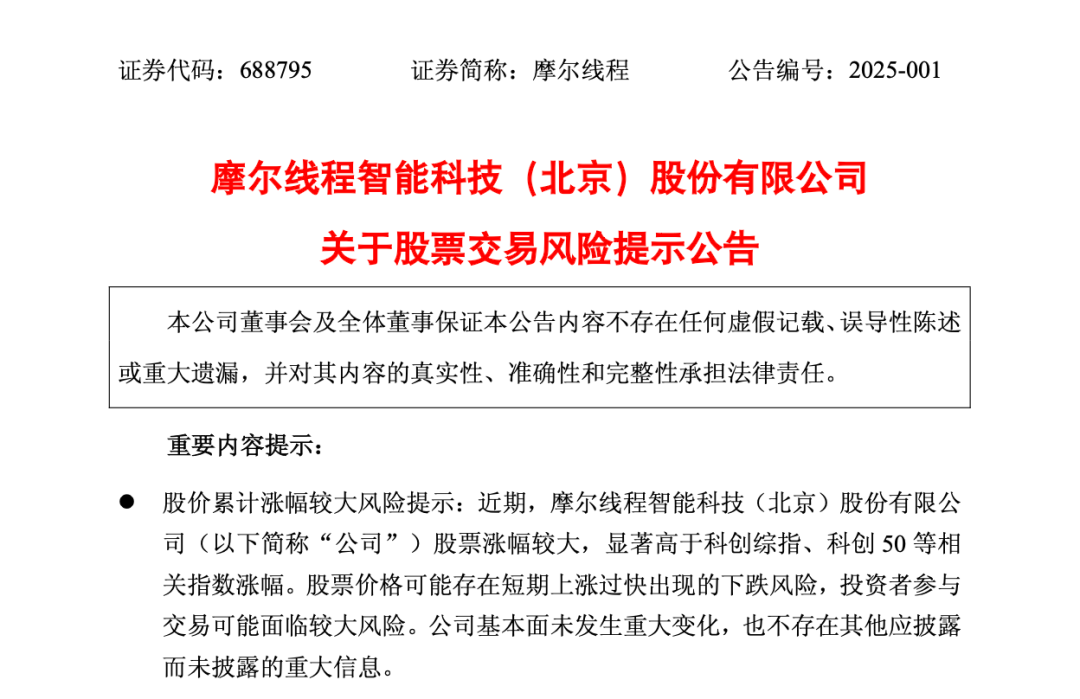
5个交易日涨超7倍,摩尔线程提示股票交易风险!
Jin Rong Shi Bao· 2025-12-12 04:13
Core Viewpoint - The stock price of Moore Threads has surged significantly since its IPO, raising concerns about potential short-term volatility and risks for investors, despite no major changes in the company's fundamentals [1][3]. Group 1: Stock Performance - As of December 11, Moore Threads' stock price reached 941.08 CNY per share, with a total market capitalization of 442.3 billion CNY, reflecting a cumulative increase of 723.49% from its initial offering price of 114.28 CNY per share within five trading days [1][3]. - On its first trading day, the stock opened with a remarkable increase of 468.78%, peaking at 688 CNY per share, and closing at 600.50 CNY, marking a single-day rise of 425.46% [2]. - The stock's trading volume was exceptionally high, with a turnover rate of 85.49% on the first day, indicating strong market interest in the stock [2]. Group 2: Market Sentiment and Demand - The overwhelming demand for Moore Threads is attributed to the surge in AI computing power needs and the acceleration of domestic alternatives, reflecting a broader market interest in China's self-sufficiency in computing power [2]. - The company experienced a low subscription rate during its IPO, with only 0.0364% of applicants successfully obtaining shares, highlighting the intense competition among investors [2]. Group 3: Upcoming Events - Moore Threads is set to hold its first MUSA Developer Conference on December 19-20, where the CEO will outline the company's full-stack development strategy and unveil a new GPU architecture [3]. - The company anticipates that this event will not have a significant short-term impact on its operational performance [3]. Group 4: Financial Performance and Risks - For the first nine months of 2025, Moore Threads reported revenues of 785 million CNY and a net loss of 724 million CNY, with projections indicating a continued loss for the year [5]. - The company has emphasized the risks associated with ongoing losses due to high R&D expenditures necessary for maintaining technological advancement, which may delay profitability [5][6]. - Moore Threads has set a long-term goal to achieve profitability by 2027, with projected revenues of 5.983 billion CNY and a gross margin of 61%, although it currently faces significant challenges compared to industry peers [6].

“贷”动红色热土 普惠革命老区
Jin Rong Shi Bao· 2025-12-12 03:42
Core Viewpoint - The news highlights the efforts of the People's Bank of China Dazhou Branch to revitalize red tourism sites in Dazhou, Sichuan, by providing financial support and innovative credit solutions to enhance the visitor experience and promote local economic development [1][2][3][4] Group 1: Financial Support and Development - The People's Bank of China Dazhou Branch has facilitated a total of 7.6 billion yuan in loans to support the development of red tourism sites, including 3.5 billion yuan for the Shenjian Garden and 4.1 billion yuan for the Wanyuan Red Army Park [2][3] - Innovative credit tools have been employed, such as using future income from tourism as collateral to expedite loan approvals and disbursements [2][4] Group 2: Tourism and Economic Impact - The Shenjian Garden has developed nine educational programs and has received over 30,000 visitors during the National Day holiday, generating approximately 33 million yuan in direct and indirect economic benefits [2] - The upgraded Wanyuan Red Army Park attracted over 50,000 visitors during the "July 1" celebrations, with more than 100 groups participating in oath-taking ceremonies [3] - The Chuanxian Red County Memorial Park has seen a significant increase in visitor engagement through modernized facilities, including VR experiences, contributing to local economic revitalization [4]
中国电影: 当镜头对准普通人的瞳孔
Jin Rong Shi Bao· 2025-12-12 03:40
Core Insights - In 2025, Chinese cinema celebrated its 120th anniversary with significant milestones, including the animated film "Nezha 2" achieving a global box office of 15.9 billion yuan, ranking among the top five in global box office history and marking the strongest Spring Festival box office ever at 8.257 billion yuan [1] - The integration of hard technology, particularly AI, into the film production process has enhanced efficiency, with over 100 films utilizing AI-assisted editing and special effects, resulting in a 40% increase in production efficiency [1] - A notable trend in 2025 is the "de-heroization" of historical narratives, focusing on ordinary individuals rather than traditional heroic figures, as seen in films like "Nanjing Photo Studio" and "East Extreme Island" [2][3] Group 1: Technological Advancements - The use of AI and particle simulation systems in "Nezha 2" has transformed animation production, making technology a core part of the creative process [1] - The film industry has seen a shift towards quality over quantity, with audiences increasingly favoring well-crafted films over mass-produced content [6][7] Group 2: Narrative Trends - The focus on ordinary people's perspectives in historical narratives has resonated with audiences, allowing for deeper emotional connections and a shift from didactic storytelling to empathy [3][4] - Films like "Chang'an's Lychee" illustrate how individual stories can reflect broader historical themes, emphasizing the significance of personal experiences in understanding history [3] Group 3: Economic Impact - The "ticket root economy" has emerged, where movie tickets serve as gateways to cross-industry consumption, promoting local tourism and dining through various promotional activities [8][9] - Collaborative efforts between films and local tourism departments have created new revenue streams, demonstrating a shift from a content-centric approach to an ecosystem-focused strategy [9][10] Group 4: Global Expansion - Chinese films are increasingly reaching international audiences, with titles like "Nezha 2" and "Nanjing Photo Studio" achieving success abroad, indicating a transition from showcasing Eastern culture to becoming global storytellers [11]

经典IP归来, 靠什么揽金
Jin Rong Shi Bao· 2025-12-12 03:40
电影《疯狂动物城2》自今年11月26日上映以来,票房表现强劲。数据显示,该片在中国内地的首周末 票房破5亿元,上映仅5天便突破了19亿元票房,超越了前作在中国内地创下的15.4亿元票房纪录,也超 越了北美票房成绩,成为本片全球第一大票仓。目前,它已经创下了中国影史进口动画片票房冠军、 2025进口片内地票房冠军。那么,暌违九年,这一"顶流"IP靠什么持续吸引观众呢? 好故事坚守顶流IP口碑 《疯狂动物城2》在票房火爆的同时,豆瓣评分达到8.5分,虽然不及前作的9.3分,但依然叫好又"叫 座"。 2016年,电影《疯狂动物城》横空出世,用充满创意的世界观和高质量的动画制作水平向全球观众展示 了一个荟萃各种动物的神奇世界,兔子朱迪和狐狸尼克的冒险故事以"食草VS食肉"的物种偏见为核 心,传递"努力就能打破标签"的乐观叙事,不仅探讨了偏见、平等、梦想等深刻议题,也用欢乐轻快的 氛围收获了全年龄段观众的喜爱。九年来,这一IP不仅没有过气,其口碑反而通过社交媒体、视频平 台、线下乐园等持续发酵,人气持续高涨。 续作将矛盾升级为"温血哺乳族与冷血爬行族"的生存博弈,故事揭露了更隐蔽的结构性不公。影片中, 猞猁家族垄断气候 ...
我国金融业迈向“制度型开放”阶段
Jin Rong Shi Bao· 2025-12-12 03:36
Core Viewpoint - The opening of the International Monetary Fund's Shanghai Center marks a significant milestone in China's participation in global financial governance, transitioning to a more institutionalized and normalized phase of financial governance [1] Group 1: Financial Market Connectivity - Financial authorities have been promoting high-level openness in the financial services sector and expanding market connectivity, optimizing mechanisms like Shanghai-Hong Kong Stock Connect and Bond Connect to facilitate investment [2] - As of August 2025, nearly 1,170 foreign investors from around 80 countries have entered China's bond market, with total bond holdings reaching approximately 3.9 trillion yuan, a nearly fourfold increase since the launch of Bond Connect [2] - The People's Bank of China and other regulatory bodies have announced support for foreign institutional investors to engage in bond repurchase transactions, enhancing the attractiveness of RMB-denominated bonds [2][3] Group 2: Cross-Border Payment Improvements - The launch of the Cross-Border Payment Link in June 2025 has significantly improved the efficiency of small cross-border remittances between mainland China and Hong Kong, processing over 700,000 transactions by July 2025 [3] - The removal of restrictions on Hong Kong and Macau financial institutions investing in mainland insurance assets has been implemented, further facilitating market access [3] Group 3: RMB Internationalization - The RMB has become the largest currency for cross-border payments in China and ranks among the top three currencies for trade financing globally, with its share in the International Monetary Fund's Special Drawing Rights basket ranking third [5][6] - As of September 2025, the RMB maintained its position as the fifth most traded currency globally, with a market share of 8.5%, reflecting a 1.5 percentage point increase from 2022 [6] Group 4: Foreign Exchange Reform and Opening Up - The State Administration of Foreign Exchange has introduced a series of measures to enhance cross-border trade and investment facilitation, including the issuance of $30.8 billion in Qualified Domestic Institutional Investor (QDII) investment quotas [7] - The foreign exchange management reform has expanded the coverage of facilitation policies to include over 23,000 quality clients, significantly improving the efficiency of foreign exchange transactions for businesses [8]