Workflow
Zhong Guo Zheng Quan Bao
icon
Search documents
商业航天按下“加速键” 卫星主题ETF涨势强劲
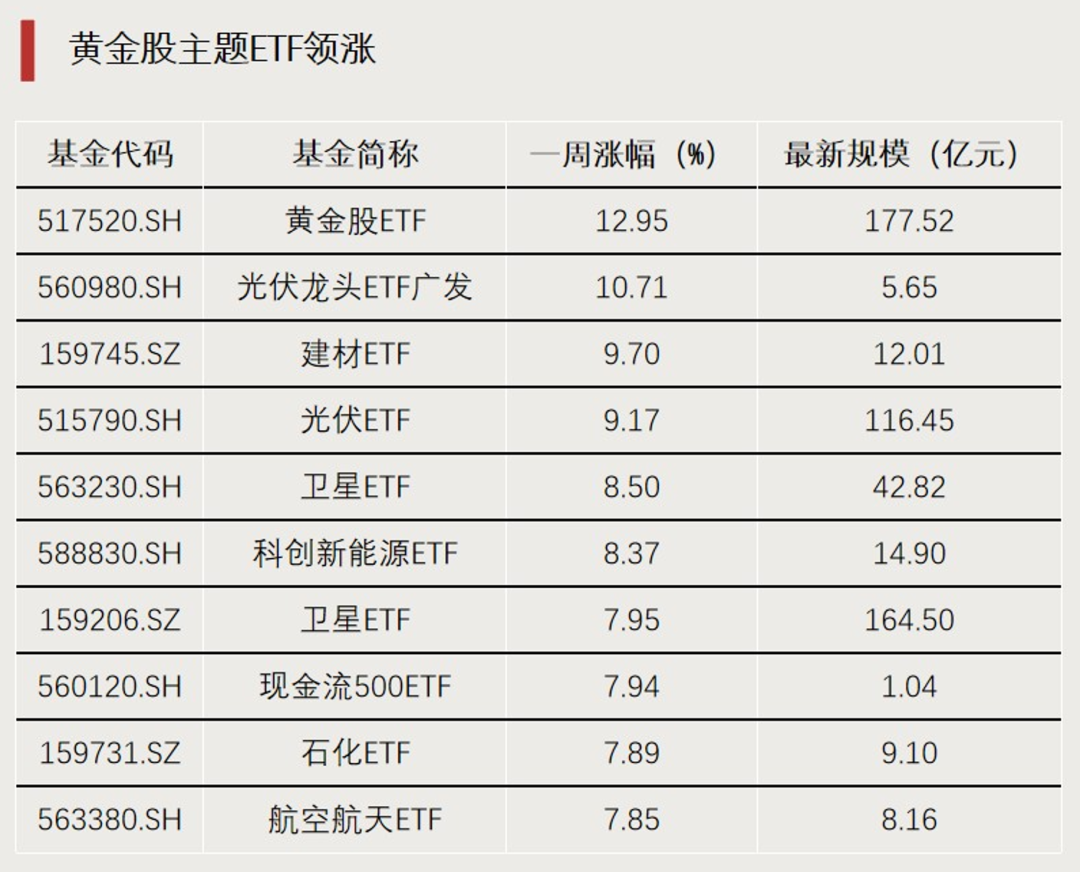
Core Insights - The commercial aerospace sector is experiencing a significant surge, transitioning from a "national strategic direction" to "actual commercial implementation," driven by technological advancements and supportive policies [1][3]. Group 1: Market Performance - The satellite-themed ETFs have shown strong performance, with the Guangfa Satellite ETF rising by 26.85% year-to-date as of January 23, ranking sixth among all ETFs [2]. - Other aerospace-related ETFs, including general aviation ETFs, have also performed well, with gains exceeding 15% year-to-date [2]. - Despite an overall trend of capital outflow, certain thematic ETFs, particularly the satellite ETFs, have attracted significant inflows, with the satellite ETF (159206) seeing a net inflow of 7.697 billion yuan [2]. Group 2: Technological and Policy Support - The commercial aerospace sector's growth is supported by a systematic policy framework that encourages participation and outlines a comprehensive support system [3][4]. - Technological innovations, such as reusable rockets and mass satellite manufacturing, are crucial for reducing costs and enabling scalable profitability in the industry [3][4]. - The establishment of a dedicated Commercial Aerospace Department by the National Space Administration and the introduction of a three-year plan are pivotal in facilitating the sector's growth [3]. Group 3: Investment Opportunities - The investment value in the satellite sector is driven by strong policy support, expanding demand scenarios, and technological advancements that lower costs [4]. - The industry is characterized by a three-tier structure: upstream manufacturing (satellites and rockets), midstream service (launch and ground operations), and downstream applications [6]. - Investors are advised to focus on long-term strategies and consider index products to mitigate risks, as the sector is still in its early stages and individual stock risks are high [6].
“大脑”与“肢体”的竞赛 资本押注具身智能赛道
Core Insights - The investment landscape for embodied intelligence is heating up, with significant funding rounds indicating strong interest from top-tier investors [1][2] - The focus of capital is shifting from merely funding technological blueprints to emphasizing scalable production and commercial viability [1][7] Investment Highlights - Self-variable Robotics completed a 1 billion yuan A++ round of financing, attracting major investors like ByteDance, Sequoia China, and local state-owned funds [1][2] - Other companies in the embodied intelligence sector, such as Future Not Far Robotics and Manifold AI, have also secured funding, reflecting a broader trend of investment in this field [1][4] Government Support - The Chinese government has recognized embodied intelligence as a new economic growth point, with supportive policies emerging from regions like Beijing, Zhejiang, and Guangdong [1][3] - The establishment of investment platforms by local governments aims to nurture embodied intelligence as a key industry [3] Market Trends - The year 2025 is projected to be a critical juncture for the commercialization of embodied intelligence, with over 140 domestic companies expected to emerge [6] - The transition of humanoid robots from experimental stages to practical applications in homes and factories is accelerating [6] Competitive Landscape - The investment community is increasingly focused on the practical application and mass production capabilities of companies, moving away from speculative funding [7] - Concerns exist regarding the concentration of capital towards leading firms and the potential for price competition as many companies pursue similar technological paths [7]
调仓换股与众不同 长跑型选手逆向而行
Core Insights - The report highlights the contrasting trading strategies of long-term fund managers compared to the overall public fund adjustments in Q4 2025, indicating a unique approach to navigating the structural market conditions [1] Fund Manager Adjustments - In Q4 2025, Zhongji Xuchuang (300308) became the largest holding for public funds, with an increase of over 22 billion yuan, while many long-term fund managers chose to reduce their positions in this stock by over 40% [2] - Similar trends were observed with Xinyisheng (300502), where public funds increased holdings by over 9 billion yuan, yet long-term fund manager Yang Dong reduced his position by over 40% [3] Divergence in Stock Adjustments - There were notable differences among long-term fund managers regarding their adjustments in Xinyisheng, with some increasing their positions while others significantly reduced theirs [3] - Industrial Fulian (601138) exited the top ten holdings for public funds, while some fund managers drastically reduced their positions, with reductions exceeding 80% [3] - In contrast, Zijin Mining (601899) and Shengyi Technology (600183) saw overall increases in public fund holdings, but individual fund managers had varying strategies, with some increasing and others decreasing their stakes [3] Position Management - Many long-term fund managers opted to lower their stock positions in Q4 2025, with significant reductions noted, such as a drop from 78.70% to 62.74% in one fund [4] - Other funds also reported reductions in stock positions ranging from 1% to 10% [4] Portfolio Diversification - Long-term funds generally maintained a high concentration in their top ten holdings, but there was a noticeable decrease in concentration compared to Q3 2025, with some funds seeing reductions of over 25 percentage points [5][6] - The focus of many fund managers shifted towards diversified sectors, including AI, cyclical industries, and consumer sectors, indicating a broader investment strategy [6] Sector Focus - The cyclical sector became a popular area for public fund increases, with significant investments in non-ferrous metals and chemicals [7] - Consumer and social service sectors also saw increased attention from fund managers, with notable additions to top holdings in these areas [8] Major Changes in Top Holdings - Several funds underwent significant changes in their top ten holdings, with multiple stocks being replaced, indicating a strategic shift in investment focus [9] Outlook for 2026 - Fund managers expressed optimism for the A-share market in 2026, anticipating a potential upward trend driven by multiple positive factors [10] - AI applications are expected to be a core focus, with varying strategies among fund managers regarding their investment in AI-related sectors [11] - The cyclical sector is recognized for its investment potential, with expectations of improved performance in related industries [12]
时隔两年北交所定增“破冰” 锦波生物20亿元再融资获批
Group 1 - The core point of the article is that Jinbo Bio has received approval from the China Securities Regulatory Commission (CSRC) for a targeted stock issuance, marking the first such approval for the Beijing Stock Exchange in 2024, which is expected to enhance the refinancing system for companies listed on the exchange [1][4] - Jinbo Bio plans to issue up to 7.1757 million shares, aiming to raise a total of no more than 2 billion yuan, with the funds primarily directed towards the development of an AI-driven collagen database and product development platform [2][3] - The introduction of Yangshengtang as a strategic investor is expected to help Jinbo Bio overcome development bottlenecks and stimulate the upstream and downstream enterprises in the industry chain [2] Group 2 - The Beijing Stock Exchange has established a flexible and diverse refinancing mechanism since its inception, primarily utilizing methods such as private placements and convertible bonds, with Jinbo Bio's project being a significant breakthrough in the past two years [4] - The successful implementation of Jinbo Bio's stock issuance is anticipated to enhance overall market attention towards companies on the Beijing Stock Exchange, attracting various long-term funds and improving market liquidity and investor returns [5] - This project is expected to provide replicable and referable practical experience for future refinancing efforts on the Beijing Stock Exchange, aligning with its core mission to serve innovative small and medium-sized enterprises [5]
打造“下一代量化旗舰架构”之路
Core Insights - The article highlights the vision and strategic approach of Mingxi Capital, led by Chen Haowei, to build a world-class quantitative investment methodology in China, emphasizing a collaborative and innovative framework [1][2]. Group 1: Company Overview - Mingxi Capital was founded in 2014 by Zhang Xiangfang, who established a strong foundation in the futures quantitative field, leading to deep market insights and initial capital accumulation [2]. - The company transitioned from a single-engine strategy to a dual-core driving model, integrating the expertise of partners with backgrounds from top hedge funds to enhance its operational capabilities [2]. Group 2: Strategic Development - The partnership between Zhang Xiangfang and Chen Haowei, along with other key members, is characterized by a complementary strategy that aims to elevate the firm from futures to a larger stock market capacity [2]. - The introduction of the NOVA system represents a significant technological advancement, designed to serve as an "AI partner" that enhances the investment research process through advanced data handling and strategy development [4][5]. Group 3: Technological Innovation - The NOVA system consists of three core intelligent modules: NOVA Matrix for data structuring, NOVA Go for strategy generation, and NOVA Pilot for risk control and portfolio optimization, creating a closed-loop system for investment operations [4][5]. - The system has proven effective during market volatility, allowing the firm to manage risks proactively and maintain operational stability [6]. Group 4: Organizational Culture - Mingxi Capital fosters a collaborative environment akin to a "Bell Labs" ecosystem, promoting knowledge sharing and innovation among team members [6][7]. - The firm employs a unique contribution attribution system that rewards not only final outcomes but also the entire process of research and development, encouraging a culture of collaboration and respect for foundational work [6][7]. Group 5: Future Vision - Looking ahead, Mingxi Capital aims to continue upgrading the NOVA system and invest heavily in computational infrastructure to enhance AI capabilities and attract top talent globally [7]. - The overarching goal is to maintain a competitive edge through continuous evolution, driven by a cohesive partnership, an autonomous intelligent system, and a supportive organizational ecosystem [7].
全天候策略遇上ETF 打造稳健投资新方案
Core Viewpoint - The increasing availability of passive investment tools in the domestic market is making ETF-based multi-asset FOF products a popular choice among investors, enhancing asset allocation efficiency and allowing managers to focus on the assets themselves [1] Group 1: FOF Investment Strategy - The FOF investment system is based on a localized all-weather strategy, supplemented by three enhancement strategies: equity and bond position management, style and sector rotation, and alternative asset investment, aiming to provide long-term stable returns for investors [1][2] - The FOF product aims to help investors achieve sustainable profit, with a strong emphasis on risk management and a focus on low volatility and steady returns [2] Group 2: All-Weather Strategy - The classic all-weather strategy is adapted to local conditions, incorporating multiple macroeconomic indicators such as credit cycles and overseas economic growth to optimize asset allocation through risk parity methods [3][4] - The all-weather strategy serves as the foundation for constructing asset portfolios that meet stable risk-return needs across different market environments [3] Group 3: Tactical Enhancement Strategies - Equity and bond position management involves monitoring market conditions to adjust portfolio allocations, helping to avoid significant deviations from targets [4] - Style rotation is prioritized over sector rotation to enhance rotation success rates, with quantitative methods used for adjustments [4] - The inclusion of alternative assets like gold and QDII is crucial for diversifying the portfolio and reducing volatility, especially in extreme market conditions [4] Group 4: Focus on Drawdown Control - The selection of broad-based ETFs and sector-specific ETFs is strategically differentiated, with broad-based ETFs acting as indicators for potential weaknesses in underlying sectors [5] - Strict standards are applied to the selection of underlying assets in the FOF, ensuring a balanced portfolio and minimizing concentrated exposure to specific risks [6] - Emphasis is placed on controlling maximum drawdown, which is considered more challenging than managing volatility, highlighting the risk management capabilities of the fund manager [6]
驶向深海 发现机器人产业“新大陆”
Core Insights - The robotics industry is experiencing significant breakthroughs, transitioning from experimental demonstrations to practical applications in logistics, industrial inspections, and household services [1][2] - The emergence of cost reduction through domestic production of core components has cleared the path for large-scale production of humanoid robots, with production costs significantly lower than in 2024 [2] - The industry is expected to see a substantial scale-up, with global humanoid robot production potentially reaching 100,000 units, driven by commercial applications across various sectors [2][3] Industry Developments - The robotics sector is entering a phase characterized by short-term catalysts, scaling up, and technological advancements, which are anticipated to drive growth from "1-10" to "10-100" in production scale [2] - The integration of AI models, particularly in visual, language, and action processing, is expected to enhance robots' capabilities, allowing for autonomous understanding and decision-making [2] - Key technological advancements, such as dexterous hands and electronic skin, will continue to expand the functional boundaries of robots [2] Investment Strategies - Investors are advised to deeply understand the established supply chains within the robotics industry, particularly those linked to the automotive sector, to identify investment opportunities [3] - Investment opportunities are categorized into three areas: supply chain targets closely tied to leading companies like Tesla, new component demands arising from technological iterations, and growth opportunities within domestic supply chains [3] - A focus on companies with high certainty of demand, strong technological barriers, and favorable industry structures is recommended for investment [4] Market Outlook - The robotics sector is characterized by a mix of optimistic long-term prospects and short-term challenges, with key milestones expected in the upcoming year, such as Tesla's production advancements and public demonstrations [5] - The domestic robot production has just surpassed the threshold of 10,000 units, while market expectations are set on reaching a million units, influencing valuation dynamics [5] - The high volatility typical of early-stage high-growth technology sectors necessitates a diversified investment approach and strategic trading based on industry trends [5]
存款到期潮将至 公募基金各显神通
Core Insights - A significant wealth migration is underway as deposit interest rates decline, prompting individuals to seek alternative investment options that offer better returns than traditional savings accounts [1] - Predictions indicate that over 50 trillion yuan of residents' medium to long-term deposits will mature by 2026, leading to a potential reshaping of asset allocation strategies among residents [1] Banking Sector Changes - Customers are experiencing a drastic reduction in deposit interest rates, with rates dropping from 3.1% to 1.55% [1] - Banks are responding by offering cash management and fixed-income products that provide slightly higher returns than traditional deposits, aiming to retain clients [1][2] Fund Market Dynamics - Public funds, particularly low-volatility funds, are expected to attract significant inflows as investors seek alternatives to maturing deposits [1] - The demand for "fixed income plus" and fund of funds (FOF) products has surged, with many new products selling out quickly and existing ones seeing substantial inflows [3][4] Investment Strategies - Investment strategies are shifting towards a combination of cash management, short to medium-term fixed-income products, and "fixed income plus" funds that include equity components for potential higher returns [1][2] - Banks are increasingly acting as "solution providers" in the asset management ecosystem, utilizing FOF and other strategies to allocate large volumes of funds effectively [2][3] Product Performance - Recent reports indicate that several FOF products have achieved significant net value growth, with some exceeding 66% in returns [6] - The trend of limiting purchases for certain funds has re-emerged, reflecting strong demand and a strategy to manage capacity and liquidity [6][7] Market Trends - The popularity of "fixed income plus" and FOF products is attributed to their ability to provide stability and flexibility, which has been validated by recent market performance [7][9] - Fund companies are enhancing their organizational capabilities and product competitiveness to prepare for the influx of funds from maturing deposits [8][10] Channel Cooperation - Fund companies are focusing on optimizing partnerships with banks by developing customized products and providing training to enhance the understanding of fund performance [10] - The collaboration with banks is shifting towards offering stable, low-volatility solutions that meet the evolving needs of depositors [10]
调仓换股与众不同长跑型选手逆向而行
Core Insights - The report highlights the contrasting trading strategies of long-term fund managers compared to the overall public fund adjustments in Q4 2025, indicating a divergence in stock selection amidst a volatile market environment [1][2]. Fund Manager Adjustments - In Q4 2025, Zhongji Xuchuang replaced Ningde Times as the top holding for public funds, with an increase in market value exceeding 22 billion yuan. However, several long-term fund managers chose to reduce their positions in Zhongji Xuchuang, with reductions exceeding 40% by managers like Mo Haibo and Shen Ai Qian [1][2]. - Similar trends were observed with another popular stock, Xinyi Semiconductor, where public funds increased holdings by over 9 billion yuan, yet long-term fund manager Yang Dong reduced his position by over 40% [2]. - Notably, Industrial Fulian exited the top ten holdings for public funds, while some long-term managers like Liu Yuanhai increased their positions, showcasing differing strategies among fund managers [3]. Portfolio Management - Many long-term fund managers opted to lower their stock positions in Q4 2025, aligning with the overall trend of reduced stock allocations in public funds. For instance, the stock allocation of Mo Haibo's fund dropped from 85.20% to 71.92%, a decrease of approximately 13 percentage points [4]. - The concentration of holdings among long-term funds remained high, with many funds having over 50% of their net asset value in the top ten holdings, although some funds showed a noticeable decrease in concentration compared to Q3 2025 [5]. Sector Allocation - Fund managers displayed a diversified approach in their sector allocations, favoring areas such as AI, cyclical stocks, and consumer sectors. For example, Yang Dong's fund gained excess returns by focusing on AI and robotics, while Liu Yuanhai's fund adjusted its AI allocations during Q4 2025 [6][7]. - The cyclical sector gained traction among fund managers, with significant investments in non-ferrous metals and chemicals. For instance, Li You's fund made substantial increases in holdings of companies like Zijin Mining and Yun Aluminum [6][9]. - In the consumer and social services sectors, managers like Mo Haibo and Miao Weibin focused on domestic demand-related stocks, indicating a strategic shift towards consumer resilience and emerging consumption trends [6][9]. Market Outlook - Looking ahead to 2026, long-term fund managers maintain an optimistic outlook for the A-share market, anticipating a potential upward trend driven by multiple positive factors, including corporate earnings recovery and improved liquidity [7][8]. - The AI sector remains a focal point, with managers emphasizing the importance of AI applications over hardware, suggesting a shift in investment focus towards practical applications of AI technology [8][9].
品牌工程指数上周报2027.72点
Market Performance - The market experienced fluctuations last week, with the China Securities Index closing at 2027.72 points, down 1.56% [1] - The Shanghai Composite Index rose by 0.84%, while the Shenzhen Component Index increased by 1.11%. The ChiNext Index fell by 0.34%, and the CSI 300 Index decreased by 0.62% [1] - Notable strong performers included Lanke Technology, Huayi Group, and Salt Lake Shares, with increases of 12.22%, 8.38%, and 7.62% respectively [1] Year-to-Date Performance - Since the beginning of 2026, notable stock performances include: - Zhaoyi Innovation up 38.74% - Lanke Technology up 35.84% - Anji Technology up 35.28% [2] - Other companies such as Zhongwei Company and Changdian Technology have also seen increases of over 30% [2] Market Sentiment and Trends - Market sentiment is relatively stable, with active funds seeking investment opportunities despite outflows from broad market indices [2] - The market style has shown signs of balance, with cyclical sectors performing notably well [2] - The current market is in a mid-uptrend phase, with expectations for a spring rally and strong overall market activity [2] Investment Strategy - Current A-shares are in a mid-uptrend phase, with attractive valuations and no signs of bubble formation [3] - Structural opportunities in 2026 are focused on five major "hard asset" directions: technology innovation, biomedicine, resource supply-side reversal, gold, and high-dividend assets [3] - Investment strategies emphasize holding hard assets, maintaining a high position, and focusing on globally competitive and scarce supply areas [3]