
Qi Huo Ri Bao Wang

Search documents
从期货到场外期权套保:一家纸浆贸易商的风险管理进阶之路
Qi Huo Ri Bao Wang· 2025-08-29 01:47
Core Viewpoint - In 2024, the pulp industry in China is undergoing a deep adjustment and transformation amid complex internal and external environments, with significant price fluctuations impacting companies' operations [1] Group 1: Market Trends - In the first half of 2024, pulp prices showed a clear upward trend, leading to optimistic market expectations [1] - However, after high-level purchases of pulp by Company X, prices fell, resulting in inventory losses and increased storage costs [2] Group 2: Company Strategy - Company X, established in early 2020, began forming a pulp trading team by the end of 2021, achieving an annual trading volume of 340,000 tons and a trading value of 1.7 billion yuan [1] - The company engaged with Huazhong Futures to develop risk management strategies, leading to the establishment of a professional futures team and a strict hedging system [1][2] Group 3: Risk Management - Company X's hedging volume increased from approximately 18,000 tons in 2021 to 36,000 tons in 2023, demonstrating effective risk management through futures and options [2] - In response to market downturns, the company sold its existing inventory at market price to recover funds and mitigate further losses [3] Group 4: Derivative Tools Utilization - The company utilized options to hedge risks, converting inventory into option positions to avoid storage costs while generating premium income to offset previous losses [3][4] - Company X adopted a dual strategy of selling both put and call options to manage its positions effectively, thereby reducing holding costs and protecting against price fluctuations [4] Group 5: Future Plans - Looking ahead, Company X plans to expand its risk management toolbox by integrating futures, options, and basis trading, aiming to build a hedging alliance within the pulp industry [5] - The company seeks to enhance its risk management capabilities, transforming them into competitive advantages in the industry, and contributing to high-quality development in the pulp sector [5]
海通期货2025年度投资菁英会顺利召开
Qi Huo Ri Bao Wang· 2025-08-29 01:47
Group 1 - The 2025 Investment Elite Conference hosted by Haitong Futures focuses on finding opportunities amid uncertainties in the market, emphasizing the theme of "seeking opportunities in crises and winning through changes" [1] - The Vice President of Guotai Haitong Securities, Luo Dongyuan, highlighted China's economic resilience and the positive impact of policies aimed at optimizing industrial structure and promoting a unified domestic market [1][2] - The current global economic landscape is characterized by intensified great power competition and a fractured globalization process, necessitating China to accelerate the development of new productive forces and implement various strategies for financial reform and internationalization of the RMB [1][2] Group 2 - Haitong International's Chief Economist, Wang Shengzu, predicts a slowdown in global economic growth in 2025, with inflation continuing to decline, making the economic trends of China and the US critical variables [2] - The "anti-involution" policy is seen as more moderate compared to the supply-side structural reforms of 2016, focusing on employment stability and technological iteration [2] - The long-term trend for commodity prices is upward, although there may be differentiation among various commodities, with specific influences noted for copper, rubber, steel, and coal prices [2][3] Group 3 - The oil market faces significant downward pressure due to weak demand from major consumers like India and the US, alongside an increase in OPEC+ production expected to add 680,000 to 960,000 barrels per day in 2025 [3] - Investment opportunities in downstream oil products are highlighted, particularly in sectors where Chinese petrochemical companies have gained pricing power due to scale and cost advantages [3] - The shipping index has experienced volatility due to US tariff policies, leading to increased uncertainty in global supply chains, prompting a need for investors to monitor trade dynamics closely [4] Group 4 - In asset allocation, Haitong Futures shows optimism towards US stocks, Hong Kong stocks, and Asian investment-grade bonds, with a favorable outlook on the valuation and yield of Asian dollar bonds [4] - The A-share market is experiencing liquidity injection driven by the rebalancing of resident asset allocation, which is expected to lead to valuation expansion [4] - The roundtable discussion at the conference provided insights into the application of derivatives in risk hedging, yield enhancement, and optimizing asset allocation [5]
逢低构建牛市价差策略
Qi Huo Ri Bao Wang· 2025-08-29 01:43
Group 1 - The market experienced a V-shaped reversal with the Sci-Tech 50 index rising by 7.23%, while other indices like the Shanghai 50, CSI 300, CSI 500, and CSI 1000 saw increases ranging from 1% to 2.5% [1][2] - The CSI 1000 index rose by 1.51%, with daily trading volume and open interest for its options at 405,700 contracts and 317,400 contracts respectively, showing a slight decrease in PCR values [1] - The CSI 300 index increased by 1.77%, with daily trading volume of 203,300 contracts and open interest of 214,100 contracts, indicating a cautious sentiment among put option sellers [1] Group 2 - The Sci-Tech 50 ETF options recorded a trading volume of 2,647,700 contracts and open interest of 1,774,000 contracts, reflecting a high level of activity since its inception [2] - The implied volatility for the September contracts reached 62%, indicating a potential overheating in the short term for the underlying index [2] - Overall market sentiment is optimistic, with a recommendation for investors to adopt a bullish spread strategy in IO options during market dips [2]
紧握期市发展新机遇 打造金融开放新高地
Qi Huo Ri Bao Wang· 2025-08-29 01:43
Core Viewpoint - The event "High-Quality Development of the Futures Market in Nansha" highlights the significant opportunities for the futures market in Guangdong, particularly following the release of the "Nansha Financial 30 Measures" aimed at enhancing the region's financial infrastructure and international cooperation [1][4]. Group 1: Nansha's Strategic Importance - Nansha is positioned as a key area for global openness and cooperation, particularly in supporting Chinese manufacturing companies to expand internationally [2][3]. - The region's proximity to manufacturing hubs like Foshan and Guangzhou provides a unique supply chain advantage, enhancing its role as a core hub in the Guangdong-Hong Kong-Macao Greater Bay Area [2][3]. Group 2: Policy and Institutional Innovations - The "Nansha Financial 30 Measures" represent a significant breakthrough in financial openness, encouraging deep participation from Hong Kong and Macao financial sectors in Nansha's financial reforms [3][4]. - Nansha's policy innovations include allowing Hong Kong and Macao investors to hold controlling stakes in domestic futures companies and piloting cross-border regulatory cooperation [3][4]. Group 3: Development of the Nansha Futures Industry Park - The Nansha Futures Industry Park, set to be completed by September 30, will cover approximately 47,000 square meters and serve as a national hub for futures institutions and international financial services [6]. - The park aims to create a "financial + exhibition + business" ecosystem, enhancing the region's capacity for international financial cooperation and competition [6][8]. Group 4: Enhancing Risk Management and Financial Services - The establishment of the Nansha Futures Industry Park is expected to improve risk management for Guangdong's manufacturing sector, allowing better utilization of futures tools to stabilize the flow of raw materials and finished products [7][8]. - The park is seen as a "converter" and "amplifier" for the futures market, transforming it into a tangible service platform that enhances price discovery and risk management efficiency [8][9]. Group 5: Future Directions and Innovations - Nansha is encouraged to leverage technological innovations and financial policies to enhance its role in the global commodity market, similar to historical precedents set by other nations [10][11]. - The integration of stablecoins with the futures market is suggested as a potential area for exploration, aiming to facilitate cross-border settlements and enhance the internationalization of futures derivatives [11].
以创新工具服务亚太区风险管理需求——专访芝商所亚太区董事总经理Russell Beattie
Qi Huo Ri Bao Wang· 2025-08-29 01:33
Group 1: Strategic Focus in Asia-Pacific - The company aims to enhance revenue by focusing on mature markets like Australia, China, Japan, South Korea, and Singapore, while also exploring emerging markets such as Malaysia, Thailand, and Vietnam through partnerships with local exchanges [1][2] - Russell emphasizes the importance of understanding the diverse commercial ecosystem in the Asia-Pacific region, which includes both developed economies and rapidly growing emerging markets [1][3] Group 2: Engagement with China - China is identified as a key market, with Russell noting the warm reception and openness from Chinese institutions during his visits [2][7] - The demand for risk management in China is similar to other markets, driven by the need for diversified products and high liquidity to manage price volatility [2][4] Group 3: Growth in Retail Trading - The company has seen a significant increase in retail traders, with over 90,000 new retail traders joining in the second quarter, marking a 56% year-on-year growth [3][4] - The average daily trading volume of micro contracts reached a record 4.1 million contracts, indicating strong product appeal to a broader user base [3][4] Group 4: Record Market Performance - The average daily trading volume surpassed 30 million contracts for the first time, with a 16% year-on-year increase in the second quarter [4][5] - International business also performed well, with an 18% year-on-year increase in average daily trading volume, reaching 9.2 million contracts [4][5] Group 5: Risk Management and Market Integrity - The company has established a multi-layered risk control system to ensure market security during periods of volatility, including price limits and circuit breakers [5][6] - The use of a velocity logic monitoring system helps track abnormal price fluctuations with millisecond precision [6] Group 6: Collaboration with Local Exchanges - The company maintains a philosophy of close cooperation with local exchanges to expand market services, exemplified by the mutual offset system with the Singapore Exchange [6][7] - This system allows traders to access liquidity from both exchanges, reducing cross-border trading costs [6] Group 7: Focus on Battery Components and Green Economy - The company has launched futures for cobalt, lithium hydroxide, and lithium carbonate to address the growing risk management needs in the electric vehicle sector [8][9] - The electric vehicle market in China is highlighted as a significant driver for demand in battery component risk management tools [7][8] Group 8: Educational Initiatives - The company is actively involved in investor education, conducting seminars and producing educational materials to enhance understanding of derivatives among market participants [11][12] - Collaborations with local institutions aim to deepen knowledge of global markets and improve risk management capabilities [11][12]

全球视角下的废铝贸易体系变局
Qi Huo Ri Bao Wang· 2025-08-29 01:29
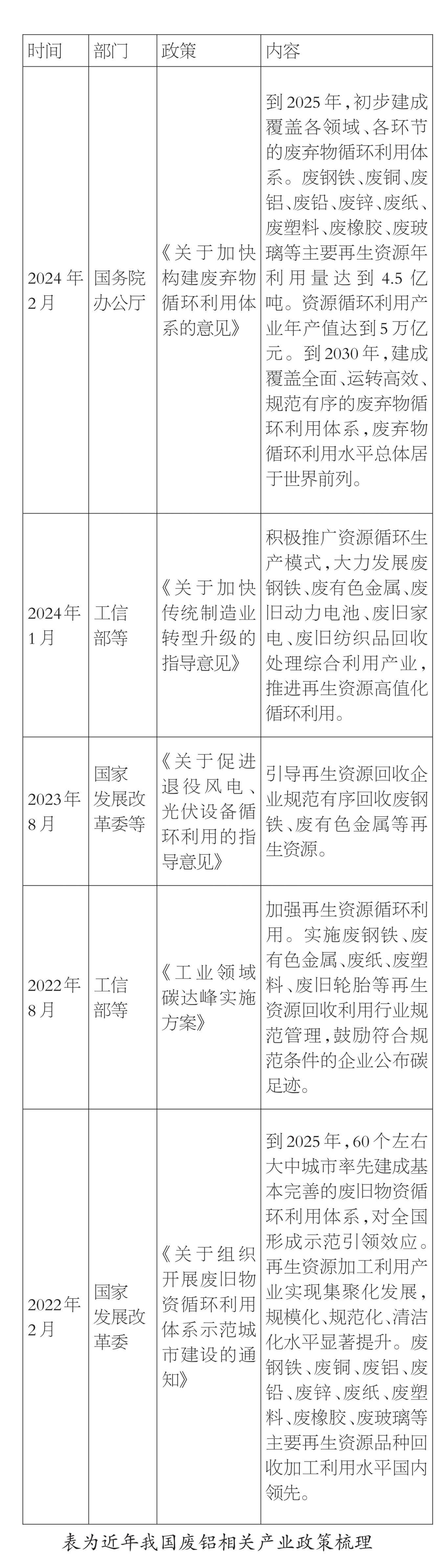
Core Viewpoint - The recycled aluminum industry is becoming a key area for global green transformation, with the global recycled aluminum market expected to reach $54.8 billion in 2024 and exceed $112.5 billion by 2034, growing at an annual rate of 7.5% [1]. Market Overview - The global recycled aluminum market is projected to grow from $54.8 billion in 2024 to $58.2 billion in 2025, reflecting a year-on-year increase of 6.2% [5]. - The demand for recycled aluminum is primarily driven by the lightweighting in transportation and green infrastructure, contributing 26% to global demand growth [6]. Policy and Regulatory Environment - The Chinese government is enhancing the planning of the recycled resource recovery system, aiming to establish a comprehensive recycling infrastructure by 2025, with a target of over 450 million tons of annual utilization of nine major categories of recycled resources [5]. - The EU has initiated monitoring of waste metal trade to address the crisis of strategic raw material outflow, covering 40% of the total trade volume of circular economy materials [11]. Trade Dynamics - The global waste aluminum trade is undergoing a structural reorganization, with Thailand emerging as the largest buyer of U.S. waste aluminum, and Southeast Asia becoming a new hub for recycling and processing [8][11]. - The shift from a cost-arbitrage driven model to a regional collaboration model is evident, as China transitions from a net importer to a dominant player in internal circulation [10]. Historical Context - China's waste aluminum import peaked at 1.2 million tons in 2004, but by 2018, imports had plummeted to 157,000 tons due to stricter quality standards and a focus on domestic recycling [7]. - The domestic recycling rate of waste aluminum has increased significantly, with a recovery volume surpassing 9 million tons in 2020, and the share of recycled aluminum in raw material supply rising from less than 40% to over 80% [7]. Future Outlook - By 2025, China's recycled aluminum production is targeted to reach 11.5 million tons, a 54% increase from 7.45 million tons in 2020, with domestic waste aluminum recovery expected to rise to 11.06 million tons by 2024 [15]. - The ongoing demand surge in Southeast Asia, coupled with resource protection policies in Europe and the U.S., is likely to constrain waste aluminum imports, maintaining strong prices for recycled aluminum [15].

“期货市场高质量发展看南沙”活动成功举办 紧握期市发展新机遇 打造金融开放新高地
Qi Huo Ri Bao Wang· 2025-08-28 21:25
Core Insights - The Guangdong futures market is poised for significant development opportunities, particularly with the introduction of the "Nansha Financial 30 Measures" aimed at enhancing the futures industry in Nansha [1][4] - Nansha is positioned as a key area for financial innovation and collaboration between mainland China and Hong Kong, facilitating the "dual circulation" development strategy [2][3] Group 1: Development Opportunities - The "Nansha Financial 30 Measures" encourages deep participation from Hong Kong and Macau financial sectors in Nansha's financial reforms, creating a high ground for financial innovation [3][4] - Nansha's futures industry park, set to be completed by September 30, will cover approximately 47,000 square meters and serve as a national hub for futures institutions and international financial services [6][5] Group 2: Strategic Positioning - Nansha's geographical advantages, being close to manufacturing hubs like Foshan and Dongguan, enhance its role in serving a trillion-level manufacturing cluster [3][7] - The region is expected to become a pivotal area for risk management in Guangdong, allowing local enterprises to better utilize futures tools for stability in raw material and finished product circulation [7][8] Group 3: Financial Ecosystem - The Nansha futures industry park aims to create a comprehensive service ecosystem integrating finance, exhibitions, and business, enhancing international financial cooperation [6][8] - The park is seen as a "converter" and "amplifier" for the futures market, transforming it into a tangible service platform for the real economy [8][9] Group 4: Challenges and Recommendations - Despite the opportunities, challenges remain, such as the high operational costs in Hong Kong, which may deter businesses from establishing branches in Nansha [9][10] - Recommendations include leveraging Hong Kong's financial advantages while utilizing Nansha's resources to maintain international competitiveness [9][10]
首单告捷!国网英大风险(深圳)助力产业链协同,共筑能源服务新标杆
Qi Huo Ri Bao Wang· 2025-08-28 09:39
Core Viewpoint - The company, State Grid Yingda Risk Management (Shenzhen) Co., Ltd., is committed to enhancing its core competitiveness and adapting to industry changes while focusing on serving the real economy and deepening its involvement in the power energy industry chain [1][4]. Group 1: Business Development - The company successfully executed its first coal agency sales business, supplying 10,000 tons of coal to a central enterprise power plant, demonstrating its capability in demand matching and efficient delivery [2]. - The company emphasizes compliance with industry regulations and has established a seamless process from demand connection to final delivery, ensuring robust support for energy supply [2][3]. Group 2: Collaborative Efforts - The successful execution of the first order is seen as a breakthrough in the agency sales sector, highlighting the company's role as a bridge connecting upstream and downstream partners [3]. - The company has implemented a mature risk management system to anticipate potential supply chain risks and develop proactive response strategies, ensuring smooth collaboration across the industry chain [3]. Group 3: Future Commitment - The company aims to continue its mission of serving the power grid's main responsibilities and enabling collaborative development within the industry chain, focusing on optimizing supply chain efficiency [4]. - The company is dedicated to building a modern industrial ecosystem that promotes green development and industrial upgrading, striving to set new benchmarks in the energy service sector [4].

郑商所发布丙烯期货做市商名单
Qi Huo Ri Bao Wang· 2025-08-27 20:14
Core Viewpoint - Zhengzhou Commodity Exchange announced the list of market makers for propylene futures, following a strict review process as per relevant regulations [1] Group 1: Market Makers - The selected market makers include Dongzheng Runhe Capital Management Co., Ltd., Guotou Guozheng Investment (Shanghai) Co., Ltd., CITIC Construction Investment Securities Co., Ltd., CITIC Zhongzheng Capital Management Co., Ltd., and others [1] - A total of 12 companies have been designated as market makers for propylene futures [1]

应对市场波动 焦煤企业避险有“妙方”
Qi Huo Ri Bao Wang· 2025-08-27 20:14
Group 1 - The focus of the recent "Coking Coal Industry Chain Risk Management Exchange Conference" held by Galaxy Futures in Qingdao was on the opportunities and challenges in the coking coal market under the new circumstances, with discussions on how futures tools can be utilized for risk management and innovative business models [1] - Domestic coking coal supply has been affected by multiple factors this year, including a notice from the National Energy Administration regarding coal mine production checks, which has impacted production, along with safety and weather-related issues leading to low capacity utilization and slow recovery in coking coal production [1][2] - The chief analyst of Zhejiang Material Environmental Energy Co., Ltd. noted that with improved safety regulations and a decline in coal prices in the first half of the year, the situation of overproduction in coal mines is decreasing, but some mines still exceed production limits [2] Group 2 - The coal supply is expected to face contraction if further checks and strict penalties on overproduction are implemented, leading to fluctuations in supply and providing support for coking coal prices, although significant price increases are unlikely due to the current profitability of coal mines [2] - An Inner Mongolia washing plant faced challenges due to continuous declines in spot market prices, resulting in reduced inventory value and increased operational risks [2] - A successful hedging strategy using coking coal futures was implemented by a company to stabilize operations and ensure normal cash flow, highlighting the positive role of coking coal futures in providing a channel for price risk avoidance [3]