
Qi Huo Ri Bao Wang

Search documents
俄总统助理:俄美原则上同意举行元首会晤
Qi Huo Ri Bao Wang· 2025-08-07 23:51
谈及俄总统普京6日在克里姆林宫与美国中东问题特使威特科夫的会谈时,乌沙科夫表示,会谈务实且 具有建设性,"双方或许对会谈结果都感到满意"。乌沙科夫还说,威特科夫在与普京会谈时提出举行俄 罗斯、美国和乌克兰三国元首会晤的方案,但这一方案未被具体讨论,"俄方完全搁置了这一方案,不 予置评",俄方建议首先集中精力筹备俄美元首会晤。 美国总统特朗普6日在白宫接受媒体采访时表示,他"很有可能"不久与普京及乌克兰总统泽连斯基就结 束俄乌冲突举行会晤。 据新华社电 俄罗斯总统助理乌沙科夫7日在莫斯科对媒体说,根据美方提议,俄美原则上同意在近期举 行两国元首会晤。 据今日俄罗斯通讯社报道,乌沙科夫说,"举行本次会晤的地点基本上已经商定"。至于会晤时间,双方 曾讨论过在下周举行会晤的选项,俄方相当积极地看待这一选项。 ...
生态重塑与制度革新:A股向上的核心引擎
Qi Huo Ri Bao Wang· 2025-08-07 23:48
中国近期在光伏、锂电、电动车等终端制造业推进的"反内卷"行动,已超越单纯产业调控范畴,深刻体 现了国家经济发展战略导向。这一导向在政策层面得到清晰延续:今年4月召开的中共中央政治局会议 提出"规范竞争秩序",7月召开的中共中央政治局会议进一步深化导向,明确提出"推动市场竞争秩序持 续优化",同时聚焦"增强国内资本市场的吸引力和包容性,巩固资本市场回稳向好势头",构建了从产 业端到资本市场的完整政策体系。从逻辑内核看,理解资本市场的吸引力与包容性,需以"反内卷"为基 石,进而巩固资本市场回稳态势,实现资本与企业的良性循环。 "反内卷"优化市场生态 "反内卷"通过系统性优化市场生态,为资本市场夯实基本面支撑,核心体现为四方面协同发力。 一是破除市场分割,需纵深推进全国统一大市场建设,打破地方保护主义,促进要素跨区域自由流动。 这一举措能从空间维度减少同质化竞争,让要素在更广域市场实现最优配置,避免局部资源低效堆积, 为企业创造公平竞争的底层环境。 二是规范竞争行为,要以法治手段治理企业无序竞争。以多晶硅行业为例,通过行业自律与监管协同, 针对部分企业为抢占市场份额而实施的低于成本价倾销等乱象,依据《中华人民共和国 ...
护航期货行业高质量发展
Qi Huo Ri Bao Wang· 2025-08-07 23:46
Core Viewpoint - The China Futures Industry Association has released a draft regulation aimed at curbing unhealthy competition in the futures brokerage business, promoting a shift from price wars to service upgrades, and ensuring high-quality development in the industry [2][6]. Industry Issues - The futures brokerage business is facing severe issues of market saturation and homogeneous competition, leading to practices such as "zero commission" and maliciously undermining competitors, which disrupt market order and negatively impact the industry's reputation [3][4]. - Such practices not only harm the development of individual futures companies but also restrict the industry's ability to effectively serve the real economy [3]. Regulatory Framework - The draft regulation defines unfair competition behaviors and establishes clear standards for identifying and addressing such actions, providing a solid basis for subsequent enforcement [4]. - It outlines a comprehensive process for managing commission fees, ensuring transparency and consistency in fee structures, and protecting customer rights [4][5]. - Eight categories of prohibited behaviors are specified, including misleading advertising and engaging in predatory pricing below service costs, aimed at maintaining market integrity and fairness [5]. Promotion of Healthy Competition - The implementation of the regulation is expected to break the cycle of unhealthy competition, encouraging futures companies to focus on enhancing customer service rather than solely competing on price [6]. - This shift will allow companies to invest more in improving trading systems, research teams, and customer service, ultimately raising the overall service quality in the industry [6]. Investor Protection - The regulation aims to enhance investor protection through standardized commission fees, improved feedback mechanisms, and clear prohibitions against misleading practices, fostering a more transparent trading environment [7]. - By reducing the risks associated with information asymmetry, investors will be better equipped to make informed decisions, thus safeguarding their rights [7]. Sustainable Development - The regulation is positioned as a crucial step towards breaking the cycle of price wars, reducing internal competition, and fostering a healthy market ecosystem that supports sustainable development in the futures industry [7]. - It encourages futures companies to focus on core competencies, including technological innovation and talent development, thereby enhancing their ability to serve the real economy effectively [7].


以“法治利剑”斩断“内卷”链条
Qi Huo Ri Bao Wang· 2025-08-07 23:46
Core Viewpoint - The revision of the Price Law aims to address the rampant "involution" competition across various industries, which undermines sustainable development and innovation, by establishing clearer legal standards and responsibilities for price-related behaviors [1][2][6] Group 1: Issues in Current Market Competition - Industries such as livestock, photovoltaic, and electric vehicles are experiencing severe price wars, leading to overall losses and diminished profit margins [1] - The phenomenon of "involution" competition is characterized by companies sacrificing profits to gain market share, which ultimately harms the entire industry's innovation capacity and international competitiveness [1][5] - The current market is plagued by low-cost dumping and other unfair pricing practices that disrupt normal market order and threaten sustainable industry development [5] Group 2: Key Changes in the Price Law Revision - The revision introduces a shift from "setting levels" to "establishing mechanisms" for government pricing, promoting fair and lawful price competition [2] - It explicitly defines unfair pricing behaviors, including below-cost dumping to eliminate competitors, and prohibits coercive pricing practices [2][3] - New provisions address unfair pricing behaviors in the digital economy, targeting practices like "forced bundling" and "big data discrimination" that exploit market dominance [3] Group 3: Strengthening Legal Responsibilities - The revision significantly increases penalties for price violations, raising the maximum fine for failing to comply with pricing regulations from 5,000 yuan to 50,000 yuan [4] - It introduces legal responsibilities for businesses that refuse or provide false information during cost audits, enhancing enforcement capabilities [4] - The changes signal a commitment to higher costs for price violations, aiming to deter ineffective regulatory practices [4] Group 4: Implications for Market Dynamics - The revision reflects a respect for economic development laws and aims to protect market order, emphasizing the importance of fair competition [6] - By addressing "involution" competition, the law seeks to redirect focus from price wars to value-based competition, preserving reasonable profit margins for businesses [6]
党建引领强作风 促进深圳期货行业稳健发展
Qi Huo Ri Bao Wang· 2025-08-07 23:46
Core Viewpoint - The Shenzhen Futures Industry Association emphasizes the integration of Xi Jinping's thoughts and the implementation of the Central Eight Regulations to enhance internal governance and member services, aiming for high-quality development in the Shenzhen futures market [1] Group 1: Political Direction of Style Construction - The association's party branch strictly implements the "first topic" system, making the Central Eight Regulations and Xi Jinping's important discussions on financial work and style construction essential learning for party members [2] - In May, the party branch and secretariat participated in a special party class on "Eight Regulations Change China," highlighting the significance of style construction in preventing financial risks and serving the real economy [2] - The new party committee established during the June elections emphasized the effectiveness of style construction as a key measure of work quality, promoting a work philosophy that links style transformation with enhanced responsibilities [2] Group 2: Collaborative Learning and Development - The association continues the "Party Building + Style Construction" model, promoting the Central Eight Regulations within the industry through joint activities with other party branches [3] - Activities included discussions on compliance and style construction, as well as immersive education combining party history and style learning [3] Group 3: Practical Implementation and Industry Value - The association integrates the Central Eight Regulations into industry governance, emphasizing discipline in risk management and promoting a clean and efficient work style [4] - Regular member visits and research are conducted to address operational challenges, with a notable increase in participation in training programs, reflecting recognition of the futures market's functions [4] - The association has organized training sessions to enhance understanding of new contract varieties and improve the service capabilities of industry professionals [4] Group 4: Future Directions - The association plans to deepen the understanding and practice of the Central Eight Regulations, aiming to synchronize industry style construction with stable institutional development and enhance compliance and risk prevention in the Shenzhen futures industry [5]
继续以备兑增收为主
Qi Huo Ri Bao Wang· 2025-08-07 23:34
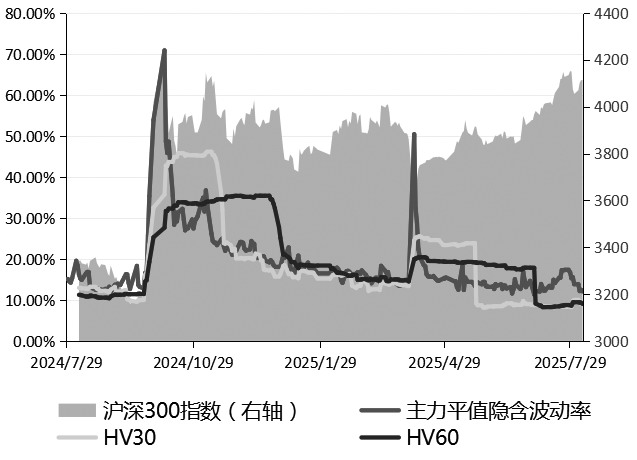
Core Viewpoint - The stock market in Shanghai and Shenzhen experienced narrow fluctuations, with slight increases in major indices like the SSE 50, CSI 300, and CSI 1000, while the CSI 500 and ChiNext saw minor declines [1][3]. Index Performance - The CSI 1000 index rose by 0.01%, with daily trading volume and open interest for its options at 239,300 contracts and 291,800 contracts respectively, indicating a high PCR value of 80.73% for trading volume and 110.66% for open interest, both above the 99th percentile over the past year [1]. - The CSI 300 index increased by 0.03%, with daily trading volume of 95,000 contracts and open interest of 209,300 contracts, resulting in a PCR value of 51.01% for trading volume and 72.1% for open interest, reflecting a historically low proportion of put options, suggesting overall optimistic market sentiment [3]. - The SSE 50 index also saw a rise of 0.03%, with trading volume and open interest at 32,400 contracts and 75,000 contracts respectively, leading to PCR values of 41.34% and 56.79%, indicating a relatively low historical level [3]. Options Market Insights - The highest open interest for call and put options on the CSI 1000 is at strike prices of 6900 and 6600, serving as short-term resistance and support levels [1]. - For the CSI 300, the concentrated areas for call and put options are at strike prices of 4100 and 4150, indicating significant short-term divergence between bullish and bearish sentiments [3]. - The implied volatility for the August contracts is at 12.08% for the CSI 300, which, despite being low, shows a 3.2 percentage point premium over the 30-day historical volatility, suggesting limited upward momentum in short-term implied volatility [3]. Market Outlook - Overall, the indices are approaching significant resistance levels, with a potential for slight pullbacks, although the expected decline is limited. Investors holding long positions in index futures may consider utilizing out-of-the-money call options for covered call strategies to enhance returns [5].
第十九届全国期货(期权)实盘交易大赛20250807
Qi Huo Ri Bao Wang· 2025-08-07 23:32
Core Insights - The article discusses the recent financial performance of the company, highlighting a significant increase in revenue and net income compared to the previous year [1] - It emphasizes the strategic initiatives undertaken by the company to enhance operational efficiency and market share [1] Financial Performance - The company reported a revenue of $5 billion, representing a 15% increase year-over-year [1] - Net income reached $1 billion, which is a 20% increase compared to the last fiscal year [1] - Earnings per share (EPS) increased to $2.50, up from $2.00 in the previous year, indicating strong profitability growth [1] Strategic Initiatives - The company has implemented cost-cutting measures that resulted in a 10% reduction in operational expenses [1] - Investments in technology and innovation have been prioritized, with a budget allocation of $500 million for R&D [1] - The expansion into new markets has been a key focus, with a 25% increase in international sales contributing to overall growth [1] Market Position - The company has strengthened its market position, now holding a 30% market share in its primary sector [1] - Competitive analysis indicates that the company is outperforming its main rivals, which have seen stagnant growth [1] - Customer satisfaction ratings have improved, with a reported 90% satisfaction rate among surveyed clients [1]
2025中国(郑州)国际期货论坛将于8月19—20日举办
Qi Huo Ri Bao Wang· 2025-08-07 16:32
Core Viewpoint - The 2025 China (Zhengzhou) International Futures Forum will focus on empowering the real economy and supporting national construction through high-quality development of the futures market, highlighting its essential role in risk management and economic stability [1][2]. Group 1: Forum Overview - The eighth edition of the forum will take place on August 19-20, 2025, in Zhengzhou, co-hosted by Zhengzhou Commodity Exchange and the Chicago Mercantile Exchange Group [1]. - The forum aims to gather government departments, regulatory agencies, industry associations, enterprises, financial institutions, and experts to discuss the development trends and innovative practices of the futures market in the current era [1][2]. Group 2: Importance of Futures Market - The futures and derivatives market serves as a "stabilizer" for the market economy and a "toolbox" for risk management, becoming indispensable in supporting the real economy and national strategies [1]. - In agriculture, the futures market stabilizes producers' income and strengthens food security, contributing to agricultural power construction [1]. - In manufacturing, it helps companies lock in raw material costs and mitigate price volatility risks, supporting the construction of a manufacturing powerhouse [1]. - The market also provides diverse hedging tools for international trade, enhancing the construction of a trade powerhouse [1]. Group 3: Industry Insights - The forum will address how to transform uncertainties in economic development into certainties, enhancing the quality of support for the real economy and national construction [2]. - High-level opening of the futures market is crucial for accelerating the construction of a "dual circulation" new development pattern and achieving Chinese-style modernization [2]. - Recent expansions in QFII and RQFII participation in commodity futures and options have broadened the market's openness, attracting foreign institutions and enhancing the international influence of Chinese futures prices [2]. Group 4: Forum Structure - The forum will feature four sub-forums focusing on key areas of national construction: foreign opening, risk management for industrial enterprises, agricultural products (oils and fats), and industrial products (polyester) [4]. - Notable speakers will include former Deputy Director of the State Council Development Research Center Yu Bin and other industry leaders, discussing topics such as the outlook for high-quality economic development and trends in the global derivatives market [4]. Group 5: Practical Implications - The forum is positioned as a platform for practical solutions, aiming to provide insights into risk management and industry upgrades through discussions and exchanges among participants [4][5]. - The event is expected to serve as a "booster" for the integration of futures and spot markets, contributing to national construction [5].

我国外贸保持向上向好势头
Qi Huo Ri Bao Wang· 2025-08-07 16:31
Group 1: Trade Performance - In the first seven months of the year, China's total goods trade value reached 25.7 trillion yuan, a year-on-year increase of 3.5%, with exports at 15.31 trillion yuan (up 7.3%) and imports at 10.39 trillion yuan (down 1.6%) [1] - In July alone, the total goods trade value was 3.91 trillion yuan, growing by 6.7%, with exports at 2.31 trillion yuan (up 8%) and imports at 1.6 trillion yuan (up 4.8%) [1] - Trade with ASEAN, EU, Africa, and Central Asia saw increases of 9.4%, 3.9%, 17.2%, and 16.3% respectively, while trade with the US decreased by 11.1% [1] Group 2: High-tech and Green Products - In the first seven months, the import and export of high-tech products reached 5.1 trillion yuan, growing by 8.4%, contributing 45.4% to the overall trade growth [2] - Exports of high-end machine tools increased by 23.4%, and imports of high-end textile machinery rose by 19.3% [2] - Exports of green and low-carbon products, referred to as the "new three samples," grew by 14.9% [2] Group 3: Commodity Imports - Major commodity imports showed a decline in prices, with iron ore imports at 69.7 million tons (down 2.3%) and crude oil at 32.7 million tons (up 2.8%) [3] - The average import price for iron ore fell by 15%, while crude oil prices decreased by 12.7% [3] - Imports of mechanical and electrical products reached 4.09 trillion yuan, growing by 5.8% [3] Group 4: Future Outlook - The recovery in July's import growth reflects enhanced import momentum, driven by price factors and increased exports [4] - The reliance on US exports has decreased, with emerging markets becoming significant growth areas [4] - Policies to stabilize growth and foreign trade are expected to be reinforced in the fourth quarter, potentially including targeted financial support for foreign trade enterprises [4]
棉花 基本面改善有限
Qi Huo Ri Bao Wang· 2025-08-07 13:48
Group 1 - Recent cotton futures prices have experienced a rise and subsequent decline, with no significant improvement in the fundamental market conditions, leading to intense long-short market battles [1] - Cotton consumption averaged around 750,000 tons per month from March to May, with June consumption at 697,000 tons and 320,000 tons in the first half of July, indicating that the first half of the year exceeded expectations [1] - The strong cotton consumption during the "golden three silver four" months is attributed to good export data and increasing production capacity in Xinjiang, which is expected to reach 30 million spindles by 2025, creating a localized tight supply situation [1] Group 2 - The cotton spinning mills' operating rate has decreased to 47.8% as of July 25, down to last year's levels, while the overall weaving mills' operating rate is at 44.4%, also lower than the previous year [1] - Raw material inventory for spinning mills is at 30.8 days, with finished goods inventory at 30.1 days, indicating a slowdown in accumulation [1] - Weaving mills have a cotton yarn inventory of 5.4 days, with a slight replenishment, while the finished goods inventory for cotton fabric is at 37.2 days, showing significant accumulation, particularly in the fabric segment, leading to a lack of confidence in the market outlook [1] Group 3 - There is a divergence in market discussions regarding the ability of the 2509 contract bulls to take delivery, with no significant cancellation of warehouse receipts observed, but an increase in effective forecasts [2] - The 2509 contract's delivery logic suggests that the market may revert to a backwardation state, with expectations of a return to near parity levels [2] - The market anticipates a bumper crop of 7.2 million tons for the new season, with favorable planting conditions and expectations of early new cotton sales, although high basis levels complicate next year's basis trading [2] Group 4 - The withdrawal of bulls from the 09 contract has confirmed the lack of cost-effectiveness in taking delivery, while the validation of the 9-1 price spread remains ongoing [3] - As September approaches, market focus will shift to new cotton negotiations, with potential for localized rush buying [3]