Qi Huo Ri Bao Wang

Search documents
证监会2025年年中工作会议提出 持续推进期货产品和服务创新
Qi Huo Ri Bao Wang· 2025-07-27 16:38
Core Viewpoint - The China Securities Regulatory Commission (CSRC) has outlined seven key measures to stabilize and enhance the capital market, focusing on reform, risk prevention, and innovation in the futures market to better serve the real economy and national strategy [1][2][5]. Group 1: Key Measures for Capital Market Development - The CSRC aims to consolidate market stability by improving monitoring and risk response mechanisms, enhancing market expectations [2][3]. - The commission will implement reforms in the Sci-Tech Innovation Board and the Growth Enterprise Market, while promoting innovation in bonds and futures products [2][3]. - There will be a strong emphasis on improving the investment value of listed companies and ensuring compliance with regulations to prevent misconduct [2][3]. Group 2: Focus on Risk Prevention and Management - The CSRC plans to address risks in key areas, including resolving real estate company bond defaults and supporting the transformation of financing platforms [3][6]. - There will be a crackdown on illegal activities in private equity and securities trading to maintain market integrity [3][6]. Group 3: Enhancing Research and Open Market Strategies - The commission will enhance the authority and influence of research on major capital market issues to better align with national strategies [4][6]. - The CSRC is committed to a high-level opening of the capital market, focusing on cross-border cooperation and the development of onshore and offshore markets [3][6]. Group 4: Opportunities in the Futures Market - The futures market is expected to see accelerated innovation in products and services, particularly in areas like renewable energy, agriculture, and green finance [5][7]. - The introduction of new futures products and collaborative service models is anticipated to support economic stability and structural adjustments [6][7].
申万期货党委召开2025年上半年全面从严治党汇报会
Qi Huo Ri Bao Wang· 2025-07-25 07:27
Group 1 - The meeting emphasized the importance of implementing strict party governance and enhancing the coordination between the company's party committee and discipline inspection committee to ensure high-quality development [1][2] - Since the beginning of 2025, the company has strengthened its political responsibility for strict party governance, integrating party discipline with its main business operations, which has enhanced organizational cohesion and the role of grassroots party organizations [1][2] - The company is committed to fostering a culture of accountability and responsibility among its leadership, ensuring that party discipline is prioritized alongside business operations [2] Group 2 - The leadership is required to actively support the discipline inspection committee in its supervisory role, promoting a culture of mutual supervision and accountability within the organization [2] - The company aims to improve its supervisory mechanisms and integrate various supervisory forces to address weaknesses in party governance [2] - The focus is on cultivating a pragmatic work style and overcoming bureaucratic tendencies, with an emphasis on achieving the company's goals and tasks effectively [2]
理性参与商品期货交易 勿被短期波动迷惑双眼
Qi Huo Ri Bao Wang· 2025-07-25 02:10
近期,多晶硅、焦煤、玻璃等工业品期货价格大幅上涨,吸引了市场各方高度关注。7月7日至22日,南 华商品指数累计上涨4.9%。 笔者认为,本轮商品期货大涨的主要原因有四点: 二是产业的结构性特点。多晶硅是本轮商品上涨行情中的最强品种,其产业结构特点助推了价格上涨。 多晶硅行业是典型的寡头垄断行业,前五大企业份额占全市场的70%左右,头部企业拥有强大的价格主 导能力。当市场出现利多信号时,头部企业可通过减产、提价等方式影响市场价格,短期内极易引发期 货价格大幅波动。然而,价格持续非理性大涨会严重伤害下游产业链。下游企业无法顺利转嫁成本,利 润空间被大幅挤压甚至亏损,长此以往会打击其生产积极性,可能减少生产规模,反过来影响上游多晶 硅等产品需求。这不仅违背政策初衷,还会破坏产业链生态平衡,可能引发系统性风险。 更重要的是,上一轮商品牛市有地产、投资等领域需求的强劲支持,当时房地产蓬勃发展和大规模基础 设施建设极大地拉动了钢铁、煤炭、水泥等工业品的需求,为价格上涨提供了坚实基础。本轮"反内 卷"政策更多是希望引导供需适配。从政策角度看,只有国内需求合理发展,带动经济稳步增长,才可 能是本轮牛市的根本驱动因素。 另一方 ...
为全国统一大市场建设注入“期货力量”
Qi Huo Ri Bao Wang· 2025-07-25 01:09
Core Viewpoint - The construction of a national unified market is a strategic deployment by the Central Committee of the Communist Party of China, aimed at breaking through the challenges posed by globalization and enhancing the socialist market economy [1] Group 1: Role of Futures Market - The futures market serves as a core component of the modern financial system, facilitating price discovery, risk management, and resource allocation, which are essential for the construction of a national unified market [1] - The futures market can provide pricing benchmarks for major commodities, helping to eliminate regional barriers and create a unified market expectation [2][3] - The authority of futures prices can guide resource flow to more efficient regions, enhancing the national production and circulation network [2] Group 2: Enhancing Market Resilience - The futures market offers risk management tools that stabilize industrial chains and enhance market resilience, allowing companies to hedge against price fluctuations [4] - Companies can lock in costs and revenues through futures contracts, ensuring supply chain stability and reducing regional shortages or surpluses [4] - The application of futures tools fosters collaboration among upstream and downstream enterprises, improving overall efficiency in the industrial chain [5] Group 3: Optimizing Resource Allocation - The futures market guides the flow of capital, technology, and data to high-value sectors, promoting a transition from low-level expansion to high-quality development [6] - The market's investment attractiveness directs social capital towards efficient industries, reducing resource misallocation [6] - The integration of standardization and digital transformation in the futures market supports the construction of a national unified market [6] Group 4: Institutional Innovation - The development of the futures market must align with the institutional design of the national unified market, providing a model for market governance [7] - The standardization of futures market practices can accelerate the integration of market rules nationwide, reducing local protectionism [7] - The futures market is becoming a testing ground for aligning domestic and international regulatory frameworks, facilitating the integration of global value chains [7] Group 5: Future Directions - The futures market can further enhance its role in the national unified market by developing strategic product systems and promoting innovative futures products [10] - The "insurance + futures" model can bridge the gap between urban and rural market participation, enhancing the resilience of small farmers [11] - Strengthening cross-regional regulatory collaboration and establishing a unified risk prevention network are essential for market stability [12] - Promoting the dual opening of the futures market and aligning with international rules can enhance the global influence of Chinese pricing [12]
郑商所优化烧碱期货交割制度
Qi Huo Ri Bao Wang· 2025-07-24 16:23
Core Viewpoint - The Zhengzhou Commodity Exchange has optimized the caustic soda futures delivery system to enhance its functionality and service to the industry, including increasing the premium for alternative delivery products and expanding delivery regions [1][2][3]. Delivery System Optimization - The premium for 50% concentration caustic soda has been raised from 80 yuan/ton to 150 yuan/ton to encourage more participation in delivery and reduce overall storage costs [1][2]. - The delivery regions have been expanded from Shandong, Jiangsu, Zhejiang, and Shaanxi to include Hebei, Tianjin, and Guangdong, with specified premium standards for these new areas [1][4]. Market Dynamics - Caustic soda futures have seen rapid market growth since their launch in September 2023, with an average daily trading volume of 683,000 contracts in the first half of 2025, a 528% year-on-year increase, and an average open interest of 303,000 contracts, up 319% [1]. - The caustic soda industry is characterized by strong regionality, with significant demand from downstream industries, particularly alumina production, which accounts for about 30% of consumption [3][4]. Regional Demand and Supply - Hebei has become the third-largest caustic soda demand region in China, with a projected demand of 2.9 million tons in 2024, creating a supply gap of 1.4 million tons [4]. - Tianjin is expected to account for 20% of the national caustic soda export volume in 2024, while Guangdong serves as a trade and storage hub for caustic soda in South China, with a demand of 1.4 million tons and a supply gap of approximately 1 million tons [4][5]. Impact on Market Participation - The optimization of the delivery system is expected to enhance the participation of traders in the futures market, particularly in regions with growing consumption potential [5][6]. - The adjustment in delivery standards is anticipated to improve the efficiency of pricing and increase the willingness of producers and traders to engage in hedging activities [5][6].
推动期市成为产业高质量发展的“护航者”
Qi Huo Ri Bao Wang· 2025-07-24 16:20
Core Viewpoint - The article emphasizes the increasing importance of the futures market as a key tool for listed companies to manage risks, stabilize operations, and promote high-quality development amidst a rapidly changing market environment [1][4]. Group 1: Role of Futures Market - The futures market serves as a crucial "safeguard" and "catalyst" for listed companies, enabling them to navigate challenges such as price volatility and supply chain disruptions [1][4]. - Companies like Tianma Group have successfully implemented futures hedging strategies to transition from a reactive to a proactive business model, demonstrating the effectiveness of futures in risk management [1][2]. Group 2: Financial Stability and Performance - Utilizing futures tools can significantly enhance the financial stability of listed companies by smoothing out performance fluctuations and reducing the risk of "earnings shocks," thereby boosting investor confidence [2]. - The number of A-share listed companies announcing hedging strategies increased by approximately 11% in the first four months of this year, with over 60% being manufacturing firms, indicating a growing recognition of futures tools in the industry [2]. Group 3: Strategic Decision-Making - The price discovery function of the futures market provides valuable insights for companies to optimize their operational decisions, as seen with Tianma Group integrating futures price signals into their entire supply chain [2][3]. - Companies like Jinneng Technology have adopted basis trading models based on futures prices, significantly reducing friction costs in traditional pricing negotiations and enhancing transaction efficiency [2]. Group 4: Industry Collaboration and Talent Development - The futures market fosters collaboration across the supply chain, as exemplified by Huadong Group's establishment of price linkage mechanisms with partners, which mitigates price volatility impacts [3]. - Developing a skilled team that understands both the industry and financial markets is essential for companies to effectively leverage futures tools and enhance risk management capabilities [3][4]. Group 5: Systematic Approach to Futures Trading - Successful futures operations require a systematic approach, including well-defined hedging processes, strict internal controls, and clear strategic positioning to avoid speculative pitfalls [4]. - The futures market acts as a comprehensive financial infrastructure that empowers companies to navigate complex environments and achieve high-quality development [4].
行业主动求变 走差异化发展之路
Qi Huo Ri Bao Wang· 2025-07-24 16:18
Core Viewpoint - The implementation of the new regulatory rules for asset management in the futures industry has led to a tightening of the market, resulting in a differentiation among firms, with weaker institutions facing increased pressure to exit the market [1][2][3]. Industry Overview - The new regulatory rules have restructured the survival criteria for futures asset management, increasing the threshold for maintaining business qualifications and leading to an accelerated clearing of the market [2][3]. - As of May 2025, the number of existing futures asset management institutions has decreased from 110 to 99, indicating a contraction in the industry [2]. - Over half of the remaining institutions manage assets below 500 million yuan, with 41 institutions managing between 100 million and 500 million yuan, and 18 institutions managing below 100 million yuan [2]. Market Dynamics - The new rules have removed transitional clauses for business resumption, directly leading to the revocation of qualifications for underperforming firms, thus promoting a shift from scale-oriented to capability-oriented business models [3][6]. - The industry is expected to transition from a homogenized market to one characterized by differentiation and specialization, entering a phase of high-quality development [6][7]. Strategic Focus - Futures asset management firms are encouraged to leverage their unique strengths in derivatives, focusing on developing specialized strategies such as CTA trend-following and quantitative hedging [7]. - There is a push for the creation of "fixed income + derivatives" products to meet the risk preferences of institutional clients, enhancing the overall service offering [7][8]. Future Outlook - The industry is likely to see a tiered structure emerge, with leading firms offering comprehensive product lines, while smaller firms focus on niche markets [6]. - Collaborations with other asset management institutions, such as banks and private equity, are anticipated to enhance the value proposition of futures asset management, particularly in the context of low market interest rates [8].
加大乡村振兴重点领域金融资源投入
Qi Huo Ri Bao Wang· 2025-07-24 16:17
Core Viewpoint - The People's Bank of China and the Ministry of Agriculture and Rural Affairs have issued an opinion to enhance financial services for rural reform and promote comprehensive rural revitalization, emphasizing increased financial resource investment in key areas of rural revitalization [1] Group 1: Financial Support for Agriculture - The opinion calls for increased financial input to ensure stable production and supply of grain and important agricultural products, with a focus on credit resource allocation to major grain-producing areas and counties [1] - It encourages local governments to implement special loan interest subsidies for grain and oilseed planting and to strengthen credit support for emergency production bases of essential food products [1] - The document emphasizes the need for differentiated financial support policies to maintain credit flow in poverty alleviation areas and enhance the quality and effectiveness of targeted assistance [1] Group 2: Innovation in Financial Services - The opinion suggests broadening collateral and guarantee methods, innovating financing models for local specialties, and promoting tailored financial products to support farmers' income growth [2] - It highlights the importance of improving financial services across all stages of agricultural production, processing, and brand sales to enhance overall agricultural efficiency [2] - The document advocates for increased green credit and transitional credit investments to accelerate the comprehensive green transformation of agriculture [2] Group 3: Policy Mechanisms and Risk Management - The opinion stresses the need to establish a robust financial service system for rural reform, encouraging local exploration of management systems for agricultural facilities and livestock collateral registration [3] - It calls for the optimization of credit management by financial institutions and the encouragement of issuing specialized financial bonds to support rural revitalization [3] - The document also provides strong policy support for futures markets to serve rural revitalization, enhancing the efficiency and precision of financial resource allocation to the agricultural sector [3] Group 4: Role of Futures Market - The futures market is seen as a tool for financial institutions to assess price volatility risks in grains and oils, thereby improving credit allocation efficiency [4] - It can empower local specialty industries through price risk management, stabilizing income across the supply chain [4] - The interaction between futures and spot markets is expected to guide financial resources towards high-value-added agricultural processing sectors [4]
上半年外资超百亿净流入 沪指冲破3600点创年内新高
Qi Huo Ri Bao Wang· 2025-07-24 15:06
Group 1 - The core viewpoint of the articles indicates a significant increase in foreign investment in China's stock market, with a net increase of $10.1 billion in the first half of 2025, reversing the trend of net reductions over the past two years, particularly with a notable increase of $18.8 billion in May and June [1][2] - The stable economic fundamentals in China, with a GDP of 660.536 billion yuan and a year-on-year growth of 5.3% in the first half of 2025, are creating a favorable macro environment for foreign investments [1][2] - The stock market indices in China reached new highs, with the Shanghai Composite Index closing at 3605.73 points, reflecting a positive market sentiment and increased trading activity [2] Group 2 - The influx of capital into China is attributed to a global rebalancing of investments, driven by changes in global trade patterns, fiscal policy uncertainties, and currency fluctuations, prompting investors to seek opportunities in emerging markets [2] - A report from China International Capital Corporation (CICC) highlights a shift in the funding landscape for A-shares, suggesting that the restructuring of the international monetary order is benefiting RMB assets [2] - The current equity risk premium for A-shares and Hong Kong stocks is at historically low levels, indicating that if U.S. Treasury yields are no longer the pricing anchor, the valuation pressure on Chinese stocks will significantly ease, making them more attractive [3]
2025年上半年我国期货市场交易持仓数据深度分析——进一步推动我国实体经济高质量发展
Qi Huo Ri Bao Wang· 2025-07-24 02:25
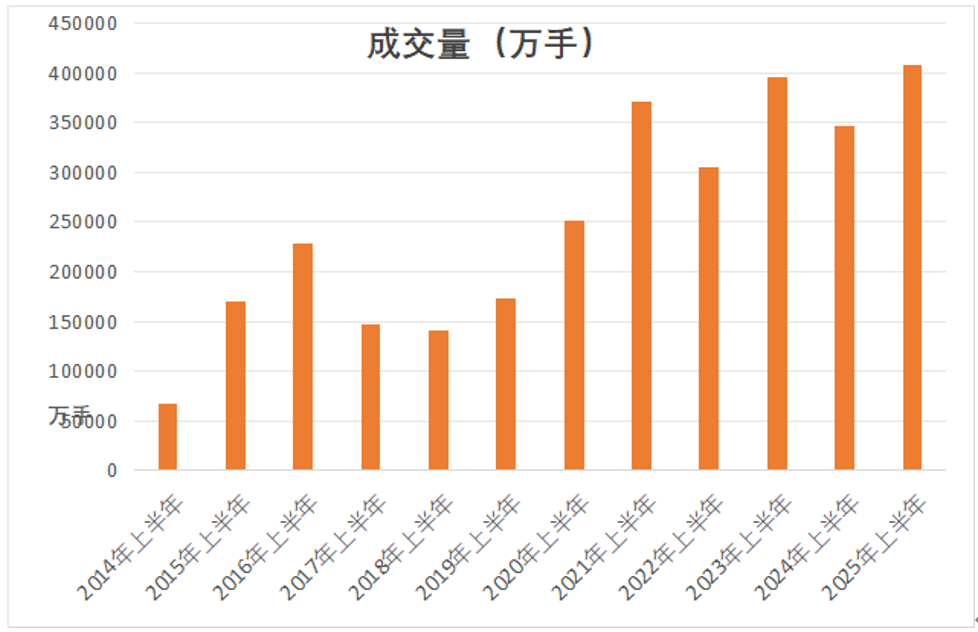
2025年上半年,全球经济环境复杂多变、地缘冲突此起彼伏、大宗商品供应扰动频现,在此背景下,我国期货期权市场呈现出"逆周期"的良好运行态势。 据中国期货业协会数据,今年上半全国期货市场成交量达40.76亿手,成交额为339.73万亿元,同比分别增长17.82%和20.68%;上半年全市场成交量创历史 同期新高;成交额则是仅次于2015年上半年,为历年同期次高;持仓量也是创历年同期新高水平,说明今年上半年我国期货期权市场成交活跃,为2025年 全年我国期货期权市场三项指标再创佳绩奠定扎实基础。 从各交易所表现来看,上期所(含INE)上半年成交量为11亿手、成交额为115.38万亿元,同比分别增长13.14%和25.85%。广期所绿色期货品种影响力逐 步扩大,上半年成交量为1.34亿手、成交额为5.82万亿元,同比分别增长71.04%和17.34%。中金所上半年成交量为1.35亿手,成交额为112.55万亿元,同比 分别增长21.98%和40.07%。 商品成交额方面,上期所(含INE)的黄金、原油、白银期货,郑商所的菜籽油、PTA、甲醇期货,大商所的棕榈油、焦煤、豆粕期货,广期所的工业 硅、碳酸锂、多晶硅期货等 ...