
Zhong Guo Huan Jing Bao

Search documents
吉林省连续15年未发生较大及以上突发环境事件
Zhong Guo Huan Jing Bao· 2025-10-14 01:44
Core Insights - Jilin Province has maintained a stable environmental safety situation, with no significant environmental incidents for 15 consecutive years, attributed to robust emergency response system development [1][2] Group 1: Emergency Response System - The newly revised "Emergency Response Plan for Sudden Environmental Events" was officially implemented in February 2024, establishing a three-tiered response system for effective coordination [1] - The province emphasizes a "prevention first, rescue combined" principle, conducting ongoing environmental risk inspections, particularly targeting key areas such as thallium-related enterprises and chemical parks [1] Group 2: Practical Drills and Future Goals - A significant emergency drill was conducted on July 23, simulating a chemical park fire and subsequent water pollution incident, involving nearly 160 participants and demonstrating effective multi-level coordination [2] - Future efforts will focus on enhancing the environmental risk prevention and emergency management system, with goals centered on professionalization, systematization, practical application, collaboration, and intelligence [2]
吉林省开展执法技能比武暨实战比武活动
Zhong Guo Huan Jing Bao· 2025-10-14 01:44
Core Viewpoint - The event aims to enhance the enforcement capabilities of ecological environment protection in Jilin Province through a combination of training and practical skills competitions [1] Group 1: Event Overview - The ecological environment protection enforcement skills competition and practical training took place from September 1 to October 28, organized by the Jilin Provincial Department of Ecology and Environment in collaboration with the Jilin Provincial Federation of Trade Unions [1] - The event innovatively integrates enforcement position training, skills competition, and practical exercises [1] Group 2: Training and Skills Competition - The second phase of enforcement position training focuses on addressing weaknesses and enhancing capabilities, covering policy interpretations, practical enforcement, and key points for inspections [1] - The skills competition emphasizes the dual enhancement of enforcement team building and capabilities, utilizing VR simulations, drones, and various detection instruments [1] Group 3: Participation and Objectives - Nearly 90 enforcement personnel from 10 teams across the province participated in the competition [1] - The competition aims to identify and address significant environmental issues and illegal activities, thereby improving the intelligence and precision of enforcement supervision [1]
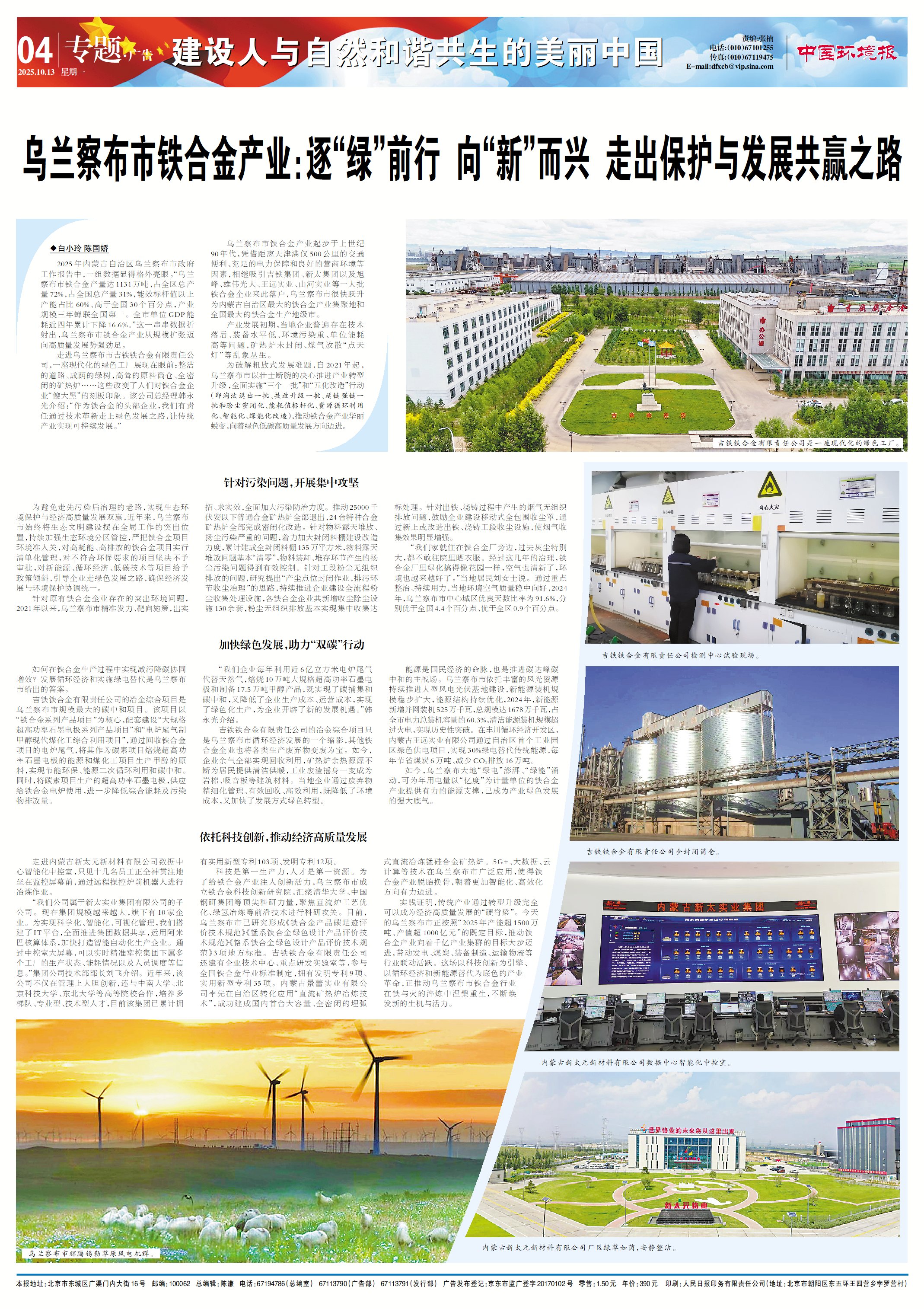
乌兰察布市铁合金产业:逐“绿”前行 向“新”而兴 走出保护与发展共赢之路
Zhong Guo Huan Jing Bao· 2025-10-13 04:36
Core Insights - The iron alloy industry in Ulanqab City has transitioned from scale expansion to high-quality development, with significant production figures and energy efficiency improvements [7][8][22] Group 1: Industry Overview - Ulanqab City has become the largest iron alloy production city in Inner Mongolia and the nation, with an iron alloy output of 11.31 million tons, accounting for 72% of the region's total and 31% of the national total [7][8] - The city has implemented a transformation strategy since 2021, focusing on upgrading technology and reducing environmental impact through initiatives like "three batches" and "five transformations" [8][10] Group 2: Environmental Initiatives - Ulanqab City has prioritized ecological civilization, enforcing strict environmental standards for iron alloy projects and promoting green development [9][10] - Significant pollution control measures have been taken, including the closure of all ordinary alloy furnaces below 25,000 kVA and the construction of 1.35 million square meters of fully enclosed material storage [10][11] Group 3: Technological Advancements - The city has established a technology innovation research institute to focus on advanced techniques such as direct current furnace optimization and green hydrogen smelting [21] - Companies like Jitie Iron Alloy Co. are leading in carbon-neutral projects, utilizing waste heat and emissions for energy and raw materials, significantly reducing production costs and environmental impact [16][17] Group 4: Future Goals - Ulanqab City aims to exceed 15 million tons of production capacity and achieve over 100 billion yuan in output value by 2025, driving growth in related sectors like power generation and logistics [22]

甘肃庆阳:“五个协同”筑牢生态安全屏障
Zhong Guo Huan Jing Bao· 2025-10-13 03:09
Core Viewpoint - The city of Qingyang in Gansu Province is implementing comprehensive ecological protection and governance strategies to combat desertification and improve water and soil conservation, aligning with national ecological initiatives and enhancing its environmental quality [1][2][3][4]. Group 1: Ecological Protection and Governance - Qingyang is focusing on integrated protection and systematic governance of its natural resources, emphasizing the importance of collaboration among various departments and levels of government [1]. - The city has invested 610 million yuan in desertification control, establishing a protected area of 309,000 acres and treating 1.26428 million acres of desertified land, achieving a shift from "sand encroachment" to "green recovery" [1]. - The total area of soil erosion in Qingyang is 23,000 square kilometers, accounting for 86% of the city's land area, prompting extensive soil erosion control measures [2]. Group 2: Water and Soil Conservation - Qingyang has completed soil erosion control over 17,600 square kilometers and has reduced annual sediment discharge into the Yellow River to below 10 million tons, indicating a sustained decrease in soil erosion intensity [2]. - The city is actively monitoring biodiversity and natural ecosystems, employing advanced technologies for wildlife monitoring and enforcing laws against illegal wildlife activities [2]. Group 3: Financial and Policy Support - Qingyang has received 7.687 billion yuan in transfer payments for ecological functions, which have been effectively utilized for environmental pollution control and ecological protection projects [3]. - The local government has implemented a series of actions to strengthen ecological civilization, including the establishment of ecological protection red lines and the promotion of legislative measures for environmental protection [4]. - By 2024, Qingyang aims to achieve stable air quality, with 95.7% of surface water quality meeting standards and a forest coverage rate of 60.63% [4].
拒绝推诿!农业产业化联合体治污应厘清责任
Zhong Guo Huan Jing Bao· 2025-10-13 02:13
监管严治。属地政府应加强对农业产业化联合体的监管。比如,天津市西青区每年组织集中排查整治行 动,对畜禽养殖场(户)进行拉网式排查,建立问题清单,对排查出的问题明确责任人、整改措施和时 限要求,有效推动了畜禽养殖业规范经营和污染治理。 农业产业化联合体以其经营主体多元化、产业链条完整融合、要素资源优化配置的鲜明特征,为农业发 展提质增效注入了活力。然而,笔者在工作中发现,部分畜禽养殖产业化联合体中企业、合作社、养殖 户间污染治理权责不清,存在"谁都不管"或"互相推诿"的现象。由于联合体中规模化养殖企业与散户并 存,部分中小养殖户受成本限制,缺乏粪污处理设备,偷排、漏排隐患突出。在一些地方,畜禽养殖产 业化联合体环境污染问题成为环境监管的重点和难点,也严重制约了联合体的高质量可持续发展。 农业产业化联合体的污染防治问题来源于三个方面。一是经营主体多元化带来的责任分散。龙头企业、 合作社、家庭农场虽以契约形式联盟,但仍是独立法人,在污染防治上缺乏刚性约束与协同机制,极易 陷入"九龙治水"困境,从而造成责任推诿与监管盲区。二是产业链条纵深发展放大污染风险。从田间生 产到加工流通再到终端销售,每一环节均潜藏污染因子。如 ...
如何做好生态环境信访工作?看看江苏宿迁的做法
Zhong Guo Huan Jing Bao· 2025-10-13 00:19
生态环境信访工作是连接群众与生态环境部门的重要桥梁,是倾听群众环境诉求、化解环境矛盾的关键 渠道。每一个环境问题,都关系到群众的切身利益和生态安全。江苏省宿迁市生态环境综合行政执法局 以"四个说清""四个不可""四个同频"三位一体,共同构建起规范、高效、暖心的信访工作体系,为及时 回应群众关切、妥善解决环境问题提供有力支撑,让生态环境保护工作真正贴近群众、服务群众,筑牢 生态环境保护与民生保障的双重防线。 "四个说清"严核查,筑牢生态环境信访办理根基 说清问题全貌。不仅要聚焦信访反映的"显性问题",更要以此为切入点,对其他产污环节进行"地毯 式"排查,挖出未被反映的 "隐性问题",避免"头痛医头、脚痛医脚"。以群众投诉的某企业大气污染问 题为例,除查清投诉涉及的污染物产生和排放情况外,还要延伸排查其他生产工序是否存在违规产、排 污点,污水处理设施是否正常运行,是否存在固危废贮存、处置不当等行为。通过全方位排查,确保问 题无死角、隐患无遗漏。 说清履职情况。接访、调查、回访人员必须保持客观公正,严格遵守工作纪律,让信访人清晰看到职能 部门全过程规范履职的轨迹,打消群众存在的"是否偏袒企业"的疑虑。接访时,认真倾 ...
科学谋划实施应对气候变化重大工程
Zhong Guo Huan Jing Bao· 2025-10-12 23:15
Core Viewpoint - The implementation of major projects to address climate change is crucial for advancing national strategies and ensuring security in key areas, with a significant increase in investment and policy actions since the "dual carbon" goals were proposed in 2020 [1] Group 1: Challenges in Implementing Climate Change Projects - The scope of climate change involves multiple sectors, including energy, industry, agriculture, and waste management, requiring comprehensive coordination across departments to achieve effective collaboration [2] - Quantifying climate benefits presents challenges due to limitations in methods and data availability, making it difficult to assess the climate impact of certain projects, particularly in adaptation efforts [3] - There is a lack of dedicated public funding for climate change initiatives compared to other sectors, which hampers the ability to secure sufficient resources and policy support for these projects [4] Group 2: Recommendations for Climate Change Project Implementation - The global climate financing scale reached $1.9 trillion in 2023, indicating a strong growth trend, while China will require approximately 139 trillion yuan in investments by 2060 to meet carbon neutrality goals, averaging 3.48 trillion yuan annually [5] - It is essential to enhance top-level design by optimizing government functions related to climate change and establishing cross-departmental coordination mechanisms to support project management and financing [6] - Differentiated organizational strategies should be adopted to address regional variations in greenhouse gas emissions and climate risks, focusing on both large-scale and localized projects [7] - Strengthening funding integration and establishing dedicated climate change funds will provide targeted support for major projects, while promoting financial innovation in climate-related products and services [8] - Capacity building is necessary to support research and development in climate change project management and financing, enhancing the capabilities of government, investment firms, and financial institutions [9]
吉林省省长胡玉亭主持召开专题会议 推动资源优势转化为发展优势
Zhong Guo Huan Jing Bao· 2025-10-10 09:54
Core Insights - The meeting chaired by Jilin Province Governor Hu Yuting focuses on accelerating the development of the new energy industry and enhancing local consumption of renewable energy through effective policy implementation [1][2] - Jilin Province is recognized for its abundant wind and solar resources, advantageous location, and favorable land and water resources, making it well-suited for the growth of the new energy sector [1] - The province aims to leverage national policies to foster high-quality development in the new energy industry, emphasizing the importance of local adaptation and maximizing policy benefits [1][2] Group 1 - The provincial government is committed to transforming policy dividends into actionable measures to support the large-scale development of new energy [1] - Jilin has positioned the new energy industry as a key driver for revitalization and economic growth, with collaborative efforts from various stakeholders [1] - The introduction of innovative national policies in the new energy sector presents significant opportunities for high-quality development [1] Group 2 - Hu Yuting stresses the need for a deep understanding of national policy directions and the importance of aligning provincial strategies with these policies [2] - The province plans to implement precise measures to help enterprises benefit from policy advantages and accelerate their growth [2] - There is a focus on expanding the scale of "green electricity direct connection" and promoting more "green hydrogen+" projects to enhance the consumption of green electricity [2]
强化水生植物综合利用,实现生态效益与经济效益双赢
Zhong Guo Huan Jing Bao· 2025-10-10 03:29
Core Viewpoint - The comprehensive utilization of aquatic plants can address ecological pollution caused by their decay in water bodies while providing new resources for economic and social development, achieving a win-win situation for ecological and economic benefits [2]. Group 1: Current Issues in Aquatic Plant Utilization - Insufficient policy support exists for the comprehensive utilization of aquatic plants, which involves multiple stages such as harvesting, transportation, and development, making it difficult for enterprises to sustain efforts alone [1]. - The degree of resource utilization is low, with current applications mainly focused on feed and food, while new fields like renewable energy and pharmaceuticals remain underexplored [1]. - Technological innovation is relatively lagging, with inadequate integration of industry, academia, and research, leading to challenges in overcoming key technical issues that affect the breadth and depth of resource utilization [1]. Group 2: Recommendations for Improvement - Strengthening government leadership is essential, suggesting a "government subsidy + market operation" model to support enterprises in establishing local factories or raw material bases, thereby reducing costs associated with aquatic plant cultivation and harvesting [2]. - Establishing a comprehensive support policy system for aquatic plant resource utilization is recommended, including prioritizing procurement of biodegradable products and promoting green credit products related to aquatic plant utilization [2]. - Encouraging technological innovation through collaboration between enterprises, universities, and research institutions is vital to enhance scientific research and expand product application areas, increasing product value and market competitiveness [2].
破解餐饮油烟噪声扰民难题,推动污染治理从“合规”走向“合需”
Zhong Guo Huan Jing Bao· 2025-10-10 02:09
Core Viewpoint - The article highlights the challenges of environmental enforcement, particularly the "compliance dilemma," where businesses meet regulatory standards but still cause disturbances to local residents [1][2] Group 1: Case Study - A resident in Beijing complained about noise and smoke from a nearby restaurant, leading to inspections that confirmed emissions were within legal limits [1] - Despite compliance, the restaurant's old exhaust system caused vibrations and noise, affecting nearby residents [1] - After discussions, the restaurant upgraded its purification equipment, resulting in a 60% reduction in smoke emissions and a noticeable decrease in noise, ultimately gaining community approval [1] Group 2: Enforcement Challenges - The "compliance dilemma" reflects a broader issue in ecological enforcement, where meeting standards does not equate to community satisfaction [1][2] - Various sources of noise and emissions, such as traffic and commercial activities, can still lead to complaints even if individual sources are compliant [1] Group 3: Recommendations for Improvement - Emphasizing a citizen-centric approach in pollution control, moving from mere compliance to addressing community needs [2] - Enhancing the capabilities of enforcement personnel in communication, guidance, and problem-solving to better manage community and business relations [2] - Establishing a comprehensive system to address the "compliance dilemma," integrating it into annual enforcement priorities and fostering inter-departmental collaboration [2]