Xin Lang Ke Ji

Search documents
阿里蔡崇信试乘小鹏X9点赞1602km超长续航
Xin Lang Ke Ji· 2025-11-27 03:09
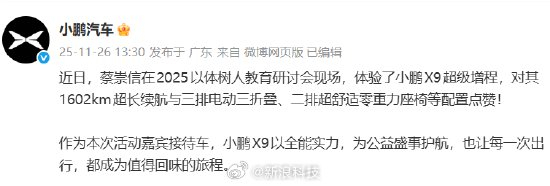
【#阿里蔡崇信试乘小鹏X9#】11月26日,小鹏汽车微博发文称,近日,阿里巴巴集团董事会主席蔡崇 信在2025以体树人教育研讨会现场,体验了小鹏X9超级增程,对其1602km超长续航与三排电动三折 叠、二排超舒适零重力座椅等配置点赞。 ...


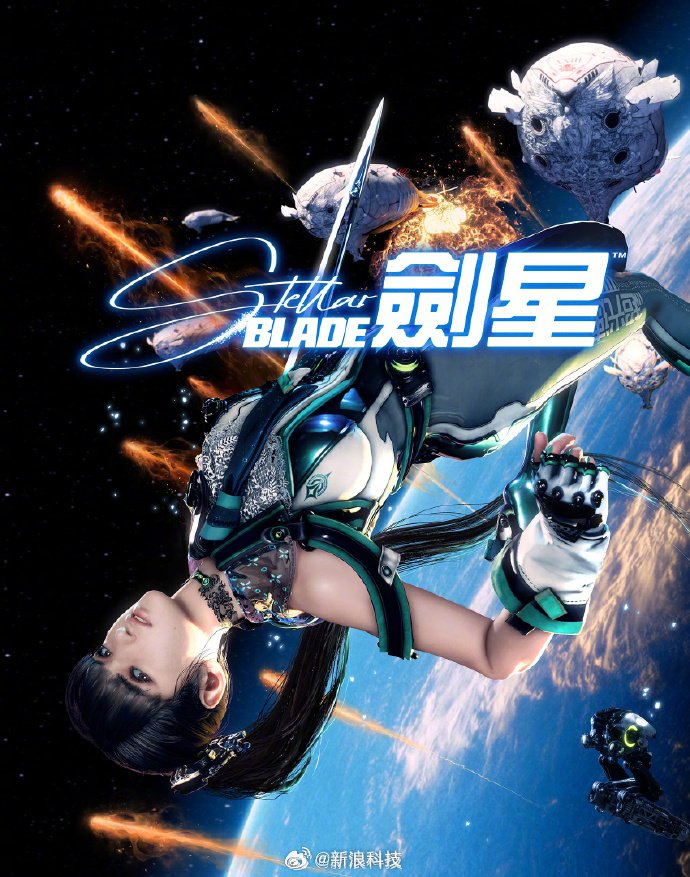
剑星开发商Shift Up与腾讯合作开发虚幻5跨平台新游Project Spirits
Xin Lang Ke Ji· 2025-11-27 02:40
Core Insights - Shift Up, the developer of "Sword Star," has announced a collaboration with Tencent to develop a new cross-platform game called Project Spirits, utilizing Unreal Engine 5 [1] - Project Spirits is set to be released on PC, consoles, and mobile platforms, and is inspired by "Eastern Fantasy" [1] - Level Infinite, a subsidiary of Tencent, aims to leverage Shift Up's success from previous titles to enhance the gaming experience for global players [1] Group 1 - Shift Up and Tencent's partnership will focus on the development and publishing of Project Spirits, previously known as Project Witches [1] - The game is categorized as a "subculture cross-platform work" and aims to reach a diverse audience [1] - Level Infinite has a track record of successful game releases, including "Goddess of Victory: Nikke" in 2022, which sets a precedent for this collaboration [1] Group 2 - "Sword Star" achieved significant success after its PC launch in June, breaking the record for the highest concurrent player count for a single-player game on Steam for Sony [2] - This strong performance indicates a growing interest in Shift Up's titles and may positively impact the anticipated success of Project Spirits [2]

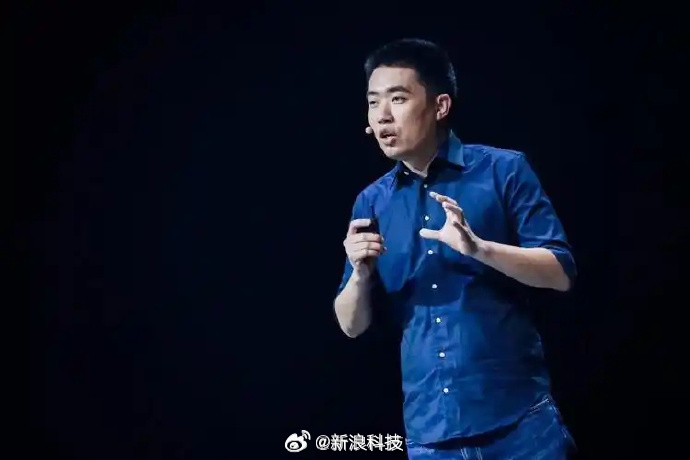
李想承认职业经理人模式错误,理想汽车回归创业公司管理
Xin Lang Ke Ji· 2025-11-27 02:07
Core Viewpoint - Li Auto's CEO Li Xiang admitted to past management mistakes and announced a shift back to a startup model from a professional management system, citing the need for adaptability in an unstable market environment [1] Group 1: Management Strategy - Li Auto will fully revert to a startup management model starting from Q4 of this year, as the previous three years of using a professional management structure did not align with the company's needs [1] - Li Xiang emphasized that leading companies like Nvidia and Tesla operate under a startup management style, suggesting that Li Auto should also embrace this approach [1] Group 2: Technological Confidence - The company has developed a strong technological foundation in embodied intelligence over the past three years, which boosts confidence in the next generation of products [1] - Li Xiang referred to the beginning of a new era for embodied intelligence robots, indicating that the company anticipates significant revenue growth, with a target of reaching billions [1] Group 3: Financial Stability and Future Goals - Li Auto aims to maintain focus on its core values and utilize the startup management model to create leading embodied intelligence products [1] - The company is committed to navigating economic cycles and leading technological advancements to generate unique value for users and society in the long term [1]

浪人早报 | 罗永浩称华杉必须公开道歉、渠道人士称对华为Mate80定价意外、英伟达回应谷歌AI芯片威胁…
Xin Lang Ke Ji· 2025-11-27 01:16
Group 1 - Luo Yonghao demands a public apology from Huashan, stating that if not issued by a specified deadline, the public relations industry in China will remember him instead of Huashan [2] - Huawei's Mate 80 series pricing surprised industry insiders, indicating Huawei's strong market position and prompting competitors to reassess their strategies [2] Group 2 - Apple is projected to surpass Samsung in global smartphone sales by 2025, with iPhone shipments expected to reach 255 million units, a 10% increase year-on-year [5] - In October, iPhone sales in China accounted for 25% of total smartphone sales, reflecting a 37% year-on-year growth [5] Group 3 - Xiaomi has conducted its fourth stock buyback this month, purchasing 7.5 million shares at an average price of 40.14 HKD, totaling over 300 million HKD [6] - The total number of shares repurchased by Xiaomi this month has reached 31.5 million, with a total expenditure exceeding 1.2 billion HKD [6] Group 4 - Li Auto reported Q3 revenue of 27.4 billion RMB, down from 42.87 billion RMB year-on-year, and anticipates Q4 deliveries between 100,000 and 110,000 vehicles [7] - The company has initiated a recall of certain models, impacting its Q3 financial results [7] Group 5 - Apple has launched a feedback form for its AI services in mainland China, indicating a focus on local user engagement [8] Group 6 - Tesla has completed the construction of its largest Supercharger station in California, featuring 168 charging stalls and a solar power system [9] - The station operates independently from the public grid, showcasing Tesla's commitment to sustainable energy solutions [9] Group 7 - Tesla's VP denied reports of supply chain decoupling from China, emphasizing the high localization rate of components produced at its Shanghai factory [10] Group 8 - Former Zeekr CBO Guan Haitao has joined Honor's marketing department, focusing on overseas market strategies [11] - Zhao Changjiang, former head of BYD's Tengshi brand, has joined Chery's collaboration with Huawei as marketing general manager [12] Group 9 - Qualcomm has officially launched the Snapdragon 8 Gen 5 processor, designed to provide flagship-level performance for lower-priced devices [14] - The new processor features significant improvements in CPU, GPU, and AI tasks, along with reduced power consumption [14] Group 10 - Ten airlines were summoned for discussions regarding consumer rights, particularly concerning the practice of charging for seat selection, which may infringe on consumer rights [16]



深蓝汽车融资挂牌背后,是销量、技术与全球化共筑的品牌自信
Xin Lang Ke Ji· 2025-11-27 00:57
Core Viewpoint - Deep Blue Automotive officially launched its financing on November 26, attracting significant industry attention amid a rational capital market and intensifying competition in the new energy sector [2] Group 1: Financing Details - The total amount of funds to be raised is yet to be determined, with the corresponding equity ratio also to be determined [5] - The financing aims to support new vehicle research and development, core technology innovation in intelligence and electrification, and enhance global brand strength [5][10] Group 2: Sales Performance - Deep Blue Automotive's cumulative sales from January to October 2025 increased by 57.1% year-on-year, significantly surpassing the industry average [7] - The company has achieved over 30,000 monthly sales for three consecutive months since September, aiming for a milestone of 700,000 units [7][8] - The brand has successfully transitioned from a price-driven strategy to a value-driven approach, focusing on high-quality growth [8] Group 3: Technological Advancements - The financing will be directed towards new product development and core technology innovations, emphasizing "smart technology" [10] - Deep Blue is building a comprehensive technological moat covering the three electric systems, intelligent driving, semiconductors, and suspension technology [10][12] - The company has made significant strides in technology, such as launching the first mass-produced model with a magnetorheological suspension system among Chinese brands [10] Group 4: Globalization Efforts - Deep Blue Automotive has entered nearly 100 global markets, establishing a presence in emerging markets like Thailand and Greece, as well as in mature markets in Europe [12] - The company emphasizes not only sales volume but also brand value and user reputation on a global scale [12] - The successful performance of flagship models like the Deep Blue S05 and S07 reflects the steady progress of the company's globalization strategy [12] Group 5: Future Outlook - Deep Blue plans to create a wider range of high-quality new vehicles and continue investing in key areas such as electric drive, intelligent cockpit, and semiconductors [13] - The financing initiative is seen as a response to the national "new quality productivity" strategy, showcasing the company's operational efficiency and strategic execution [13][14] - The transition from "price competition" to "value competition" is a significant aspect of Deep Blue's strategy, aiming to build a world-class electric vehicle brand [14]
80后「女帅」掌舵海信家电一周年,业绩增速垫底 | BUG
Xin Lang Ke Ji· 2025-11-27 00:38
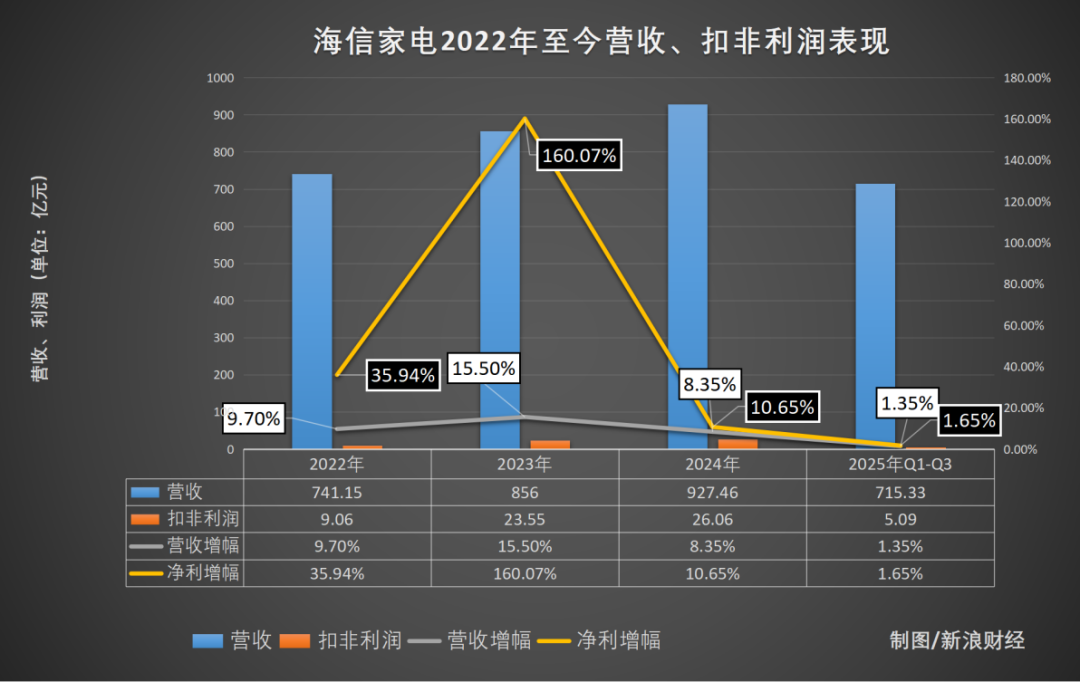
Core Viewpoint - The leadership of Gao Yuling at Hisense Home Appliances has seen a decline in revenue and net profit growth, marking the lowest performance in recent years, amid increasing competition in the domestic home appliance industry [1][7][9]. Leadership Changes - Gao Yuling was elected as the new chairman of Hisense Home Appliances on November 21, 2022, marking the beginning of the "Gao Yuling era" [2]. - Following her appointment, several key personnel changes occurred, including the resignation of former president Hu Jianrong and the departure of board member Zhu Dang [2][3]. - Key figures supporting Gao Yuling, including Yin Zhixin, have been promoted to significant roles within the company, indicating a consolidation of leadership [3][4]. Financial Performance - The financial data from 2022 to the first three quarters of 2025 shows a significant decline in revenue growth and net profit growth, with figures of 13.90%, 13.81%, 8.75%, and 1.35% for revenue growth, and 14.10%, 165.99%, 10.99%, and 1.65% for net profit growth, respectively [6][7]. - This performance represents the lowest growth rates in nearly four years for the company [7]. Business Segment Analysis - The ice washing business, previously led by Yin Zhixin, has shown strong performance with revenues of 26.07 billion, 30.84 billion, and 15.39 billion for 2023, 2024, and the first half of 2025, respectively, reflecting year-on-year growth rates of 22.93%, 18.29%, and 4.76% [5]. - In contrast, the air conditioning segment, which is the largest revenue source, has seen much lower growth rates of 12.02%, 4.22%, and 4.07% during the same periods [5]. Market Challenges - The home appliance industry is experiencing intensified competition, leading to price reductions in high-margin products like air conditioners, which has negatively impacted Hisense's revenue and profit [9][10]. - The company's air conditioning products have faced a decline in gross margin, with a year-on-year decrease of 1.56% reported for the first half of the year [10]. - Despite efforts to restructure and enhance market competitiveness, the effectiveness of these initiatives has yet to be realized, as indicated by the declining market share in both online and offline channels [11].

瑞士学者:科技公司界限开始模糊 AI应用的终极目标是传统企业
Xin Lang Ke Ji· 2025-11-26 23:13
Core Insights - The article discusses the blurring boundaries between hardware, software, and services in the tech industry, driven by geopolitical uncertainties and the integration of artificial intelligence (AI) [3][4]. Group 1: Industry Trends - The traditional segmented business models in the tech sector are becoming obsolete, as companies now focus on providing a complete user experience rather than specializing in hardware or software [3]. - The IMD's Future Readiness Indicator evaluates companies based on seven dimensions, including financial foundation, investor growth expectations, business diversity, employee structure, R&D investment, early innovation outcomes, and cash and debt management [3][4]. - A clear divide is emerging between strong and weak companies, with some leveraging AI for growth while others remain trapped by past successes [4]. Group 2: Company Performance - In the pharmaceutical sector, leaders like Johnson & Johnson, Roche, and AstraZeneca have built comprehensive systems from basic research to next-generation treatment platforms, while companies reliant on traditional products are struggling [4]. - In the fashion industry, companies that have embraced platformization and supply chain resilience are thriving, while those slow to adapt are losing touch with modern consumers [5]. - The strongest companies in the tech sector, such as NVIDIA, Microsoft, and Google, are not just selling products but controlling the entire IT technology stack, allowing them to manage workflows effectively [6][7]. Group 3: Investment Landscape - The current investment landscape in the U.S. is characterized by significant funding directed towards AI-driven projects, with estimates of $600 to $700 billion being invested every six months [8]. - Tech giants are hedging against the risk of AI applications not generating substantial revenue, indicating a strategic shift towards ensuring that their investments create real economic value [9]. - The article suggests that China has advantages in the emerging field of robotics and AI applications, positioning itself well for future developments [10].




瑞士学者:为什么小米能实现强势回归?
Xin Lang Ke Ji· 2025-11-26 23:12
Core Insights - The article discusses the impact of geopolitical uncertainties on technology development and highlights the blurring boundaries between hardware, software, and services in the tech industry [1][3]. Group 1: Industry Trends - The traditional segmented business models in the tech industry are becoming obsolete, with companies now focusing on providing a complete user experience rather than specializing in hardware or software [3]. - The IMD's Future Readiness Indicator evaluates companies based on their long-term competitiveness across seven dimensions, including financial foundation, investor growth expectations, business diversity, employee structure, R&D investment, early innovation outcomes, and cash and debt management [3][4]. Group 2: Company Performance - The 2025 Future Readiness Indicator reveals a clear divide between strong and weak companies, with some leveraging AI and geopolitical changes for growth while others remain trapped by outdated success paths [4]. - In the pharmaceutical sector, leading companies like Johnson & Johnson, Roche, and AstraZeneca have built comprehensive systems from basic research to next-generation treatment platforms, while others struggle due to reliance on traditional products [4]. Group 3: Fashion Industry Insights - In the fashion industry, platformization and supply chain resilience are critical, with luxury brands leveraging "super luxury combinations" to enhance lifestyle offerings [5]. - Companies that fail to adapt and modernize their brand culture are losing touch with contemporary consumers, while those with diversified ecosystems can absorb market shocks and turn volatility into an advantage [5]. Group 4: Technology Giants - Leading tech companies such as NVIDIA, Microsoft, Google, and Meta are not just selling products but are controlling the entire IT technology stack, allowing them to manage workflows effectively [6][7]. - Xiaomi is highlighted as a unique case, successfully expanding from smartphones to home appliances and vehicles while maintaining a connected ecosystem that enhances user experience [7]. Group 5: AI Investment Landscape - The current investment landscape in the U.S. is characterized by significant funding directed towards AI-driven projects, with major companies investing approximately $600 to $700 billion every six months [8]. - Concerns arise regarding the sustainability of these investments if AI applications do not yield substantial returns, prompting tech giants to hedge their bets by ensuring that traditional companies can create real value through AI [9]. Group 6: Competitive Advantages - The article emphasizes that the strongest companies are those that do not rely on a single product but possess the capability to manage entire ecosystems [5][6]. - The next wave of innovation is expected to focus on real-world interactions, with significant investments in robotics and AI applications that extend beyond traditional industries [9][10].
全文|理想汽车Q3业绩会实录:11月份起,i6的电池供应将正式启用双供应商模式
Xin Lang Ke Ji· 2025-11-26 15:03
Financial Performance - Li Auto reported total revenue of 27.4 billion yuan for Q3 2025, a year-over-year decline of 36.2% and a quarter-over-quarter decline of 9.5% [1] - The company incurred a net loss of 624.4 million yuan, compared to a net profit of 2.8 billion yuan in the same period last year and a net profit of 1.1 billion yuan in the previous quarter [1] - Adjusted net loss was 359.7 million yuan, down from a net profit of 3.9 billion yuan year-over-year and 1.5 billion yuan quarter-over-quarter [1] Management Insights - Li Auto's management emphasized a return to a startup mentality and outlined a ten-year product and technology roadmap, focusing on AI-driven product design [2] - The company anticipates that products equipped with the M100 chip will be delivered in 2026, fundamentally transforming user experience [2][3] - The management highlighted the importance of time in transitioning to new technologies and products, indicating that significant improvements may take time to materialize [2] Technology and Product Development - Li Auto is focusing on self-research in the three core areas of electric drive, battery, and electronic control, achieving key breakthroughs [4] - The company has developed a full-stack self-research capability in battery technology, emphasizing fast charging and safety [4] - Li Auto plans to mass-produce its self-developed 5C battery next year, enhancing battery safety and user charging experience [4] Market Strategy and Challenges - The company is addressing supply chain challenges by implementing a dual-supplier model for battery supply starting November, aiming to increase monthly production capacity of the i6 model to 20,000 units by early next year [6] - Li Auto's management acknowledged the impact of reduced delivery volumes on cash flow, attributing it to delivery pressures and shortened supplier payment cycles [6][7] - The company is optimistic about the long-term growth of the NEV market, projecting a penetration rate of 55%-60% by 2026 [8] Future Outlook - Li Auto is preparing for changes in replacement subsidy policies and increased vehicle purchase taxes, with strategies to mitigate short-term impacts while enhancing user value through technological advancements [8] - The 2026 L series will feature significant upgrades based on user feedback and core technology accumulation, aiming to strengthen the brand's position in the extended-range vehicle market [9][10] - The company is committed to delivering a historical breakthrough in delivery volumes in 2026, leveraging product strength and user value to navigate market uncertainties [8] AI and Innovation - Li Auto's VLA model has been fully deployed across its models, showing significant improvements in user experience and driving performance [12] - The company is continuously iterating on the VLA model, with upcoming updates aimed at enhancing safety and decision-making capabilities [12] - Li Auto is developing its self-research AI inference chip, expected to launch commercially next year, which aims to significantly reduce costs while improving performance [14]
值得买科技:11月MCP月输出量破亿、“张大妈”活跃用户增长8倍
Xin Lang Ke Ji· 2025-11-26 12:39
Core Insights - Worth Buying Technology's CTO Wang Yunfeng announced significant advancements in AI, including over 40 partners for the "Haina" MCP Server and an output volume exceeding 1 billion in November [1] - The AI shopping assistant "Zhang Dama" saw an 8-fold increase in active users and a 24% increase in average retention compared to the previous month [1] - The core product "What Worth Buying" experienced a 4-fold increase in AIGC reading time compared to the same period last year [1] Company Developments - In October, Worth Buying Technology formed a strategic partnership with Weimeng to integrate its consumer data service capabilities with Weimeng's SaaS commercial operating system, aiming to create an AI e-commerce transaction closed loop in China [1] - The company plans to further collaborate with Alipay to explore AI payment services, establishing a collaborative transaction closed loop involving AI agents, users, merchants, and payment platforms [1] Technology and Infrastructure - The ACP (Dialogue Commerce Protocol) is introduced as a foundational technology standard that connects AI capabilities with commercial value, expected to create new opportunities in the AI era [1] - The "Haina" ACP will first be implemented in the "Zhang Dama" App, facilitating a seamless process from dialogue to recommendation, ordering, and payment, thereby creating a verifiable sample of AI e-commerce [1]