
Jin Shi Shu Ju

Search documents
美联储三年亏损期终落幕!2432亿美元窟窿还需数年来填?
Jin Shi Shu Ju· 2025-12-03 12:05
Group 1 - The Federal Reserve has reportedly turned around its unprecedented losses that lasted for three years, closely linked to the monetary policies implemented post-COVID-19 [2] - Since early November, the Federal Reserve has returned to profitability, allowing it to slowly begin to fill its deferred assets, which have decreased from $243.8 billion to $243.2 billion by November 26 [2] - Analysts expect that the process of replenishing deferred assets and returning profits to the Treasury will take years to complete [2] Group 2 - During the pandemic, the Federal Reserve significantly increased its asset holdings by purchasing government bonds and mortgage-backed securities, peaking at $9 trillion in the summer of 2022 [3] - Rising inflation pressures led the Federal Reserve to raise interest rates significantly starting in early 2022, creating a mismatch between its income and the payments it needed to make to banks [3] - The cessation of losses for the Federal Reserve is attributed to the reduction in interest on reserve balances (IORB) and not from special earnings like seigniorage [3]
克宫:普京对美方提议“有取有舍”,愿持续谈判以达成协议
Jin Shi Shu Ju· 2025-12-03 11:41
"目前工作正在专家层面进行,"佩斯科夫说。"应该在专家层面取得某些成果,然后这些成果将成为最 高级别接触的基础。" 11月曾有一份泄露的28项美国和平提议草案浮出水面,这令乌克兰和欧洲官员感到震惊,他们称这些提 议是向莫斯科低头。 AI播客:换个方式听新闻 下载mp3 音频由扣子空间生成 克里姆林宫周三表示,俄罗斯总统普京接受了美国旨在结束俄乌冲突的部分提议,但拒绝了其他提议, 不过俄罗斯准备与美国谈判代表进行多次会晤,直至达成协议。 克里姆林宫发言人佩斯科夫是在莫斯科的会谈结束后发表上述讲话的。此次会谈在普京与美国总统特朗 普的特使威特科夫及女婿库什纳之间进行,一直持续到当地时间周三凌晨。克里姆林宫的一位助手随后 表示,"尚未找到妥协方案"。 当被问及说普京拒绝了美国的提议是否准确时,佩斯科夫表示并不准确。 "昨天首次进行了直接的意见交换,"佩斯科夫说。"有些内容被接受了,有些内容被标记为不可接受。 这是寻找妥协方案的正常工作流程。" 佩斯科夫表示,俄罗斯感谢特朗普所做的努力,但克里姆林宫不会对与美国的讨论进行实时评论,因为 公开宣传不太可能起到建设性作用。 欧洲大国随后提出了反提案,在日内瓦的会谈中,美国 ...
马斯克预言美国政坛将迎“伟大12年”:特朗普后,万斯将接棒且连任
Jin Shi Shu Ju· 2025-12-03 09:43
在通过视频出席其前联邦削减成本团队的重聚活动时,马斯克预测,美国正处于一个"伟大的12年跨 度"的开端,这一时期将由美国总统特朗普的第二任期以及随后万斯的两个连续任期组成。 马斯克感谢团队在华盛顿任职期间所做出的牺牲,包括放弃更高薪的工作、承受政治反弹以及忍受死亡 威胁。 在其一贯的思维跳跃且有时略显随性的发言中,马斯克的话题从对国内冲突的担忧,跳跃到衡量文明技 术进步理论的卡尔达肖夫指数,再谈到他在火星建立殖民地的构想。他开玩笑说,从地球发射的导弹无 法迅速到达火星,而且即使发射了,六个月的飞行时间也能给定居者留出充足的准备时间,这番话引来 了全场的笑声。 包括Steve Davis和Anthony Armstrong在内的多位参与政府效率部工作的马斯克高级亲信出席了聚会。在 聚会上,一些成员交流了他们在执行马斯克削减成本指令期间,居住在华盛顿总务管理局(GSA)大楼 六层的轶事。 在近期接受采访时,马斯克曾反思道:"总的来说,我发现当我卷入政治时,结局都很糟糕。" 当与会者在感恩节主题的长桌旁享用烧烤和墨西哥烤肉时,马斯克告诉在场众人,他之所以选择不亲自 到场,是因为此次重聚的消息已经公开。 他表示,他认 ...
特朗普放话换人,鲍威尔还有“王牌”:留任理事,守护美联储!
Jin Shi Shu Ju· 2025-12-03 09:03
"作为一名职业公务员,哈姆林的动机是出于对机构的忠诚以及一种信念,即使命比头衔更重要。第二 个,也是更具相关性的先例是马里纳·埃克尔斯(Marriner Eccles),"Reid说。"在带领美联储度过大萧 条和二战后,埃克尔斯在1948年被杜鲁门总统排挤。他没有辞职,而是作为理事留任。杜鲁门更换了主 席,但要求他留在理事会,部分原因是埃克尔斯在市场上备受尊敬,部分原因是总统知道自己迫使埃克 尔斯离开的权力有限。埃克尔斯留下来是为了捍卫央行的独立性。" 因此,Reid总结道: "鲍威尔在2026年可能面临类似的时刻。如果政治环境被视为威胁到美联储独立实施货币政 策的能力,他可能会选择效仿埃克尔斯的做法。通过保留其理事席位,他将在联邦公开市场 委员会(FOMC)保有一票表决权,尽管这种举动已经几十年未见了。这在很大程度上可能 取决于政府选择谁作为下一任美联储主席。" 德意志银行的Jim Reid表示,"普遍的假设是,一旦主席的领导任期结束,他们就会彻底离开美联储, 即使他们作为理事的单独任命还有数年时间。传统支持这种观点。但法律并非如此。" Reid补充说,"而这就是事情变得有趣的地方。鲍威尔的主席任期可能在2 ...
数据荒下“小非农”又成焦点!美联储降息剧本还会反转吗?
Jin Shi Shu Ju· 2025-12-03 08:52
美国10月私营部门新增42000个岗位,教育和医疗保健行业,以及贸易、运输和公用事业行业引领增 长。然而,自10月私营就业数据发布后,ADP的周度就业数据发现,雇主持续裁员。例如,ADP报告 显示,截至11月8日的四周内,私营就业平均每周减少13500个岗位。 此外,美联储最新的《褐皮书》指出,就业"略有下降"。约半数地区表示劳动力需求减弱,而纽约、达 拉斯和明尼阿波利斯联储报告称,10月初至11月中旬就业人数小幅下滑。 北京时间周三晚9点15分,薪资处理公司ADP将公布美国最新私营部门就业数据,预计将显示11月劳动 力市场保持相对稳定。由于美联储官员手头的经济数据少于往常,这可能会在美联储官员下周制定利率 时引发进一步分歧。 FactSet调查的经济学家预计,美国私营部门雇主11月新增4万个岗位,但彭博社的共识预期仅为增长 5000个。 所有这些都表明,ADP最新就业数据可能成为官员和投资者判断12月降息概率的关键因素。如果数据未 显示就业明显下滑,那么担忧通胀持续高于2%目标的美联储官员可能会有更多理由认为,下周维持利 率稳定是正确的前进方向。 除了ADP和《褐皮书》数据外,多项关键劳动力指标并未显示明显 ...
美国假日季网购创纪录背后:虚假繁荣掩盖经济脆弱,消费寒冬将至?
Jin Shi Shu Ju· 2025-12-03 08:20
Core Insights - The holiday shopping season in the U.S. began with record online sales of $44.2 billion during "Cyber Week," despite signs of potential economic weakness and declining consumer confidence [2] - Consumers are showing signs of anxiety, with a notable increase in the use of "buy now, pay later" services and a shift towards seeking discounts on essential items [2][3] - A survey indicated a 4% drop in consumers feeling capable of purchasing everyday essentials, reflecting a slow erosion of household financial health [3][4] Consumer Behavior - There is a growing trend of consumers adjusting their shopping habits due to tariff-related price impacts, with many planning to purchase gifts earlier or reducing their overall spending [3] - The significant discounts during Thanksgiving suggest that consumers require more incentives to spend, indicating a connection between consumer sentiment and purchasing behavior [3] - Consumers are attempting to maximize the value of their spending through "trading down," yet they have not completely ceased consumption [5] Economic Outlook - Analysts suggest that the financial strain on middle and lower-income consumers is becoming more pronounced, with retail spending flattening after months of preemptive purchases to cope with tariff costs [4] - The potential for consumer fatigue may become more evident in the months following the holiday shopping season, influenced by additional pressures from tariffs and government policies [4] - Despite the challenges, some economists remain optimistic, noting a historical disconnect between consumer sentiment and actual spending patterns [4]
美联储降息也挡不住!美国货币市场基金规模飙破8万亿
Jin Shi Shu Ju· 2025-12-03 06:36
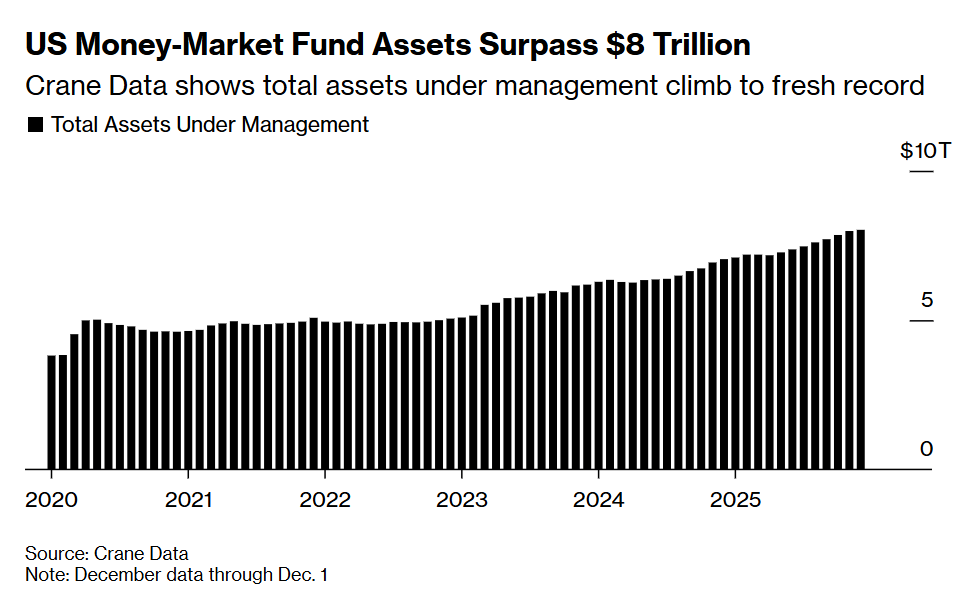
Core Insights - The total assets under management in U.S. money market funds have surpassed $8 trillion, marking a significant milestone for the industry [1][4] - Despite the Federal Reserve's interest rate cuts, investors continue to flock to money market funds due to their yield advantages over other investment vehicles, particularly bank deposits [4][5] Group 1: Asset Growth - As of the latest week, U.S. money market fund assets increased by approximately $105 billion, reaching a historical high [1] - Year-to-date, over $848 billion has flowed into these funds, indicating strong investor interest [5] Group 2: Yield and Interest Rates - The Crane 100 Money Fund Index reported a seven-day annualized yield of 3.80% as of December 1, showcasing the competitive returns offered by money market funds [4] - The Federal Reserve has lowered the policy interest rate by 25 basis points in both September and October, now ranging from 3.75% to 4.00% [4] Group 3: Investor Behavior - Institutional and corporate treasurers are increasingly outsourcing cash management to money market funds for better yields, rather than managing it internally [5] - Retail investors currently allocate about 15% to 20% of their portfolios to money market funds, consistent with historical averages, suggesting stability in fund inflows [5]

全球黄金协会:各国央行10月份加大黄金购买力度
Jin Shi Shu Ju· 2025-12-03 06:06
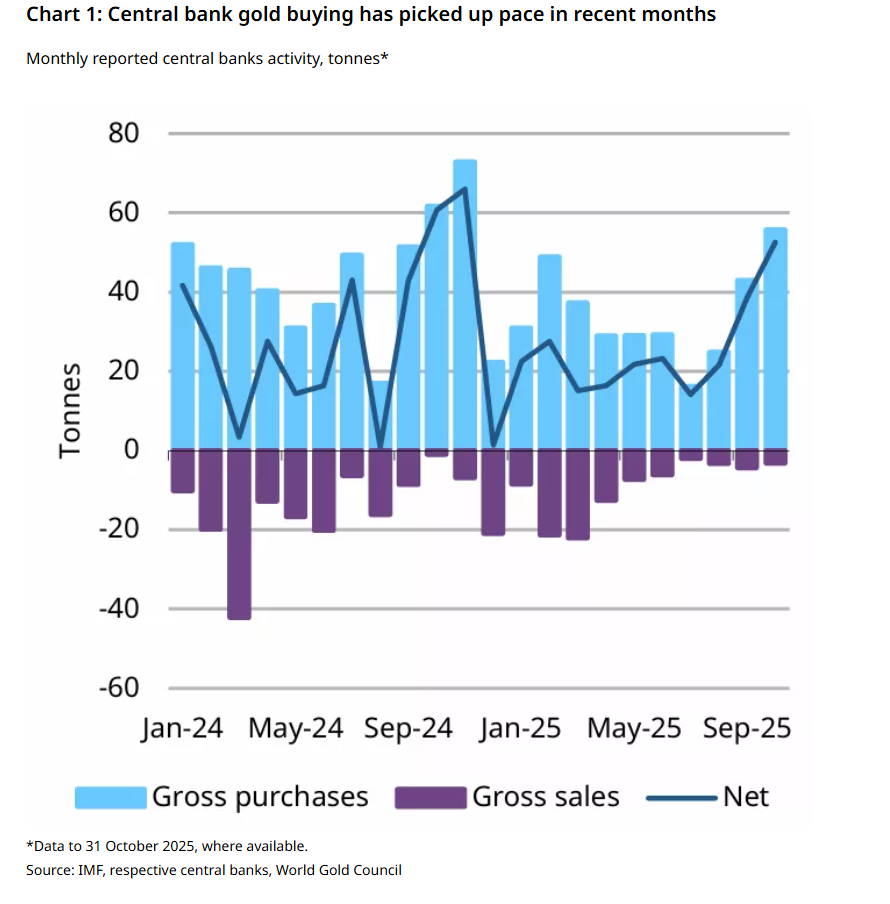
Core Insights - Central banks worldwide showed strong demand for gold in October, with net purchases reaching 53 tons, a 36% month-over-month increase, marking the largest monthly net demand of the year [1] - The total net gold purchases by central banks for the year reached 254 tons as of October, indicating a slowdown compared to the previous three years, likely due to rising gold prices [3][6] - Emerging market central banks continue to purchase gold strategically, highlighting its importance amid ongoing macroeconomic uncertainties [3] Group 1: Central Bank Purchases - The National Bank of Poland was the most active buyer in October, purchasing 16 tons of gold, raising its reserves to 531 tons, which constitutes 26% of its total reserves [6][8] - The Central Bank of Brazil also increased its gold holdings by 16 tons in October, following a 15-ton purchase in September, bringing its total reserves to 161 tons, or 6% of total reserves [6] - Other notable purchases in October included the Central Bank of Uzbekistan (9 tons), Bank Indonesia (4 tons), and the Central Bank of Turkey (3 tons) [7] Group 2: Long-term Trends and Goals - The National Bank of Serbia aims to increase its gold reserves to at least 100 tons by 2030, nearly doubling its current reserves of 52 tons, emphasizing gold's strategic asset status [10] - Madagascar and South Korea expressed intentions to increase their gold reserves, although no specific timelines were provided [10] - A WGC survey indicated that 95% of respondents expect an increase in gold reserves among central banks over the next year [10]
亚马逊急推Trainium3:挑战英伟达AI芯片的最强一击!
Jin Shi Shu Ju· 2025-12-03 03:28
Core Insights - Amazon's cloud computing division is accelerating the launch of its latest AI chip, "Trainium3," to compete with Nvidia and Google's products [1] - The chip is designed to offer high performance at a lower cost, aiming to attract businesses seeking cost-effective AI solutions [1] - Amazon is also updating its core AI model series, "Nova," to enhance its competitiveness in the AI market [4] Group 1: Trainium3 Chip - The Trainium3 chip has been deployed in select data centers and will be available to customers starting Tuesday [1] - Amazon aims to scale up production rapidly by early next year, indicating a fast-paced iteration in the chip industry [1] - The chip is expected to operate AI models with higher efficiency and lower costs compared to Nvidia's leading GPUs [1] Group 2: Client Adoption and Performance - Currently, most Trainium chips are utilized by Anthropic, which plans to scale up to 1 million chips by year-end for training AI models [2] - Bedrock Robotics, which operates on AWS, opted for Nvidia chips due to their strong performance and ease of use, highlighting a challenge for Amazon [2] - Anthropic also uses Google's TPU chips, indicating a multi-vendor strategy for AI infrastructure [3] Group 3: Nova AI Model - Amazon announced an update to its Nova AI model series, introducing a new variant called Omni that can process various input types [4] - The new models aim to provide competitive performance in real-world applications, addressing previous shortcomings in standardized testing [4] - A new product, Nova Forge, allows users to customize models with their own data, enhancing the model's relevance to specific fields [5]

AI独角兽Anthropic加速冲刺IPO,正面硬刚OpenAI?
Jin Shi Shu Ju· 2025-12-03 03:28
Core Viewpoint - AI startup Anthropic is preparing for an initial public offering (IPO) as early as 2026, potentially becoming one of the largest listings in history, competing with OpenAI in the public market [1][2]. Group 1: IPO Preparation - Anthropic has engaged law firm Wilson Sonsini to assist in the IPO preparations, which may include discussions with major investment banks regarding underwriting [1][2]. - The company is currently in talks for a private funding round, with a valuation expected to exceed $300 billion [1][2]. - Internal structural adjustments are being made to facilitate the IPO process, including the hiring of Krishna Rao as CFO, who has experience from Airbnb's IPO [3]. Group 2: Market Position and Competition - Investors are optimistic about Anthropic's IPO, believing that listing before larger competitor OpenAI could provide a market advantage [2]. - OpenAI is also preparing for a future IPO, with a current valuation of $500 billion, while Anthropic's valuation is projected to be between $300 billion and $350 billion following recent investments from Microsoft and NVIDIA [2]. Group 3: Financial Challenges - Both companies face challenges in their IPO processes due to high expansion rates and astronomical costs associated with training AI models, making financial performance difficult to predict [2].