抵押贷款债券

Search documents
沃什力挺,影响深远!时隔75年,美联储又要和美国财政部达成协议了?
华尔街见闻· 2026-02-09 10:16
Core Viewpoint - The article discusses the potential implications of Trump's nomination of Waller as the next Federal Reserve Chair, focusing on his proposal for a new agreement between the Federal Reserve and the U.S. Treasury to reshape their relationship, reminiscent of the historic 1951 agreement [1][4]. Group 1: Proposed Agreement and Historical Context - Waller's proposal aims to emulate the 1951 agreement, which significantly limited the Federal Reserve's footprint in the bond market and established its autonomy in monetary policy [5]. - The new agreement is expected to clarify the Federal Reserve's balance sheet size and align it with the Treasury's debt issuance plans [2][6]. Group 2: Concerns and Market Reactions - Treasury Secretary Yellen shares skepticism about prolonged quantitative easing (QE), advocating for its use only in emergencies and with government coordination [3][7]. - The market is debating whether this proposal represents a minor bureaucratic adjustment or a significant restructuring of the Federal Reserve's over $6 trillion securities portfolio, which could lead to increased volatility in the $30 trillion U.S. Treasury market [3][8]. Group 3: Asset Composition Shift - A substantial aspect of the proposed agreement may involve a shift in the Federal Reserve's asset holdings from medium- and long-term securities to Treasury bills with maturities of 12 months or less [10][13]. - This transition could allow the Treasury to reduce the issuance of notes and bonds, potentially stabilizing borrowing costs [11][12]. Group 4: Risks and Independence Concerns - There are warnings that a formal agreement linking the Federal Reserve's balance sheet operations to Treasury financing could undermine the Fed's independence and lead to concerns about inflation and the attractiveness of U.S. assets [15][16]. - Some experts express skepticism about the feasibility of a formal agreement, citing potential obstacles and the risk of diminishing the Federal Reserve's autonomy [18][19].

沃什力挺,影响深远!时隔75年,美联储又要和美国财政部达成协议了?
美股IPO· 2026-02-09 04:27
Core Viewpoint - The article discusses the potential implications of a new agreement between the Federal Reserve and the U.S. Treasury, which could reshape their relationship and impact the $30 trillion U.S. Treasury market, raising concerns about central bank independence, inflation expectations, and the attractiveness of the dollar [1][3]. Group 1: Proposed Agreement Details - The proposed agreement aims to clarify the Federal Reserve's balance sheet size and align it with the Treasury's debt issuance plan [3][5]. - Treasury Secretary Yellen supports limiting the use of quantitative easing (QE) to emergency situations and under government coordination [3][6]. - There is debate among market participants about whether this is a minor bureaucratic adjustment or a significant restructuring of the Fed's $6 trillion securities portfolio [3][4]. Group 2: Historical Context and Policy Implications - The proposal is reminiscent of the 1951 agreement, which limited the Fed's footprint in the bond market and established its independence in monetary policy [4]. - The Fed's recent actions, including massive securities purchases during crises, have been criticized for violating the principles established in the 1951 agreement [4]. Group 3: Asset Composition Shift - A significant aspect of the new agreement may involve a shift in the Fed's asset holdings from medium- and long-term securities to Treasury bills with maturities of 12 months or less [8][11]. - This shift could allow the Treasury to reduce the issuance of notes and bonds, potentially stabilizing borrowing costs [9][12]. Group 4: Market Risks and Concerns - The coordination between the Fed and Treasury could lead to increased market volatility and concerns about the Fed's independence, as it may tie monetary operations to fiscal deficits [13]. - Experts warn that if the agreement implies that the Treasury can rely on the Fed to purchase debt, it could undermine the Fed's inflation-fighting mandate and weaken the dollar's appeal [13][15]. Group 5: Skepticism About Formal Agreement - Some experts express skepticism about the likelihood of a formal agreement, suggesting that while cooperation may increase, it could also reduce the chances of a definitive arrangement [14][15]. - The potential for the Fed to exchange its mortgage-backed securities for Treasury bills is discussed, but this idea faces significant obstacles [14].
特朗普推2000亿房改施压美联储换帅 美房产库存较疫情前低20%仍缺400万套
Sou Hu Cai Jing· 2026-01-28 05:44
Group 1 - The core viewpoint of the articles highlights the ongoing challenges in the U.S. housing market, including high prices and low inventory, exacerbated by government interventions and Federal Reserve policies [1][2] - President Trump criticized Federal Reserve Chairman Powell for maintaining high interest rates and announced plans to appoint a new chairman, while also implementing measures to influence the housing market [1] - The Federal Housing Finance Agency reported a 0.6% month-over-month increase and a 1.9% year-over-year increase in national home prices, with significant regional disparities in price changes [1] Group 2 - The current housing inventory in the U.S. is only four months of sales, which is below the six-month market equilibrium point, indicating a persistent shortage of approximately 4 million homes [2] - The average interest rate for a 30-year fixed mortgage is currently 6.09%, having decreased from 8.0% two years ago, following government actions to purchase $200 billion in mortgage loans [2] - Analysts noted that the consumer price index is expected to rise by 2.7% from June 2024 to June 2025, outpacing the 1.9% increase in home prices, which raises concerns about housing affordability amid high interest rates [2]
美联储换帅在即,特朗普版“房改”能否奏效
第一财经· 2026-01-28 04:31
Core Viewpoint - The article discusses the recent measures taken by the Trump administration to lower housing costs in the U.S., including the purchase of $200 billion in mortgage bonds by Fannie Mae and Freddie Mac, and the restriction on large institutional investors from buying single-family homes. However, experts believe these measures are short-term solutions and do not address the underlying structural issues in the housing market [3][4]. Group 1: Housing Market Trends - As of November 2025, U.S. home prices increased by 0.6% month-over-month and 1.9% year-over-year, with significant regional variations in price changes [3]. - The Pacific Coast region saw a 0.4% decline in home prices over the past year, while the Northeast Central region experienced the highest annual increase at 5.1% [3]. - The current housing inventory in the U.S. is at a 4-month sales level, which is below the 6-month balance point, indicating a persistent shortage of approximately 4 million homes [4]. Group 2: Interest Rates and Mortgage Trends - The average rate for a 30-year fixed mortgage is currently at 6.09%, down from a peak of 8.0% two years ago, following Trump's announcement to purchase $200 billion in mortgages [5]. - Economists suggest that if mortgage rates drop to 5.5%, it could significantly impact the market by encouraging first-time homebuyers and alleviating the "lock-in effect" for current homeowners [7]. - Predictions indicate that mortgage rates could fall to between 5% and 5.5% in 2026, potentially accelerating home price increases by 2% to 5% [8]. Group 3: Regional Market Dynamics - The U.S. housing market is fragmented, with varying affordability and supply-demand dynamics across different regions. The Northeast and Midwest face inventory constraints, while the South and West are experiencing affordability pressures despite more active construction [10][11]. - Cities like Chicago, New York, and Cleveland saw the highest year-over-year price increases, while cities such as Phoenix, Dallas, and Tampa experienced declines [11]. - Dallas is highlighted as a potential hotspot for real estate investment in 2026, driven by its status as a major financial center and significant population growth [12].
特朗普达沃斯宣战机构炒房资本,称美国不能变“租房者国家”
Feng Huang Wang· 2026-01-22 12:57
Group 1 - Trump emphasized a series of measures aimed at alleviating housing affordability, asserting that the U.S. will not become a nation of renters [1] - The executive order titled "Stop Wall Street from Competing with Ordinary Homebuyers" was signed, although it does not immediately impose new rules but initiates a multi-step policy process [1] - The White House's National Economic Council Director, Kevin Hassett, indicated that a significant housing policy will be announced soon, highlighting its importance in the upcoming State of the Union address [1] Group 2 - Trump acknowledged that his housing affordability plans would impact Wall Street banks and institutional investors, proposing a permanent ban on institutional investor home purchases [3] - He stated that homes are built for people, not corporations, and expressed a desire to protect the wealth of current homeowners from policy changes [3] - The plan to limit credit card interest rates to 10% was presented as a means to help Americans save for down payments, addressing the issue of rising credit card debt [4] Group 3 - Jamie Dimon, CEO of JPMorgan Chase, warned that capping credit card interest rates could lead to an "economic disaster" for the U.S. [4]
地缘政治强行“续命”石油美元?
Xin Lang Cai Jing· 2026-01-19 13:16
Group 1 - The core viewpoint of the article is that the U.S. military intervention in Venezuela is reshaping the geopolitical landscape in Latin America and bringing oil dollars back into focus for investors, providing a new short-term narrative for the U.S. dollar [2][3][15]. - The recent strengthening of the U.S. dollar index is attributed not only to economic fundamentals but also to geopolitical restructuring and monetary policy expectations [3][15]. - The U.S. military action in Venezuela is seen as a way to reintroduce the largest undeveloped oil reserves into the dollar settlement system, thus injecting new support into the oil dollar mechanism [4][16]. Group 2 - Venezuela, holding approximately 300 billion barrels of proven oil reserves (17% of the global total), has strategic energy assets that exceed typical geopolitical conflict targets [4][16]. - The Trump administration's announcement allowing U.S. energy companies to participate in the reconstruction of Venezuela's oil infrastructure indicates a long-term management plan for resource development [4][16]. - The military intervention has led to a rapid market response, with the dollar index rising and non-U.S. currencies weakening [4][16]. Group 3 - U.S. economic data, such as a December 2025 unemployment rate of 4.4% (below the expected 4.5%), provides fundamental support for the dollar, reducing expectations for a Fed rate cut in January [17]. - Despite the dollar's strength, precious metal prices are experiencing upward movement due to increased geopolitical uncertainty and rising demand for safe-haven assets [5][17]. - The Trump administration's unconventional monetary policy, referred to as "Trump QE," aims to stimulate the housing market by purchasing $200 billion in mortgage-backed securities, which may indirectly support precious metals [5][17]. Group 4 - The current foreign exchange market is undergoing a structural repricing driven by geopolitical factors, with the dollar gaining new support from its connection to Venezuelan oil resources [6][18]. - The potential institutionalization of the U.S. management model in Venezuela could reflect a broader strategy to prolong the dollar's dominance [6][18]. - Investors are advised to monitor OPEC+ responses, U.S. arrangements for Venezuelan oil exports, and the actual implementation scale of "Trump QE," as these variables will influence the future dynamics between the dollar and precious metals [6][18].

资深央行记者:为赢中选,特朗普“三大杠杆”刺激经济,今年“极有可能成功”,但是......
Hua Er Jie Jian Wen· 2026-01-15 00:16
Core Viewpoint - The article discusses unprecedented measures taken by Trump to accelerate the U.S. economy, with a focus on coordinated fiscal, monetary, and credit policies aimed at stimulating growth ahead of the midterm elections [1] Group 1: Fiscal Policy Shift - The fiscal policy has shifted from tightening to injecting nearly $200 billion into the economy through the tax reform signed by Trump in July [2][3] - The average tariff rate is not expected to rise, and there may even be a decrease if certain tariffs are deemed illegal by the Supreme Court [2] - Tax cuts introduced in the tax and spending bill will provide new or expanded deductions, leading to a dual stimulus effect with higher take-home pay for workers and tax refunds [2] Group 2: Credit Policy Relaxation - Regulatory changes have led to a loosening of credit restrictions, allowing banks to hold more U.S. Treasury securities and reducing barriers to mergers [3] - The government has ordered Fannie Mae and Freddie Mac to purchase $200 billion in mortgage-backed securities, which could lower mortgage rates by 0.1 to 0.25 percentage points, boosting housing demand [4][3] Group 3: Monetary Policy Changes - Trump is attempting to exert control over the Federal Reserve, advocating for lower interest rates to align with his economic policies [5] - The Federal Reserve is expected to lower interest rates from the current range of 3.5% to 3.75% by 0.25 percentage points, moving towards a more stimulative stance [5] Group 4: Long-term Consequences - The current policy approach may lead to a significant increase in debt-to-GDP ratio, potentially exceeding 100%, which could impoverish future generations and pose a risk of a debt crisis [6][8] - The relaxation of credit and regulatory measures in an already high-valuation environment could ultimately lead to a market crash [7][8]
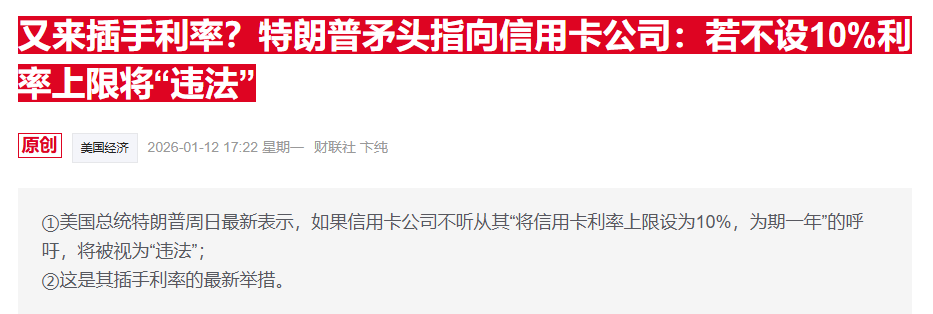
为保中期选举 特朗普向两种利率“下手”
Jin Rong Shi Bao· 2026-01-13 08:08
Core Viewpoint - The Trump administration is exerting pressure on the Federal Reserve to lower interest rates, which is seen as a challenge to the Fed's independence and reflects the political pressures ahead of the 2026 midterm elections [1] Group 1: Economic Context - The upcoming 2026 midterm elections are critical for the Trump administration, as a loss for the Republican Party could alter the balance of power in Congress, impacting policy implementation and Trump's political future [1] - Rising living costs are increasing public concern about the future, with a New York Fed survey indicating a worsening perception of credit access among households compared to the previous year [1] - The probability of consumers being unable to make minimum debt payments in the next three months has risen by 1.6 percentage points to 15.3%, the highest level since April 2020, particularly affecting older individuals, those with lower education, and households earning under $50,000 annually [1] Group 2: Policy Measures - The Trump administration is focusing on improving consumer debt affordability, with Trump proposing a cap on credit card interest rates at 10% for one year starting January 20, despite lacking legal support for this measure [2] - Trump's call for a credit card interest rate cap has faced criticism, with concerns that it could lead to credit card companies withdrawing services, forcing consumers to seek high-interest loans [2] - Additionally, Trump has requested Fannie Mae and Freddie Mac to purchase $200 billion in mortgage-backed securities to lower interest rates and monthly payments, indicating direct intervention in financial markets [3] Group 3: Market Implications - The administration's strategy of targeting credit card and mortgage rates is seen as a more immediate approach compared to influencing the federal funds rate, which has seen limited adjustments by the Fed [4] - The effectiveness of Trump's request for Fannie Mae and Freddie Mac to buy mortgage bonds in genuinely reducing mortgage burdens remains uncertain, as mortgage rates typically follow the trends of long-term U.S. Treasury yields [4]
穆迪首席经济学家称特朗普可负担性政策将推高房价:忽视了基本的经济学
Xin Lang Cai Jing· 2026-01-13 07:31
Core Viewpoint - Moody's Chief Economist Mark Zandi warns that President Trump's directive for Fannie Mae and Freddie Mac to purchase $200 billion in mortgage-backed securities may backfire, leading to increased home prices rather than addressing the severe housing affordability issue in the U.S. [1][5] Group 1: Economic Implications - Trump's claim that the directive will restore affordability and the "American Dream" by lowering monthly payments is criticized by Zandi as ignoring basic economics [1][5] - Following the directive, U.S. fixed mortgage rates fell by 10-20 basis points to just above 6%, but Zandi cautions that this relief is misleading [6] - Zandi believes that while lower rates may support housing demand, the severe housing shortage means that this stimulus will likely lead to rising home prices under unchanged conditions [6] Group 2: Federal Reserve Conflict - Zandi highlights a deeper institutional conflict related to the Federal Reserve, noting that despite the Fed's return to quantitative easing in December, it still allows for early payments and maturities of its mortgage-backed securities (MBS) [6][7] - The directive for government-sponsored enterprises (GSEs) to purchase these bonds effectively undermines the Fed's efforts to manage its mortgage portfolio [7] Group 3: Historical Context and Risks - Zandi questions the overreach of executive power in monetary policy, suggesting that it is more concerning than market mechanisms [3][7] - He warns that the re-expansion of Fannie Mae and Freddie Mac's balance sheets, which Trump touts as a great decision, poses a dangerous regression [3][7] - Zandi expresses concern that the principal limits imposed on these institutions after the 2008 financial crisis are gradually eroding, which could lead them back to their pre-crisis role as "giant hedge funds" [4][7]
华尔街警报:特朗普与美联储“开战”或推高利率,市场面临失控风险
Xin Lang Cai Jing· 2026-01-12 23:48
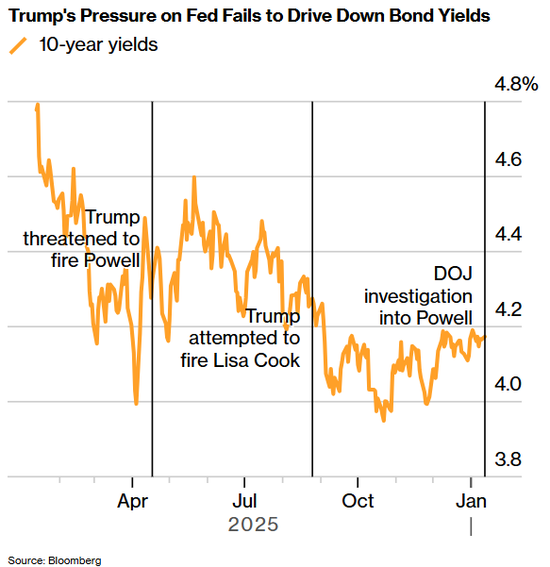
Core Viewpoint - The pressure exerted by Trump on the Federal Reserve threatens its independence, which contradicts his goal of lowering interest rates, injecting significant new risks into the financial markets [1][4][11]. Group 1: Impact on Financial Markets - Investment managers from major bond firms warn that Trump's attacks on the Fed's independence could undermine its credibility in combating inflation, leading to higher U.S. Treasury yields and increased costs for mortgages and corporate loans [1][4]. - The 10-year U.S. Treasury yield has remained around 4.2%, despite the Fed resuming rate cuts, which has become a source of frustration for Trump [4][12]. - The market's reaction indicates a belief that legal and political processes are strong enough to protect the Fed from government pressure, with only a slight increase in long-term yields observed [13][15]. Group 2: Political Dynamics and Fed Independence - Trump's attempts to pressure the Fed include urging more aggressive rate cuts and attempting to dismiss a Fed governor, reflecting a broader strategy to influence monetary policy [12][14]. - The recent threats against Fed Chair Jerome Powell have been viewed as a potential retaliation against the Fed's rate decisions, raising concerns about the Fed's independence [4][14]. - Analysts suggest that any perceived threat to the Fed's independence could lead to unexpected consequences, including higher interest rates in the long run [16][17]. Group 3: Market Sentiment and Future Expectations - Despite the political tensions, investors seem to welcome Powell's commitment to maintaining the Fed's independence, which is seen as crucial for financial stability [13][14]. - Market participants continue to expect only two rate cuts of 25 basis points each this year, indicating a stable outlook despite the political pressures [14]. - The bond market's resilience suggests that buyers are willing to engage at appropriate levels, viewing slight yield increases as constructive rather than alarming [14].