Xin Lang Ji Jin

Search documents
思源电气股价涨5.13%,华富基金旗下1只基金重仓,持有2600股浮盈赚取2.51万元
Xin Lang Ji Jin· 2026-02-09 02:21
华富中小企业100指数增强型(410010)基金经理为李孝华。 截至发稿,李孝华累计任职时间4年280天,现任基金资产总规模104.37亿元,任职期间最佳基金回报 149.62%, 任职期间最差基金回报-16.89%。 声明:市场有风险,投资需谨慎。 本文基于第三方数据库自动发布,不代表新浪财经观点,任何在本 文出现的信息均只作为参考,不构成个人投资建议。如有出入请以实际公告为准。如有疑问,请联系 biz@staff.sina.com.cn。 责任编辑:小浪快报 2月9日,思源电气涨5.13%,截至发稿,报197.64元/股,成交9.67亿元,换手率0.81%,总市值1545.66 亿元。 资料显示,思源电气股份有限公司位于上海市闵行区华宁路3399号,成立日期1993年12月2日,上市日 期2004年8月5日,公司主营业务涉及输变电设备的研发、生产、销售及服务。主营业务收入构成为:输 配电设备行业99.47%,汽车电子电器0.53%。 从基金十大重仓股角度 数据显示,华富基金旗下1只基金重仓思源电气。华富中小企业100指数增强型(410010)四季度减持 400股,持有股数2600股,占基金净值比例为5.3 ...

华工科技股价涨5.02%,国泰基金旗下1只基金重仓,持有165.9万股浮盈赚取615.47万元
Xin Lang Ji Jin· 2026-02-09 02:14
Group 1 - Huagong Technology Co., Ltd. experienced a stock price increase of 5.02%, reaching 77.63 CNY per share, with a trading volume of 1.791 billion CNY and a turnover rate of 2.33%, resulting in a total market capitalization of 78.057 billion CNY [1] - The company, established on July 28, 1999, and listed on June 8, 2000, is located in Wuhan, Hubei Province, and specializes in laser technology, including laser processing equipment, holographic anti-counterfeiting products, optical devices, and electronic components [1] - The revenue composition of Huagong Technology includes: 49.08% from optoelectronic devices, 25.46% from sensitive components, 21.97% from laser processing equipment and intelligent manufacturing lines, 2.77% from holographic film products, and 0.72% from leasing and other services [1] Group 2 - Guotai Fund has a significant holding in Huagong Technology, with the Guotai CSI Machine Tool ETF (159667) reducing its stake by 634,700 shares in the fourth quarter, now holding 1.659 million shares, which constitutes 14.14% of the fund's net value, making it the largest holding [2] - The Guotai CSI Machine Tool ETF (159667) was established on October 12, 2022, with a current size of 930 million CNY, yielding a return of 7.85% year-to-date, ranking 866 out of 5,579 in its category; over the past year, it achieved a return of 57.71%, ranking 428 out of 4,289 [2] - The fund manager, Miao Mengyu, has been in the position for 4 years and 136 days, overseeing total assets of 8.146 billion CNY, with the best fund return during the tenure being 75.57% and the worst being -39.92% [2]

赛微电子股价涨5.28%,国寿安保基金旗下1只基金重仓,持有7.3万股浮盈赚取19.34万元
Xin Lang Ji Jin· 2026-02-09 02:12
截至发稿,李康累计任职时间10年330天,现任基金资产总规模85.87亿元,任职期间最佳基金回报 57.1%, 任职期间最差基金回报-48.35%。 从基金十大重仓股角度 数据显示,国寿安保基金旗下1只基金重仓赛微电子。国寿安保创精选88ETF(159804)四季度持有股 数7.3万股,占基金净值比例为2.93%,位居第二大重仓股。根据测算,今日浮盈赚取约19.34万元。 国寿安保创精选88ETF(159804)成立日期2020年3月4日,最新规模1.39亿。今年以来收益3.93%,同 类排名2427/5579;近一年收益31.28%,同类排名2035/4289;成立以来收益54.21%。 国寿安保创精选88ETF(159804)基金经理为李康、苏天醒。 2月9日,赛微电子涨5.28%,截至发稿,报52.87元/股,成交9.36亿元,换手率3.01%,总市值387.12亿 元。 资料显示,北京赛微电子股份有限公司位于北京市西城区裕民路18号北环中心A座2607室(德胜园区),北 京市北京经济技术开发区科创八街21号院1号楼,成立日期2008年5月15日,上市日期2015年5月14日, 公司主营业务涉及MEMS ...

天合光能股价涨5.35%,易方达基金旗下1只基金位居十大流通股东,持有4726.24万股浮盈赚取5246.12万元
Xin Lang Ji Jin· 2026-02-09 01:56
2月9日,天合光能涨5.35%,截至发稿,报21.85元/股,成交5.81亿元,换手率1.16%,总市值511.85亿 元。 资料显示,天合光能股份有限公司位于江苏省常州市新北区天合光伏产业园天合路2号,成立日期1997 年12月26日,上市日期2020年6月10日,公司主营业务涉及光伏产品、光伏系统、智慧能源三大板块。 光伏产品包括单、多晶的硅基光伏组件的研发、生产和销售;光伏系统包括电站业务及系统产品业务;智 慧能源包括光伏发电及运维服务、智能微网及多能系统的开发和销售以及能源云平台运营等业务。主营 业务收入构成为:光伏产品64.66%,系统解决方案21.23%,其他(补充)5.54%,数字能源服务4.42%,储 能业务4.14%。 从基金十大重仓股角度 数据显示,易方达基金旗下1只基金重仓天合光能。易方达上证科创板新能源ETF(589960)四季度持 有股数90.79万股,占基金净值比例为6.05%,位居第三大重仓股。根据测算,今日浮盈赚取约100.78万 元。 易方达上证科创板新能源ETF(589960)成立日期2025年9月10日,最新规模2.49亿。今年以来收益 15.71%,同类排名66/557 ...

蓝色光标股价涨5.11%,国泰基金旗下1只基金重仓,持有156.66万股浮盈赚取151.96万元
Xin Lang Ji Jin· 2026-02-09 01:44
数据显示,国泰基金旗下1只基金重仓蓝色光标。国泰创业板人工智能ETF(159388)四季度持有股数 156.66万股,占基金净值比例为3.16%,位居第四大重仓股。根据测算,今日浮盈赚取约151.96万元。 国泰创业板人工智能ETF(159388)成立日期2025年3月26日,最新规模5.72亿。今年以来收益6.57%, 同类排名1363/5579;成立以来收益115.92%。 2月9日,蓝色光标涨5.11%,截至发稿,报19.94元/股,成交5.52亿元,换手率0.80%,总市值715.89亿 元。 资料显示,北京蓝色光标数据科技集团股份有限公司位于北京市朝阳区酒仙桥北路9号恒通国际创新园 C9-C,香港铜锣湾希慎道33号利园1期19楼1920室,成立日期2002年11月4日,上市日期2010年2月26日, 公司主营业务涉及整合数字营销、公共关系、广告创意策划及媒体代理、活动管理以及国际传播业务。 主营业务收入构成为:出海广告投放83.45%,全案推广服务11.32%,全案广告代理5.22%。 从基金十大重仓股角度 截至发稿,麻绎文累计任职时间2年187天,现任基金资产总规模136.57亿元,任职期间最佳基 ...

昆仑万维股价涨7.66%,诺安基金旗下1只基金重仓,持有178.96万股浮盈赚取751.63万元
Xin Lang Ji Jin· 2026-02-09 01:43
Group 1 - The core point of the news is that Kunlun Wanwei's stock price increased by 7.66% to 59.00 CNY per share, with a trading volume of 396 million CNY and a turnover rate of 0.54%, resulting in a total market capitalization of 74.066 billion CNY [1] - Kunlun Wanwei Technology Co., Ltd. was established on March 27, 2008, and listed on January 21, 2015. The company is based in Beijing and primarily engages in comprehensive internet value-added services and new energy investment [1] - The revenue composition of Kunlun Wanwei includes: 38.37% from online advertising, 18.51% from Opera search, 15.61% from short drama platforms, 13.92% from overseas social networks, 6.40% from gaming, 4.27% from casual social entertainment platforms, 1.75% from AI software technology, and 1.16% from other businesses [1] Group 2 - From the perspective of major fund holdings, one fund under Nuoan Fund has a significant position in Kunlun Wanwei. The Nuoan Active Return Mixed A Fund (001706) reduced its holdings by 438,900 shares in the fourth quarter, now holding 1.7896 million shares, which represents 4.31% of the fund's net value, making it the sixth-largest holding [2] - The Nuoan Active Return Mixed A Fund was established on September 22, 2016, with a current scale of 979 million CNY. Year-to-date, it has achieved a return of 10.46%, ranking 710 out of 8994 in its category; over the past year, it has incurred a loss of 2%, ranking 8106 out of 8194; since inception, it has returned 120.8% [2] - The fund manager of Nuoan Active Return Mixed A Fund is Liu Huiying, who has been in the position for 3 years and 192 days. The total asset scale of the fund is 19.259 billion CNY, with the best return during her tenure being 93.21% and the worst being 24.81% [3]

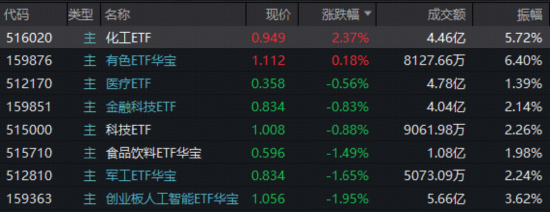
冰火两重天!化工、有色强者恒强,科技股延续低迷,资金去向何方?
Xin Lang Ji Jin· 2026-02-08 12:14
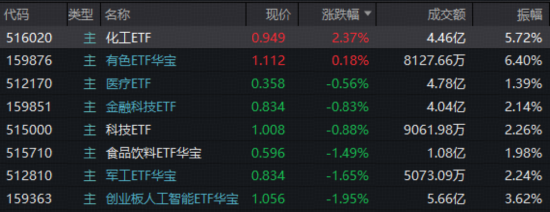
Market Overview - A-shares experienced volatility on February 6, with the Shanghai Composite Index closing down 0.25% at 4065.58 points, and the ChiNext Index down 0.73% [1] - The overall market turnover decreased to 2.16 trillion yuan, marking a continuous six-day decline in trading volume [1] Sector Performance - The chemical and new energy sectors led the market, while the pharmaceutical sector showed relative resilience. Consumer goods experienced a pullback, and technology continued to be sluggish [1] - The chemical ETF (516020) saw a significant inflow of 199 billion yuan, with a daily gain of 2.37% after reaching a peak increase of 3.45% during the day [2][5][6][8] Chemical Sector Insights - The chemical sector is experiencing a strong upward cycle, driven by increased demand for lithium batteries and key chemical materials [9][10] - Major stocks in the chemical sector, such as Enjie Co., Ltd. and Zhejiang Longsheng, saw significant gains, with some stocks rising over 6% [6][9] Non-Ferrous Metals Sector - The non-ferrous metals sector demonstrated resilience, with the non-ferrous ETF (159876) reversing early losses to close slightly up by 0.18% despite fluctuations in international gold prices [3][11] - Over 100 billion yuan of main funds flowed into the non-ferrous metals sector, indicating strong investor interest [11] Hong Kong Market Dynamics - The Hong Kong market experienced a downward trend, with the Hang Seng Index and Hang Seng Tech Index both closing down over 1% [3] - Despite the overall decline, there was significant buying activity from southbound funds, with purchases reaching 133.7 billion HKD, 249.8 billion HKD, and 148.6 billion HKD over three days [4] Pharmaceutical Sector Developments - The Hong Kong pharmaceutical sector showed signs of recovery, with the innovative drug ETF (520880) rising by 2% during the day, driven by strong earnings forecasts from key companies [15][16] - Notable performers included Innovent Biologics, which projected a revenue increase of approximately 134% by 2025, and several other companies expecting significant profit growth [16][18] Investment Opportunities - Analysts suggest that the chemical sector remains a promising investment opportunity, particularly in leading companies and price recovery products [10][22] - For investors looking to capitalize on the pharmaceutical sector, the innovative drug ETF (520880) and the medical ETF (159137) are recommended for their strong growth potential and coverage of key industry players [21][22]

黄金大反攻!有色ETF华宝(159876)最高上探1.5%,此前两日吸金4093万元!机构:供应+需求+库存出现转折
Xin Lang Ji Jin· 2026-02-08 12:09
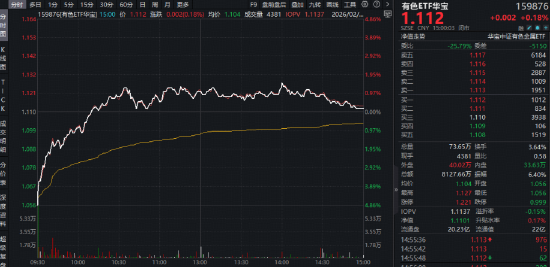
Core Viewpoint - The escalation of geopolitical tensions between the US and Iran has led to a significant increase in gold prices, with spot gold rising above $4900 per ounce, benefiting the non-ferrous metal sector and related ETFs [1][3]. Group 1: Market Performance - The non-ferrous ETF Huabao (159876) saw a maximum intraday increase of 1.53%, ultimately closing up 0.18%, indicating resilience in the market [1]. - Over 10 billion yuan of main capital has flowed into the non-ferrous metal sector, with Huabao ETF attracting 40.93 million yuan in the previous two days [1]. - Key stocks in the sector include Hunan Gold, which surged over 9%, Shengxin Lithium Energy up over 6%, and Guocheng Mining rising over 5% [1]. Group 2: Geopolitical and Economic Factors - The US-Iran geopolitical situation has intensified, with Iran warning it can easily access US military bases, prompting the US to advise its citizens to leave Iran [3]. - Recent US employment data fell short of expectations, increasing speculation about potential interest rate cuts by the Federal Reserve, which is favorable for gold prices [3]. Group 3: Supply and Demand Dynamics - According to Citic Futures, the short-term outlook for precious metals is mixed due to fluctuating investor expectations regarding Federal Reserve policies, but pre-holiday stocking demand may support prices [3]. - Guojin Securities highlights significant changes in the fundamentals of non-ferrous metals, with supply, demand, and inventory all undergoing important shifts [3]. - National Securities predicts that the combination of supply-demand mismatch, macroeconomic easing, and industrial upgrades will sustain high profitability in the non-ferrous sector for 3-5 years [3]. Group 4: Investment Strategies - The Huabao non-ferrous ETF and its linked funds cover a wide range of metals, including copper, aluminum, gold, rare earths, and lithium, making it an efficient tool for investors to gain exposure to the non-ferrous metal sector [4][5]. - It is suggested to allocate 10%-20% of investment portfolios to the non-ferrous metal sector to benefit from potential price increases while diversifying risk [3].
算力瓶颈催化确定性机会!创业板人工智能ETF周线回调或现“黄金买点”
Xin Lang Ji Jin· 2026-02-08 12:08
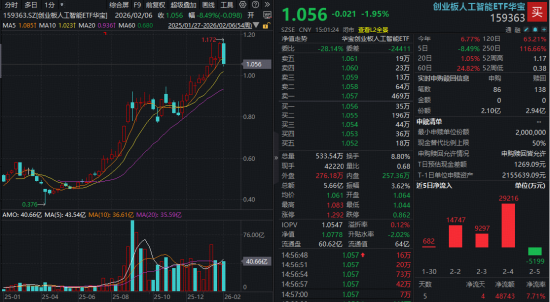
当AI发展正从算力建设转向应用落地,一键布局"算力+AI应用"的创业板人工智能ETF(159363)及场 外联接(A类023407、C类023408),更直接受益于AI技术商业化爆发的增长红利。从赛道看,创业板 人工智能约六成仓位布局算力(光模块龙头+IDC龙头),约四成仓位布局AI应用,不止是"算力"核 心,也是真正的"AI应用"代表。 周五(2月6日),A股缩量盘整,创业板人工智能午后翻绿收跌,算力、AI应用双双走低。成份股大面 积飘绿,AI应用龙头昆仑万维领跌超7%,光模块龙头新易盛下跌5%,中际旭创下跌4%;IDC算力租赁 方向相对活跃,铜牛信息、奥飞数据盘中均拉升超5%。 热门ETF方面,双线布局"算力+AI应用"的创业板人工智能ETF(159363)场内收跌1.95%,日线三连 跌,单日缩量成交5.66亿元。单周来看,科技风格回调明显,创业板人工智能ETF(159363)周线十连 阳后首阴,短期调整或属正常技术回踩,中长期产业趋势未变,可关注逢跌布局机会。 IDC算力租赁方面,千问APP因春节活动高峰出现服务卡顿,暴露算力瓶颈,国产算力机会显现!消息 面上,据智通财经报道,阿里千问APP"春节30 ...

多空激战!有色韧性凸显,化工逆市冲锋,516020冲高3.45%!港股抄底时刻到了?南向资金连续3日百亿级爆买
Xin Lang Ji Jin· 2026-02-06 09:46
Market Overview - A-shares experienced volatility on February 6, with the Shanghai Composite Index closing down 0.25% at 4065.58 points, and the ChiNext Index down 0.73% [1] - The overall market turnover decreased to 2.16 trillion yuan, marking a continuous six-day decline in trading volume [1] Sector Performance - The chemical and new energy sectors led the market, while the pharmaceutical sector showed relative resilience. Consumer goods experienced a pullback, and technology continued to be sluggish [1] - The chemical ETF (516020) saw a significant inflow of 199 billion yuan, with a daily gain of 2.37% after reaching a peak increase of 3.45% during the day [2][5][6][8] Chemical Sector Insights - The chemical sector is experiencing a strong upward cycle, driven by increased demand for lithium batteries and phosphorous chemicals, with key materials seeing a surge in prices [9][10] - Major stocks in the chemical sector, such as Enjie Co., Ltd. and Zhejiang Longsheng, reported significant gains, with some stocks rising over 6% [6][8] Non-Ferrous Metals Sector - The non-ferrous metals ETF (159876) demonstrated resilience, closing up 0.18% despite initial declines, supported by over 100 billion yuan in inflows [3][11] - The sector is expected to maintain high profitability over the next 3-5 years, driven by supply-demand dynamics and macroeconomic conditions [11] Hong Kong Market Dynamics - The Hong Kong market saw a significant influx of southbound capital, with purchases reaching 133.7 billion HKD, 249.8 billion HKD, and 148.6 billion HKD over three days [4] - The pharmaceutical sector in Hong Kong showed signs of recovery, with the Hong Kong Innovation Drug ETF (520880) rising by 2% during the day, driven by strong earnings forecasts from key companies [15][16] Investment Opportunities - Analysts suggest focusing on leading companies in the chemical sector and those benefiting from rising prices, with recommendations to invest through the chemical ETF (516020) for higher efficiency [10][21] - The Hong Kong Innovation Drug ETF (520880) and the Hong Kong Medical ETF (159137) are highlighted as attractive options for investors looking to capitalize on the pharmaceutical sector's growth [20][21]