Tai Mei Ti A P P

Search documents
阿福和灵光,能承载蚂蚁的TO C野心吗?
Tai Mei Ti A P P· 2025-12-23 12:10
Core Insights - Ant Group is attempting to establish a second consumer-facing entry point beyond Alipay in the AI era, with the launch of AI health application "Ant Afu" and general AI assistant "Lingguang" [1][2][22] - The company is focusing on two distinct paths: deepening its presence in the high-barrier health sector and entering the competitive general AI assistant market with differentiated features [2][22] Ant Afu: AI and Health - Ant Afu aims to leverage Ant Group's decade-long experience in the health sector, having built a service network covering 800 million medical insurance users and over 30,000 doctors [3][7] - The app has achieved over 15 million monthly active users within six months of launch, with a compound growth rate of 83.4%, significantly surpassing the industry average of 13.5% [7][22] - A notable 55% of health inquiries come from third-tier cities, indicating a significant market opportunity due to uneven healthcare resource distribution [7][22] - However, the health sector has inherent limitations, including low-frequency usage and challenges in maintaining user engagement [8][9][22] Lingguang: General AI Assistant - Lingguang was launched as a general AI assistant with a focus on "flash applications," allowing users to generate applications quickly [13][15] - The app saw over 2 million downloads within six days and generated 3.3 million "flash applications" in two weeks [15][16] - Despite initial popularity, user retention poses a challenge, with feedback indicating that generated applications are often simplistic and not fully functional [19][20][21] - Lingguang's reliance on Ant Group's ecosystem limits its adaptability to other platforms, which may hinder its growth potential [20][22] Competitive Landscape and Strategic Positioning - Ant Group's strategy reflects a shift to independent applications outside of Alipay, aiming to capture users in new scenarios [22][23] - The competitive landscape is intensifying, with major players like ByteDance and Tencent also launching their AI applications, making it challenging for Lingguang to carve out a niche [23][24] - The health management sector, while presenting high barriers, also has a clear ceiling in terms of user engagement, necessitating a focus on building user loyalty over time [23][24] Future Outlook - Ant Group's dual approach of targeting both general and vertical markets aims to maintain relevance in the AI space while establishing a competitive edge [24][27] - The success of Ant Afu and Lingguang will ultimately depend on their ability to address core user needs effectively, rather than just technological capabilities [27]


进击的无招,进化的钉钉
Tai Mei Ti A P P· 2025-12-23 09:40
Core Insights - The core idea of the news is the transformation of DingTalk under the leadership of its founder, Wu Zhao, who is redefining the product to be AI-centric, moving from a human-centric approach to one that integrates AI and agents into the workflow [4][21][36] Group 1: Product Transformation - DingTalk has launched AI DingTalk 1.1, which includes over 20 new AI products and features, marking a significant shift in its product strategy [4][36] - The new positioning of DingTalk as "Agent OS" signifies a fundamental change in how the platform will operate, focusing on AI and agents rather than just serving human users [4][21] - The transition from the old DingTalk to the new version is likened to biological evolution, where the platform is undergoing a transformation akin to a tadpole becoming a frog [5][8] Group 2: Organizational Changes - The team structure has been redefined into smaller groups of 5-7 members, fostering innovation in specific scenarios using AI [9][10] - DingTalk mandates that at least 30% of the code must be AI-generated, emphasizing a shift in development practices [9][10] - The organization is encouraged to adopt an entrepreneurial mindset, with a focus on AI-driven innovation [7][9] Group 3: AI Integration - The new AI-driven approach aims to redefine the relationship between humans, AI, and information, with a goal of minimizing direct human interaction with information flows [21][24] - The concept of "Agent OS" is designed to connect AI with the physical world, allowing for autonomous decision-making by AI agents [21][22] - The introduction of a runtime environment for agents within enterprises is crucial for ensuring that AI operates within defined boundaries and permissions [14][15][37] Group 4: Market Positioning - DingTalk aims to leverage the AI revolution to redefine work processes, similar to how previous technological advancements have shaped industries [36][37] - The company is positioning itself to capitalize on the opportunity to define the future of work in the AI era, moving away from being merely a SaaS provider [34][36] - The launch of the Real hardware and software ecosystem is expected to facilitate the deployment of AI solutions within enterprises, breaking down previous barriers to AI integration [37]

给AI接上专有知识库:RAG的工程化实现
Tai Mei Ti A P P· 2025-12-23 07:09
Core Insights - The article discusses the limitations of general AI models in corporate settings and introduces the concept of Retrieval-Augmented Generation (RAG) as a solution to integrate proprietary knowledge into AI systems [3][4][23] - RAG aims to enhance the capabilities of general AI by providing it with access to internal company knowledge, thus transforming it from a general assistant to a specialized expert [22][23] Group 1: Limitations of General AI - General AI models have three critical shortcomings in enterprise applications: they lack access to proprietary knowledge, their knowledge becomes outdated quickly, and they may generate inaccurate information when uncertain [3][4][22] - These limitations lead to situations where AI provides irrelevant or incorrect answers, causing confusion among employees [4] Group 2: Value of RAG - RAG's core idea is to pair general AI with a "research assistant" that can efficiently retrieve relevant company information, ensuring that AI responses are based on accurate and up-to-date data [5][7] - The implementation of RAG addresses three major pain points for enterprises: it eliminates inaccuracies, allows for real-time knowledge updates without retraining the AI model, and enables AI to answer proprietary questions accurately [8][22] Group 3: Engineering Implementation of RAG - RAG requires a structured engineering framework consisting of a "two-way data flow pipeline" that includes offline knowledge preparation and online question-answering capabilities [9][19] - The implementation involves three stages: index construction to organize internal knowledge, retrieval enhancement to accurately locate relevant information, and output generation to produce high-quality answers based on retrieved data [10][12][15] Group 4: Management Challenges - The successful implementation of RAG necessitates a deep management transformation within companies, focusing on knowledge management, business adaptation, and ongoing operations [19][21] - Companies must establish a clear knowledge management system to ensure the quality of the knowledge base, addressing issues like knowledge fragmentation, version control, and responsibility assignment [19] - Continuous operation of RAG is essential, requiring regular updates to the knowledge base, user feedback mechanisms, and a system for evaluating the effectiveness of RAG [21][22] Group 5: Conclusion on RAG's Necessity - RAG is not a panacea but is essential for companies looking to leverage AI effectively, as it enhances AI's ability to provide accurate, context-aware responses [22][23] - By integrating proprietary knowledge, RAG transforms AI into a valuable internal resource, enabling companies to harness AI's potential for improved productivity and decision-making [23]
百度慧播星获评钛媒体2025 EDGE AWARDS「最佳AI创新应用」
Tai Mei Ti A P P· 2025-12-23 06:17
Group 1 - The core viewpoint of the article highlights that Baidu's Huibo Star has been recognized in the 2025 EDGE AWARDS global innovation selection as the best AI innovation application [1] Group 2 - Huibo Star is described as a next-generation digital human with high persuasive power, functioning as a multi-agent system capable of thinking, decision-making, and execution [3] - It supports core functionalities such as digital human image generation, intelligent script creation, and real-time interactive Q&A, while also possessing emotional interaction traits and the ability to track hot topics [3] - The system enables businesses to create live broadcasts and short videos at lower costs, thereby enhancing operational efficiency [3] Group 3 - Huibo Star has demonstrated performance that surpasses real humans in various business scenarios, including e-commerce transactions, lead expansion, content live streaming, and video creation [4]

快手遭黑产攻击瘫痪,“自动化攻击” 时代网络安全怎么做?
Tai Mei Ti A P P· 2025-12-23 02:35
12月22日22时许,国内知名短视频平台快手遭遇黑灰产猛烈攻击。在短短60到90分钟内,黑客组织通过 技术手段侵入快手系统,导致整个平台安全体系陷入瘫痪。攻击者利用约1.7万个僵尸账号开设直播 间,大量播放包含色情、暴力、恐怖等违规内容,有的直播间单场观看量甚至逼近10万人。 值得注意的是,这些直播中还隐藏着病毒链接。许多用户点入后,微信账号即被盗取,不法分子随即向 账号好友发送借款请求,实施诈骗。目前快手平台已紧急关闭和下架绝大多数直播内容,但事件造成的 用户隐私泄露和财产损失已难以挽回。平台方提醒用户保持警惕,切勿轻信异常链接,防止上当受骗。 从22时左右异常初现,到大量违规内容刷屏直播间,再到平台紧急启动最高级别应急响应,这场持续近 两小时的网络攻防战,不仅短暂打乱了平台的正常运营节奏,更将短视频行业的安全防御困境再次推向 公众视野。 事件还原 不同于传统网络攻击的"瞬间瘫痪",此次针对快手的攻击呈现出"精准突袭、梯次推进"的特征,从用户 感知异常到平台完成核心防御,形成了清晰的时间线脉络。结合快手官方通报、用户反馈及行业监测数 据,此次事件的关键节点可精准梳理为四个阶段。 第一阶段为预警潜伏期(大概在 ...

H200春节前重返中国,黄仁勋有多少胜算?
Tai Mei Ti A P P· 2025-12-23 02:35
Core Viewpoint - Nvidia aims to export H200 chips to China before February 17, 2024, with an expected initial shipment of 40,000 to 80,000 units, primarily from inventory capacity [2][3] Group 1: Export Plans and Market Dynamics - Nvidia plans to increase production of H200 chips to supply the Chinese market in Q2 2024 [2] - The export of H200 chips to China is subject to significant uncertainty, as there is currently no approval from Chinese authorities for any related procurement [3] - Following the announcement by Trump allowing Nvidia to export H200 chips to China, the company must pay 25% of sales proceeds to the U.S. government [3][4] Group 2: Regulatory Environment and Challenges - The U.S. government has initiated a review process for the export of H200 chips, which may take up to 30 days, with Trump holding the final decision-making power [4] - There is opposition within the U.S. Congress regarding the export, with calls for more transparency on whether the chips could be used for military purposes [6] - Concerns about "backdoor" security risks have been raised, with previous incidents involving Nvidia's H20 chip [6][9] Group 3: Market Demand and Competition - Major Chinese tech companies like Alibaba, ByteDance, and Tencent are expected to be the first buyers of H200 chips, indicating strong demand in the AI infrastructure sector [7] - Despite the potential for Nvidia's return to the Chinese market, domestic chip manufacturers are rapidly improving their capabilities, posing a competitive threat [9] - AMD and Intel are also targeting the Chinese market, with AMD having already secured export licenses for its AI chips [10][11] Group 4: Financial Implications - The estimated sales revenue from the initial shipment of H200 chips could range from $1 billion to $4 billion, considering the market price and the required tax [8] - Nvidia's previous quarterly revenue from the Chinese market was significantly lower, indicating challenges in regaining market share [8]

越南2025年电商规模将达310亿美元;Temu跃居英国电商访问量第三;今年全球玩具与游戏销售额达2870亿美元|一周出海参考
Tai Mei Ti A P P· 2025-12-23 02:35
Group 1 - The Singapore-China Joint Cooperation Committee achieved a record 27 agreements during its 21st meeting, highlighting a comprehensive partnership across various sectors including finance, technology, and cultural exchanges [1] - Since 2015, the Singapore-China connectivity projects have signed 347 government and commercial cooperation projects totaling $26 billion, showcasing significant collaborative efforts [1] Group 2 - Vietnam's e-commerce sector is projected to reach $31 billion by 2025, with a growth rate exceeding 25%, making it one of the fastest-growing e-commerce markets globally [2] - The cross-border e-commerce market in Vietnam is expected to generate $4.1 billion in total online import and export value by 2024, with exports anticipated to grow by 18% to $2 billion by 2025 [2] Group 3 - Vietnam is set to reduce the special consumption tax on hybrid electric vehicles (HEVs) to 70% of the rate applied to gasoline and diesel vehicles starting January 1, 2026, which is expected to stimulate market growth [3] Group 4 - The Vietnamese government is enhancing regulations to combat plastic waste and promote sustainable packaging, with over 6,000 packaging companies transitioning to eco-friendly alternatives [4] Group 5 - Dubai has launched a new integrated R&D and Innovation ecosystem to accelerate innovation and strengthen global collaboration, managed by the Dubai Future Foundation [5] Group 6 - China's trade with Belt and Road Initiative countries exceeded 21 trillion yuan in the first 11 months of the year, accounting for over half of the country's total foreign trade [6] - Exports to Belt and Road countries grew by 11.3%, significantly outpacing overall export growth, driven by high-end manufacturing products like chips and electric vehicles [6] Group 7 - TikTok Shop has released a promotional calendar for Southeast Asia for 2026, following a record GMV increase of 2.7 times during the previous year's 12.12 sales event [7] Group 8 - ByteDance has signed agreements to establish a new entity in the U.S. for TikTok's operations, retaining a 19.9% stake while allowing Oracle and other investors to hold 50% [8] Group 9 - Shopee is launching a market expansion plan for Brunei starting January 2026, allowing Malaysian sellers to reach Bruneian customers without opening new stores [9] Group 10 - Shopee Philippines will adjust fees for certain activities starting January 1, 2026, increasing service fees for large coupon activities during promotional days [10] Group 11 - Temu has introduced its first official Shopify app, enabling merchants to manage products across over 30 markets, including the U.S. and Canada [11] Group 12 - Temu has become the third most visited e-commerce platform in the UK, with a monthly visit count of 28.4 million, significantly increasing its user base [12] Group 13 - Amazon has introduced a new "Prompts" feature in its advertising backend, designed to match relevant products to customer inquiries using AI [13] Group 14 - Lazada has fully launched its third-party fulfillment (3PF) logistics model in Vietnam, enhancing local delivery capabilities for cross-border sellers [14] Group 15 - The Russian e-commerce platform Megamarket reported that LEGO accounted for 85% of toy sales during the 2025 New Year gift season, indicating strong brand dominance [15] Group 16 - The global toy and game sales are projected to reach $287 billion by 2025, driven by nostalgia and high-value products, with Asia-Pacific being the largest market [16] Group 17 - The number of households in the UK using professional home security monitoring services is expected to grow by 31% by 2025, reflecting a shift towards smart technology for home safety [17] Group 18 - Guangzhou has successfully implemented a "tax refund upon departure" model for cross-border e-commerce, streamlining processes for businesses [18] Group 19 - SF International has signed a memorandum of cooperation with MSC Air Cargo to enhance international logistics services through multi-modal transport solutions [19] Group 20 - SF Middle East has signed a cooperation agreement with Asyad Group in Oman to strengthen cross-border transport and supply chain collaboration [20] Group 21 - Thailand will impose a 17% tax on all imported goods starting January 1, 2026, eliminating previous exemptions for low-value items [21] Group 22 - Malaysia will enforce new regulations on large social media platforms starting January 1, 2026, requiring them to register and comply with national security laws [22] Group 23 - Japan will implement significant changes to its cross-border market regulations in 2026, including the removal of tax exemptions for low-value imports and new compliance requirements for overseas platforms [23]



争夺“大模型第一股”,智谱向左、MiniMax向右
Tai Mei Ti A P P· 2025-12-23 01:50
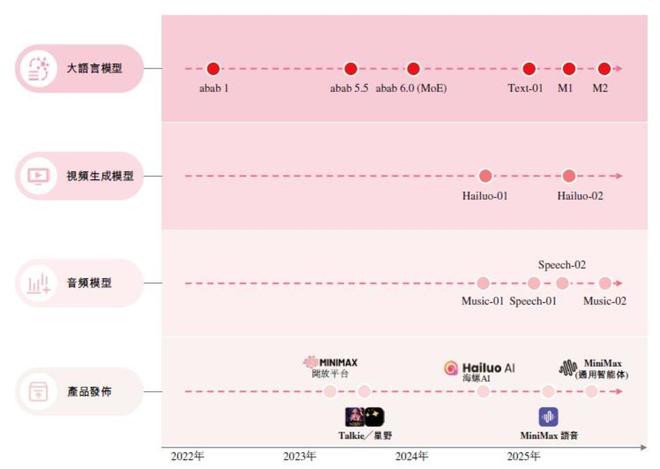
Core Insights - MiniMax, a company in the "big model" sector, has released its prospectus shortly after Zhipu AI, highlighting the financial data and potential risks of leading domestic AI companies [1][2] - MiniMax's revenue over the past three years is $87.42 million (approximately 620 million RMB), with a cumulative loss of $1.32 billion (approximately 929 million RMB), which is higher than Zhipu AI's losses [1][2] - The company emphasizes its multi-modal AI capabilities and a range of consumer-facing products, contrasting with Zhipu AI's focus on B2B clients [1][2] Financial Performance - MiniMax's revenue has shown rapid growth, increasing from $3.46 million in 2023 to $30.52 million in 2024, a year-on-year growth of 782.1%, and further rising to $53.44 million in the first nine months of 2025, a 174.8% increase from the previous year [9][12] - The revenue structure has shifted significantly, with consumer applications contributing 71.4% of total revenue in 2024, up from 21.9% in 2023 [11][12] - Despite revenue growth, MiniMax's net losses have also expanded, from $73.73 million in 2022 to $270 million in 2023, and projected to reach $470 million in 2024 [14][15] Business Model and Strategy - MiniMax adopts a "multi-modal + product-heavy" strategy, developing capabilities across text, voice, image, and video, aiming for a comprehensive AI solution [3][7] - The company has raised over $1.55 billion from prominent investors, allowing it to pursue multiple technology paths simultaneously [3][7] - MiniMax's core growth comes from AI-native applications rather than enterprise services, indicating a more diversified revenue approach compared to Zhipu AI [19][20] Market Position and Competition - MiniMax's user base has expanded significantly, with active users increasing from 3.1 million in 2023 to 19.1 million in 2024, and paid users growing from 120,000 to 650,000 in the same period [12][14] - The company faces competition from specialized players in various fields, such as ChatGPT in text generation and Midjourney in image generation, which increases operational complexity [8][20] - MiniMax's reliance on overseas markets is notable, with over 70% of its revenue coming from international sources, raising potential legal and operational risks [16][17] Comparative Analysis with Zhipu AI - Both MiniMax and Zhipu AI are experiencing rapid revenue growth and high R&D expenditures, but they differ in their monetization strategies, with MiniMax focusing on consumer applications and Zhipu AI on B2B services [18][24] - Zhipu AI's revenue model is more predictable, relying on high-margin enterprise deployments, while MiniMax's approach is riskier but offers higher growth potential [19][24] - The contrasting paths of these companies highlight the diverse strategies within the AI sector, suggesting that multiple business models may coexist in the market [24]
中签率0.032%、网下申购超4400倍,锡华科技凭什么被抢筹?
Tai Mei Ti A P P· 2025-12-22 23:24
Core Viewpoint - The wind power sector is experiencing a value reassessment opportunity driven by the "dual carbon" goals and supportive policies, with Xihua Technology's IPO serving as a significant indicator of market perception of wind power value [2] Group 1: IPO Performance - Xihua Technology's IPO saw a final online subscription rate of 0.03181828%, with over 13.85 million online subscriptions and a 4,400-fold effective offline subscription multiple, indicating strong market interest [2][3] - The offline issuance accounted for 30.63% of the total issuance after the strategic placement, while the online issuance made up 69.37% [3] - The pricing of Xihua Technology's shares was set at 10.10 yuan per share, corresponding to a 2024 diluted P/E ratio of 33.12, which is lower than the industry average of 43.21 [4] Group 2: Company Strengths - Xihua Technology has established a strong market position in the wind power gearbox casting sector, holding approximately 20% of the global market share in this niche [6] - The company has developed several core technologies in material research and processing, ensuring high product quality and reliability [6][7] - Xihua Technology's products are increasingly being adopted in large MW wind turbine applications, with sales of products rated at 7MW and above expected to rise from 31.71% in 2024 to 58.31% in 2025 [7] Group 3: Financial Performance - The company has maintained stable annual revenues exceeding 900 million yuan from 2022 to 2024, with projected revenue growth of 33.74% to 4.185 billion yuan in 2025 [8] - The net profit for the first half of 2025 is expected to reach 94.29 million yuan, reflecting a year-on-year growth of 55.67% [7][8] Group 4: Industry Outlook - The wind power industry is in a rapid growth phase, with global installed capacity expected to reach 117GW in 2024 and 194GW by 2030, indicating a compound annual growth rate of 7.05% [9] - Despite being the world's largest market for wind power installations, China's wind power generation accounts for only about 10% of total electricity generation, suggesting significant growth potential [10] Group 5: Strategic Initiatives - Xihua Technology plans to use IPO proceeds to enhance production capacity and invest in R&D, aiming to alleviate current capacity pressures and strengthen its market position [11][12] - The company's focus on core projects is expected to improve production efficiency and reinforce its competitive edge in the high-end equipment sector [11]

赵何娟对话张宏江:世界模型已是兵家必争之地|2025 T-EDGE全球对话
Tai Mei Ti A P P· 2025-12-22 14:52
Core Insights - The discussion highlights the transformative impact of AI, particularly the emergence of superintelligence, which may lead to job displacement [2][8] - The conversation emphasizes the high expectations surrounding world models and next-generation AI models, with significant investments being made in startups despite their early stages [4][20] - The debate around the sustainability of scaling laws in AI development is addressed, with experts suggesting that new paths must be explored beyond traditional scaling [19][20] Group 1: AI Development and Trends - The emergence of new AI startups in Silicon Valley has led to valuations reaching $4 billion to $5 billion, indicating strong market confidence in world models [4] - The scaling law, which has been a guiding principle in AI development, is believed to be reaching its limits, prompting calls for new technological pathways [19][20] - The efficiency of scaling laws has diminished over time, suggesting that while progress continues, it may not be as rapid as in previous years [19][20] Group 2: Competitive Landscape - The competition between Google and OpenAI is highlighted, with both companies having distinct advantages; however, it is too early to determine a clear winner [6][41] - The potential for coexistence of multiple systems in the AI era is discussed, drawing parallels to the PC and mobile internet eras [41] - The importance of execution and resource management in AI development is emphasized, particularly in relation to Google's full-stack capabilities [34] Group 3: Infrastructure and Investment - The current phase of AI development is characterized by significant infrastructure investments, including data centers and energy resources, which are essential for future growth [48][49] - Concerns about high debt levels in AI infrastructure investments are raised, with the need for a balance between investment and sustainable returns [50] - The analogy of AI infrastructure investments to historical infrastructure developments, such as railroads and electricity, is presented to argue against the notion of a bubble [48][49]