Tsingtao Brewery(00168)

Search documents
一瓶青岛啤酒的“低碳账本”
Zhong Guo Xin Wen Wang· 2025-06-06 02:16
以"生态思维"领创可持续效益 技术创新是推动发展方式绿色低碳转型的关键引擎。 6月5日是世界环境日,在青岛啤酒的智能化生产车间,青翠的玻璃瓶在生产线上叮叮当当,吸引众多游 客拍照打卡。"可别小瞧这些啤酒瓶,它们可跟普通玻璃瓶不同,被称作'轻量瓶'。"青岛啤酒厂包装车 间的工人告诉记者,在满足使用要求和保证产品质量的条件下,轻量瓶重量更轻、用料更少、更加环 保。 秉承"为了更美好的世界"环境理念,青岛啤酒加速推动啤酒制造的高端化、智能化、绿色化转型以及全 价值链的可持续发展,青啤集团目前已有25家工厂获得国家级绿色工厂荣誉称号,17家工厂成为无废工 厂,3家工厂获得碳中和认证。 从"一滴水到一度电"精准把控 王健是青岛啤酒(济南)有限公司能源管理工程部高级业务经理,每天早上8点,他上班第一件事就是将 过去一天工厂所用的能源分析数据分享在微信群。从一滴水到一度电再到一立方米天然气,一旦哪个指 标出现异常,就落实到人现场查核、及时整改。 作为青啤集团首批实现绿色电力采购的公司,青岛啤酒济南公司得益于绿色电力、光伏发电、生物质锅 炉等独特优势,连续两年单位产品碳排放强度位列制造工厂第一,也成为青啤集团首家实现碳中和的 ...

探智造之城 览山海风华——青岛上市公司深度调研
21世纪经济报道· 2025-06-05 08:06
Core Viewpoint - The article highlights an upcoming event in Qingdao focused on deep industry and capital dialogue, featuring visits to benchmark companies and showcasing their innovative strategies in the context of the IoT era and consumer engagement. Group 1: Event Details - The "Qingdao Listed Companies Deep Research" event is scheduled for June 10-12, lasting three days and two nights, organized by Nanfang Financial Education Base in collaboration with Stock Market Broadcasting and Investment Express [1][6]. Group 2: Company Insights - The first company is recognized as a global leader in smart home ecosystems and a benchmark for transformation in the IoT era, having led global retail sales of large home appliances for 14 consecutive years [2]. - The second company, a century-old brand, is exploring youth marketing strategies to engage Generation Z, evolving from traditional products like "calcium milk biscuits" to trendy items [3]. - The third company is noted for its 120-year brewing legacy, ranking as the fifth largest beer brand globally and leading the high-end beer market in China [4]. Group 3: Research Highlights - The event will include a visit to the "Ecological Interconnected Factory" to experience comprehensive smart home solutions and observe the transformation of traditional manufacturing into an open ecological platform [3]. - Participants will analyze the global layout of the brands "Haier + Casarte + Candy," which operate in nearly 200 countries, focusing on localized operational innovations [3]. - The event will feature a tour of the Qingdao Beer Museum, showcasing the transition from traditional brewing methods to intelligent production, along with a tasting of high-end product lines to understand the brand matrix and scene marketing strategies [5].

“青岛啤酒交易所”何以出圈?
Sou Hu Cai Jing· 2025-06-04 19:13
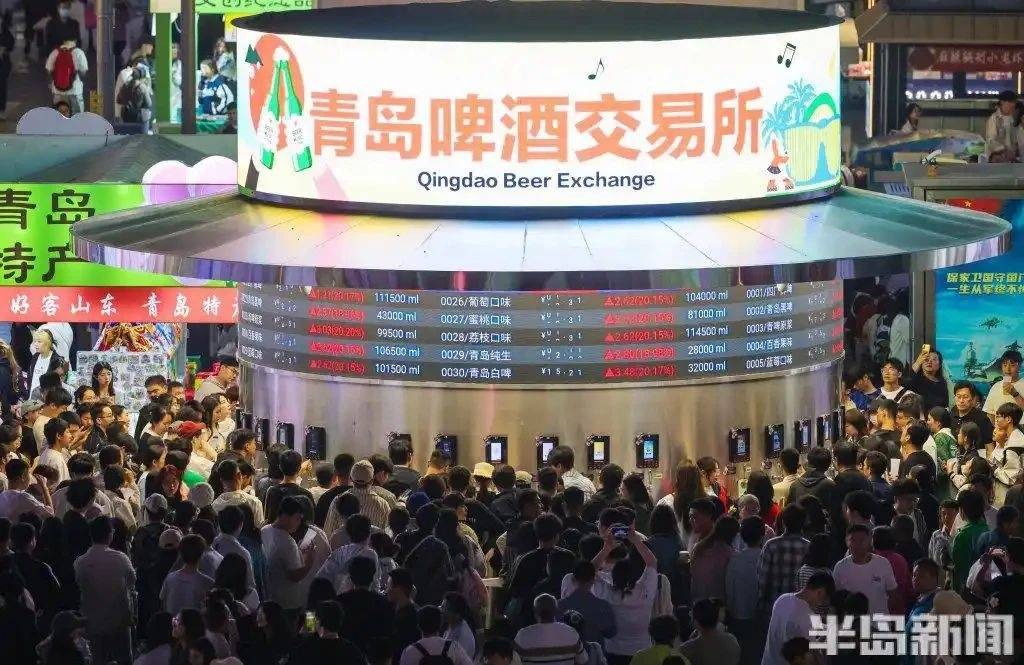
Core Insights - The "Qingdao Beer Exchange" has become a trending topic on social media, attracting over 10,000 daily visitors and selling more than 120,000 milliliters of beer in a single day during the Dragon Boat Festival holiday [1][2] Group 1: Concept and Features - The "Qingdao Beer Exchange" features a 3-meter tall, 360-degree smart beer column that allows consumers to purchase from 30 different types of beer, with real-time price fluctuations based on sales [1][2] - The exchange operates on a dynamic pricing mechanism that updates every 10 minutes, adjusting prices based on demand, similar to stock market trading [3][4] Group 2: Consumer Experience - Consumers engage in a unique, immersive experience where they act as "traders," influencing beer prices through their purchases, thus enhancing the overall enjoyment of the product [4] - The self-service model allows customers to select their beer and complete transactions via QR codes, creating an interactive and engaging environment [2][3] Group 3: Market Impact - The innovative concept not only revitalizes the local tourism and consumption market but also promotes a younger, more digital shopping experience, benefiting surrounding restaurants and cultural businesses [4]
上海汇正财经:啤酒行业进入旺季,助力夏季消费场景
Sou Hu Cai Jing· 2025-06-04 15:08
Group 1 - The peak season for beer production typically occurs from June to September due to increased demand for chilled beer in hot weather [1][3] - High temperatures significantly boost beer consumption, making the second and third quarters traditional sales peaks for the industry [3] - The Chinese beer industry has been undergoing a high-end upgrade since around 2018, shifting focus from market share to profitability, with leading companies enhancing their product offerings [4][5] Group 2 - In 2024, the overall beer consumption is expected to be weak, but the resilience of the industry remains, with leading companies still seeing profit levels increase despite a slowdown in growth rates [4][6] - Sales performance among leading beer brands varies, with some brands like Zhujiang Beer and Yanjing Beer showing positive growth while Qingdao Beer experiences a decline due to conservative marketing strategies [6][7] - The craft beer market in China is expanding rapidly, driven by a younger consumer base that values quality and unique experiences, with the market size expected to reach 11 billion yuan by 2028 [8] Group 3 - The beer industry is expected to recover in 2025, supported by improved consumer spending and favorable policies for the restaurant sector, which will positively impact beer sales [6][7] - The current low inventory levels and the approach of the beer consumption peak season present opportunities for investment in resilient companies with positive sales and pricing trends [9]
风评 | 端午小长假,火了“青交所”!
Sou Hu Cai Jing· 2025-06-04 14:34
Core Insights - The Qingdao Beer Exchange has gained significant popularity during the Dragon Boat Festival, merging local beer culture with modern financial symbols, appealing particularly to Generation Z consumers [2][6] - This innovative concept disrupts traditional commercial space logic, resembling a beer can-shaped vending machine with an LED screen displaying real-time beer prices and trading volumes, creating an engaging consumer experience [2][4] Industry Trends - The Qingdao Beer Exchange features over thirty types of beer, with prices fluctuating by up to 10%, providing a transparent and gamified consumption experience that resonates with younger consumers [4][6] - The integration of financial trading logic into the consumer space reflects a broader trend of experiential economy reshaping traditional retail environments [4][9] Market Performance - During the Dragon Boat Festival, the Qingdao Beer Exchange sold hundreds of barrels of beer, indicating strong consumer interest and engagement [6] - The Taidong Pedestrian Street, where the exchange is located, has seen significant foot traffic, with 2.245 million visitors during the Qingming and May Day holidays, and projected annual traffic of 110 million in 2024 [7] Cultural Significance - The Qingdao Beer Exchange not only serves beer but also embodies the cultural identity of Qingdao, transforming material consumption into a spiritual experience that reflects the city's character [9] - The success of the Qingdao Beer Exchange is a result of multi-dimensional synergy between industrial upgrades, cultural innovation, and urban governance, showcasing the city's evolution in the experience economy era [9]
中国必选消费6月投资策略:布局“高股息+基本面改善”的股票
Haitong Securities International· 2025-06-04 11:20
Investment Focus - The report emphasizes the strategy of investing in stocks with high dividends and improved fundamentals, particularly in the essential consumer sector [1][6] - Key stocks recommended for investment include Kweichow Moutai, Wuliangye, and Yili, all rated as "Outperform" [1] Industry Overview - In May 2025, six out of eight tracked industries maintained positive growth, with the restaurant sector growing by 3.7%, beer by 3.3%, and soft drinks by 3.1% [3][8] - The industries experiencing negative growth include mass-market and above mid-range liquor, with declines of 13.0% and 2.5% respectively [3][8] Price Trends - In May, the price of Moutai continued to decline, while high-end products like Wuliangye stabilized [4] - The overall price trend in the liquor market showed more declines than increases, particularly in the mid-range segment [4][10] Cost Analysis - The cost index for soft drinks, seasonings, and other categories showed slight increases, while beer and instant noodles experienced declines [4] - Packaging material prices have decreased significantly compared to last year, with aluminum can prices up by 12.01% [4] Fund Flows - As of the end of May, net inflows into Hong Kong Stock Connect amounted to 41.99 billion yuan, with the essential consumer sector's market capitalization share at 5.65% [5] - The food additives sector saw an increase in market share, while the dairy sector experienced a slight decrease [5] Valuation Metrics - The PE historical percentile for A-share food and beverage stocks was 19% (21.5x), a decrease from the previous month [5] - H-share essential consumer sector PE historical percentile increased to 34% (18.8x), reflecting a rise in valuation [5] Recommendations - The report suggests waiting for opportunities or buying high-dividend stocks, as the current fundamentals lack catalysts for growth [6] - Key stocks with high dividend yields include Master Kong, Uni-President, and China Feihe, among others [6]






食品饮料周报:重点关注软饮料、低度酒精布局机会
Tianfeng Securities· 2025-06-03 10:35
Investment Rating - Industry Rating: Outperform the market (maintained rating) [6] Core Views - The report emphasizes investment opportunities in the soft drink and low-alcohol segments due to new products, low base effects, and the upcoming peak season [4][5][15] - The white liquor sector is recommended with a focus on Moutai and Fenjiu, while the yellow wine sector is under observation for data validation [3][18] - The report identifies four key themes in the consumer goods sector: cost control, new consumption trends, potential performance elasticity in Q2, and thematic expectations [18][22] Summary by Sections Market Performance Review - From May 26 to May 30, the food and beverage sector declined by 1.06%, while the Shanghai Composite Index fell by 0.03% [24] - Notable performances included soft drinks (+9.27%), other alcoholic beverages (+7.13%), and beer (+3.22%) [24] White and Yellow Liquor - The white liquor sector saw a decline of 2.76%, attributed to recent regulations and seasonal factors [3] - Shanxi Fenjiu aims for national expansion and product growth, indicating a strategic opportunity during the industry's adjustment phase [3][18] Beer and Beverage - The beer sector increased by 3.22%, supported by seasonal demand and promotional activities [14] - The report highlights the potential of the soft drink and low-alcohol segments, with significant growth in companies like Li Ziyuan and Dongpeng Beverage [15][22] Consumer Goods - The consumer goods sector is recommended based on four main themes: cost control, new consumption, potential performance elasticity, and thematic expectations [18][22] - The report suggests focusing on companies that can leverage these themes, such as Ximai Food and H&H [22] Investment Recommendations - Top picks include soft drinks and low-alcohol products like Li Ziyuan, Chengde Lulou, and Dongpeng Beverage [5][22] - For the white liquor sector, leading companies like Shanxi Fenjiu and Guizhou Moutai are recommended [5][22] - The report also suggests monitoring companies in the consumer goods sector that align with the identified themes [22]



6月金股大数据揭晓,时隔三年,医药生物重回推荐度第一
Xin Lang Cai Jing· 2025-06-03 10:09
Summary of Key Points Core Viewpoint - The June stock recommendations from 42 brokerage firms show a significant increase in the number of recommended stocks, with the pharmaceutical and biotechnology sector returning to the top of the industry recommendation rankings after three years, indicating a renewed market interest in cyclical industries [1][3]. Stock Recommendations - A total of 332 stocks received 457 recommendations, with 42 stocks from the ChiNext gaining 53 recommendations, 45 stocks from the STAR Market receiving 59 recommendations, and 43 Hong Kong stocks getting 62 recommendations, marking an increase of 6 and 7 stocks respectively compared to the previous month [1]. - Six stocks received recommendations from five brokerage firms: China Merchants Bank, Yara International, Smoore International, SF Holding, Qingdao Beer, and Haida Group [1]. - Six stocks received recommendations from four brokerage firms: Zijin Mining, China Mobile, Zhenhua Heavy Industries, Tencent Holdings, Hangzhou Bank, and Dongpeng Beverage [1]. Industry Rankings - The pharmaceutical and biotechnology sector achieved a recommendation rate of 10.2%, reclaiming the top position, while the electronics sector fell to second place with a recommendation rate of 9.3% [3]. - The food and beverage sector ranked third with a recommendation rate of 6.58%, and the machinery equipment sector ranked fourth with a rate of 6.35% [3]. - The coal industry saw a significant increase in recommendation rate by 59.6%, while the transportation sector increased by 52.1%, indicating a positive outlook for these industries [3]. Declining Industry Interest - The retail trade sector experienced a notable decline in recommendation rate by 43.17%, attributed to renewed trade tensions and previous excessive price increases [4]. - The defense and military industry saw a decrease of 34.77%, mainly due to the easing of the Russia-Ukraine situation [4]. - The automotive sector's recommendation rate dropped by 30.99%, reflecting concerns over industry competition [4]. Performance of Brokerage Recommendations - In May, 30 out of 45 brokerage firms reported positive returns, with the top performers being Guoyuan Securities (6.28%) and Caitong Securities (5.93%) [5][6]. - As of May 30, 36 out of 45 brokerage firms had positive returns for the year, with 16 firms achieving returns close to or exceeding 10% [6]. Market Outlook - Analysts suggest that June will see continued improvement in returns and win rates, with a focus on large-cap growth stocks, although the market is expected to remain volatile [7]. - The market sentiment has been affected by fluctuating U.S. tariff policies and slow progress in U.S.-China trade negotiations, which are key factors influencing market risk appetite [7].




智通AH统计|6月3日
智通财经网· 2025-06-03 08:19
Core Insights - The article highlights the top and bottom AH share premium rates, indicating significant disparities among various companies in the market [1][2][3] Group 1: Top AH Share Premium Rates - Northeast Electric (00042) leads with a premium rate of 1020.33%, followed by Andeli Juice (02218) at 341.81% and Chenming Paper (01812) at 263.08% [1][2] - The top three companies with the highest deviation values are Andeli Juice (44.30%), Northeast Electric (39.74%), and Qingdao Bank (11.69%) [1][2] Group 2: Bottom AH Share Premium Rates - The companies with the lowest AH share premium rates include Ningde Times (03750) at -1.48%, China Merchants Bank (03968) at 6.19%, and BYD Company (01211) at 6.45% [1][2] - The bottom three companies with the lowest deviation values are Zhejiang Shibao (-77.86%), China Shipbuilding Defense (-38.64%), and Junshi Biosciences (-32.19%) [1][3] Group 3: Additional Insights on Premium and Deviation - The top ten AH stocks by premium rate also include Sinopec Oilfield Service (01033) at 261.90% and Fudan Zhangjiang (01349) at 239.41% [2] - The bottom ten AH stocks by premium rate feature WuXi AppTec (02359) at 9.53% and Chifeng Gold (06693) at 12.81% [2][3]

券商6月份132只金股“揭开面纱”
Zheng Quan Ri Bao Zhi Sheng· 2025-06-02 16:41
5月份,格力电器和江苏银行均获得6家券商推荐,当月股价分别上涨4.11%、8.07%;海大集团获得5家 券商推荐,当月股价上涨9.25%。 券商金股组合指数的表现也能反映出券商研究所的业务实力。5月份,有26只券商金股组合指数实现上 涨,其中14只券商金股组合指数当月涨超3%。"国元证券金股指数"当月上涨11.91%,涨幅居首;"国盛 证券金股指数""华创证券金股指数""浙商证券金股指数"当月分别上涨5.29%、4.8%、4.63%。 本报记者 周尚伃 见习记者 于宏 近日,券商密集发布6月份金股名单。截至6月2日,券商已合计推荐132只金股,其中,亚钾国际被推荐 次数暂居第一,已获得4家券商推荐。从行业分布来看,上述132只金股中,来自工业和信息技术行业 (Wind一级行业,下同)的金股数量较多。展望6月份市场行情,多位券商分析师预计,科技、消费板 块仍为投资主线。 5月份最强金股涨超45% 回顾5月份,券商5月份合计推荐的272只金股中,132只金股当月股价实现上涨,占比48.53%。32只金 股当月股价涨幅超10%,占比11.76%。 具体来看,5月份涨幅最高的金股为天风证券推荐的潮宏基,当月涨幅为45 ...