
CHINA RES BEER(00291)

Search documents
啤酒旺季平稳,饮料龙头势强
GOLDEN SUN SECURITIES· 2025-09-02 03:26
Investment Rating - The report maintains an "Increase" rating for the food and beverage industry [3][5] Core Insights - The beer sector shows stable performance during peak season, with slight revenue decline but consistent cost benefits contributing to profits [1][9] - The soft drink sector faces intensified competition, yet leading companies continue to demonstrate strong performance [2][17] Summary by Sections Beer Sector - The beer industry achieved total revenue of 879.3 billion CNY in 25H1, a year-on-year decrease of 0.5%, while net profit rose by 5.9% to 152.3 billion CNY [9] - The gross margin improved to 48.1%, up 1.3 percentage points year-on-year, and net margin increased to 18.7%, up 1.2 percentage points [9][15] - The revenue decline is attributed to weak overall demand and diversified consumer preferences, while profit performance remains strong due to cost reductions and structural upgrades [9][10] - Key players like Yanjing and Zhujiang outperformed in revenue and profit growth, while Budweiser Asia faced challenges due to weak channel performance [9][10] Soft Drink Sector - The soft drink industry reported total revenue of 226.4 billion CNY in 25H1, reflecting a year-on-year growth of 7.5%, with net profit increasing by 1.7% to 39.5 billion CNY [17] - The gross margin for the sector was 41.8%, up 0.6 percentage points, while net margin decreased to 17.5%, down 1.0 percentage points [17][22] - Despite fierce competition, leading companies like Dongpeng Beverage and Quanyuan maintained strong growth, while other companies experienced varying degrees of decline [17][18] - In 25Q2, the soft drink sector saw revenue rise to 107.1 billion CNY, a 14.7% increase year-on-year, but profit margins were pressured due to increased competition and spending [18][20] Key Investment Recommendations - The report suggests focusing on companies with strong single products and distribution channels, highlighting high-growth leaders and stable dividend or undervalued stocks [5][6]



华润啤酒(00291) - 截至2025年8月31日止月份的月报表
2025-09-01 09:10
股份發行人及根據《上市規則》第十九B章上市的香港預託證券發行人的證券變動月報表 | 截至月份: | 2025年8月31日 | 狀態: 新提交 | | --- | --- | --- | | 致:香港交易及結算所有限公司 | | | | 公司名稱: | 華潤啤酒(控股)有限公司 | | | 呈交日期: | 2025年9月1日 | | | I. 法定/註冊股本變動 不適用 | | | | 1. 股份分類 | 普通股 | 股份類別 | | 不適用 | | 於香港聯交所上市 (註1) | 是 | | | --- | --- | --- | --- | --- | --- | --- | --- | --- | | 證券代號 (如上市) | 00291 | | 說明 | | | | | | | 多櫃檯證券代號 | 80291 | RMB 說明 | | | | | | | | | | 已發行股份(不包括庫存股份)數目 | | | 庫存股份數目 | | 已發行股份總數 | | | 上月底結存 | | | | 3,244,176,905 | | 0 | | 3,244,176,905 | | 增加 / 減少 (-) | | ...
智通港股沽空统计|9月1日
智通财经网· 2025-09-01 00:25
Short Selling Ratios - The top three stocks with the highest short selling ratios are China Resources Beer-R (80291) at 100.00%, China Mobile-R (80941) at 86.07%, and Kuaishou-WR (81024) at 80.01% [1][2] Short Selling Amounts - The highest short selling amounts are for Meituan-W (03690) at 3.021 billion, Alibaba-SW (09988) at 1.950 billion, and Tencent Holdings (00700) at 1.645 billion [1][2] Deviation Values - The stocks with the highest deviation values are China Resources Beer-R (80291) at 55.21%, Kuaishou-WR (81024) at 40.66%, and China Mobile-R (80941) at 40.21% [1][2]



华润啤酒在川断供即时零售 电商平台亟待构建新生态
Zhong Guo Jing Ying Bao· 2025-08-30 13:40
Core Viewpoint - The recent price war among instant retail platforms has led to a significant disruption in the beer market, prompting companies like China Resources Beer to halt sales of certain products in specific regions to stabilize pricing and protect their business model [2][3][4] Industry Overview - The instant retail market in China reached a scale of 650 billion yuan in 2023, with a year-on-year growth of 28.89%, significantly outpacing traditional online retail growth [7] - By 2030, the overall market size of instant retail is expected to exceed 2 trillion yuan, indicating a vast potential for growth and a new competitive landscape for beverage companies [7] Company Actions - China Resources Beer confirmed the suspension of sales for its "Yong Chuang Tian Ya" and "Pure Life" series on instant retail platforms due to price disruptions caused by aggressive competition [2][3] - The company is actively communicating with instant retail platforms to resolve the issues and has resumed sales of certain products, suggesting initial success in negotiations [2] Market Dynamics - The price war has led to a situation where the consumer price for certain products has dropped below acceptable thresholds, causing concerns about market stability and the potential for profit erosion among manufacturers [3][4] - Industry experts highlight that the chaotic competition in instant retail could lead to a decline in product quality and service standards, as companies are forced to absorb high subsidy costs [4][5] Strategic Partnerships - China Resources Beer has established strategic partnerships with major platforms like Alibaba, Meituan, and JD.com, which have become crucial for its online sales, with projections indicating that online business could account for a significant portion of total sales in the near future [6][7] - The collaboration with Meituan's "Yima Songjiu" has been particularly fruitful, with sales on this platform expected to grow significantly in the coming years [6] Future Outlook - Experts suggest that the industry must innovate and adapt to the evolving landscape of instant retail, focusing on product differentiation and enhanced service delivery to meet the demands of younger consumers [7][8] - The need for a balanced approach to pricing and quality control is emphasized, as companies navigate the challenges posed by aggressive competition and strive to build a sustainable market ecosystem [8]

渠道失利 百威亚太营收被华润啤酒反超
Jing Ji Guan Cha Wang· 2025-08-30 12:38
Group 1 - The core viewpoint of the article highlights that Budweiser APAC experienced the largest decline in revenue and net profit among the top six beer companies in China, with decreases of 8.06% and 24.4% respectively [2] - The Chinese beer market is dominated by a few major players, with the top six companies holding over 90% market share for the past three years [2] - Budweiser APAC lost its position as the top revenue earner in the industry to China Resources Beer, with revenues of 22.275 billion and 23.942 billion respectively [2] Group 2 - The Chinese market is crucial for Budweiser APAC, contributing over 70% of its revenue in 2024, but sales volume and net income in the first half of 2025 saw declines of 8.2% and 10.2% year-on-year [2] - The CEO of Budweiser APAC noted that the company's sales in China did not meet industry averages due to weak performance in key markets and channels [2][3] - Budweiser APAC plans to accelerate the expansion of non-drinking channels, which currently account for about 50% of its business in China, compared to the industry average of 60% [4] Group 3 - China Resources Beer has been proactive in adapting to the rise of new retail channels, including e-commerce and instant retail, which are growing rapidly at rates of 30% or higher [5] - The company has established strategic partnerships with major platforms such as Alibaba and Meituan, resulting in significant growth in online and instant retail business, with GMV increasing by nearly 40% and 50% respectively in the first half of 2025 [5]


中国必选消费品8月成本报告:现货成本小幅回升
Haitong Securities International· 2025-08-28 11:15
Investment Rating - The report assigns an "Outperform" rating to several companies including China Feihe, Huazhu, and others, while Budweiser APAC is rated as "Neutral" [1]. Core Insights - The report indicates a slight rebound in spot costs for essential consumer goods, with most indices showing an increase, while futures indices generally declined [35]. - The overall trend in the consumer goods sector reflects a mixed performance, with some categories experiencing cost increases while others face declines [8][35]. Summary by Category Beer - The spot cost index for beer increased by 0.39% month-on-month, while the futures index decreased by 6.06%. Year-to-date changes show a decline of 4.17% for spot and 6.16% for futures [36][13]. - Glass prices initially rose but later fell, with month-on-month changes of +0.3% for spot and -13.9% for futures [12]. Seasonings - The spot cost index for seasonings decreased by 0.16% month-on-month, while the futures index fell by 5.93%. Year-to-date changes are -1.76% for spot and -6.01% for futures [37]. - Domestic soybean prices have increased due to supply contraction, while imported soybeans remain weak [16]. Dairy - The spot cost index for dairy products increased by 0.7% month-on-month, while the futures index decreased by 1.44%. Year-to-date changes are -3.2% for spot and -2.11% for futures [38]. - Fresh milk prices have declined to 3.02 yuan/kg, with various factors contributing to price pressures [19]. Instant Noodles - The spot cost index for instant noodles increased by 1.3% month-on-month, while the futures index decreased by 2%. Year-to-date changes are -3.01% for spot and -4.21% for futures [39]. - Palm oil prices have risen, impacting overall costs [23]. Frozen Foods - The spot cost index for frozen foods increased by 1.15% month-on-month, while the futures index rose by 0.97%. Year-to-date changes are -1.83% for spot and -2.74% for futures [40]. - Vegetable prices have shown significant fluctuations due to seasonal demand [27]. Soft Drinks - The spot cost index for soft drinks increased by 0.78% month-on-month, while the futures index decreased by 5.63%. Year-to-date changes are -4.99% for spot and -8.6% for futures [41]. - PET prices are stable to weak, reflecting changes in demand and inventory levels [31].


娃哈哈:宗庆后持有的29.4%股权由宗馥莉100%继承|首席资讯日报
首席商业评论· 2025-08-28 04:28
Group 1 - Zhuhai is enhancing support for low-altitude economy development by formulating a "policy package" to leverage its resources and platforms, aiming to establish a competitive low-altitude industry cluster [2] - Rongtai Health has entered a strategic partnership with Aoshark Intelligent to explore "human-machine symbiosis" applications in health technology and robotics [3] - The Hong Kong Securities and Futures Commission reported a significant increase in IPO fundraising, with a total of 51 IPOs raising HKD 128 billion, marking a year-on-year increase of over 610% [4] Group 2 - China Resources Beer announced a halt in the supply of certain products to instant retail platforms in response to market chaos caused by price wars, aiming to maintain product value and brand competitiveness [4] - Mixue Group reported a revenue of CNY 14.87 billion for the first half of the year, a year-on-year increase of 39.3%, with a net profit of CNY 2.718 billion, up 44.1% [5] - FWD Group signed a ten-year lease with Swire Properties, becoming the largest single office tenant in Taikoo Place, with an office space of 330,000 square feet [6] Group 3 - Wahaha confirmed that the 29.4% stake directly held by Zong Qinghou has been fully inherited by his daughter, Zong Fuli, following a notarized will [7] - Cainiao Network employees will receive a "double year-end" bonus if they were employed as of August 1, with the special bonus to be distributed by the end of August [8] - Jia Yueting executed a stock purchase plan, acquiring approximately USD 200,000 worth of Faraday Future common stock, indicating confidence in the company's future [11]

华润啤酒(0291.HK):啤酒成本改善明显 利润稳增长
Ge Long Hui· 2025-08-28 02:44
Core Viewpoint - The company reported a stable performance in its beer business for the first half of 2025, while the white liquor segment faced significant challenges due to reduced demand from business banquets [1][2]. Group 1: Beer Business Performance - In H1 2025, the company achieved beer revenue of 240.75 billion yuan, a year-on-year increase of 6.69%, with sales volume reaching 6.487 million kiloliters, up 2.19% year-on-year [1]. - The company continued to push for premiumization, with revenue per kiloliter increasing by 4.4% year-on-year, and sales of premium and above beer growing over 10% [1]. - The company’s gross margin improved to 48.88%, an increase of 1.97 percentage points year-on-year, driven by a 0.41% decrease in beer cost per kiloliter [1]. Group 2: White Liquor Business Challenges - The white liquor segment reported revenue of 7.83 billion yuan in H1 2025, a decline of 33.53% year-on-year, primarily due to the impact of reduced business banquet scenarios [2]. - The white liquor business incurred an EBIT loss of 1.52 billion yuan, attributed to the significant drop in revenue [2]. - The company plans to enhance pricing strategies and optimize expenses to improve sales in the second half of the year [2]. Group 3: Financial Outlook and Dividends - The company declared an interim dividend of 0.464 yuan per share, with a payout ratio of 26.07%, reflecting a year-on-year increase of 0.34 percentage points [2]. - Earnings per share (EPS) forecasts for 2025-2027 are projected at 1.93, 1.97, and 2.09 yuan, corresponding to price-to-earnings ratios of 14, 13, and 13 times based on the closing price on August 25, 2025 [2].
摘要酒济南终端探底400元,董事长曾表示不会“以价换量”
Sou Hu Cai Jing· 2025-08-27 10:17
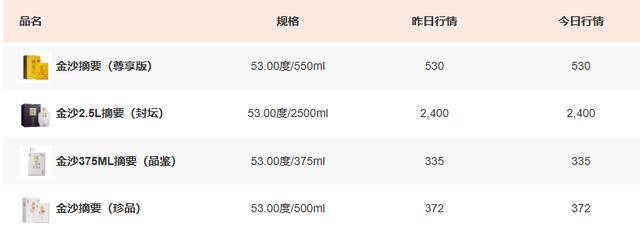
Group 1 - The wholesale reference price for the premium version of the product from Guizhou Jinsha Distillery Co., Ltd. is 372 yuan, while the retail price has dropped to around 400 yuan, indicating a price inversion situation [1] - The online sales data shows that the price for a two-bottle pack of the product has decreased significantly, with historical prices reaching as high as 1839 yuan for the same pack [2] - The financial report from China Resources Beer Holdings Co., Ltd. indicates that the white liquor business revenue was 783 million yuan, a decrease of 400 million yuan year-on-year, with a pre-tax loss of 152 million yuan [4][5] Group 2 - The vice president of China Resources Beer stated that the domestic catering market has faced significant challenges due to policy impacts, affecting white liquor sales [5] - The company plans to continue focusing on high-end products and will not adjust pricing strategies, aiming for a transaction price range of 500 to 600 yuan for the product [5] - Guizhou Jinsha Distillery, established as one of the earliest state-owned liquor producers, has a fixed asset value of 4.5 billion yuan and an annual production capacity of 24,000 tons [5]
华润啤酒回应四川部分产品停供淘宝、京东、美团:即时零售价格战致市场乱象
Xin Lang Cai Jing· 2025-08-27 05:02
Core Viewpoint - China Resources Beer has decided to halt the supply of certain products on instant retail platforms in response to market chaos caused by price wars in the industry [1] Group 1: Company Actions - The Sichuan marketing center of China Resources Beer issued a notice to stop the sales of the "Yongchuan" and "Pure Draft" series on instant retail platforms [1] - The decision aims to protect the market value of the company's products and maintain its core competitive advantage [1] Group 2: Industry Context - The company highlighted that some instant retail platforms were providing subsidies to consumers purchasing Snow Beer, which were exploited by unscrupulous vendors to create a profit chain [1] - This practice not only harms consumer rights but also disrupts the healthy development of the industry ecosystem [1] - The Sichuan marketing center is actively communicating with various instant retail platforms to ensure a sustainable cooperative model [1]