
LENOVO GROUP(00992)

Search documents
联想申请图像检索方法及电子设备专利,根据输入问题生成问题向量并确定目标图像
Jin Rong Jie· 2025-12-26 08:34
Core Insights - Lenovo (Beijing) Co., Ltd. has applied for a patent titled "Image Retrieval Method and Electronic Device," with publication number CN121210697A, filed on September 2025 [1] - The patent describes an image retrieval method that generates a question vector based on an input question and identifies at least one target image from multiple images based on the question vector [1] Company Overview - Lenovo (Beijing) Co., Ltd. was established in 1992 and is located in Beijing, primarily engaged in the manufacturing of computers, communications, and other electronic devices [1] - The company has a registered capital of 565 million HKD and has invested in 107 enterprises, participated in 5,000 bidding projects, and holds 1,751 trademark records and 5,000 patent records [1] - Additionally, the company possesses 238 administrative licenses [1]

联想(00992)将推出超级AI智能体,对标豆包手机助手
智通财经网· 2025-12-26 05:47
Core Insights - Lenovo Group plans to launch its first global "AI Super Intelligent Agent" during CES, which is positioned as a strategic application for the company. The brand name of this application has not yet been disclosed [1] - The AI Super Intelligent Agent is expected to have capabilities similar to the Doubao mobile assistant but will offer more comprehensive features and enable cross-device connectivity and coordination [1] - This application will not be an operating system but a system-level application that connects various AI capabilities and hardware terminals, assisting users in coordinating multiple intelligent agents in the background [1] Group 1 - Lenovo's AI Super Intelligent Agent can seamlessly operate across its Motorola smartphones, PCs, tablets, and wearable devices, enhancing the hardware ecosystem [1] - The application will interact with users through text, voice, and environmental perception, learning personal habits over time [1] - In comparison, Lenovo's embedded system-level permissions in smartphones or PCs may provide a competitive advantage over ByteDance's Doubao mobile application [2] Group 2 - Lenovo holds the highest global market share in the PC sector at 25.5% for the latest quarter [2] - The company’s Motorola smartphones shipped over 16 million units in the latest quarter, generating over $3.9 billion in revenue, with a global market share of 4.9%, ranking eighth in the global smartphone market [2]
联想申请散热装置及加工方法专利,引导散热流体的流动方向
Jin Rong Jie· 2025-12-26 05:16
Group 1 - Lenovo (Beijing) Co., Ltd. has applied for a patent titled "Heat Dissipation Device, Electronic Equipment, and Processing Method for Heat Dissipation Device" with publication number CN121218551A, filed on November 2025 [1] - The patent abstract reveals a heat dissipation device that includes a cavity with opposing first and second plates, where the first plate has a first region near the heat source and a second region adjacent to it [1] - Multiple columns are arranged between the first and second plates, forming guiding structures that direct the flow of heat dissipation fluid within the cavity, consisting of different first and second guiding structures [1]
联想将发布首款面向全球市场的“AI超级智能体”,对标豆包手机助手
Ge Long Hui A P P· 2025-12-26 02:25
Core Insights - Lenovo Group plans to launch its first global "AI Super Intelligent Agent" during CES, positioning it as a strategic application for the company [1] - The brand name of this intelligent agent has not yet been disclosed, but it is expected to have capabilities similar to the Doubao mobile assistant, with more comprehensive functions and cross-device connectivity [1] Product Features - The AI Super Intelligent Agent will operate seamlessly across Lenovo's Motorola smartphones, PCs, tablets, and wearable devices, facilitating multi-device usage [1] - This intelligent agent is not an operating system but a system-level application that connects various AI capabilities and hardware terminals, helping users coordinate multiple intelligent agents in the background [1] - It will interact with users through text, voice, and environmental awareness, learning personal habits over time [1]
联想将推出超级AI智能体,对标豆包手机助手
Xin Lang Cai Jing· 2025-12-26 01:44
Core Viewpoint - Lenovo Group plans to launch its first global "AI Super Intelligent Agent" during CES, positioning it as a strategic application for the company. The brand name has not yet been disclosed, but it is expected to offer more comprehensive AI capabilities than the existing Doubao mobile assistant, with cross-device connectivity and coordination [1][2][3]. Group 1 - The AI Super Intelligent Agent will be able to operate seamlessly across Lenovo's Motorola smartphones, PCs, tablets, and wearable devices, integrating the company's hardware ecosystem [1][3]. - This application is not an operating system but a system-level application that connects various AI capabilities and hardware terminals, assisting users in coordinating multiple intelligent agents in the background [3][4]. - The agent will interact with users through text, voice, and environmental awareness, learning personal habits over time [3][4]. Group 2 - According to IDC data, Lenovo is the leading PC manufacturer globally, with a market share of 25.5% in the latest quarter [4]. - Lenovo's Motorola smartphones shipped over 16 million units in the latest quarter, generating revenue exceeding $3.9 billion, with a global market share of 4.9%, ranking eighth in the global smartphone market [4]. - This positions Lenovo's Super Intelligent Agent with potentially greater system-level integration and collaboration advantages compared to ByteDance's Doubao mobile application [4].
福布斯发布“2025 中国人工智能科技企业 TOP50”榜单,联想集团脱颖而出
Xin Lang Cai Jing· 2025-12-25 12:40
Core Insights - Forbes China released the 2025 Top 50 AI Technology Companies list, highlighting Lenovo Group as a core representative of China's AI industry due to its strategic layout and execution capabilities [1][5][6] - Lenovo's CEO Yang Yuanqing was recognized in the "2025 Influential Entrepreneurs" list for his commitment to technology and promoting inclusive AI, aligning with Lenovo's "full-stack AI" strategy [1][7] Full-Stack AI Strategy: Industry Layout - Lenovo's "full-stack AI" strategy integrates various components from AI-embedded smart terminals to AI-driven infrastructure and native solution services, covering the entire AI industry chain [2][8] - In the smart terminal sector, Lenovo launched popular products like YOGA and ThinkPad, which incorporate personal large models and AI agents, transforming traditional computing tools into proactive intelligent partners [2][8] - Lenovo developed an "AI infrastructure" product and solution combination, featuring the Neptune water-cooling technology to address high power consumption in AI computing, ensuring technological leadership through partnerships with Nvidia and Intel [2][8] Solution Services - Lenovo's "Qingtian" intelligent engine simplifies complex AI technologies into easily deployable and subscription-based solutions, lowering the barriers for enterprises to adopt AI [3][9] - Collaborations with emerging domestic models like DeepSeek enable Lenovo to provide cost-effective intelligent upgrade paths for SMEs, while personal and enterprise intelligent systems empower various industries [3][9] Hybrid AI Ecosystem: Global Vision - Lenovo recognizes the future AI architecture will involve a hybrid model of public and private large models, leading to the creation of an open and collaborative hybrid AI ecosystem [4][10] - This open approach allows Lenovo to offer optimized AI solutions for diverse user types, solidifying its unique position in the global AI competitive landscape [4][10] Core Competitiveness - Lenovo's core competitiveness lies in its comprehensive and forward-looking strategic layout, covering the entire value chain from hardware to software and services, enabling it to capitalize on opportunities in AI PC upgrades and server demand [5][12] - The company's global operational capabilities, including extensive sales channels and strong partnerships with top tech firms, provide a competitive edge that local AI companies may struggle to replicate [5][12] - Lenovo's ability to closely integrate technology with application scenarios allows it to address user pain points effectively, showcasing its strong "technology-business" closed-loop capability [6][12]
最新"全球品牌中国线上500强"季度榜单出炉,大疆首次进入前10、泡泡玛特上升显著
Ge Long Hui· 2025-12-25 06:54
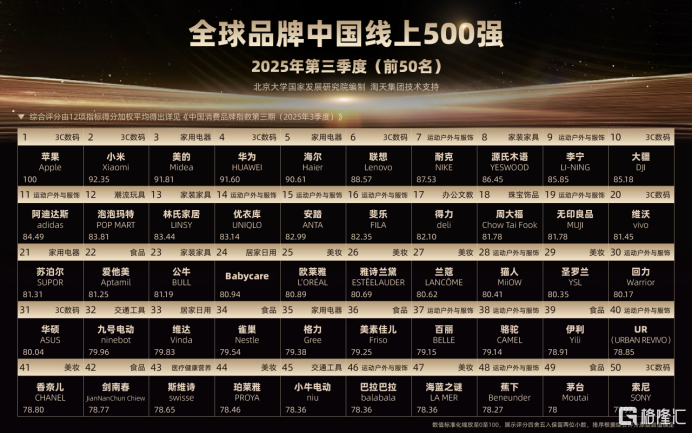
Core Insights - The latest quarterly "China Online Consumption Brand Index" (CBI) and "Global Brand China Online Top 500" (CBI500) indicate a continued rise in consumer preference for brand goods, with the CBI reaching 62.65, a year-on-year increase of 0.92% [1] - DJI and Pop Mart have shown rapid growth, with DJI entering the top 10 of the CBI500 for the first time, and Pop Mart ranking 12th [1] Industry Trends - The CBI series indices reflect a macroeconomic trend of consumption recovery and a shift towards high-quality development, with a notable increase in the core CPI by 0.6% year-on-year in the first three quarters [1][4] - Significant growth in the CBI index was observed in sectors such as women's clothing, 3C smart products, daily beauty products, outdoor sports, pet supplies, men's clothing, and home furnishings, indicating a heightened consumer focus on quality and brand [4][5] - The women's clothing sector saw a notable increase of over 5 points in its index, driven by intensified competition and a focus on quality upgrades [4] Brand Performance - The top five brands in the CBI500 remain consistent with previous quarters: Apple, Xiaomi, Midea, Huawei, and Haier [6] - Brands like DJI and Pop Mart have improved their rankings significantly due to product innovation and seasonal demand, with DJI leveraging unique features in its products and Pop Mart capitalizing on its original IP [6][7] - New entrants in the food category, such as Guangzhou Restaurant and Crab Taotai, benefited from seasonal demand for mooncake gift boxes, while educational brands like Deli and Morning Glory also saw significant improvements [6] Consumer Behavior - The CBI500 rankings are based on real consumer purchasing behavior, utilizing 12 metrics including sales, price, search volume, and positive reviews to assess brand competitiveness [7] - The emphasis on quality and innovation is seen as a key driver for brand strength, moving away from cost-based competition towards a focus on quality, brand differentiation, and value [8]





Best Buy Canada Boxing Day Sale Deals 2025 *LIVE* - Hot Canada Deals
Hot Canada Deals· 2025-12-25 05:57
Best Buy Canada has an awesome Boxing Day Sale available now. Enjoy great savings on many brands and a low price guarantee. Save on all Logitech, Beats, Bose products and much more.Best Buy Canada has FREE shipping on orders of $35 or more. Here are some of the markdowns that are part of the Boxing Day Sale: Save $800 on Samsung 65″ S84F Series 4K UHD HDR OLED Tizen Smart TVSave $130 on PlayStation 5 Pro ConsoleGet the Nintendo Switch 2 Mario Kart World Bundle for $699.99Save $126 on Sony WH-CH720N Over-Ear ...



AI芯片海外限制缓解利好算力基础设施建设 国信证券建议关注联想(00992)、工业富联(601138.SH)等
Zhi Tong Cai Jing· 2025-12-25 02:24
Group 1 - The overall high-end AI chip market in China is expected to grow by over 60% by 2026, with local AI chip manufacturers aiming for a market share of around 50% [1] - Nvidia's H200 chip, which has significantly improved performance compared to the H20, is anticipated to attract terminal customers, potentially maintaining a market share of about 30% if successfully sold in China [1] - Nvidia plans to deliver between 5,000 to 10,000 H200 chip modules to Chinese customers by mid-February next year, translating to approximately 40,000 to 80,000 H200 chips [1] Group 2 - Guosen Securities believes that the development of domestic AI chips and the easing of overseas restrictions will benefit the construction of domestic computing infrastructure, with related companies expected to gain significantly [2] - Companies to watch include Industrial Fulian (601138.SH), Huqin Technology (603296.SH), Hushan Electronics (002463.SZ), Loongson Technology (688047.SH), Lenovo Group (00992), Luxshare Precision (002475.SZ), and Amlogic (688099.SH) [2]



AI芯片海外限制缓解利好算力基础设施建设 国信证券建议关注联想、工业富联等
Ge Long Hui· 2025-12-25 02:08
Group 1 - The overall high-end AI chip market in China is expected to grow by over 60% by 2026, with local AI chip manufacturers aiming for a market share of around 50% [1] - Nvidia's H200 chip, which significantly outperforms the H20, is expected to attract terminal customers, potentially maintaining a market share of about 30% if successfully sold in China [1] Group 2 - Nvidia plans to deliver its second-ranking AI chip, the H200, to Chinese customers by mid-February next year, with an estimated shipment of 5,000 to 10,000 chip modules, equivalent to approximately 40,000 to 80,000 H200 chips [2] - The U.S. government has initiated a review process for export licenses related to the H200 chip to China, fulfilling its commitment to allow sales of this type of chip [2] - Guosen Securities believes that the development of domestic AI chips and the easing of overseas restrictions will benefit the domestic computing infrastructure, with companies such as Industrial Fulian, Huqin Technology, and Lenovo Group expected to gain from this trend [2]
