
XIAOMI(01810)

Search documents
盘前公告淘金:宇树科技澄清销量数据,小米集团宣布25亿港元回购计划,恒逸石化拟斥5亿-10亿元回购
Jin Rong Jie· 2026-01-23 00:45
Important Events - Shunhao Co., Ltd. announced that its affiliated company, the first-generation experimental satellite "Chengguang No. 1," has completed development but has not yet been launched [1] - Yinglian Co., Ltd.'s subsidiary Jiangsu Yinglian signed a strategic agreement with LG Chem to accelerate the layout of the global lithium battery innovation materials market [1] - Lizhong Group's subsidiary has been designated for an aluminum alloy wheel project, with expected sales of approximately 1.37 billion yuan during the project cycle [1] - Qiangrui Technology's Dongguan Aluminum Bao primarily supplies precision structural components for liquid cooling heat dissipation modules to clients such as Qihong, maintaining a high supply share [1] - Yushu released a sales data clarification announcement stating that the actual shipment of humanoid robots for the entire year of 2025 will exceed 5,500 units, with over 6,500 units of the main body rolling off the production line [1] Performance - ShenNan Electric A expects a year-on-year net profit increase of 585%-722% for 2025 [1] - Runtou Co., Ltd. anticipates a year-on-year net profit increase of 181.05%-227.89% for 2025, benefiting from investment income from holding Muxi Co., Ltd. [1] - Ruisheng Intelligent expects a year-on-year net profit increase of 112%-140% for 2025, expanding its computing server business [1] - Zhaoyi Innovation forecasts a year-on-year net profit increase of approximately 46% for 2025, driven by an upward cycle in the storage industry and improved supply-demand structure [1] - Qiangyi Co., Ltd. expects a year-on-year net profit increase of 58%-71% for 2025, supported by strong order growth from leading clients in the communication network and AI computing chip sectors [1] - Founder Technology anticipates a year-on-year net profit increase of 67%-98% for 2025, expanding into high-value-added businesses such as AI servers, high-speed optical modules, and high-end switches [1] - Zhongbing Hongjian expects a pre-tax profit of 34 million to 46 million yuan for 2025, with significant growth in revenue from special equipment product deliveries [1] Share Buybacks and Increases - Hengyi Petrochemical plans to repurchase company shares with an investment of 500 million to 1 billion yuan [2] - Yunyi Electric's controlling shareholder and chairman intends to increase shareholding by 30 million to 60 million yuan [2] - Xiaomi Group announced an automatic share repurchase plan of up to 2.5 billion Hong Kong dollars and will cancel the repurchased shares [2]


智通港股沽空统计|1月23日
智通财经网· 2026-01-23 00:22
Short Selling Ratios - China Resources Beer (80291) and JD Group (89618) have the highest short selling ratios at 100.00% each, followed by Lenovo Group (80992) at 95.62% [1] - The top ten short selling ratios include Li Ning (82331) at 93.21% and Anta Sports (82020) at 88.46% [1] Short Selling Amounts - Alibaba (09988) leads in short selling amount with 1.173 billion, followed by Baidu (09888) at 1.111 billion and Pop Mart (09992) at 1.049 billion [1] - Other notable companies in the top ten include Meituan (03690) at 814 million and China Life (02628) at 806 million [1] Deviation Values - JD Group (89618) has the highest deviation value at 37.56%, followed by China Ping An (82318) at 33.98% and China Huaneng (03788) at 33.27% [1] - Other companies with significant deviation values include SenseTime (80020) at 32.05% and Li Ning (82331) at 31.52% [1]





陆家嘴财经早餐2026年1月23日星期五
Wind万得· 2026-01-23 00:13
Monetary Policy and Economic Measures - The central bank governor Pan Gongsheng stated that a moderately loose monetary policy will continue in 2026, with room for further cuts in reserve requirement ratios and interest rates to maintain ample liquidity [3] - The first batch of 936 billion yuan of ultra-long special government bonds has been allocated to support approximately 4,500 projects in various sectors, expected to drive total investment exceeding 460 billion yuan [4] - The People's Bank of China will conduct a 900 billion yuan MLF operation on January 23, net injecting 700 billion yuan into the market, marking the 11th consecutive month of increased operations [4] Consumer and Investment Trends - State-owned banks collectively announced the implementation of personal consumption loan interest subsidy policies, allowing some high-quality clients to enjoy effective interest rates in the "2%" range, lower than current housing loan rates [3] - Public funds have focused their fourth-quarter 2025 positions on core sectors such as electronics and power equipment, with Zhongji Xuchuang becoming the largest holding stock [3] Market Performance - The A-share market saw a slight increase, with the Shanghai Composite Index rising 0.14% to 4122.58 points, and the Shenzhen Component Index increasing by 0.5% [6] - The Hong Kong stock market also experienced minor fluctuations, with the Hang Seng Index rising 0.17% to 26629.96 points, and net inflows from southbound funds amounting to 5.166 billion HKD [6] Corporate Developments - Alibaba Group has decided to support its chip company "Pingtouge" for independent listing, with plans for restructuring to a mixed-ownership enterprise [7] - Xiaomi Group has initiated a stock repurchase plan of up to 2.5 billion HKD [9] - Nanjing Bank reported a net profit growth of 8.08% year-on-year for 2025 [9] Regulatory and Policy Updates - The State Administration for Market Regulation has issued a red card for the first time in the public utility sector, prohibiting a merger between two gas companies [10] - Nine departments jointly issued opinions to promote high-quality development in the pharmaceutical retail industry, encouraging mergers and acquisitions among retail pharmacies [10] Economic Indicators - The unemployment rate for urban labor aged 16-24 was reported at 16.5% in December 2025, while the rate for those aged 25-29 was 6.9% [5] - The National Bureau of Statistics reported a 28.1% year-on-year increase in sales revenue for the smart device manufacturing industry in 2025 [10]





盘前必读丨预制菜将有国家标准了;小米集团拟最高回购25亿港元股份并注销
Di Yi Cai Jing· 2026-01-23 00:08
Group 1 - The market is expected to be driven by earnings as a key factor in the near term [10] - The People's Bank of China will continue to implement a moderately loose monetary policy in 2026, focusing on stabilizing economic growth and reasonable price recovery [3] - The Ministry of Commerce and nine other departments have issued opinions to promote high-quality development in the pharmaceutical retail industry, encouraging participation in centralized procurement [3][4] Group 2 - The U.S. stock market indices have shown positive performance, with the Dow Jones up 0.63%, S&P 500 up 0.55%, and Nasdaq up 0.91% [7] - Major technology stocks have performed well, with Meta rising 5.66% and Tesla up 4.15%, while Intel's stock fell over 12% after earnings report [8] - Commodity markets are experiencing divergence, with international oil prices declining while gold and silver prices have reached historical highs [9]



【钛晨报】央行行长潘功胜:2026年将继续实施好适度宽松的货币政策,发挥增量政策和存量政策集成效应;落实个人消费贷款最新财政贴息政策,六大行集体公告;商务部等9部门关于促进药品零售行业高质量发展的意见
Sou Hu Cai Jing· 2026-01-22 23:39
Monetary Policy - The People's Bank of China (PBOC) will continue to implement a moderately loose monetary policy in 2026, focusing on promoting stable economic growth and reasonable price recovery [2] - The PBOC plans to flexibly use various monetary policy tools such as reserve requirement ratio (RRR) cuts and interest rate reductions to maintain ample liquidity [2] - There is still room for RRR cuts and interest rate reductions this year, with an emphasis on managing interest rate policies to keep financing costs low [2] Structural Policies - The PBOC has introduced a series of structural monetary policies, including a 0.25 percentage point reduction in the interest rates of various structural monetary policy tools [3] - The PBOC has set up a dedicated 1 trillion yuan relending facility for private enterprises and increased the relending quota for agricultural and small enterprises by 500 billion yuan to 4.35 trillion yuan [3] - The PBOC aims to maintain stable financial markets and manage expectations, ensuring the RMB exchange rate remains stable [3] Real Estate Market - The real estate market in 2025 is expected to stabilize with four positive signals, including a noticeable stabilization in sales scale for new and second-hand homes [4] - There is increasing differentiation among cities and regions, with some core cities showing signs of activity in the real estate market [4] - Inventory levels have shown a certain degree of decline, contributing to the overall market recovery [4] Investment and Innovation - A strong domestic demand market is crucial for promoting technological innovation, as it attracts global resources, talent, and capital [5] - A domestic company with leading foundational model capabilities could benefit from a stronger consumer environment, enhancing subscription revenue and model investment interactions [5] AI and Technology Developments - Baidu has officially released the Wenxin large model 5.0, which supports various forms of information understanding and output [6] - Baichuan Intelligent has launched the Baichuan-M3 Plus, which significantly reduces the hallucination rate in medical scenarios and introduces evidence anchoring technology for verifiable medical judgments [8] Market Regulations - The State Administration for Market Regulation has prohibited certain gas companies from establishing joint ventures, marking a significant enforcement of antitrust laws in the public utility sector [15] - The Ministry of Commerce and other departments have issued opinions to promote high-quality development in the pharmaceutical retail industry, encouraging participation in centralized procurement [13] International Investment Trends - The Swedish largest private pension fund has sold a significant portion of its U.S. Treasury holdings due to concerns over the unpredictability of the U.S. government and rising debt levels [20] - Chinese enterprises are expected to maintain healthy and orderly development in foreign investments, with direct investments reaching $174.38 billion in 2025, a 7.1% increase from the previous year [14]


智通港股通资金流向统计(T+2)|1月23日
智通财经网· 2026-01-22 23:36
Core Insights - Tencent Holdings (00700), Meituan-W (03690), and Xiaomi Group-W (01810) ranked as the top three in net inflow of southbound funds, with net inflows of 660 million, 574 million, and 395 million respectively [1] - China Mobile (00941), SMIC (00981), and Innovent Biologics (01801) led in net outflows, with net outflows of -831 million, -723 million, and -216 million respectively [1] Net Inflow Summary - Tencent Holdings (00700): Net inflow of 660 million, representing a 4.51% increase, closing at 601.000 with a decrease of 1.48% [2] - Meituan-W (03690): Net inflow of 574 million, with a 12.93% increase, closing at 97.350 with a decrease of 1.17% [2] - Xiaomi Group-W (01810): Net inflow of 395 million, showing a 4.91% increase, closing at 35.480 with a decrease of 2.74% [2] - Other notable inflows include Pop Mart (09992) with 350 million and a 5.95% increase, and China Life (02628) with 232 million and a 7.71% increase [2] Net Outflow Summary - China Mobile (00941): Net outflow of -831 million, a -34.50% decrease, closing at 79.300 with no change [2] - SMIC (00981): Net outflow of -723 million, a -14.66% decrease, closing at 74.500 with a decrease of 3.25% [2] - Innovent Biologics (01801): Net outflow of -216 million, a -28.25% decrease, closing at 83.200 with a decrease of 2.52% [2] - Other significant outflows include Zijin Mining (02899) with -204 million and a -8.43% decrease, and China National Aviation (00753) with -116 million and a -26.75% decrease [2] Net Inflow Ratio Summary - Southern Hong Kong Technology (03442): Net inflow ratio of 88.29% with a net inflow of 3.8171 million, closing at 9.040 with a decrease of 1.36% [3] - Haipru (09989): Net inflow ratio of 61.65% with a net inflow of 801.6 thousand, closing at 5.230 with an increase of 0.19% [3] - Fudan Zhangjiang (01349): Net inflow ratio of 60.38% with a net inflow of 2.1035 million, closing at 3.020 with a decrease of 0.33% [3] Net Outflow Ratio Summary - China Longgong (03339): Net outflow ratio of -54.88% with a net outflow of -12.6831 million, closing at 3.140 with an increase of 0.64% [3] - Miniso (09896): Net outflow ratio of -52.86% with a net outflow of -89.0301 million, closing at 38.140 with an increase of 0.26% [3] - Sichuan Chengyu Expressway (00107): Net outflow ratio of -51.05% with a net outflow of -5.9294 million, closing at 5.120 with an increase of 0.39% [3]


智通ADR统计 | 1月23日
智通财经网· 2026-01-22 22:19
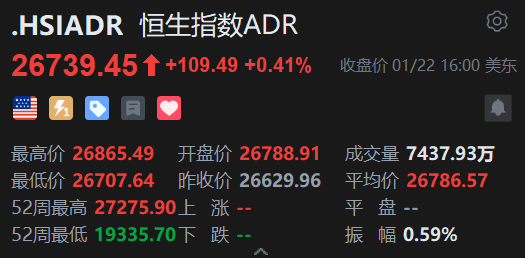
Market Overview - The Hang Seng Index (HSI) closed at 26,739.45, up by 109.49 points or 0.41% as of January 22, 16:00 Eastern Time [1] - The index reached a high of 26,865.49 and a low of 26,707.64 during the trading session, with a trading volume of 74.379 million shares [1] Stock Performance - HSBC Holdings closed at HKD 130.600, an increase of 0.69% compared to the previous close [2] - Tencent Holdings closed at HKD 594.990, a decrease of 0.42% compared to the previous close [2] - Alibaba Group (ADR) saw a price increase of 4.78%, closing at HKD 164.800, while its ADR price was USD 172.684 [3] - Other notable stock movements include: - China Ping An: down 2.34% to HKD 66.900 [3] - Baidu Group: up 4.10% to HKD 160.000 [3] - BYD Company: up 0.71% to HKD 99.750 [3] - New World Development: up 3.63% to HKD 114.200 [3]

从“单点突破”到“全链引领” 黑河寒区试车产业实现蝶变
Xin Lang Cai Jing· 2026-01-22 21:16
Core Insights - Heihe City has rapidly developed its cold-region vehicle testing industry, leveraging opportunities in the new energy vehicle and intelligent connected vehicle sectors, achieving a transformation from "single testing" to "full-chain leadership" with a growth rate of 10% annually [1][2] Group 1: Strategic Development - The cold-region vehicle testing industry has been integrated into Heihe's modern industrial system with a strategic path defined as "one core, two wheels driving, and two wings flying" [2] - Policies such as the "Cold Region Vehicle Testing Industry Service Regulations" and the "Heihe Cold Region Vehicle Testing Full Industry Chain Development Plan (2022-2035)" have been established to support industry growth [2] - Over 1 billion yuan has been invested in cold-region testing infrastructure, leading to the establishment of significant testing facilities [2] Group 2: Technological Empowerment - Heihe has made significant advancements in intelligent connected vehicle testing, including the construction of a 1.6 km testing road and the successful outdoor cold-weather flight tests for drones and flying cars [3] - The proportion of new energy vehicle testing in Heihe has increased from less than 30% to over 60% during the 14th Five-Year Plan period, with major companies like Xiaomi and Tesla conducting long-term tests [3] Group 3: Economic Integration - The integration of cold-region vehicle testing with tourism and sports has led to the successful hosting of events like the Cold Region Vehicle Testing Festival, generating over 600 million yuan in revenue and creating more than 1,500 jobs [4] - The cold-region vehicle testing industry has become a vital part of Heihe's urban development, with significant contributions to local economic growth [5] Group 4: Industry Impact - Heihe's cold-region vehicle testing accounts for 85% of the national market and 45% of the global market, earning accolades such as "China Heihe Automotive Cold Region Testing Base" [5] - The industry has transitioned from "industrial advantages" to "brand advantages," enhancing its reputation and recognition [5]


华为登顶,吃了谁的蛋糕?
Xin Lang Cai Jing· 2026-01-22 20:13
Core Insights - Huawei has regained the top position in the Chinese smartphone market with a shipment of 46.7 million units and a market share of 16.4% in 2025, although this is significantly lower than its peak of 124.9 million units and 38.3% market share in 2020 [2][3][6] - The competition among the top three manufacturers—Huawei, Apple, and Vivo—is intense, with their shipment volumes closely aligned, indicating a highly competitive market landscape [4][7] - Despite Huawei's return to the top, its shipment volume has decreased by approximately 2% year-on-year, reflecting a broader market decline [5][6] Shipment and Market Share - In 2025, the top five smartphone manufacturers in China by shipment volume are: 1. Huawei: 46.7 million units (16.4%) 2. Apple: 46.2 million units (16.2%) 3. Vivo: 46.1 million units (16.2%) 4. Xiaomi: 43.8 million units (15.4%) 5. OPPO: 43.4 million units (15.3%) [3][6] - The overall smartphone market in China saw a slight decline, with total shipments of 284.4 million units in 2025, down 0.6% from 2024 [6] Activation vs. Shipment - Huawei's activation volume ranks fifth, significantly lower than its shipment volume, indicating potential inventory issues with a gap of over 3 million units between shipments and activations [10][12] - In contrast, other brands like Vivo, Apple, and OPPO have activation volumes closely matching their shipment volumes, suggesting healthier inventory management [12][10] Competitive Landscape - The competition is not only between Huawei and Apple but also includes Vivo, which has maintained a strong presence in the market, and Xiaomi, which has shown positive growth [30][34] - OPPO has also demonstrated resilience, achieving a year-on-year shipment growth of nearly 30% in 2025, indicating a robust competitive strategy [34] Product Strategy and Pricing - Huawei's successful return is attributed to its strong product lineup, including the Mate 70 and Pura 80 series, which have seen significant sales despite the absence of advanced 3nm chips [21][24] - The company has strategically reduced prices on key models, with reductions exceeding 800 yuan, making its products more competitive in a market where other brands have raised prices [27][29] Future Outlook - The smartphone market in 2026 is expected to face challenges, including rising storage costs and a potential decline in overall shipments, which could reshape the competitive dynamics [36][38] - The ability of manufacturers to adapt to these changes and maintain product appeal will be crucial for sustaining market positions in the coming years [38]
车企密集推出“7年低息”购车方案 超长期低息方案的真实让利边界、成本分摊方式及其对行业竞争秩序的影响 仍有待市场检验
Zheng Quan Ri Bao· 2026-01-22 16:40
Core Viewpoint - The automotive market is shifting from direct price reductions to low-interest financing options, with several brands introducing long-term low-interest plans to stimulate demand amid consumer hesitation and inventory pressure [1][3]. Group 1: Low-Interest Financing Strategies - Following Tesla's introduction of a "7-year low-interest" financing plan, brands like Xiaomi, Li Auto, Xpeng, and Dongfeng Yipai have launched similar "6 to 7-year low-interest" and "low down payment, low monthly payment" installment policies [1][2]. - Tesla's financing plan offers an annual interest rate as low as 0.5% (approximately 0.98% annualized), with options tailored to different models and down payment levels [2]. - Xiaomi and Li Auto have adopted the "7-year low-interest" model to attract budget-sensitive consumers, emphasizing low monthly payments and down payment thresholds [2]. Group 2: Market Dynamics and Consumer Behavior - The introduction of low-interest financing is closely linked to fluctuations in consumer demand, with data indicating a 3.8% year-on-year increase in retail sales of passenger vehicles in 2025, but a decline in December retail numbers [3]. - The current market environment, characterized by consumer hesitation, has led automakers to utilize financial tools to stimulate demand and secure orders [3]. Group 3: Regulatory Environment and Compliance - Regulatory bodies have emphasized the need to resist chaotic price wars, enhancing the tactical value of financial subsidies as a means to maintain market order [4]. - The Ministry of Industry and Information Technology and other agencies have called for strict monitoring of pricing behaviors and compliance with regulations to ensure fair market practices [4]. - The introduction of guidelines for pricing behavior in the automotive industry aims to standardize promotional and pricing practices, indicating that financial subsidies are not outside regulatory scrutiny [5]. Group 4: Potential Implications and Concerns - While low-interest financing can reduce immediate cash flow pressure and encourage purchases, there are concerns about the long-term sustainability of such strategies [5]. - Risks include potential consumer leverage issues, demand being pulled forward, and the possibility of a return to price wars if financial incentives are not managed properly [5][6]. - The future effectiveness of these promotional strategies will depend on transparent compliance with promotional rules and the ability of companies to provide sustainable product value beyond financial incentives [6].
