XIAOMI(01810)

Search documents
小米集团-W(01810)2月12日斥资1.48亿港元回购405万股
智通财经网· 2026-02-12 10:26
智通财经APP讯,小米集团-W(01810)发布公告,于2026年2月12日斥资约1.48亿港元回购405万股;就根 据股份计划授予参与人(发行人的董事除外)的股份奖励或期权而发行9800股股份。 ...
小米集团-W2月12日斥资1.48亿港元回购405万股
Zhi Tong Cai Jing· 2026-02-12 10:26
小米集团-W(01810)发布公告,于2026年2月12日斥资约1.48亿港元回购405万股;就根据股份计划授予参 与人(发行人的董事除外)的股份奖励或期权而发行9800股股份。 ...
净买入逾45亿港元 大举加仓腾讯和小米流出泡泡玛特



Xin Lang Cai Jing· 2026-02-12 10:25
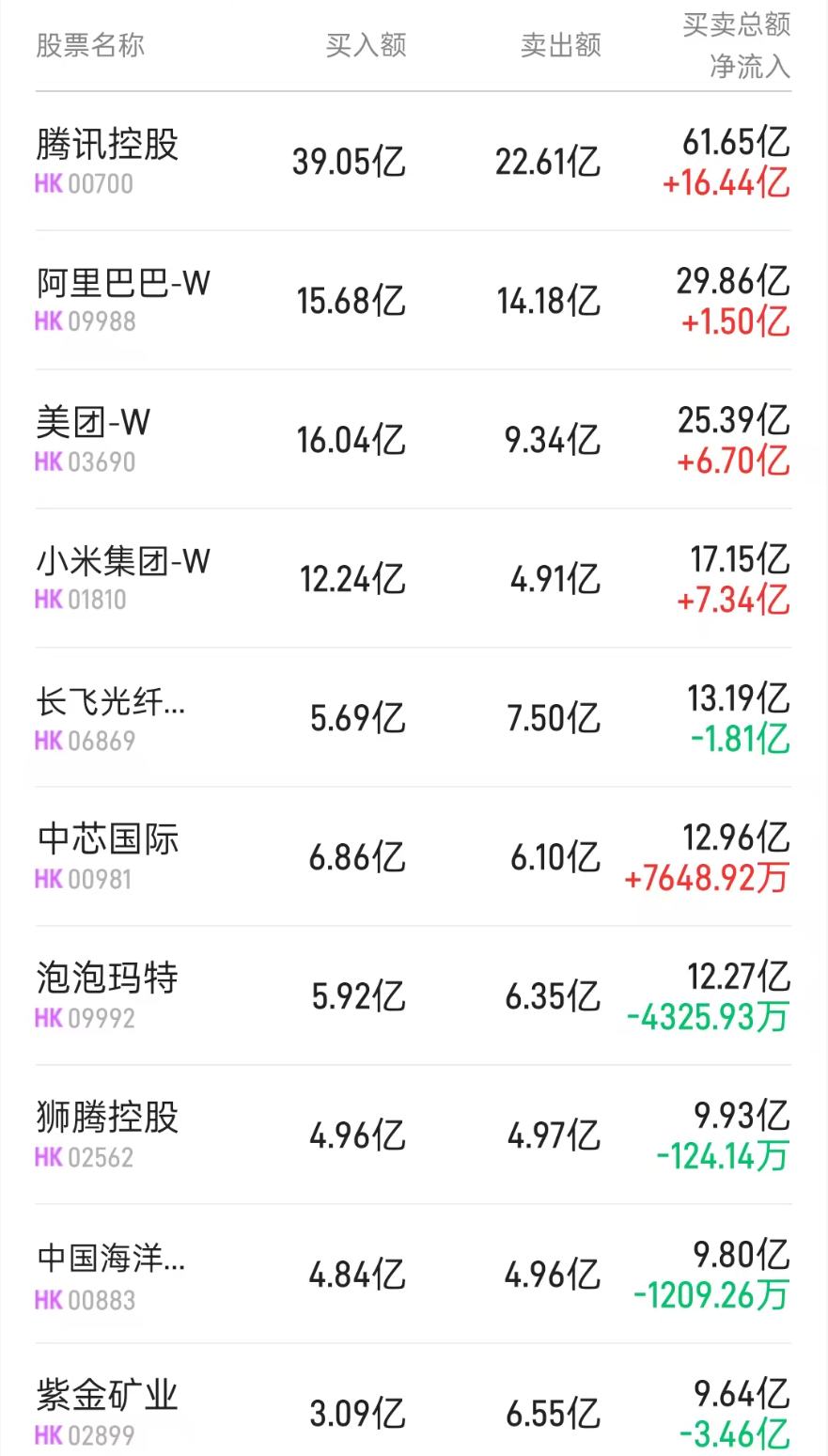
Core Viewpoint - Southbound capital flow into Hong Kong stocks showed a net inflow of approximately 45.67 billion HKD despite a generally weak market performance, indicating continued interest from investors [2][3]. Southbound Capital Flow - Today's southbound trading volume reached about 947.77 billion HKD, an increase of approximately 40 billion HKD from the previous day, accounting for 39.70% of the total turnover of the Hang Seng Index, which has fallen below 40% again [2]. - The net inflow from the Shanghai-Hong Kong Stock Connect was about 46.56 billion HKD, while the Shenzhen-Hong Kong Stock Connect experienced a net outflow of approximately 0.89 billion HKD [2]. Individual Stock Performance - Significant net purchases included Tencent Holdings (14.29 billion HKD), Xiaomi Group (10.20 billion HKD), Meituan (9.85 billion HKD), and Kingsoft Cloud (1.89 billion HKD) [3]. - Major net outflows were observed in WuXi Biologics (3.92 billion HKD), Zijin Mining (3.46 billion HKD), and Pop Mart (3.01 billion HKD) [3]. Investment Highlights - Tencent Holdings saw a decline of 2.28% with a net increase of 25.2 million shares over the past five days, indicating a short-term inflow trend [4]. - Xiaomi Group decreased by 1.56%, with a net increase of 53.81 million shares in the last five days, showing continued short-term inflow [4]. - Meituan dropped 4.50%, but there was a net increase of 20.59 million shares over the past five days, suggesting accelerated short-term inflow [4]. - Kingsoft Cloud increased by 7.82%, with a net increase of 35.20 million shares in the last five days, indicating sustained short-term inflow [4]. - WuXi Biologics fell by 0.14%, but there was a net increase of 25.83 million shares over the past five days, maintaining a primary inflow trend [4]. - Zijin Mining rose by 3.45%, with a net reduction of 8.28 million shares in the last five days, indicating a primary outflow trend [4]. - Pop Mart decreased by 1.10%, with a net increase of 5.58 million shares over the past five days, showing a slowdown in inflow [4]. Recent Trading Activity - In the past month, Tencent Holdings had a net capital inflow of 16.44 billion HKD, while Meituan experienced a net inflow of 6.70 billion HKD despite a 4.50% decline [5]. - Xiaomi Group recorded a net inflow of 7.34 billion HKD, while WuXi Biologics faced a net outflow of 3.92 billion HKD [5].


小米集团-W(01810.HK)2月12日耗资1.48亿港元回购405万股
Ge Long Hui· 2026-02-12 10:18
格隆汇2月12日丨小米集团-W(01810.HK)公告,2月12日耗资1.48亿港元回购405万股。 ...
小米集团(01810) - 翌日披露报表
2026-02-12 10:14
FF305 翌日披露報表 (股份發行人 ── 已發行股份或庫存股份變動、股份購回及/或在場内出售庫存股份) 表格類別: 股票 狀態: 新提交 公司名稱: 小米集团 (於開曼群島註冊成立以不同投票權控制的有限公司) 呈交日期: 2026年2月12日 如上市發行人的已發行股份或庫存股份出現變動而須根據《香港聯合交易所有限公司(「香港聯交所」)證券上市規則》(「《主板上市規則》」)第13.25A條 / 《香港聯合交易所有限公司GEM證券 上市規則》(「《GEM上市規則》」)第17.27A條作出披露,必須填妥第一章節 。 | 第一章節 | | | | | | | | | | --- | --- | --- | --- | --- | --- | --- | --- | --- | | 1. 股份分類 | 不同投票權架構公司普通股 | 股份類別 | B | | 於香港聯交所上市 | 是 | | | | 證券代號 (如上市) | 01810 | 說明 | | | | | | | | 多櫃檯證券代號 | 81810 | RMB 說明 | | | | | | | | A. 已發行股份或庫存股份變動 | | | | | | | ...
北水动向|北水成交净买入45.67亿 高盛看好小米加码AI 北水加仓小米(01810)超10亿港元
智通财经网· 2026-02-12 10:06
美团-W(03690)获净买入9.84亿港元。消息面上,美团LongCat原生"深度研究"(Deep Research)智能体正式发布。据悉,该 智能体是LongCat团队采用了"真实场景+科学训练"的训练方法,这让智能体每次研究都会从真实生活经验出发,从而缓解当 前AI在解决真实物理世界问题时容易出现幻觉的痛点。 港股通(深)活跃成交股 腾讯(00700)获净买入14.29亿港元。消息面上,小摩发表报告指,农历新年仍是中国消费科技领域最密集、历史上最具效力的 发布窗口。如果DeepSeek新版本在农历新年期间发布,真正重要的影响主要体现在可能释放平台经济效益。对互联网平台而 言,该行认为腾讯最有可能从潜在的DeepSeek新版本中受惠最大。 小米集团-W(01810)、金山云(03896)分别获净买入10.19亿、1.89亿港元。消息面上,高盛发布研报称,预计小米将于2026年 在AI领域投入约100亿元人民币,而金山云将可成为小米持续对AI发展加大投资的主要受益者。该行表示,小米锐意通过 其"人车家"生态,将AI与物理世界融合,预计金山云将在今年中前更新与小米的关连交易协议,使2026至2027年来自小米 ...

受存储涨价压力,2026年全球手机产量恐下行
WitsView睿智显示· 2026-02-12 09:53
Core Viewpoint - The global smartphone production is expected to decline by 10% in 2026 due to rising memory prices, potentially dropping to 1.135 billion units, with a pessimistic scenario predicting a decline of 15% or more [2][3]. Group 1: Market Impact - The significant increase in memory prices, with contract prices for 8GB+256GB models expected to rise nearly 200% in Q1 2026 compared to the same period in 2025, has led to the BOM cost share of memory in smartphones increasing from 10-15% to 30-40% [5]. - Brands are likely to raise terminal prices to maintain operations and may need to adjust product configurations to cope with the ongoing surge in memory prices [5]. Group 2: Brand Performance - Samsung, as the leading smartphone brand and a major player in the memory industry, is expected to see a decline in production, but the drop will be less severe due to its vertical integration advantages [5]. - Apple, with a higher proportion of high-end models, is better positioned to absorb rising memory costs and has a consumer base more accepting of price adjustments, providing some support for its production performance [5]. - Xiaomi and Transsion, which focus on lower-end models, are more sensitive to cost fluctuations and are expected to experience significant production cuts in 2026 due to the ongoing rise in memory prices [5]. Group 3: Competitive Landscape - Vivo, Oppo, Xiaomi, and Honor will face not only memory cost pressures but also strong competition from Huawei, which is expected to have the smallest production adjustment among brands and may even see growth due to its flexible pricing strategy [6]. - The current decline in terminal demand is attributed to rising memory prices, but the overall functionality of electronic devices has reached a level that satisfies most consumer needs, leading to longer replacement cycles and reduced upgrade momentum [6].


跌9.39%VS买636亿!南向资金节前逆势扫货|中环观察
2 1 Shi Ji Jing Ji Bao Dao· 2026-02-12 09:28
Core Viewpoint - The Hong Kong stock market is experiencing a significant influx of southbound capital despite recent declines in the Hang Seng Index and Hang Seng Tech Index, indicating a potential investment opportunity as valuations reach attractive levels [1][2]. Group 1: Market Performance and Capital Inflow - From January 29 to February 6, the Hang Seng Index fell by 4.55%, while the Hang Seng Tech Index dropped by 9.39%, yet southbound capital net bought HKD 636.64 billion during this period [1]. - On February 5, a record single-day net purchase of HKD 249.77 billion was noted, the highest since August 2025 [1]. - The increase in southbound capital is attributed to the perceived undervaluation of Hong Kong stocks, which have adjusted from 28,000 points to 26,200 points [1][2]. Group 2: Investment Strategies and Preferences - Southbound capital is focusing on two main types of stocks: technology leaders that are scarce in the A-share market and high-dividend stocks that offer better yields than their A-share counterparts [2][3]. - In 2025, the banking sector saw a net inflow of nearly HKD 210 billion, while tech giants Alibaba and Meituan attracted over HKD 250 billion combined, highlighting a preference for high-growth and dividend-paying stocks [2]. Group 3: Future Market Outlook - Analysts predict that the Hong Kong market has room for valuation recovery, with expectations of a slow bull market supported by increased southbound capital inflow and foreign investment [7][8]. - DBS Bank has raised its 12-month target for the Hang Seng Index to 30,000 points, while HSBC anticipates a target of 31,000 points by the end of 2026, driven by strong earnings growth and structural opportunities [8]. - Investment strategies for 2026 emphasize sectors such as technology, consumer goods, and essential retail, while cautioning against potential risks from geopolitical tensions and inflation [9].
港股收评:三大指数低迷!餐饮股走弱,电力设备逆势发力
Ge Long Hui· 2026-02-12 08:48
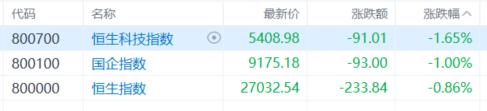
Market Overview - The Hong Kong stock market experienced a decline, with the Hang Seng Index halting a three-day rally, closing at 27,032.54, down 0.86% [1][2] - The Hang Seng Tech Index fell by 1.65%, while the Hang Seng China Enterprises Index dropped by 1% [1][2] Sector Performance Technology Sector - Major tech stocks saw significant declines, with Meituan and NetEase both dropping over 4%, and Baidu and Tencent falling more than 2% [2][4] - Other tech companies like Kuaishou, Xiaomi, JD.com, and Alibaba also reported losses [2][4] Financial Sector - Financial stocks, including banks, Chinese brokerage firms, and insurance companies, mostly declined, adding pressure to the market [2] Consumer Sector - The restaurant sector faced downturns, with Jiumaojiu falling over 5% and Haidilao dropping more than 3% [6] - The overall consumer demand in the restaurant industry is stabilizing, with expectations for improvement in 2026 [6] Entertainment Sector - The film and entertainment sector was weak, with Emperor Culture Industries dropping nearly 6% [7] Energy Sector - The power equipment sector showed strength, with Harbin Electric rising over 13% [9] - The oil sector was active, with China Petroleum and Sinopec both gaining over 2% [14] Heavy Machinery Sector - Heavy machinery stocks continued to rise, with China National Heavy Duty Truck Group and Sany International both increasing over 5% [12] Semiconductor Sector - Semiconductor stocks saw gains, with Tensun Zhixin and Zhaoyi Innovation both rising over 20% [10] Notable Stocks - Dipo Technology surged by 8.34%, reaching a market value of 29.707 billion HKD [16] - The stock has increased 2.46 times since its IPO price of 26.66 HKD [21]

内存涨价,千元机的天塌了
3 6 Ke· 2026-02-12 08:43
Core Insights - The storage chip market has experienced a significant price surge since the second half of last year, with consumer-grade memory prices increasing by over 600%, making it a highly valuable investment product [1] - The demand for AI infrastructure has led to a depletion of production capacity among major storage chip manufacturers, including Samsung, Micron, and SK Hynix, with all their HBM production capacity booked until 2026 [1][11] - The rising prices of storage chips have disproportionately affected low-end smartphones, particularly brands like Transsion, which saw a 22.6% revenue increase but an 11% drop in net profit in Q3 last year [3][4] Market Dynamics - The high profit margins associated with HBM memory used in AI chips have prioritized its production over consumer-grade products, leading to supply constraints for low-end smartphones [3] - Various smartphone manufacturers are shifting focus from low-priced product lines to higher-margin high-end models due to the impact of rising storage costs [4][12] - Transsion's market share dropped from fourth to "others" category, indicating a significant decline in its competitive position [3][4] Pricing and Cost Structure - The cost structure of low-end smartphones is heavily impacted by the rising prices of storage chips, which are considered a rigid cost that cannot be easily adjusted [5][8] - The BOM (Bill of Materials) cost for a 12GB+256GB iPhone Pro Max indicates that storage costs account for approximately 10% of total costs, highlighting the sensitivity of low-end models to price increases [8][9] - The average selling price (ASP) of smartphones is projected to exceed $400 for the first time, reflecting a shift towards higher-priced models as low-end market segments shrink [13][16] Supply Chain Challenges - The demand for AI-related products has created a seller's market for storage chips, leading to unpredictable cost structures for smartphone manufacturers, especially in the low-end segment [12] - Major companies like Apple are facing significant supply pressures, with only partial agreements in place for NAND Flash and DRAM supplies for the upcoming quarters [11] - Samsung's internal conflicts regarding storage pricing have further complicated supply chain management, as the mobile division struggles to secure favorable terms from the semiconductor division [12]