XIAOMI(01810)

Search documents
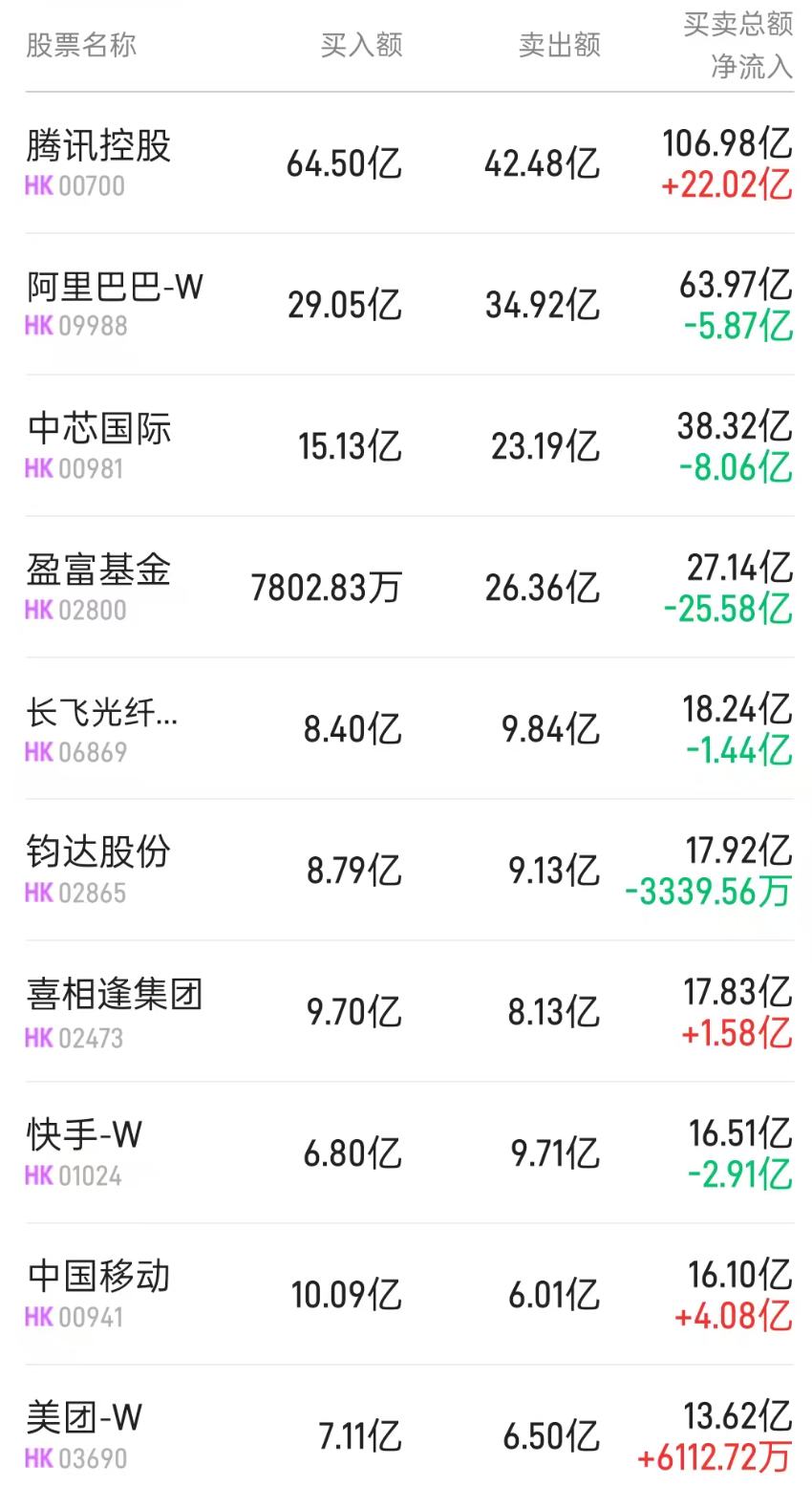
北水动向|北水成交净买入9.52亿 科网及芯片股明显分化 内资抛售盈富基金(02800)超37亿港元
智通财经网· 2026-02-03 09:57
Summary of Key Points Core Viewpoint - The Hong Kong stock market experienced significant net buying and selling activity on February 3, with a total net buy of 9.52 billion HKD from Northbound trading, primarily driven by Tencent and Southern Hang Seng Technology stocks, while notable sell-offs occurred in the Yingfu Fund and Alibaba [1][4]. Group 1: Northbound Trading Activity - Northbound trading saw a net buy of 17.33 billion HKD through the Shanghai Stock Connect and a net sell of 7.81 billion HKD through the Shenzhen Stock Connect [1]. - The most bought stocks included Tencent (00700), Southern Hang Seng Technology (03033), and China Mobile (00941) [1]. - The most sold stocks were Yingfu Fund (02800), SMIC (00981), and Alibaba-W (09988) [1]. Group 2: Stock Performance Details - Tencent Holdings had a net inflow of 22.02 billion HKD, with total trading volume of 106.98 billion HKD [2]. - Alibaba-W experienced a net outflow of 5.87 billion HKD, with total trading volume of 63.97 billion HKD [2]. - SMIC saw a net outflow of 8.06 billion HKD, with total trading volume of 38.32 billion HKD [2]. - Yingfu Fund faced a significant net outflow of 25.58 billion HKD, with total trading volume of 27.14 billion HKD [2]. Group 3: Market Sentiment and Influences - Market rumors suggested potential tax rate adjustments for the financial and internet value-added services sectors, which negatively impacted stock prices, particularly for Tencent and other internet companies [4]. - However, tax experts clarified that the current VAT rate remains unchanged at 6%, dismissing the rumors as unfounded [4]. - China Mobile received a net buy of 4.07 billion HKD, with analysts noting its resilience against potential profit margin pressures due to its higher profitability [5]. - Xiaomi Group-W had a net buy of 3.29 billion HKD, attributed to strong electric vehicle deliveries and ongoing investments in AI and robotics [5]. Group 4: Chip Sector Dynamics - The semiconductor sector showed mixed results, with Hua Hong Semiconductor receiving a net buy of 2.56 billion HKD, while SMIC faced a net sell of 15.77 billion HKD [5]. - The chip industry is experiencing a price increase trend, with some domestic chip manufacturers announcing price hikes of up to 80% [6]. - Yingfu Fund's significant net sell was influenced by global risk-off sentiment and liquidity pressures, although a mid-term positive outlook for Chinese assets remains [6].






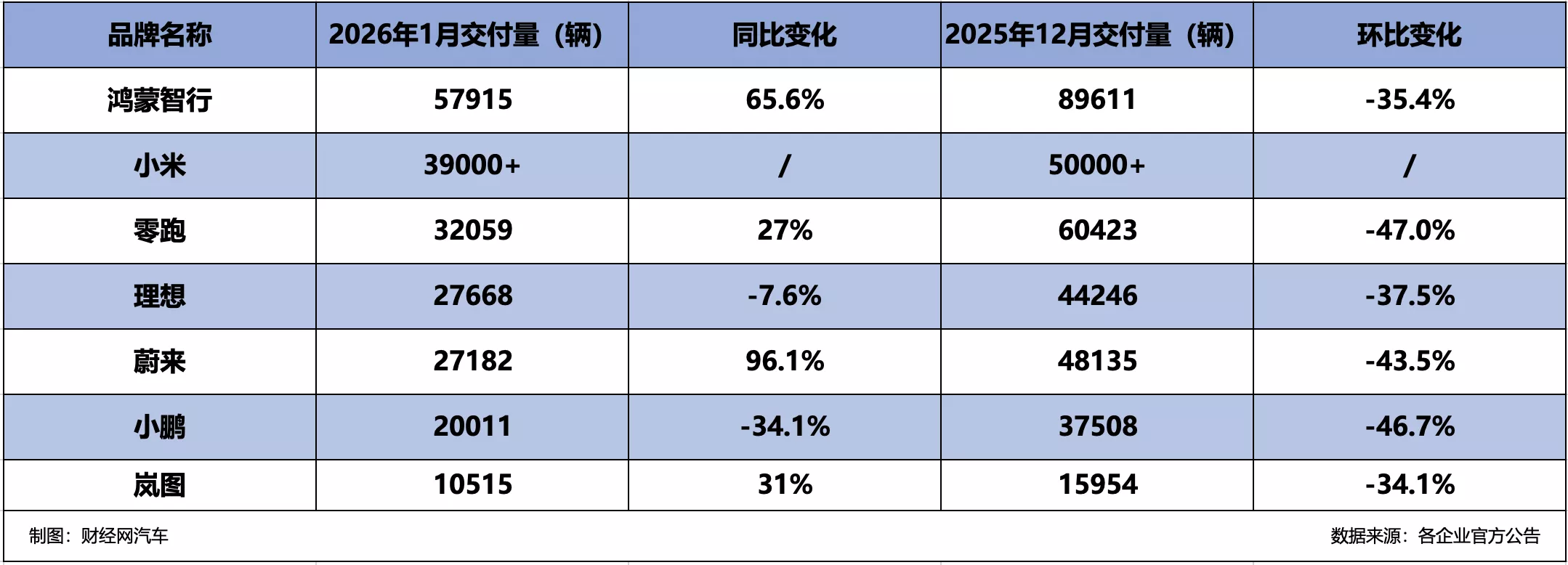
部分造车新势力1月交付数据丨鸿蒙智行57915台 小米、零跑超3万台
Cai Jing Wang· 2026-02-03 09:19
Core Insights - New energy vehicle companies in China reported mixed delivery results for January, with some experiencing significant growth while others faced declines in both year-over-year and month-over-month metrics [1][4]. Delivery Data Summary - Hongmeng Zhixing led the delivery rankings with 57,915 units, a year-over-year increase of 65.6% [5]. - Xiaomi delivered over 39,000 units, marking a 95% increase compared to January 2025 [5]. - Leap Motor delivered 32,059 units, a year-over-year increase of 27% but a month-over-month decline of 47% [5][6]. - Li Auto delivered 27,668 units, down 7.6% year-over-year and 37.5% month-over-month [7]. - NIO delivered 27,182 units, showing a 96.1% year-over-year increase but a 43.5% month-over-month decline [8]. - XPeng delivered 20,011 units, down 34.1% year-over-year and 46.7% month-over-month [10]. - Lantu delivered 10,515 units, a year-over-year increase of 31% [11]. Market Trends and Insights - The overall retail sales of passenger vehicles in China dropped by 28% year-over-year and 37% month-over-month, with new energy vehicles experiencing a notable decline [4]. - The penetration rate of new energy vehicles fell from 59.1% in December to 45.9% in January [4]. - A new energy vehicle company executive attributed the market downturn to the traditional off-peak season and the expiration of tax exemption policies, which led to demand being pulled forward [4][11].



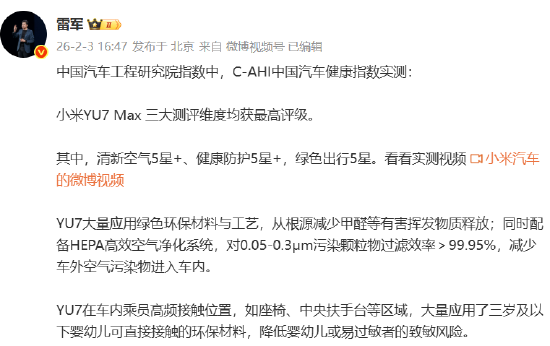
雷军:小米YU7 Max三大测评维度均获最高评级
Xin Lang Cai Jing· 2026-02-03 09:16
Group 1 - The core announcement is that Xiaomi's YU7 Max received the highest ratings across three evaluation dimensions in the China Automotive Health Index (C-AHI) by the China Automotive Engineering Research Institute [1][3] Group 2 - YU7 Max achieved a 5-star+ rating in Fresh Air, Health Protection, and Green Travel categories [2][4] - The vehicle utilizes a significant amount of green and eco-friendly materials and processes to reduce the release of harmful volatile substances like formaldehyde [2][4] - It is equipped with a HEPA air purification system that filters over 99.95% of pollutants in the size range of 0.05-0.3μm, minimizing the entry of outdoor air pollutants into the cabin [2][4] - The car's interior features eco-friendly materials in high-contact areas, such as seats and central armrests, which are safe for children aged three and under, reducing allergen risks for infants and sensitive individuals [2][4]
小米取得信息传输方法专利
Jin Rong Jie· 2026-02-03 08:23
Group 1 - The core point of the article is that Beijing Xiaomi Mobile Software Co., Ltd. has obtained a patent for an "Information Transmission Method, Device, Communication Equipment, and Storage Medium," with the authorization announcement number CN116326133B, and the application date being January 2023 [1] Group 2 - Beijing Xiaomi Mobile Software Co., Ltd. was established in 2012 and is located in Beijing, primarily engaged in software and information technology services [1] - The company has a registered capital of 148.8 million RMB [1] - According to data analysis from Tianyancha, the company has invested in 4 enterprises, participated in 150 bidding projects, and holds 5000 patent records, in addition to having 123 administrative licenses [1]
小米取得信息更新方法专利
Jin Rong Jie· 2026-02-03 06:59
作者:情报员 声明:市场有风险,投资需谨慎。本文为AI基于第三方数据生成,仅供参考,不构成个人投资建议。 本文源自:市场资讯 国家知识产权局信息显示,北京小米移动软件有限公司取得一项名为"一种信息更新方法、装置、用户 设备、基站及存储介质"的专利,授权公告号CN116406525B,申请日期为2021年11月。 天眼查资料显示,北京小米移动软件有限公司,成立于2012年,位于北京市,是一家以从事软件和信息 技术服务业为主的企业。企业注册资本148800万人民币。通过天眼查大数据分析,北京小米移动软件有 限公司共对外投资了4家企业,参与招投标项目150次,专利信息5000条,此外企业还拥有行政许可123 个。 ...
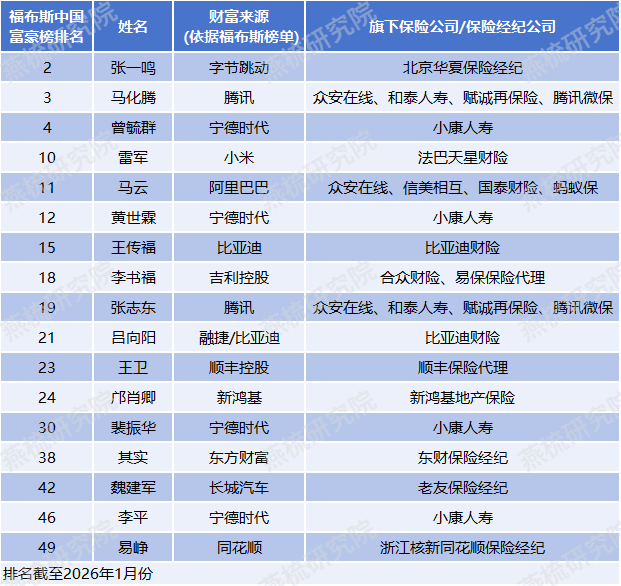
2026福布斯中国富豪榜揭晓,超三成头部富豪扎堆布局保险业
Jin Rong Jie· 2026-02-03 06:43
Core Insights - The Forbes China Rich List reveals that tech, new energy, and consumer sectors continue to lead, with many billionaires diversifying into the insurance industry, indicating its potential [1] - Over one-third of the top 50 billionaires have ventured into insurance, with 17 having established or invested in insurance companies or brokerage licenses [1][2] Group 1: Tech Giants' Insurance Strategies - Tencent has built a comprehensive insurance ecosystem through multiple platforms, including ZhongAn Online and WeChat Insurance, covering product development to sales [4] - Alibaba has also established a strong presence in insurance with entities like ZhongAn Online and Ant Insurance, simplifying the insurance purchasing process for users [4] - ByteDance, while entering the insurance space later, leverages its user base and algorithmic capabilities to create a unique competitive edge in the insurance market [4] Group 2: New Energy and Automotive Sector Involvement - New energy and automotive billionaires are increasingly participating in the insurance sector, aiming to create a full lifecycle management system from car sales to insurance services [5] - Companies like BYD and Geely have established their own insurance entities, integrating insurance with automotive services to enhance value [5] - The collaboration between insurance and the new energy sector is expected to open new growth opportunities, reflecting a long-term recognition of insurance's value [5] Group 3: Other Industries' Insurance Integration - Other industry billionaires are also penetrating the insurance market by integrating it with their core business scenarios, such as logistics and real estate [6] - SF Express has launched insurance products tailored to logistics, embedding insurance into its business model [6] - Real estate firms like New World Development are providing various insurance products to protect their assets, demonstrating a dual empowerment of their main business and insurance [6] Group 4: Trends in Insurance Industry - The insurance industry is becoming a standard for billionaires due to its stable cash flow and risk management capabilities, making it an attractive long-term investment [7] - The integration of insurance into various business ecosystems allows companies to enhance user engagement and reduce operational risks [7] - The ongoing trend of cross-industry collaboration is reshaping the competitive landscape of the insurance sector, pushing traditional insurers to accelerate digital transformation [7]


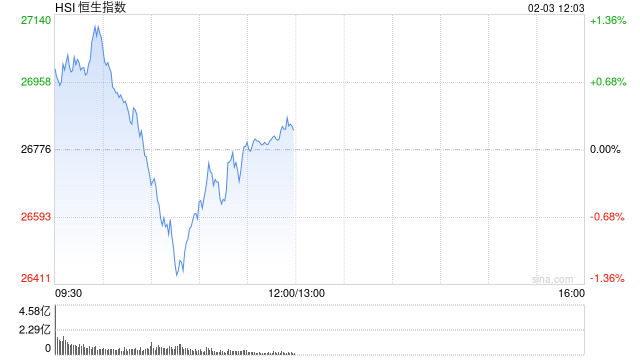
午评:港股恒指涨0.2% 科指跌1.32% 科网股普跌 商业航天概念回暖 百度跌超3%
Xin Lang Cai Jing· 2026-02-03 04:04
Market Overview - The Hong Kong stock market showed mixed performance with the Hang Seng Index rising by 0.2% to 26,830.23 points, while the Hang Seng Tech Index fell by 1.32% and the National Enterprises Index decreased by 0.22% [1][8] - Technology stocks experienced a broad decline, with Kuaishou and Bilibili dropping over 4%, and Baidu and Tencent falling more than 3% [1][8] - The commercial aerospace sector saw significant gains, particularly with Asia Pacific Satellite rising over 9% [1][8] Brokerage Sector - Chinese brokerage stocks weakened, with China International Capital Corporation (CICC) declining by over 2% [1][12] - GF Securities noted a continuous trend of incremental capital entering the market, suggesting that the brokerage sector may experience amplified elasticity due to seasonal market movements [5][12] IPO Performance - Dongpeng Beverage's Hong Kong stock debut saw it break below its issue price. The company issued 40.89 million H-shares at a price of HKD 248 each, raising approximately HKD 10.1 billion, marking it as the largest IPO in the Hong Kong consumer sector for 2026 [6][12] - The company attracted significant institutional investment, with notable backers including Qatar Investment Authority and Temasek, collectively subscribing for HKD 49.9 billion, accounting for about 49.2% of the offering [6][12]



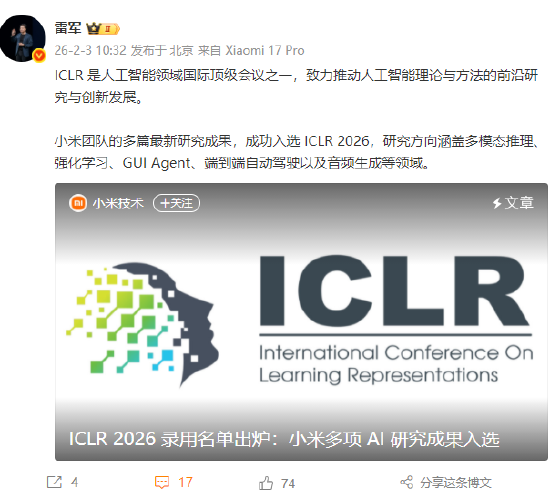
雷军:小米多篇AI最新研究成果成功入选ICLR 2026
Sou Hu Cai Jing· 2026-02-03 03:35
Core Insights - Xiaomi's founder and CEO Lei Jun announced that multiple research achievements from the Xiaomi team have been selected for ICLR 2026, focusing on areas such as multimodal reasoning, reinforcement learning, GUI agents, end-to-end autonomous driving, and audio generation [1] Group 1: Reinforcement Learning - The Xiaomi team's research titled "Shuffle-R1" introduces a dynamic data reorganization framework that addresses challenges in multimodal large model training, significantly improving gradient signal quality while surpassing existing reinforcement learning baselines with minimal computational overhead [2] Group 2: Mobile Intelligent Agents - The "MobileIPL" framework developed by the Xiaomi team pioneers iterative preference learning, optimizing thinking steps at a granular level and overcoming the scarcity of high-quality trajectories, achieving record performance in mainstream GUI-Agent tests [4] Group 3: End-to-End Autonomous Driving - The "ReCogDrive" research integrates innovative technologies by injecting prior driving knowledge into a hierarchical cognitive data pipeline, utilizing a cognitive-guided diffusion planner to generate physically feasible trajectories, and introducing the DiffGRPO reinforcement learning algorithm to directly optimize driving strategies, leading in closed-loop tests [5] Group 4: Other Innovations - Additional innovations from the Xiaomi team include "ThinkOmni," which enables zero-cost transfer of text reasoning capabilities to all modalities; "Flow2GAN," which combines flow matching and adversarial generation for high-fidelity audio synthesis; and "WorldSplat," which advances 4D driving scene generation technology [5]

雷军官宣小米多篇最新研究成果成功入选ICLR 2026国际顶级会议
Sou Hu Cai Jing· 2026-02-03 03:13
Core Insights - Xiaomi's founder and CEO Lei Jun announced that multiple research achievements from the Xiaomi team have been selected for ICLR 2026, covering areas such as multimodal reasoning, reinforcement learning, GUI agents, end-to-end autonomous driving, and audio generation [1][3]. Group 1: Research Achievements - The research paper titled "Shuffle-R1: Efficient RL framework for Multimodal Large Language Models via Data-centric Dynamic Shuffle" addresses inefficiencies in existing reinforcement learning training processes, particularly issues like Advantage Collapsing and Rollout Silencing, which hinder long-term optimization capabilities [4]. - Shuffle-R1 proposes a streamlined reinforcement learning framework that significantly enhances training efficiency through two core designs: Pairwise Trajectory Sampling and Advantage-based Batch Shuffle, leading to improved gradient signal quality and increased exposure of valuable trajectories [4]. - Experimental results indicate that Shuffle-R1 consistently outperforms various reinforcement learning baselines with minimal computational overhead [4]. Group 2: Mobile Agents and GUI - The paper "MobileIPL: Enhancing Mobile Agents Thinking Process via Iterative Preference Learning" introduces a framework to improve the reasoning and planning capabilities of Mobile GUI Agents, addressing challenges such as the scarcity of high-quality CoaT trajectories and the limitations of existing self-training methods [7][8]. - MobileIPL employs Thinking-level DPO and Instruction Evolution to enhance process supervision and expand task distribution, resulting in state-of-the-art performance on mainstream GUI-Agent benchmarks [8][10]. Group 3: Language Models - "FutureMind: Equipping Small Language Models with Strategic Thinking-Pattern Priors via Adaptive Knowledge Distillation" presents a modular reasoning framework for small language models (SLMs) that enhances their performance in complex tasks without additional training or parameter increments [12][13]. - FutureMind extracts advanced cognitive abilities from large language models (LLMs) through adaptive knowledge distillation, creating a dynamic reasoning pipeline that significantly improves reasoning efficiency and retrieval accuracy [12][13]. Group 4: Multimodal Reasoning - The paper "ThinkOmni: Lifting Textual Reasoning to Omni-modal Scenarios via Guidance Decoding" proposes a framework that transfers mature textual reasoning capabilities to multimodal scenarios without the need for costly model fine-tuning [16][17]. - ThinkOmni includes components like LRM-as-a-Guide and Stepwise Contrastive Scaling, which balance perception and reasoning signals, demonstrating consistent performance improvements across multiple multimodal reasoning benchmarks [17]. Group 5: Audio Generation - "Flow2GAN: Hybrid Flow Matching and GAN with Multi-Resolution Network for Few-step High-Fidelity Audio Generation" introduces a two-stage audio generation framework that combines Flow Matching pre-training with lightweight GAN fine-tuning for efficient audio generation [23][24]. - The framework enhances audio modeling capabilities by addressing the unique properties of audio signals and demonstrates superior performance in generating high-fidelity audio with improved computational efficiency compared to existing methods [24].
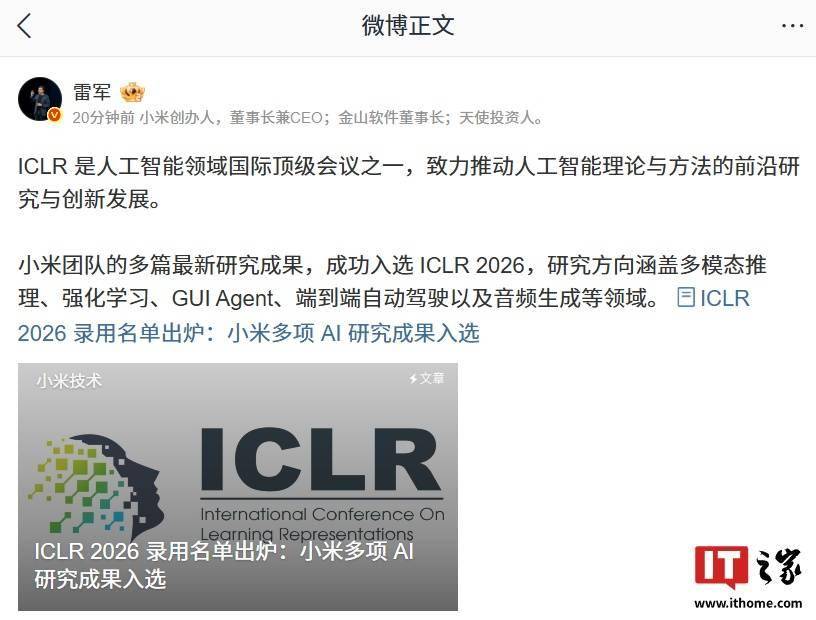
雷军:小米团队多篇最新研究成果成功入选ICLR 2026
Xin Lang Cai Jing· 2026-02-03 02:46
2月3日消息,雷军发微博表示,小米团队的多篇最新研究成果,成功入选 ICLR 2026,研究方向涵盖多 模态推理、强化学习、GUI Agent、端到端自动驾驶以及音频生成等领域。 据介绍,ICLR 是人工智能领域国际顶级会议之一,致力推动人工智能理论与方法的前沿研究与创新发 展。 责任编辑:李思阳 2月3日消息,雷军发微博表示,小米团队的多篇最新研究成果,成功入选 ICLR 2026,研究方向涵盖多 模态推理、强化学习、GUI Agent、端到端自动驾驶以及音频生成等领域。 据介绍,ICLR 是人工智能领域国际顶级会议之一,致力推动人工智能理论与方法的前沿研究与创新发 展。 责任编辑:李思阳 ...