LI AUTO-W(02015)

Search documents
Li Auto beats Q3 topline estimates (NASDAQ:LI)
Seeking Alpha· 2025-11-26 09:01
To ensure this doesn’t happen in the future, please enable Javascript and cookies in your browser.If you have an ad-blocker enabled you may be blocked from proceeding. Please disable your ad-blocker and refresh. ...


理想汽车:第三季度经营亏损为人民币12亿元
Di Yi Cai Jing· 2025-11-26 08:53
理想汽车发布数据显示,2025年第三季度营收274亿元,上年同期为428.7亿元;第三季度经营亏损为人 民币12亿元(165.4百万美元),而2024年第三季度的经营利润为人民币34亿元,2025年第二季度的经 营利润为人民币827.0百万元;预计2025年第四季度车辆交付量将在10万至11万辆之间。 (文章来源:第一财经) ...
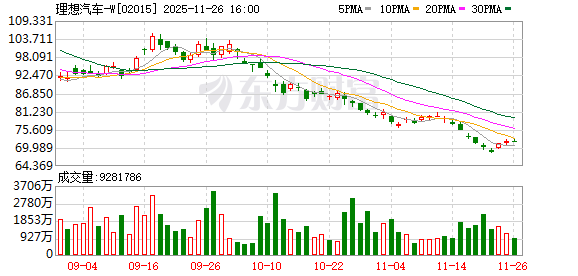
理想汽车第三季度营收274亿元人民币,预估266.2亿元人民币
Hua Er Jie Jian Wen· 2025-11-26 08:46
市场有风险,投资需谨慎。本文不构成个人投资建议,也未考虑到个别用户特殊的投资目标、财务状况或需要。用户应考虑本文中的任何 意见、观点或结论是否符合其特定状况。据此投资,责任自负。 风险提示及免责条款 理想汽车预计第四季度营收265亿元人民币至292亿元人民币;预计第四季度交付量100000至110000辆。 ...
Li Auto Inc. Announces Unaudited Third Quarter 2025 Financial Results
Globenewswire· 2025-11-26 08:45
Core Viewpoint - Li Auto Inc. reported a significant decline in vehicle deliveries and financial performance for the third quarter of 2025, reflecting challenges in the new energy vehicle market and operational difficulties. Operating Highlights - Total deliveries for Q3 2025 were 93,211 vehicles, a 39.0% year-over-year decrease [2][3] - The company had 542 retail stores in 157 cities and 3,420 supercharging stations in operation as of September 30, 2025 [3] Financial Highlights - Vehicle sales amounted to RMB 25.9 billion (US$ 3.6 billion) in Q3 2025, down 37.4% from RMB 41.3 billion in Q3 2024 and down 10.4% from RMB 28.9 billion in Q2 2025 [4][13] - Total revenues were RMB 27.4 billion (US$ 3.8 billion), a decrease of 36.2% year-over-year [4][13] - Gross profit was RMB 4.5 billion (US$ 627.8 million), down 51.6% from RMB 9.2 billion in Q3 2024 [4][13] - Net loss was RMB 624.4 million (US$ 87.7 million), compared to a net income of RMB 2.8 billion in Q3 2024 [4][24] Cost and Margin Analysis - Cost of sales was RMB 22.9 billion (US$ 3.2 billion), a decrease of 32.0% from RMB 33.6 billion in Q3 2024 [18] - Vehicle margin was 15.5% in Q3 2025, down from 20.9% in Q3 2024 [4][18] - Gross margin was 16.3%, compared to 21.5% in Q3 2024 [4][18] Operating Expenses - Operating expenses were RMB 5.6 billion (US$ 793.1 million), a decrease of 2.5% from RMB 5.8 billion in Q3 2024 [4][18] - Research and development expenses increased by 15.0% year-over-year to RMB 3.0 billion (US$ 417.8 million) [18] Cash Flow and Financial Position - Net cash used in operating activities was RMB 7.4 billion (US$ 1.0 billion) in Q3 2025, compared to RMB 11.0 billion net cash provided in Q3 2024 [7][24] - Free cash flow was negative RMB 8.9 billion (US$ 1.3 billion) in Q3 2025 [7][24] - Cash position was RMB 98.9 billion (US$ 13.9 billion) as of September 30, 2025 [24] Recent Developments - The company launched the Li i6, a new battery electric SUV, in September 2025 [9] - In October 2025, Li Auto opened its first overseas authorized retail store in Tashkent, Uzbekistan [10] - The Li i8 achieved the highest score in the China-Automobile Health Index assessment [11] Management Commentary - The CEO highlighted strong momentum in the BEV portfolio and confidence in achieving long-term strategic objectives despite market challenges [12] - The CFO noted operational resilience with a gross margin of 20.4% when excluding recall costs [12]
理想汽车(02015) - 2025 Q3 - 季度业绩
2025-11-26 08:45
香港交易及結算所有限公司及香港聯合交易所有限公司對本公告的內容概不負責,對其準確性 或完整性亦不發表任何聲明,並明確表示,概不對因本公告全部或任何部分內容而產生或因倚 賴該等內容而引致的任何損失承擔任何責任。 Li Auto Inc. 理想汽車 (於開曼群島註冊成立以不同投票權控制的有限責任公司) (股份代號:2015) 內幕消息 截至2025年9月30日止季度的 未經審計財務業績 有限的經營歷史;與增程式電動汽車和高壓純電動汽車有關的風險;理想汽車研 發、製造及交付優質且吸引客戶的車輛的能力;理想汽車產生正現金流及利潤的 能力;使車輛性能不及預期的產品缺陷或任何其他故障;理想汽車成功競爭的能 力;理想汽車建立品牌及承受負面報道的能力;理想汽車的車輛訂單被取消;理 想汽車研發新汽車的能力;及消費者需求及政府獎勵、補貼或其他有利的政府政 策變化。有關以上及其他風險的更多資料載於理想汽車向美國證交會及香港聯交 所提交的文件中。本公告中提供的所有資料均截至本公告發佈之日,除適用法律 要求外,理想汽車不承擔更新任何前瞻性陳述的義務。 建議本公司股東及潛在投資者勿過於依賴第三季度業績,並於買賣本公司證券時 審慎行事。 ...
Top Wall Street Forecasters Revamp Li Auto Expectations Ahead Of Q3 Earnings - Hesai Gr (NASDAQ:HSAI), Li Auto (NASDAQ:LI)
Benzinga· 2025-11-26 06:00
Earnings Report - Li Auto Inc. is set to release its third-quarter earnings results on November 26, with analysts expecting earnings of 4 cents per share and revenue of $3.76 billion [1] Partnership and Stock Performance - Hesai Technology has been named the exclusive lidar supplier for Li Auto's next-generation assisted driving platform, covering all upcoming models, which signifies a major expansion of their collaboration [2] - Following the announcement, shares of Li Auto increased by 1.1%, closing at $18.32 [2] Analyst Ratings - Piper Sandler analyst Alexander Potter initiated coverage on Li Auto with a Neutral rating and a price target of $19, while Barclays analyst Jiong Shao maintained an Equal-Weight rating but reduced the price target from $31 to $24 [5]
Top Wall Street Forecasters Revamp Li Auto Expectations Ahead Of Q3 Earnings
Benzinga· 2025-11-26 06:00
Core Insights - Li Auto Inc. is set to release its third-quarter earnings results on November 26, with analysts predicting earnings of 4 cents per share and revenue of $3.76 billion [1] Group 1: Company Developments - Hesai Technology has been named the exclusive lidar supplier for Li Auto's next-generation assisted driving platform, which includes all upcoming models such as the "L" Series, "i" Series, and "MEGA," indicating a significant expansion of their collaboration [2] - Li Auto's shares increased by 1.1%, closing at $18.32 on the day of the announcement regarding the lidar supply agreement [2] Group 2: Analyst Ratings - Piper Sandler analyst Alexander Potter initiated coverage on Li Auto with a Neutral rating and a price target of $19, reflecting an accuracy rate of 77% [5] - Barclays analyst Jiong Shao maintained an Equal-Weight rating but reduced the price target from $31 to $24, with an accuracy rate of 70% [5]
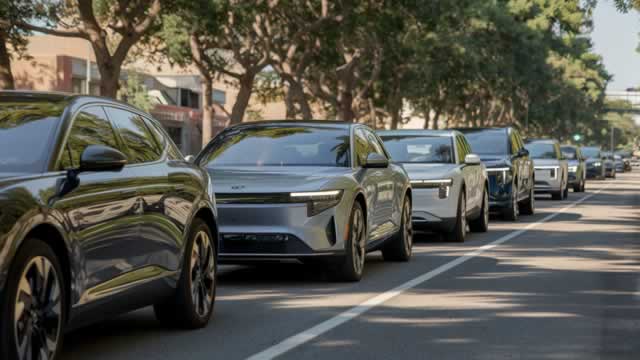
理想汽车将推出智能AI眼镜
Feng Huang Wang· 2025-11-26 05:35
Core Viewpoint - Li Auto's founder Li Xiang announced that the company will not produce smartphones but will introduce ecosystem products, including smart glasses, which he considers the best AI accessory for Li Auto vehicles [1] Group 1: Product Development - Li Auto has discussed the necessity and feasibility of developing self-researched smart glasses since last year's strategic meeting [1] - A new department called "Wearable Robotics" was established in June to potentially develop the smart glasses [1] - Smart speakers are also under consideration, aiming to enhance the AI capabilities in users' lives [1]
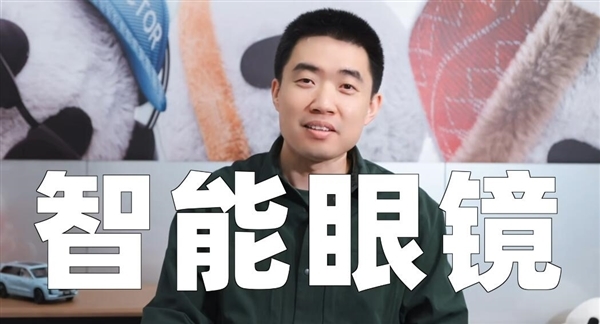
理想汽车将发布AI智能眼镜,李想称其为最佳人工智能附件
Mei Ri Jing Ji Xin Wen· 2025-11-26 03:10
Core Viewpoint - Li Auto is entering the smart glasses market, with CEO Li Xiang announcing the upcoming release of "Li Auto AI Glasses," which he describes as the company's best artificial intelligence accessory [1] Group 1 - Li Auto's CEO Li Xiang shared a video on social media regarding the launch of smart glasses [1] - The announcement positions Li Auto in the competitive landscape of smart eyewear, referred to as the "hundred glasses battle" [1] - The smart glasses are expected to enhance the company's portfolio of AI-related products [1]

理想汽车入局“百镜大战”,李想称将发布智能眼镜
Xin Lang Cai Jing· 2025-11-26 01:38
Core Insights - Li Auto's CEO Li Xiang announced the upcoming launch of the "Li Auto AI Glasses," positioning it as the best AI accessory for the company [1] - The company aims to enhance its AI capabilities across various platforms, including cars, smartphones, and now smart glasses, targeting a user base of approximately 3 to 5 million people [1] - The AI glasses market is becoming increasingly competitive, with significant growth expected in the coming years, as indicated by research from RUNTO [1] Company Developments - Li Auto is not venturing into smartphone production but is focusing on enhancing its AI assistant app, "Li Xiang Classmate," which is already available on mobile devices [1] - The company has previously applied for a patent related to VR glasses, indicating its commitment to innovation in this space [1] Industry Trends - The AI glasses market is experiencing rapid growth, with projections indicating that global sales will reach 5.1 million units by 2025, with a growth rate exceeding 200% [1] - Major players in the AI glasses sector include tech giants like Xiaomi and Alibaba, who have recently launched their own AI glasses, highlighting the competitive landscape [2] - Xiaomi's AI glasses sold 31,000 units in the first week of launch, capturing 12% of the overall AI/AR market, while Alibaba's Quark AI glasses are set to be released soon [2]