LI AUTO-W(02015)

Search documents
“银十”变“金十” 多家新能源车企10月销量创新高
Bei Jing Ri Bao Ke Hu Duan· 2025-11-03 08:23
Core Insights - The automotive market in October experienced strong performance, driven by favorable policies and the launch of new models, leading to a "golden October" for the industry [3] Group 1: New Energy Vehicle Sales - Leap Motor achieved a monthly delivery of 70,289 units, marking a year-on-year increase of over 84%, maintaining its position as the monthly sales champion among new forces [1] - Xiaopeng Motors delivered 42,013 vehicles in October, a historical high with a year-on-year growth of 76% and a month-on-month increase of 1% [1] - NIO's deliveries reached 40,397 units, a year-on-year increase of 92.6%, supported by the launch of new models [1] - Xiaomi Motors also surpassed 40,000 monthly deliveries [1] - Li Auto's deliveries decreased both year-on-year and month-on-month, totaling 31,767 units in October [1] Group 2: Traditional Automakers' Performance - Geely's Zeekr brand sold 21,400 units in October, a year-on-year increase of 63.8% [2] - BAIC's Arcfox brand achieved sales of 23,400 units, a remarkable year-on-year growth of 110% [2] - Dongfeng's Lantu delivered 17,200 units, while Changan's Avita Technology sold 13,500 units, both reaching historical highs [2] - SAIC's Zhiji brand sold 13,200 units, also a record for the brand [2] Group 3: Overall Market Trends - BYD's new energy vehicle sales reached 441,706 units in October, showing a year-on-year decline of 12% but a month-on-month increase of 11.47%, with overseas sales surging by 155% [2] - SAIC's total vehicle sales for October were 453,978 units, reflecting a year-on-year growth of 12.96%, with new energy vehicle sales increasing by 31.6% [2] - Chery Group's total sales reached 281,161 units, a year-on-year increase of 3.3%, with new energy vehicle sales surpassing 110,000 units for the first time [2]





召回常态化,让隐患清零让信任重塑
Bei Ke Cai Jing· 2025-11-03 08:01
Core Viewpoint - Li Auto announced a recall of 11,411 units of the Li MEGA model due to insufficient coolant corrosion resistance, offering free replacement of power batteries and related equipment for affected owners [1] Group 1: Recall Context and Industry Implications - The automotive industry is characterized by its complexity, with each vehicle containing thousands of components across various systems, making recalls a crucial method for balancing safety, industry development, and consumer rights [1] - The recall system in China has evolved since its establishment in 2004, now forming a comprehensive framework that includes legal, technical, regulatory, and execution aspects [1] - In the past five years, the average annual number of vehicle recalls in China has reached 216, totaling over 7.59 million vehicles, indicating that recalls have become a normalized practice [2] Group 2: Quality Management and Consumer Trust - Recalls reflect a proactive approach to risk management, demonstrating that companies have established robust quality monitoring systems capable of identifying and addressing issues before they escalate [2] - The automotive industry emphasizes systemic safety, where consumers are purchasing not just functionality but also trust in the brand [2] - Proactive recalls are indicative of a company's internal risk control capabilities and long-term brand management strategy, where transparency and responsibility are foundational to consumer trust [2][3] Group 3: Regulatory Compliance and Industry Maturity - New energy vehicle companies are adapting to the regulatory environment by viewing recalls as part of quality management rather than merely public relations events [3] - The notion that recalls equate to quality crises is outdated; instead, they are a routine aspect of a mature automotive industry [2][5] - The frequency of recalls should be viewed through a governance lens, reflecting a company's ability to identify and resolve issues efficiently [5] Group 4: Safety Standards and Industry Evolution - Safety in the automotive sector is defined by absolute standards rather than cost-effectiveness, with proactive recalls being more trustworthy than a zero-recall approach [4] - The normalization of recalls is essential for the continuous upgrade of safety standards and the steady pace of innovation within the industry [5] - Recalls serve as a core metric for industry maturity and are vital for driving technological iteration and building a trust-based ecosystem [5]

10月各家车企销量
数说新能源· 2025-11-03 03:16
Sales Performance Summary - BYD achieved sales of 441,700 units in October, representing a year-on-year increase of 5.31% and a month-on-month increase of 11%. Cumulative sales for 2025 reached 3.7019 million units, with a year-on-year growth of 20.93% [1] - Geely Automobile reported sales of 307,100 units in October, showing a year-on-year increase of 35.49% and a month-on-month increase of 12%. Cumulative sales for 2025 reached 2.4773 million units, with a year-on-year growth of 44.33% [1] - Great Wall Motors sold 143,100 units in October, marking a year-on-year increase of 22.50% and a month-on-month increase of 7%. Cumulative sales for 2025 reached 1.0664 million units, with a year-on-year growth of 9.87% [1] - Xpeng Motors recorded sales of 42,000 units in October, a significant year-on-year increase of 76% and a month-on-month increase of 1%. Cumulative sales for 2025 reached 355,200 units, with a year-on-year growth of 190.02% [1] - Li Auto's sales were 31,800 units in October, reflecting a year-on-year decline of 38.25% and a month-on-month decline of 6%. Cumulative sales for 2025 reached 328,900 units, with a year-on-year decrease of 16.36% [1] - NIO sold 40,400 units in October, achieving a year-on-year increase of 92.59% and a month-on-month increase of 16%. Cumulative sales for 2025 reached 241,600 units, with a year-on-year growth of 41.91% [1] - Leap Motor reported sales of 70,300 units in October, with a year-on-year increase of 94.78% and a month-on-month increase of 5%. Cumulative sales for 2025 reached 465,800 units, with a year-on-year growth of 126.93% [1] - Zeekr's sales were 21,400 units in October, showing a year-on-year decline of 14.48% but a month-on-month increase of 17%. Cumulative sales for 2025 reached 165,000 units, with a year-on-year decrease of 1.73% [1] - Deep Blue sold 36,800 units in October, marking a year-on-year increase of 69.33% and a month-on-month increase of 9%. Cumulative sales for 2025 reached 262,400 units, with a year-on-year growth of 80.66% [1] - Lantu reported sales of 17,200 units in October, achieving a year-on-year increase of 69.52% and a month-on-month increase of 13%. Cumulative sales for 2025 reached 114,200 units, with a year-on-year growth of 82.14% [1]




理想汽车主动召回1.14万辆MEGA 前10月交付降16.4%位列新势力第四
Chang Jiang Shang Bao· 2025-11-03 03:15
Core Viewpoint - The company has initiated a proactive recall of the Li Auto MEGA 2024 model due to safety concerns following a fire incident, reflecting a commitment to customer safety and product reliability [1][2][3]. Group 1: Recall and Safety Measures - The recall involves 11,411 units of the Li Auto MEGA 2024 model, which will undergo safety inspections and necessary repairs starting from November 7, 2025 [3][4]. - The recall is due to insufficient corrosion resistance of the coolant, which could lead to battery overheating and potential safety hazards [3][5]. - The company will provide free replacement of coolant, battery, and front motor controller for the recalled vehicles [4]. Group 2: Sales Performance - In October 2025, the company delivered 31,800 new vehicles, marking a 38.25% year-on-year decline, and a total of 328,900 vehicles delivered in the first ten months, down 16.36% year-on-year [2][7]. - The company has dropped to fourth place among new car manufacturers, with competitors like Leap Motor and Xpeng outperforming it in sales [2][7]. - The initial sales target for 2025 was set at 700,000 units, which has been revised down to 640,000 units, indicating challenges in meeting sales expectations [8][10]. Group 3: Financial Performance - For the first half of 2025, the company reported revenue of 56.172 billion yuan, a 2% decline year-on-year, marking the first mid-year revenue drop since its IPO [10]. - The net profit for the same period was 1.744 billion yuan, reflecting a 3% year-on-year increase [10]. Group 4: Infrastructure Expansion - As of September 30, 2024, the company had established 479 retail centers across 145 cities and 436 service centers in 221 cities [10]. - By September 30, 2025, the number of retail centers increased to 542, covering 157 cities, with 546 service centers in 225 cities [10].
新能源免购置税倒计时:多家车企宣布税费“兜底”政策 ,年底抢单大战开始!
Mei Ri Jing Ji Xin Wen· 2025-11-03 03:00
Core Viewpoint - The upcoming reduction of the new energy vehicle purchase tax is expected to stimulate a surge in vehicle purchases before the end of the year, with many consumers eager to take advantage of the tax benefits before they expire [1][5]. Group 1: Purchase Tax Policies - Several automakers have introduced "guarantee" policies for the purchase tax, ensuring that if vehicles are delayed due to production or transportation issues, the companies will cover the tax difference, with subsidies reaching up to 15,000 yuan per vehicle [1][4]. - Ideal Auto has set a deadline for consumers to place orders by the end of November to qualify for the purchase tax guarantee, with additional cash subsidies for those who order earlier [2][3]. Group 2: Market Dynamics - The automotive market is currently in a sales push as companies aim to meet their annual targets, coinciding with the critical window of the purchase tax policy [5][7]. - Data from the China Passenger Car Association indicates that the retail sales of new energy vehicles reached 901,000 units from October 1 to 26, marking a 22% year-on-year increase, reflecting sustained consumer enthusiasm [7]. Group 3: Consumer Behavior - Consumers are encouraged to place orders quickly to avoid missing out on tax benefits, especially for vehicles priced over 200,000 yuan, where the purchase tax represents a significant cost [5][7]. - The competitive landscape is intensifying as various manufacturers, including Xiaomi and Chery, implement similar tax guarantee policies to attract buyers [4][5].
10月新能源车企销量普增,比亚迪、零跑等创新高
Cai Jing Wang· 2025-11-03 01:51
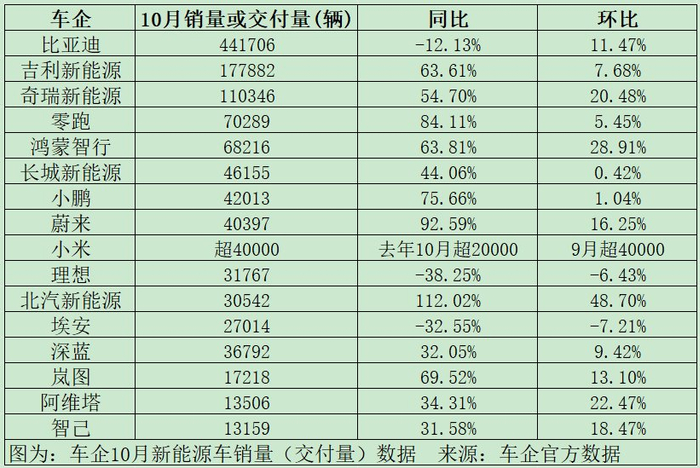
Core Insights - The overall delivery volume of new energy vehicle companies in October showed a month-on-month increase compared to September, with significant contributions from both traditional and new energy vehicle manufacturers [1] Group 1: Company Performance - BYD achieved a total sales volume of 441,706 units in October, marking an 11.47% increase month-on-month but a 12.13% decrease year-on-year [1] - Geely New Energy and Chery New Energy ranked second and third in sales, with year-on-year increases of 63.61% and 54.70%, respectively [1] - Leap Motor's monthly delivery volume reached a record high of 70,289 units, representing an 84.11% increase year-on-year [1] Group 2: State-Owned Enterprises - Among state-owned enterprises, Deep Blue, BAIC New Energy, and Lantu ranked highest in sales, with Lantu achieving nine consecutive months of growth since 2025 [1] - BAIC New Energy reported a remarkable year-on-year increase of 112.02% in sales, reaching 30,542 units in October [1] - Lantu's sales increased by 69.52% year-on-year, totaling 17,218 units [1] Group 3: Emerging Players - Companies like Xpeng and NIO also reported significant growth, with Xpeng achieving a year-on-year increase of 75.66% and NIO experiencing a decline of 38.25% [1] - The overall performance of new energy vehicle startups indicates a competitive landscape, with several companies breaking their previous monthly delivery records [1]
智通港股通持股解析|11月3日
智通财经网· 2025-11-03 00:37
Core Insights - The top three companies by Hong Kong Stock Connect holding ratios are China Telecom (71.03%), Gree Power Environmental (70.14%), and COSCO Shipping Energy (70.01%) [1] - The companies with the largest increase in holdings over the last five trading days are SMIC (+1.651 billion), CNOOC (+1.474 billion), and Hua Hong Semiconductor (+1.336 billion) [1] - The companies with the largest decrease in holdings over the last five trading days are Alibaba-W (-2.229 billion), Li Auto-W (-1.200 billion), and CSPC Pharmaceutical (-0.894 billion) [2] Hong Kong Stock Connect Holding Ratios - China Telecom (00728): 9.859 billion shares, 71.03% [1] - Gree Power Environmental (01330): 0.284 billion shares, 70.14% [1] - COSCO Shipping Energy (01138): 0.907 billion shares, 70.01% [1] - Other notable companies include: - Kaisa New Energy (01108): 0.170 billion shares, 68.09% [1] - China Shenhua (01088): 2.289 billion shares, 67.75% [1] Recent Increases in Holdings - SMIC (00981): +1.651 billion, +22.0185 million shares [1] - CNOOC (00883): +1.474 billion, +74.5610 million shares [1] - Hua Hong Semiconductor (01347): +1.336 billion, +16.7516 million shares [1] - Other companies with significant increases include Tencent Holdings (+1.016 billion) and Meituan-W (+0.777 billion) [1] Recent Decreases in Holdings - Alibaba-W (09988): -2.229 billion, -13.5031 million shares [2] - Li Auto-W (02015): -1.200 billion, -15.0509 million shares [2] - CSPC Pharmaceutical (01093): -0.894 billion, -11.6849 million shares [2] - Other companies with notable decreases include Xpeng Motors (-0.457 billion) and BYD Electronics (-0.398 billion) [2]



对理想25年10月交付31767辆的分析
自动驾驶之心· 2025-11-03 00:04
Core Insights - The article discusses the delivery performance of the company in October 2025, highlighting that the delivery of 31,767 units is considered low and that detailed model-specific expectations will be available later [2][3]. Delivery Performance - The delivery figure of 31,767 units for October 2025 is viewed as underwhelming, with specific model breakdowns expected to be released around November 10 [2]. - The L series orders are reported to be poor, while the MEGA model is performing normally [3]. Production Capacity Issues - The i8 model faces production capacity challenges due to a low configuration selection rate of approximately 2%, making it difficult for the supplier to ramp up production [4]. - The configuration strategy for the i8 differs significantly from the L78 model, with a smaller price gap and greater configuration differences [4]. - The i6 model will not be delivered with the Xinhua battery version in 2025, as the supplier also struggles to increase production capacity [10]. Configuration Preferences - The configuration distribution for the i8 is approximately 2% low configuration, 20% mid configuration, and 80% high configuration, which contrasts sharply with the L78 model's configuration choices [9]. - The L series models show a low configuration selection rate of about 22% for L7 and 37% for L8 [8]. Market Dynamics and Challenges - Various hypotheses are presented regarding the poor performance of L series orders, including rapid competitor iterations, economic conditions, and potential organizational issues [14][15]. - The company may have misjudged market conditions, leading to a lack of timely decisions regarding battery supply options [12][13]. Future Expectations - There are indications that the company may deliver around 100,000 units in Q4 2025, with expectations for Q1 2026 to remain positive, although the reliability of this information is uncertain [16].
智通港股通资金流向统计(T+2)|11月3日
智通财经网· 2025-11-02 23:32
Core Insights - The article highlights the net inflow and outflow of funds for various companies in the Hong Kong stock market, indicating significant movements in investor sentiment and market dynamics [1][2][3] Net Inflow Summary - The top three companies with the highest net inflow of funds are Huahong Semiconductor (华虹半导体) with 388 million, Pop Mart (泡泡玛特) with 320 million, and Qingdao Beer (青岛啤酒股份) with 305 million [1][2] - The net inflow percentages for these companies are 8.15%, 7.92%, and 58.54% respectively, indicating strong investor interest, particularly in Qingdao Beer [2][3] Net Outflow Summary - The companies with the highest net outflow of funds include Alibaba-W (阿里巴巴-W) with -523 million, Southern Hang Seng Technology (南方恒生科技) with -429 million, and Tencent Holdings (腾讯控股) with -355 million [1][2] - The net outflow percentages for these companies are -3.89%, -4.86%, and -3.36% respectively, reflecting a negative sentiment among investors towards these stocks [2][3] Net Inflow Ratio Summary - The companies with the highest net inflow ratios are Shenzhen Expressway (深圳高速公路股份) at 68.48%, Anhui Wanshan Expressway (安徽皖通高速公路) at 64.22%, and Legend Holdings (联想控股) at 59.98% [1][3] - These ratios suggest a strong demand for shares in these companies relative to their trading volume [3] Net Outflow Ratio Summary - The companies with the highest net outflow ratios are Huadian International Power (华电国际电力股份) at -62.31%, CIMC Enric (中集安瑞科) at -54.98%, and Connoisseur-B (康诺亚-B) at -52.78% [1][3] - These figures indicate significant selling pressure and a lack of confidence among investors in these stocks [3]

纵横游长江,零跑晒奶奶,奔驰淋黄油,阿维塔开餐厅…… 车企渴望“胆大出奇迹”
汽车商业评论· 2025-11-02 23:06
Core Viewpoint - The automotive industry is experiencing a "year-end sprint" as 2025 approaches, with companies employing unconventional marketing strategies to capture consumer attention amidst a crowded market [4][5]. Group 1: Innovative Marketing Strategies - Mercedes-Benz collaborated with McDonald's to promote the new electric CLA by transforming the car into a "giant hamburger" and using youth-oriented language in their campaign [6][8]. - Chery Jetour's G700 made headlines by successfully crossing the Yangtze River, showcasing its capabilities and significantly boosting brand visibility, with over 15,717 orders within 24 hours of its launch [10][12]. - GAC Group partnered with JD.com for a promotional event leading up to Double Eleven, generating significant buzz and engagement through a blind auction that attracted over 23,000 bids [14][18]. Group 2: Celebrating Milestones - FAW-Volkswagen celebrated the production of its 30 millionth vehicle with a month-long marketing campaign, including a cultural festival and promotional offers that attracted around 130,000 participants [16][20]. - The success of FAW-Volkswagen's campaign highlights the importance of integrating celebration with promotional activities to maximize brand value [20]. Group 3: Unique Brand Engagement - Leap Motor's 61-year-old sales representative gained widespread admiration, leading to the launch of a training program that emphasizes the brand's commitment to employee empowerment and customer connection [21][23]. - Avita introduced a unique dining experience in its showrooms, offering high-quality meals to visitors, aiming to enhance customer engagement and brand perception [35][37]. Group 4: Product Testing and Globalization - Avita and Great Wall Motors are conducting extreme environment tests in Antarctica to validate their vehicles' performance, addressing the growing demand for adaptability in various climates [25][30]. - This focus on rigorous testing reflects the industry's shift towards ensuring product reliability in diverse global markets [30]. Group 5: Addressing Safety Concerns - Multiple incidents of vehicle fires in October raised safety concerns across the industry, with Li Auto taking proactive measures by recalling over 11,000 vehicles to address identified issues [41][45]. - The response from Li Auto contrasts with the silence from other brands, highlighting the importance of transparency and accountability in maintaining consumer trust [45].