LI AUTO-W(02015)

Search documents
港股开盘 | 恒生指数高开0.34% 新能源车多数走高 理想汽车(02015)涨超3%
智通财经网· 2025-09-16 01:41
Group 1 - The Hang Seng Index opened up 0.34%, and the Hang Seng Tech Index rose by 0.45%, indicating a positive market sentiment [1] - New energy vehicle stocks showed strength, with Li Auto rising over 3%, NIO increasing by more than 2%, and Xpeng Motors gaining nearly 1% [1] Group 2 - According to Zhongyin International, the acceleration of domestic substitution and the rapid development of the AI industry cycle are expected to benefit tech stocks during the current revaluation of RMB assets [2] - The macroeconomic "weak recovery" pattern remains unchanged, suggesting that large-cap tech companies still have room for growth, with a clear absolute prosperity advantage [2] - The strategy team at CMB Securities (Hong Kong) believes that the improvement in supply-demand dynamics may lead to an economic cycle turning point, with capital expenditure and R&D in the tech sector gradually translating into corporate profits [2] - The expectation of a rate cut by the Federal Reserve may lead to continued inflows of southbound and foreign capital into the Hong Kong stock market, which is seen as a global valuation low [2] - Huatai Securities' chief macroeconomist noted that the liquidity environment for Hong Kong stocks remains ample, with a rebound in fundamental expectations providing significant support [2] Group 3 - China Galaxy Securities' chief strategist Yang Chao suggests focusing on three investment opportunities in Hong Kong stocks: high earnings growth sectors with low to medium valuations, sectors benefiting from policy support such as the AI industry chain and consumption, and financial sectors that may offer stable returns and high dividends amid domestic and international uncertainties [3]

财经早报:中美就妥善解决TikTok问题达成基本框架共识
Xin Lang Zheng Quan· 2025-09-15 23:37
Group 1 - The Chinese Ministry of Commerce announced a basic framework consensus with the U.S. to resolve the TikTok issue and promote economic cooperation [2] - Nvidia is under further investigation for violating China's antitrust laws related to its acquisition of Mellanox Technologies [3] - The State Administration of Foreign Exchange released new measures to facilitate foreign investment and improve cross-border financing [4] Group 2 - The National Bureau of Statistics reported that the real estate market is stabilizing, with a narrowing decline in sales and prices over the first eight months of the year [8] - Multiple automotive companies, including Dongfeng and BYD, have committed to a new payment standard to enhance collaboration within the industry [9] - The U.S. is pressuring allies to impose tariffs on China based on its purchase of Russian oil, which China strongly opposes [7] Group 3 - Elon Musk disclosed a $1 billion purchase of Tesla shares, boosting investor confidence and the company's stock price [13] - Recent rumors about the collapse of gold merchants in Shenzhen were found to be exaggerated, with many businesses still operating normally [14] - Several new energy vehicle companies, including Neta and WM Motor, are attempting to revive operations after previous shutdowns [15] Group 4 - The energy storage industry is experiencing significant growth due to favorable policies and increased demand [16] - The semiconductor market is seeing a new wave of price increases, benefiting several related stocks [16] - The A-share market showed mixed performance, with the Shanghai Composite Index closing at 3860.50 points, down 0.26% [16][17]




智驾政策法规有望加速落地,推进有条件批准L3级车型生产准入
Changjiang Securities· 2025-09-15 23:30
Investment Rating - The report maintains a "Positive" investment rating for the automotive and automotive parts industry [7]. Core Insights - The "Automotive Industry Stability Growth Work Plan (2025-2026)" was issued by the Ministry of Industry and Information Technology and seven other departments on September 12, 2025. The plan aims to enhance the quality and reasonable growth of the automotive industry from both supply and demand sides, promote the industrial application of intelligent connected technology, and conditionally approve the production access of L3 level vehicles [2][4]. - The gradual implementation of policies and regulations is expected to accelerate the growth of advanced intelligent driving. The concept of "equal rights for intelligent driving" is likely to reassess the value of complete vehicles, with intelligent driving becoming a new opportunity for reshaping the market following electrification. Strong intelligent driving vehicles are anticipated to capture a larger market share while enhancing their AI capabilities through data accumulation, thus driving investment opportunities in core segments of the industry chain [2][4]. Summary by Sections Policy and Market Outlook - The plan targets achieving approximately 32.3 million vehicle sales in 2025, a year-on-year growth of about 3%, with new energy vehicle sales expected to reach around 15.5 million, reflecting a year-on-year increase of about 20%. The automotive export is also projected to maintain stable growth [4]. Intelligent Driving Development - The report emphasizes the push for the industrial application of intelligent connected technology, with L3 level intelligent driving expected to accelerate. The plan encourages the approval of intelligent connected vehicles and the establishment of pilot programs for road access, alongside improvements in legal frameworks related to traffic safety insurance [4]. Investment Opportunities - The report identifies two main lines of investment opportunities: 1. **Functionality Enhancement**: The continuous exploration of intelligent driving capabilities and the reduction of costs associated with high-level intelligent driving systems are expected to enhance consumer appeal [4]. 2. **Cost Reduction**: Technological advancements are anticipated to lower the costs of intelligent driving systems, with companies like Xiaopeng and BYD leading the charge in making intelligent driving more affordable [4]. Recommended Companies - The report recommends several companies for investment, including: - **Complete Vehicle Manufacturers**: Xiaopeng Motors, Great Wall Motors, Geely, BYD, Xiaomi Group, Leap Motor, Li Auto, SAIC Motor, and Changan Automobile [4]. - **Parts Suppliers**: Top Group, Bertel, and Xingyu Co., with a focus on companies like Desay SV and Coboda [4].



多家车企回应账款支付倡议:合力构建健康、透明的产业链金融秩序
Shang Hai Zheng Quan Bao· 2025-09-15 19:09
Core Viewpoint - The China Automobile Industry Association (CAAM) has launched an initiative advocating for automakers to pay small and medium-sized suppliers in cash or bank acceptance bills, aiming to establish a healthy and transparent financial order in the industry [1] Group 1: Industry Response - Major automakers including SAIC Motor, BYD, and Xpeng have expressed their support for the initiative, emphasizing the importance of a healthy and transparent supply chain [1][2] - Dongfeng Motor Group has committed to implementing the initiative across key processes such as order confirmation, delivery, payment, and contract duration to protect supplier rights and enhance supply chain resilience [2] - SAIC Motor announced that by June 2025, it will standardize supplier payment terms to within 60 days and will not use commercial acceptance bills to avoid increasing supplier financial pressure [2] - GAC Group has maintained a payment principle of not exceeding 60 days for suppliers since its establishment in 1997, demonstrating its commitment to supply chain stability [2] Group 2: Specific Company Actions - Chery Group plans to shorten the average payment period for suppliers through four strategies: standardizing payment terms, implementing full-chain execution, digitizing approvals, and establishing a prepayment mechanism [3] - Xpeng Motors has reiterated its commitment to a payment term of within 60 days and aims to ensure timely acceptance of goods and efficient reconciliation [4] - Li Auto has pledged to collaborate with upstream and downstream enterprises to build a stable and mutually beneficial partnership within the automotive supply chain [4] - BYD has also committed to the initiative, focusing on key areas such as order confirmation and payment processes, while leveraging technological innovation and management optimization [4]


截至9月15日20点, 理想i8交付4653辆
理想TOP2· 2025-09-15 15:32
25年9月15日22:56理想第二产品线负责人张晓微博表示: 另外,此时此刻定购理想i8,预计交付时间已经排到了11月中旬,还在犹豫的朋友们,可以听听身边已提车车主的评价,尽快锁单锁定产能, 以便年内能开上心爱的理想i8。 应焦急等待交付的准车主朋友需求,跟大家同步一下目前理想i8 的交付进度。 截至今天晚上8点,我们已经有4653位理想i8的用户提到了爱车,再加上已经匹配好车辆待交付的用户,已匹配车辆的小订时间已经来到了7月 17日10时53分16秒。 当您的定单匹配车辆后,App里的定单页面会发生变化,会显示您的车辆已在运输中,交付专家会联系您约定具体的交付时间,并办理交付相 关的手续。 当然,在交付过程中也有一些特殊情况,有的用户的车辆已经到交付中心等待交付了,但车主由于某种原因选择暂时不提车(比如要改配、指 标有点问题、贷款有点问题),这些现车会根据所在城市就近按顺序匹配新定单,所以会偶尔出现比自己晚下订单但先提车的情况,但这种比例在全量 定单里只有不到1%…… 还未匹配车辆的用户,App里定单页面显示的预计交付时间是准确的,不会更晚但也很难提前。所有在8月12日及以前小订转大定的用户,我们 都会在十 ...

理想很在意MEGA NPS是如何执行的?
理想TOP2· 2025-09-15 15:32
Core Viewpoint - The article discusses a recent experience related to the vehicle registration process for the MEGA Home model, highlighting the importance of understanding the differences between vehicle inspection exemptions and verification exemptions in the registration process [2][4]. Group 1: Vehicle Registration Process - The vehicle registration process involves two key procedures: inspection exemption and verification exemption, which are often confused due to their similar names [4]. - Inspection exemption means that the vehicle does not need to undergo on-site checks at the vehicle management office, such as lighting and emissions tests [4]. - Verification exemption indicates that the vehicle does not require checks of the chassis number or the three certificates during registration [4]. Group 2: Recent Developments - The MEGA model is currently undergoing the verification exemption process, which is a recent initiative by relevant authorities to facilitate vehicle registration [4]. - The verification exemption work at the Beijing factory, where the MEGA is produced, was completed in August, allowing for smoother registration for customers [5]. Group 3: Customer Experience - A customer initially faced challenges with the registration process due to a misunderstanding about the requirements, but ultimately received successful registration after confirming with local authorities [5][7]. - The article emphasizes the importance of customer diligence and communication with the company to avoid potential issues during the vehicle registration process [7].

美股异动 | 新能源汽车中概股普涨 理想汽车(LI.US)涨逾5%
智通财经网· 2025-09-15 14:24
Core Viewpoint - The news highlights a significant rally in Chinese electric vehicle (EV) stocks, driven by the announcement of a new initiative aimed at improving payment practices between automakers and suppliers [1] Group 1: Stock Performance - Chinese EV stocks experienced a notable increase, with Li Auto (LI.US) rising over 5%, NIO (NIO.US) increasing by more than 3%, and Xpeng Motors (XPEV.US) gaining nearly 3% [1] Group 2: Industry Initiative - On September 15, the China Association of Automobile Manufacturers (CAAM) released the "Payment Norms Initiative for Automotive Manufacturers and Suppliers" [1] - Seventeen major automakers, including FAW, Dongfeng, Changan, SAIC, BAIC, GAC, Jiangling, Seres, Chery, Geely, Great Wall, BYD, Li Auto, NIO, Leap Motor, Xpeng, and Xiaomi, committed to actively implement this initiative [1] - The initiative aims to establish a collaborative and mutually beneficial ecosystem between vehicle manufacturers and parts suppliers, promoting high-quality development in the automotive industry [1]
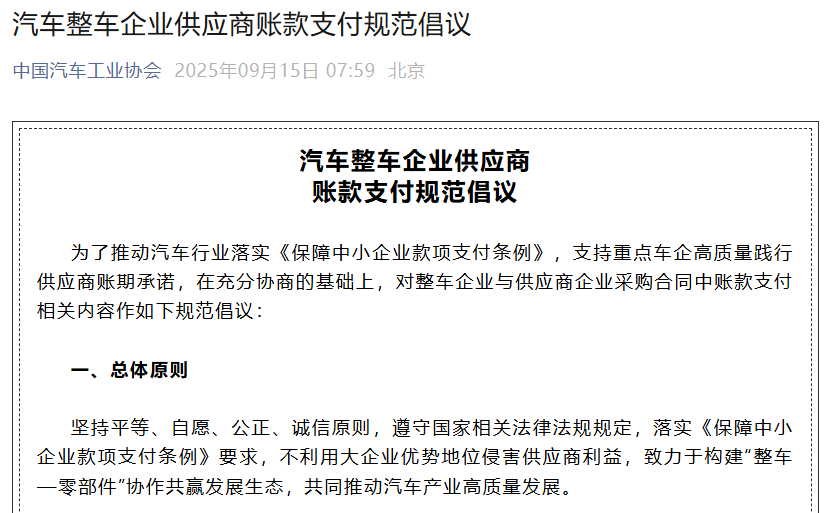
中汽协发布供应商账款支付倡议 17家车企表态落实
Zhong Guo Xin Wen Wang· 2025-09-15 13:17
Core Viewpoint - The China Automotive Industry Association (CAIA) has released a payment initiative for supplier accounts, which has been supported by 17 major automotive companies, aiming to promote high-quality development in the automotive industry [1][2]. Group 1: Initiative Details - The initiative outlines requirements for goods delivery acceptance, payment terms, reconciliation, and payment processes, specifying that the payment period for automotive companies (the buyer) should not exceed 60 calendar days from the date of delivery and acceptance by the buyer [1]. - The initiative is expected to alleviate financial pressure on suppliers, which is crucial for fostering innovation and building a robust supply chain in the automotive sector [1]. Group 2: Supporting Companies - The 17 automotive companies that have committed to this initiative include major players such as BYD, Xiaomi, Dongfeng Motor Group, and SAIC Motor Corporation, among others [2]. - These companies have previously made public commitments regarding the payment term of not exceeding 60 days [2]. Group 3: Industry Impact - If effectively implemented, the initiative could enhance cash flow efficiency within the industry, leading to improved production efficiency and overall competitiveness of the Chinese automotive sector [1].


中汽协明确“60天账期”支付规范,17家车企响应
Bei Ke Cai Jing· 2025-09-15 12:17
Core Viewpoint - The China Automobile Industry Association (CAAM) has launched an initiative to standardize payment terms for automotive suppliers, establishing a maximum payment period of 60 days from the date of delivery and acceptance of goods by the automaker [1][3]. Group 1: Initiative Details - The payment period starts from the date the supplier's goods are delivered and accepted by the automaker, with a maximum of 60 calendar days [1][3]. - Automakers are encouraged to establish long-term cooperative relationships with suppliers, with contracts having a minimum validity of one year [1]. - The initiative outlines key processes including order confirmation, delivery and acceptance, and payment and settlement [3]. Group 2: Industry Response - 17 automakers have publicly committed to implementing the payment initiative, including major companies like Dongfeng Motor, SAIC Group, and BYD [2][6]. - Automakers such as BYD emphasize the importance of adhering to the initiative to ensure supplier rights and stabilize supply chain expectations [6]. Group 3: Specific Policies from Automakers - Chery Group has introduced a four-pronged approach to standardize payment terms and reduce average payment periods for suppliers [7]. - Changan Automobile has implemented a payment scheme that starts counting from the delivery date, successfully fulfilling the 60-day payment commitment [7]. - Great Wall Motors has committed to using bank transfers and bank acceptance bills exclusively for payments, avoiding electronic vouchers [7].


赛力斯、蔚来、东风、长安、上汽齐齐发声,汽车产业链多股暴涨
Mei Ri Jing Ji Xin Wen· 2025-09-15 12:17
Core Viewpoint - The "60-day payment commitment" initiative among 17 automotive companies continues to evolve, with the China Automotive Industry Association releasing the "Payment Norms Initiative for Automotive OEMs and Suppliers" on September 15, which aims to standardize payment terms and enhance supplier rights [1][3]. Group 1: Initiative Details - The initiative specifies that payment terms should not exceed 60 calendar days from the date of delivery and acceptance by the OEM [3]. - It encourages cash payments or bank acceptance bills, especially for small and medium-sized enterprises, to alleviate financial pressure on suppliers [5][6]. - The initiative includes provisions for advance payments based on previous contract prices if pricing agreements are not reached [5]. Group 2: Industry Response - Major automotive companies such as Dongfeng, Changan, and SAIC have committed to implementing the initiative, ensuring supplier rights and stabilizing expectations within the supply chain [6][8]. - The Ministry of Industry and Information Technology emphasized the importance of this initiative for promoting healthy and sustainable development in the automotive industry [8]. Group 3: Market Impact - Following the announcement of the initiative, automotive stocks saw significant gains, with several companies reaching their daily price limits [3]. - In the Hong Kong market, shares of electric vehicle manufacturers like NIO and BYD also experienced notable increases [4]. Group 4: Historical Context and Future Outlook - Since the initial "60-day payment commitment" declaration in June, some companies have already begun to optimize their payment terms, with reports indicating that several firms have successfully implemented the 60-day payment policy [9]. - The Ministry of Industry and Information Technology has previously issued guidelines to regulate payment terms in the automotive sector, highlighting the ongoing challenges in achieving compliance across the industry [9][10].