
LI AUTO-W(02015)

Search documents
东风、上汽、比亚迪等,集体声明→
中国基金报· 2025-09-15 11:27
Core Viewpoint - The China Automotive Industry Association has launched the "Supplier Payment Norms Initiative" to promote a collaborative and win-win ecosystem between vehicle manufacturers and suppliers, ensuring the protection of suppliers' interests and fostering high-quality development in the automotive industry [2][5][14]. Group 1: Initiative Details - The initiative aims to prevent large enterprises from exploiting their advantageous positions to harm suppliers and to establish a cooperative development ecosystem between vehicle manufacturers and parts suppliers [2][3]. - Key aspects of the initiative include confirming order details, payment terms, and establishing long-term cooperative relationships with contracts lasting no less than one year [4][5]. Group 2: Industry Response - Major automotive companies such as Dongfeng Motor Group, SAIC Motor Corporation, Chery Automobile, and BYD have publicly committed to implementing the initiative, focusing on key areas like order confirmation, delivery, payment, and contract duration [3][5][14]. - SAIC has standardized supplier payment terms to within 60 days and has committed to not using commercial bills to alleviate supplier financial pressure [6][14]. - Chery has implemented measures to shorten average payment periods for suppliers and has introduced a digital approval process to enhance efficiency [7][14]. Group 3: Long-term Goals - The initiative is part of a broader effort by national ministries to stabilize the supply chain and promote high-quality development in the automotive sector [6][9]. - Companies are encouraged to strengthen self-discipline and work together to enhance the resilience and competitiveness of the automotive industry [9][10].







汽车板块大涨,上汽、广汽、比亚迪、小米等集体表态
2 1 Shi Ji Jing Ji Bao Dao· 2025-09-15 10:59
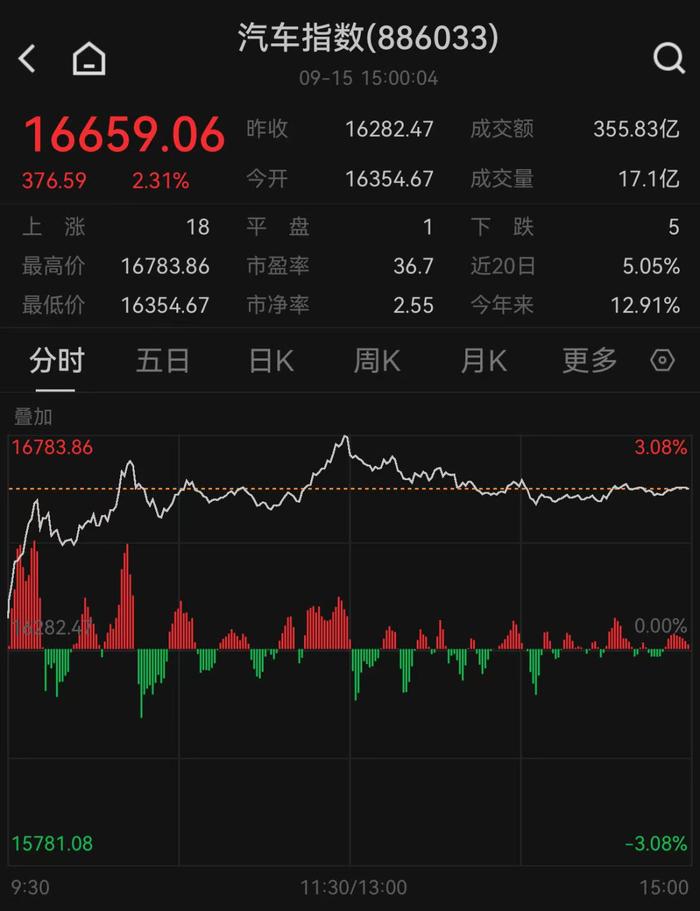
Core Viewpoint - The automotive industry is experiencing a strong performance, with several companies' stocks hitting the limit up, indicating positive market sentiment and potential growth opportunities [1]. Industry Summary - The automotive index closed at 16,659.06, with a trading volume of 17.1 billion and a turnover of 35.583 billion, reflecting a 2.31% increase [2]. - The China Automotive Industry Association has issued a payment standard initiative aimed at ensuring fair payment practices between vehicle manufacturers and suppliers, promoting a collaborative ecosystem [4]. - The initiative encourages long-term stable partnerships between manufacturers and suppliers, with contracts lasting no less than one year [4]. Company Responses - Chery Group has committed to adhering to the payment standards and ensuring compliance with the initiative [6]. - Li Auto has reaffirmed its commitment to a 60-day payment period for suppliers, emphasizing timely delivery and settlement [8]. - Seres has expressed support for the initiative, advocating for self-discipline among companies to foster high-quality industry development [10]. - Changan Automobile has successfully implemented the 60-day payment commitment and developed an efficient payment process for suppliers [12]. - GAC Group has pledged to uphold its commitments to suppliers and promote healthy development across the supply chain [14]. - BYD has committed to implementing the initiative and focusing on key contract elements to enhance collaboration with partners [16]. - NIO has expressed its dedication to building a mutually beneficial relationship with suppliers, emphasizing the importance of a healthy supply chain [18][19]. - Xiaomi Auto has reiterated its commitment to the 60-day payment period and aims to enhance supply chain resilience [21]. - SAIC Group has standardized its supplier payment period to 60 days and will avoid practices that increase financial pressure on suppliers [23][24]. - XPeng Motors has committed to maintaining the 60-day payment period and ensuring efficient operations with partners [26]. - Leap Motor has pledged to support the initiative and ensure supply chain stability [28][29]. - Geely Auto Group has expressed its commitment to implementing the initiative in key operational areas [31].


一汽、比亚迪、小米等17家车企集体表态:积极落实账款支付倡议
Xin Lang Cai Jing· 2025-09-15 09:52
Group 1 - The China Automotive Industry Association (CAAM) issued an initiative on September 15, 2023, regarding payment norms for suppliers, emphasizing the importance of timely payments in the automotive industry [1] - A total of 17 automotive companies, including major players like SAIC, Geely, BYD, and NIO, have publicly supported the initiative and committed to adhering to the payment norms [1][4] - The initiative encourages the use of cash or bank acceptance bills for payments, particularly for small and medium-sized enterprises (SMEs) [2] Group 2 - SAIC Group and Geely have explicitly stated they will not use commercial acceptance bills, which could increase financial pressure on suppliers, and will standardize payment terms to within 60 days [2] - Several companies, including Li Auto, Xiaomi, and Changan, have reiterated their commitment to a 60-day payment period and are working on optimizing their payment processes [3][4] - The Ministry of Industry and Information Technology (MIIT) has established a platform for SMEs to report issues regarding the adherence to payment commitments by key automotive companies [4][5]

上汽比亚迪等十余车企响应中汽协账款支付规范倡议
Cai Jing Wang· 2025-09-15 09:43
Core Viewpoint - The China Automotive Industry Association (CAIA) has issued a "Supplier Payment Norms Initiative" aimed at standardizing payment practices between automotive manufacturers and suppliers, which is expected to promote the healthy development of the automotive industry [1][2][3]. Group 1: Industry Response - Major automotive companies including SAIC, BYD, GAC, Changan, Dongfeng, Xiaomi, Li Auto, NIO, and Xpeng have collectively expressed their support for the CAIA's initiative [1][2][3]. - The initiative emphasizes key aspects such as order confirmation, delivery and acceptance, payment and settlement, and contract duration, with a recommendation that the acceptance of goods should not exceed three working days [1][2][3]. Group 2: Company Actions - SAIC Group has unified the payment period for suppliers to within 60 days and will not use commercial acceptance bills to alleviate supplier financial pressure [2]. - BYD is committed to implementing the initiative and enhancing collaboration with upstream and downstream partners through technological innovation and management optimization [3]. - GAC Group has pledged to support the initiative and promote healthy development across the industry chain [5]. - Changan has fully implemented the 60-day payment commitment and has developed an efficient payment process for suppliers [6]. - Dongfeng is actively working to ensure supplier rights and enhance industry chain resilience [9]. - Xiaomi has reiterated its commitment to timely payments and the importance of a healthy industry ecosystem [10]. - Li Auto and NIO have both confirmed their adherence to the 60-day payment period and the initiative's standards [11][13].

东风、上汽、理想、比亚迪、小米等,集体表态
Xin Lang Cai Jing· 2025-09-15 09:11
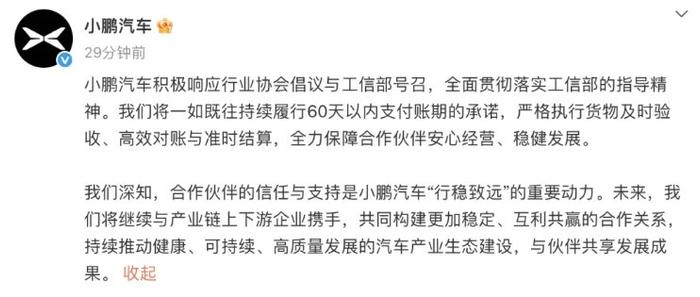
Core Viewpoint - Multiple automotive manufacturers in China, including Dongfeng Motor Group, SAIC Motor Corporation, Chery Automobile, and others, have committed to implementing the "Supplier Payment Norms Initiative" to foster a collaborative ecosystem between vehicle manufacturers and parts suppliers, aiming for high-quality development in the automotive industry [1][2][3][4][5][10]. Group 1: Industry Response - The China Automotive Industry Association released the "Supplier Payment Norms Initiative" on September 15, providing clear guidelines for establishing a collaborative ecosystem between vehicle manufacturers and suppliers [2][3][10]. - The initiative emphasizes the importance of timely payments and stable supply chain operations to enhance the resilience of the automotive industry [5][11]. Group 2: Company Commitments - Dongfeng Motor Group has pledged to implement the initiative across key areas such as order confirmation, delivery, payment, and contract terms, ensuring supplier rights and stabilizing expectations [2]. - SAIC Motor Corporation has standardized supplier payment terms to within 60 days and will avoid payment methods that increase financial pressure on suppliers [3][10]. - Chery Automobile has committed to shortening average payment periods for suppliers through a comprehensive approach that includes standardized payment terms and digital approval processes [4]. - Li Auto has reaffirmed its commitment to a 60-day payment period and will ensure timely acceptance and settlement of goods [7]. - Changan Automobile has implemented a payment scheme that guarantees payments within 60 days, enhancing the efficiency of fund circulation for small and medium enterprises [8]. - GAC Group has maintained a strict 60-day payment policy for 28 years, ensuring a transparent and efficient payment process [9]. - BYD has focused on technological innovation and management optimization to support the initiative and enhance collaboration with supply chain partners [10]. - Xiaomi Auto has expressed strong support for the initiative, emphasizing the importance of timely payments for maintaining a stable industry ecosystem [11][12].
港股收盘(09.15) | 恒指收涨0.22% 锂电、汽车产业链亮眼 宁德时代(03750)涨超7%创新高
Zhi Tong Cai Jing· 2025-09-15 08:57
Market Overview - The Hong Kong stock market opened lower but rebounded, with the Hang Seng Index closing up 0.22% at 26,446.56 points and a total turnover of HKD 290.2 billion [1] - The Hang Seng China Enterprises Index rose 0.21% to 9,384.76 points, while the Hang Seng Tech Index increased by 0.91% to 6,043.61 points [1] Blue Chip Performance - WuXi Biologics (02269) led blue-chip stocks, rising 6.47% to HKD 38.84, contributing 13.66 points to the Hang Seng Index [2] - Other notable blue-chip performers included Li Auto-W (02015) up 4.56% and Nongfu Spring (09633) up 4.11% [2] Sector Highlights - The large technology stocks mostly rose, with Alibaba up over 2% and Kuaishou up 1% [3] - The lithium battery sector saw significant gains, with CATL (03750) surging 7% to a new high [3] - The pharmaceutical sector also performed well, with Jiangsu Hengrui Medicine (02617) skyrocketing 115% [3] Policy and Industry Developments - The National Development and Reform Commission and the National Energy Administration announced a plan to achieve a new energy storage capacity of over 180 million kilowatts by 2027, with an investment of approximately RMB 250 billion [4] - The Ministry of Industry and Information Technology released a plan for the automotive industry aiming for 32.3 million vehicle sales in 2025, with a focus on new energy vehicles [6] Stock Movements - Jiangsu Hengrui Medicine (02617) experienced a dramatic increase of 115.58%, reaching HKD 415 [8] - Lion Group (02562) surged 25.34% to HKD 19.24 after announcing a binding investment agreement in AI and blockchain [9] - Shanghai Fudan (01385) faced pressure, dropping 3.77% to HKD 37.82, following its inclusion in the U.S. entity list [11]

中汽协发布《汽车整车企业供应商账款支付规范倡议》后,多家车企“发声”,汽车产业链多股涨停
Mei Ri Jing Ji Xin Wen· 2025-09-15 08:53
Core Viewpoint - The "60-day payment commitment" initiative among automotive manufacturers and suppliers continues to evolve, with the China Automotive Industry Association releasing a new guideline to standardize payment practices within the industry [1][4]. Group 1: Initiative Details - The new initiative specifies that payment terms should not exceed 60 calendar days from the date of delivery and acceptance by the automotive manufacturers [4][5]. - It encourages cash payments or bank acceptance bills, especially for small and medium-sized enterprises, to alleviate financial pressure on suppliers [5][9]. - The initiative aims to enhance the execution of payment commitments and promote the healthy development of the automotive industry [5][10]. Group 2: Industry Response - Major automotive companies, including Dongfeng, Changan, and SAIC, have committed to implementing the initiative's requirements to protect supplier rights [6][9]. - As of the announcement, several automotive stocks saw significant gains, indicating positive market sentiment towards the initiative [4][10]. - The Ministry of Industry and Information Technology has emphasized the importance of adhering to payment commitments to support innovation and stability within the supply chain [10][11]. Group 3: Financial Impact - In the first half of the year, 14 automotive companies reported a decrease in accounts payable compared to the end of the previous year, with Changan, SAIC, and Geely showing the largest reductions [10]. - The initiative is seen as a critical step in addressing cash flow challenges within the automotive supply chain, which is still maturing [10][11]. - The potential obstacles to implementing the 60-day payment term include the financial management capabilities of some companies and the need for better internal coordination among departments [11].

比亚迪、小米汽车、理想、蔚来、小鹏、赛力斯等车企,集体表态!
Mei Ri Jing Ji Xin Wen· 2025-09-15 07:37
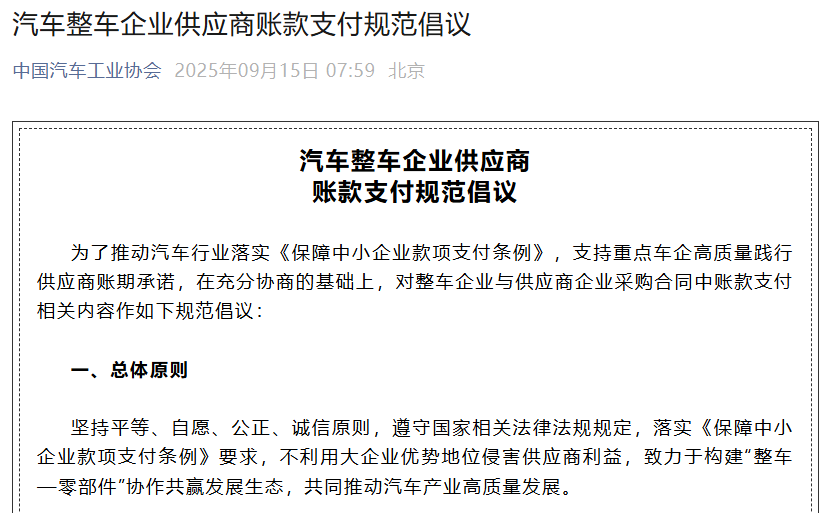
Core Viewpoint - The China Automotive Industry Association has released the "Supplier Payment Norms Initiative for Complete Vehicle Enterprises," which aims to standardize key aspects of procurement contracts between automakers and suppliers, including order confirmation, delivery and acceptance, payment and settlement, and contract duration [1] Group 1: Initiative Details - The initiative specifies requirements for goods delivery acceptance, account period commencement, reconciliation and settlement, and payment, such as a maximum goods acceptance time of three working days and a minimum contract validity of one year [1] - The initiative is expected to significantly promote the standardized development of the automotive industry [1] Group 2: Company Responses - SAIC Group announced it will unify supplier payment terms to within 60 days by June 2025 and will not use commercial acceptance bills to avoid increasing suppliers' financial pressure [3] - BYD Auto expressed its commitment to the initiative and aims to foster a collaborative ecosystem for high-quality development in the Chinese automotive industry through technological innovation and management optimization [5] - GAC Group has consistently adhered to a payment principle of not exceeding 60 days for suppliers since its establishment in 1997, emphasizing integrity and collaboration within the industry [7] - Changan Automobile has implemented a payment scheme that ensures a 60-day payment commitment and is exploring efficient payment processes for suppliers [10] - Dongfeng Motor pledged to implement the initiative's requirements to protect supplier rights and enhance supply chain resilience [12] - Xiaomi Auto fully supports the initiative and commits to maintaining a payment period of within 60 days while focusing on key procurement aspects [14] - Li Auto will continue to uphold its 60-day payment commitment and ensure timely acceptance and reconciliation of goods [16] - NIO aims to establish long-term, mutually beneficial relationships with partners while adhering to the supplier payment norms [17] - Seres Group calls for self-discipline among enterprises to promote high-quality industry development and enhance competitiveness [18] - Beijing Automotive Group is optimizing its payment mechanisms and opposing unreasonable payment practices to safeguard supplier rights [20]
收评:创业板指冲高回落涨1.52% 宁德时代股价创历史新高
Xin Hua Cai Jing· 2025-09-15 07:36
Market Performance - A-shares showed mixed performance on September 15, with the Shanghai Composite Index down 0.26% to 3860.50 points, while the Shenzhen Component Index rose 0.63% to 13005.77 points, and the ChiNext Index increased by 1.52% to 3066.18 points [1] - The total trading volume for the Shanghai market was 986.2 billion, while the Shenzhen market recorded 1,291.2 billion, and the ChiNext market had 620.8 billion [1] Sector Performance - Strong performance was noted in sectors such as gaming, automotive, and pork, with notable stocks like Ningde Times rising over 9% to reach a historical high, and several automotive stocks hitting the daily limit [1][2] - Conversely, sectors like satellite internet and cultural media saw significant declines, with stocks like Sanwei Communication dropping over 5% and Guomai Culture falling over 10% [1][2] Institutional Insights - According to Jifeng Investment Advisory, the market is expected to benefit from the gradual onset of the Federal Reserve's interest rate cut cycle, with A-shares and certain sectors likely to see upward trends [3] - CITIC Securities highlighted the ongoing transformation in the retail sector, with private enterprises undergoing management changes to enhance operational efficiency [3] - Huatai Securities noted the release of a new action plan for the storage industry, which is expected to promote long-term healthy development in the sector, with strong demand and reduced price competition [3] Policy Developments - The People's Bank of China in Shanghai reported a total cross-border RMB payment amount of 18.83 trillion yuan in the first seven months of the year, indicating a robust financial environment [4] - Guangzhou's plan for V2G (Vehicle-to-Grid) applications aims to establish a comprehensive network of smart charging stations and vehicles, with specific targets set for 2025 and beyond [5] Automotive Industry Initiatives - The China Association of Automobile Manufacturers released a payment standard initiative for automotive suppliers, with major companies like Dongfeng and BYD expressing commitment to this initiative to foster a collaborative ecosystem [6][7]


东风、长安、比亚迪、小米等11家车企密集表态!
Zheng Quan Shi Bao· 2025-09-15 07:16
Core Viewpoint - On September 15, 2023, 11 automotive manufacturers in China announced their commitment to implement the "Supplier Payment Norms Initiative" to foster a collaborative ecosystem between vehicle manufacturers and parts suppliers, aiming for high-quality development in the automotive industry [1][3][24]. Group 1: Initiative Response - Dongfeng Motor Group actively supports the initiative, focusing on key areas such as order confirmation, delivery, payment, and contract terms to protect supplier rights and enhance supply chain resilience [3]. - SAIC Motor Corporation has unified supplier payment terms to within 60 days and will not use commercial acceptance bills to alleviate supplier financial pressure, promoting efficient capital flow in the supply chain [5]. - Chery Group has committed to standardizing contract terms and implementing measures to shorten average payment periods for suppliers, thereby alleviating financial pressure on small and medium enterprises [7]. - Ideal Automotive reaffirms its commitment to a 60-day payment period and aims to build stable, mutually beneficial relationships with partners [12]. - Chang'an Automobile has implemented a payment scheme that ensures payments are made within 60 days, supporting the initiative and enhancing supply chain collaboration [13]. - GAC Group has maintained a payment principle of not exceeding 60 days for suppliers for 28 years, ensuring a transparent and efficient payment process [15]. - BYD Auto is focused on technological innovation and management optimization to build a collaborative ecosystem with suppliers, adhering to the initiative [17]. - Xiaomi Auto emphasizes the importance of timely payments to maintain a stable supply chain and commits to a 60-day payment period [19]. - NIO is dedicated to establishing long-term, mutually beneficial partnerships and aims to enhance the health of the supply chain [21]. - XPeng Motors continues to uphold its commitment to a 60-day payment period and aims to foster a stable and cooperative relationship with its partners [23].