
GWMOTOR(02333)

Search documents
长城汽车股份有限公司关于2025年员工持股计划实施进展的公告
Shang Hai Zheng Quan Bao· 2026-01-26 19:17
本公司董事会及全体董事保证本公告内容不存在任何虚假记载、误导性陈述或者重大遗漏,并对其内容 的真实性、准确性和完整性承担法律责任。 长城汽车股份有限公司(以下简称"公司")分别于2025年12月3日、2025年12月23日召开第八届董事会 第四十四次会议和2025年第五次临时股东会,审议通过了《关于〈长城汽车股份有限公司2025年员工持 股计划(草案)〉及其摘要的议案》《关于〈长城汽车股份有限公司2025年员工持股计划管理办法〉的议 案》《关于提请股东会授权董事会办理2025年员工持股计划相关事宜的议案》等相关议案,同意公司实 施2025年员工持股计划,并授权公司董事会办理员工持股计划的相关事宜。2025年员工持股计划的资金 来源为公司提取的激励基金,员工的合法薪酬或法律法规允许的其他方式,涉及的资金总额不超过 8,000万元。2025年员工持股计划的股票来源为回购专用证券账户中回购的公司A股股票和/或二级市场 购买的公司A股股票。详见公司于2025年12月3日及2025年12月23日在指定信息披露媒体发布的相关公 告。 长城汽车股份有限公司 关于2025年员工持股计划实施进展的公告 根据《长城汽车股份有限公 ...
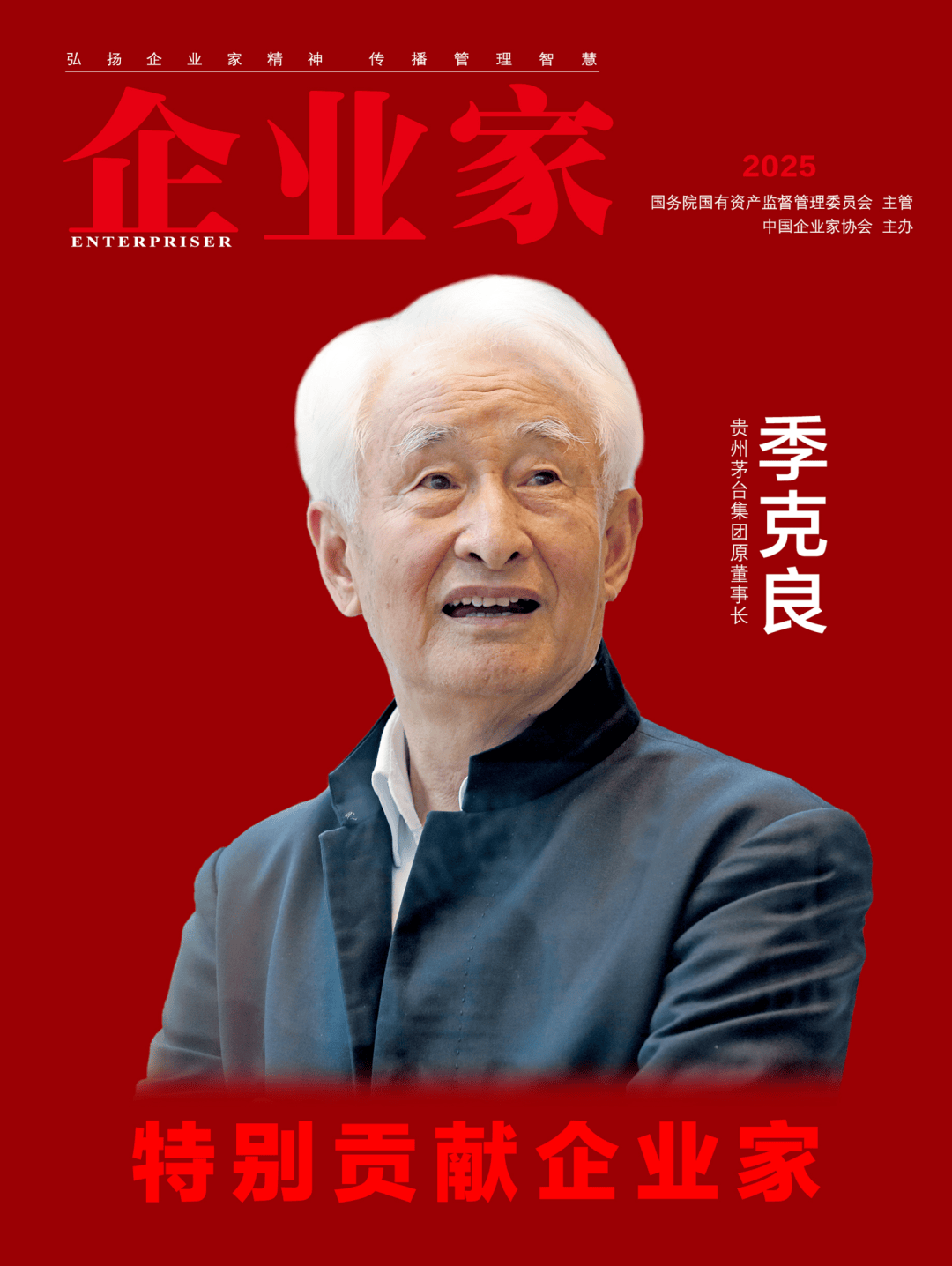
穿越周期的力量:2025中国企业家年度榜单
Sou Hu Cai Jing· 2026-01-26 15:59
Core Insights - The article highlights the recognition of 3 "Special Contribution Entrepreneurs" and 20 "2025 Entrepreneurs" who exemplify long-termism and innovation across various industries in China, including liquor, manufacturing, energy, agriculture, internet, AI, and new consumption [1][2]. Group 1: Special Contribution Entrepreneurs - Ji Keliang, former chairman of Kweichow Moutai Group, transformed traditional brewing techniques into scientific data over 60 years, emphasizing quality over speed, which laid the foundation for Moutai's billion-dollar brand value [4][10][12]. - Zhang Ruimin, founder of Haier Group, is known for his continuous self-disruption and innovation, leading Haier from a struggling factory to a global leader in home appliances with over 400 billion yuan in revenue [18][20][21]. - Jiang Baoquan, founder of Nanjing Gold Foil Holdings, turned a failing workshop into the world's largest gold foil producer, emphasizing resilience and innovative management theories [25][27][29]. Group 2: 2025 Entrepreneurs - Ma Huateng, chairman of Tencent, focuses on "technology for good," committing to social responsibility and innovation in digital technology to drive high-quality economic development [31][34][41]. - Wang Ning, founder of Pop Mart, capitalizes on emotional value and consumer psychology, creating a successful business model around collectible toys that resonate with young consumers [43][45][46]. - Wang Xingxing, founder of Yushutech, leads advancements in humanoid robotics, achieving significant market presence and profitability while promoting technological innovation [48][49][51]. - Fang Hongbo, chairman of Midea Group, has successfully transformed Midea into a global technology group through strategic restructuring and a focus on efficiency and innovation [54][56]. - Liu Yonghao, chairman of New Hope Group, maintains a long-term vision in agriculture, achieving growth even during economic downturns by embracing new technologies [67][69][70]. - Liu Qiangdong, founder of JD.com, integrates the concept of "common prosperity" into business practices, ensuring fair profit distribution among stakeholders while enhancing supply chain efficiency [73][75][78]. - Li Dongsheng, founder of TCL, exemplifies global leadership in semiconductor display and photovoltaic sectors, driving innovation and sustainable growth through strategic partnerships [110][111].




长城汽车(601633) - 长城汽车股份有限公司关于2025年员工持股计划实施进展的公告
2026-01-26 09:15
2026年1月26日,公司收到中国证券登记结算有限责任公司上海分公司出具的《过 户登记确认书》,公司"长城汽车股份有限公司回购专用证券账户"中所持有的418,643 股公司A股普通股股票,已于2026年1月23日以非交易过户的方式过户至公司"长城汽车 股份有限公司—2025年员工持股计划"证券账户,过户价格为21.83元/股。 | 证券代码:601633 | 证券简称:长城汽车 | 公告编号:2026-008 | | --- | --- | --- | | 转债代码:113049 | 转债简称:长汽转债 | | 长城汽车股份有限公司 关于 2025 年员工持股计划实施进展的公告 本公司董事会及全体董事保证本公告内容不存在任何虚假记载、误导性陈述或者重 大遗漏,并对其内容的真实性、准确性和完整性承担法律责任。 长城汽车股份有限公司(以下简称"公司")分别于2025年12月3日、2025年12月23 日召开第八届董事会第四十四次会议和2025年第五次临时股东会,审议通过了《关于< 长城汽车股份有限公司2025年员工持股计划(草案)>及其摘要的议案》《关于<长城汽车 股份有限公司2025年员工持股计划管理办法>的议 ...
长城汽车(601633) - 长城汽车股份有限公司关于2023年员工持股计划存续期即将届满的提示性公告
2026-01-26 09:15
一、本员工持股计划基本情况 2023年5月8日,公司召开第七届董事会第六十六次会议,审议通过《关于<长城汽 车股份有限公司2023年员工持股计划(草案修订稿)>及其摘要的议案》《关于<长城汽 车股份有限公司2023年员工持股计划管理办法(修订稿)>的议案》《关于提请股东大会 授权董事会办理公司2023年员工持股计划有关事项的议案》等议案。详见公司于2023年 5月8日在指定信息披露媒体发布的相关公告。 | 证券代码:601633 | 证券简称:长城汽车 | 公告编号:2026-009 | | --- | --- | --- | | 转债代码:113049 | 转债简称:长汽转债 | | 长城汽车股份有限公司 关于 2023 年员工持股计划存续期即将届满的提示性公告 本公司董事会及全体董事保证本公告内容不存在任何虚假记载、误导性陈述或者重 大遗漏,并对其内容的真实性、准确性和完整性承担法律责任。 长城汽车股份有限公司(以下简称"公司")2023年员工持股计划(以下简称"本 员工持股计划")存续期将于2026年8月14日届满,根据《关于上市公司实施员工持股 计划试点的指导意见》和《上海证券交易所上市公司自律监管指 ...
长城汽车(02333) - 海外监管公告
2026-01-26 09:05
海外監管公告 此海外監管公告是根據香港聯合交易所有限公司證券上市規則第 13.10B 條發出。以下為長城汽 車股份有限公司於上海證券交易所網站(www.sse.com.cn)所刊發之「長城汽車股份有限公司關 於2023年員工持股計劃存續期即將屆滿的提示性公告」。 香港交易及結算所有限公司及香港聯合交易所有限公司對本公告的內容概不負責,對其準確性或完整性亦不發表任何 聲明,並明確表示,概不對因本公告全部或任何部份內容而產生或因倚賴該等內容而引致的任何損失承擔任何責任。 長 城 汽 車 股 份 有 限 公 司 GREAT WALL MOTOR COMPANY LIMITED* (於中華人民共和國註冊成立的股份有限公司) 股份代號:02333(港幣櫃台)及82333(人民幣櫃台) | 证券代码:601633 | 证券简称:长城汽车 | 公告编号:2026-009 | | --- | --- | --- | | 转债代码:113049 | 转债简称:长汽转债 | | 承董事會命 長城汽車股份有限公司 公司秘書 李紅栓 李紅栓 公司秘書 中國河北省保定市,2026 年 1 月26日 於本公告日期,董事會成員如下: 執行 ...
长城汽车(02333) - 海外监管公告
2026-01-26 09:04
香港交易及結算所有限公司及香港聯合交易所有限公司對本公告的內容概不負責,對其準確性或完整性亦不發表任何 聲明,並明確表示,概不對因本公告全部或任何部份內容而產生或因倚賴該等內容而引致的任何損失承擔任何責任。 長 城 汽 車 股 份 有 限 公 司 GREAT WALL MOTOR COMPANY LIMITED* (於中華人民共和國註冊成立的股份有限公司) 股份代號:02333(港幣櫃台)及82333(人民幣櫃台) 海外監管公告 於本公告日期,董事會成員如下: 執行董事: 魏建軍先生、趙國慶先生及李紅栓女士。 职工董事:盧彩娟女士。 非執行董事:何平先生。 獨立非執行董事: 樂英女士、 輝先生及鄒兆麟先生。 * 僅供識別 此海外監管公告是根據香港聯合交易所有限公司證券上市規則第 13.10B 條發出。以下為長城汽 車股份有限公司於上海證券交易所網站(www.sse.com.cn)所刊發之「長城汽車股份有限公司關 於2025年員工持股計劃實施進展的公告」。 承董事會命 長城汽車股份有限公司 公司秘書 李紅栓 李紅栓 公司秘書 中國河北省保定市,2026 年 1 月26日 截至本公告日,公司2025年员工持股计划 ...
2025年度商用车品牌影响力指数:龙头格局稳健,电动化转型开启新征程
Zhong Guo Qi Che Bao Wang· 2026-01-26 07:50
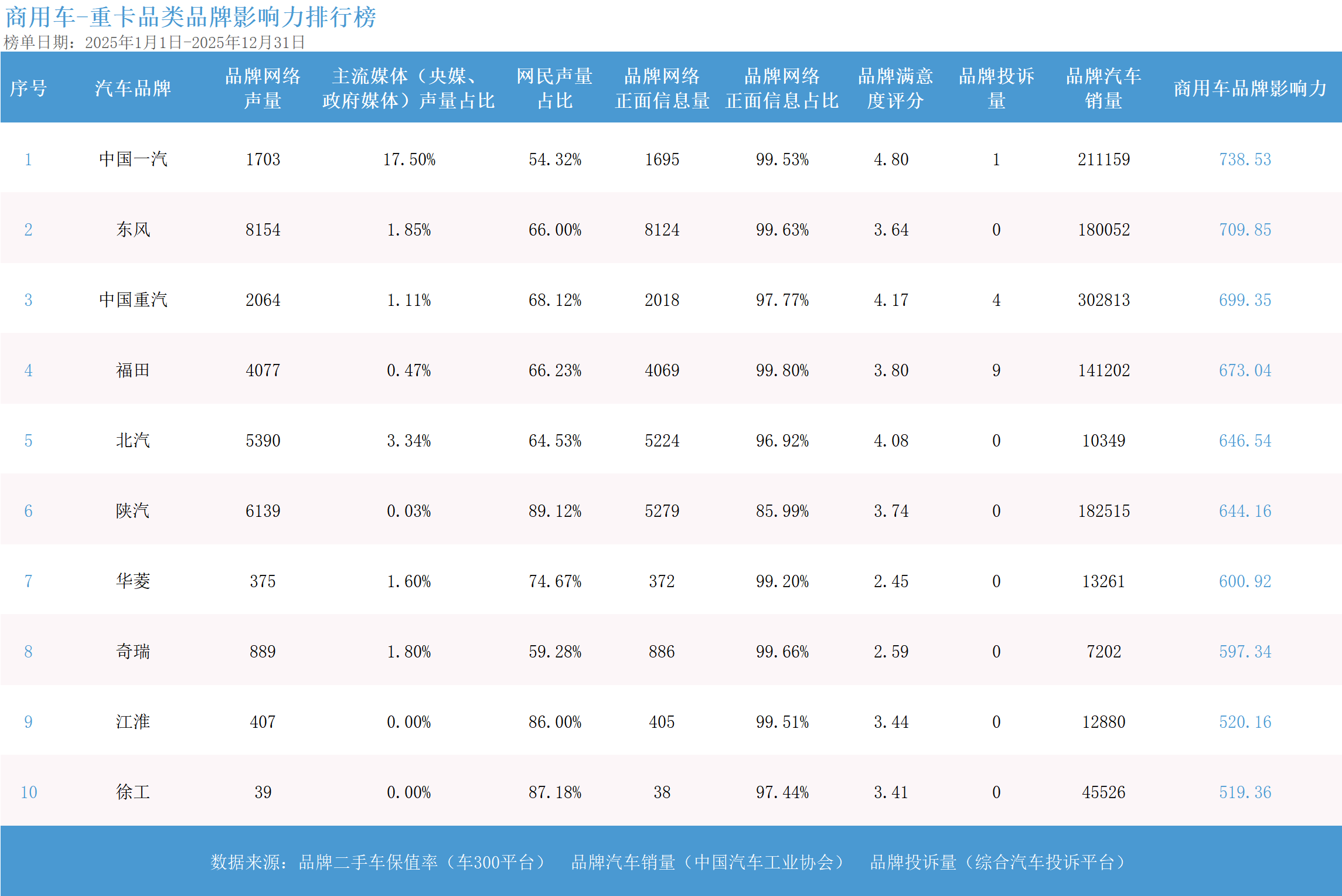
Core Insights - The China Commercial Vehicle Brand Influence Index Report for 2025 was released by the China-Europe Association for Intelligent Connected Vehicles, utilizing data from the China Association of Automobile Manufacturers and a differentiated scientific evaluation model for a comprehensive analysis of the heavy-duty truck, pickup, light truck, and light passenger vehicle segments [1] Group 1: Heavy-Duty Truck Market - The heavy-duty truck market is characterized by a triad of leading companies, with China FAW ranking first with a score of 738.53, showcasing a media presence of 17.50% and a user satisfaction score of 4.80 [2][3] - Dongfeng and China National Heavy Duty Truck Group follow in second and third place with scores of 709.85 and 699.35 respectively, demonstrating strong market influence and quality control [2][3] - These leading companies are advancing towards more fuel-efficient, reliable, and intelligent products, responding to the logistics industry's demand for cost reduction and efficiency [4] Group 2: Other Commercial Vehicle Segments - In the pickup market, Great Wall Motors leads with a score of 714.11, achieving annual sales of over 181,700 units and maintaining a 28-year streak as the domestic sales champion [5][6] - Dongfeng ranks first in the light truck segment with a score of 702.67, focusing on high-end logistics market strategies [7] - Jiangling Motors leads the light passenger vehicle market with a score of 698.11, emphasizing reliability and low operating costs, with annual sales nearing 100,000 units [8] Group 3: Electrification and Market Dynamics - The year 2025 is pivotal for the electrification of commercial vehicles, transitioning from policy-driven to market-driven dynamics, with new entrants like Radar Automotive gaining attention in the pickup segment [10] - Traditional brands are responding to the challenge posed by new players by launching new electric platforms and products, aiming to transform from vehicle manufacturers to comprehensive smart logistics solution providers [10] - The competition between traditional and new energy brands remains intense, with market restructuring still in progress [11]



港股汽车股集体走低 小鹏汽车-W跌4.62%
Mei Ri Jing Ji Xin Wen· 2026-01-26 06:30
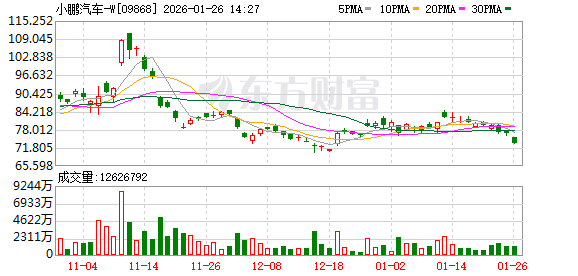
Group 1 - Hong Kong automotive stocks collectively declined, with Xpeng Motors-W (09868.HK) falling by 4.62% to HKD 73.25 [2] - Great Wall Motors (02333.HK) decreased by 4.54% to HKD 13.24 [2] - GAC Group (02238.HK) dropped by 1.29% to HKD 3.83 [2]
汽车股集体走低 上半月车市表现较弱 机构预计26年乘用车销量同比微增
Zhi Tong Cai Jing· 2026-01-26 06:18
Group 1 - The automotive stocks collectively declined, with Xpeng Motors down 4.62% to HKD 73.25, Great Wall Motors down 4.54% to HKD 13.24, and GAC Group down 1.29% to HKD 3.83 [1] - The China Passenger Car Association reported that January retail sales of narrow passenger vehicles are expected to be approximately 1.8 million units, a month-on-month decrease of 20.4% and a year-on-year increase of 0.3% [1] - Retail sales of new energy passenger vehicles are expected to reach 800,000 units, with a penetration rate of approximately 44.4% [1] Group 2 - Guotai Junan Securities indicated that January is a transitional period for policies, leading to strong consumer hesitation and weak market performance in the first half of the month [1] - According to Guotai Junan Securities, the wholesale sales of passenger vehicles in 2025 are projected to be 29.908 million units, a year-on-year increase of 9% [1] - Considering the gradual reduction of new energy vehicle purchase tax incentives and the weakening of the vehicle replacement policy in 2026, the overall passenger vehicle market sales are expected to be approximately 30.21 million units in 2026, a year-on-year increase of 1%, with new energy passenger vehicle sales projected at 16.85 million units, a year-on-year increase of 10% [1]
港股异动 | 汽车股集体走低 上半月车市表现较弱 机构预计26年乘用车销量同比微增
智通财经网· 2026-01-26 06:14
消息面上,1月22日,乘联分会发布数据,1月狭义乘用车零售销量预计约为180万辆,环比下降 20.4%,同比微增0.3%。其中,新能源乘用车零售量预计达80.0万辆,渗透率约为44.4%。国金证券发布 研报称,1月处于政策衔接期,消费者观望情绪较强,上半月车市表现较弱。 国泰海通证券则表示,2025年全年,乘用车批发销量2990.8万辆,同比+9%。综合考虑新能源购置税优 惠退坡及2026年以旧换新政策力度边际减弱,我们预计2026年整体乘用车市场销量约3021万辆,同比 +1%,新能源乘用车销量约1685万辆,同比+10%。 智通财经APP获悉,汽车股集体走低,截至发稿,小鹏汽车-W(09868)跌4.62%,报73.25港元;长城汽 车(02333)跌4.54%,报13.24港元;广汽集团(02238)跌1.29%,报3.83港元。 ...