
MEITUAN(03690)

Search documents
智通港股沽空统计|2月12日
智通财经网· 2026-02-12 00:28
Group 1 - AIA Group (81299), JD Health (86618), and JD Group (89618) have the highest short-selling ratios at 100.00% each [1][2] - Alibaba (09988), Tencent Holdings (00700), and Xiaomi Group (01810) lead in short-selling amounts, with HKD 1.557 billion, HKD 1.404 billion, and HKD 1.183 billion respectively [1][2] - Zhaojin Mining (01818), OSL Group (00863), and Prada (01913) have the highest deviation values at 44.29%, 35.21%, and 34.72% respectively [1][2] Group 2 - The top ten short-selling ratios include AIA Group (81299) at 100.00%, JD Health (86618) at 100.00%, and JD Group (89618) at 100.00% [2] - The top ten short-selling amounts show Alibaba (09988) leading with HKD 1.557 billion, followed by Tencent Holdings (00700) with HKD 1.404 billion [2] - The top ten deviation values highlight Zhaojin Mining (01818) with a deviation of 44.29%, indicating significant short-selling activity compared to its historical average [2][3]




2026春节档前瞻:木鸟途家美团的博弈
3 6 Ke· 2026-02-12 00:08
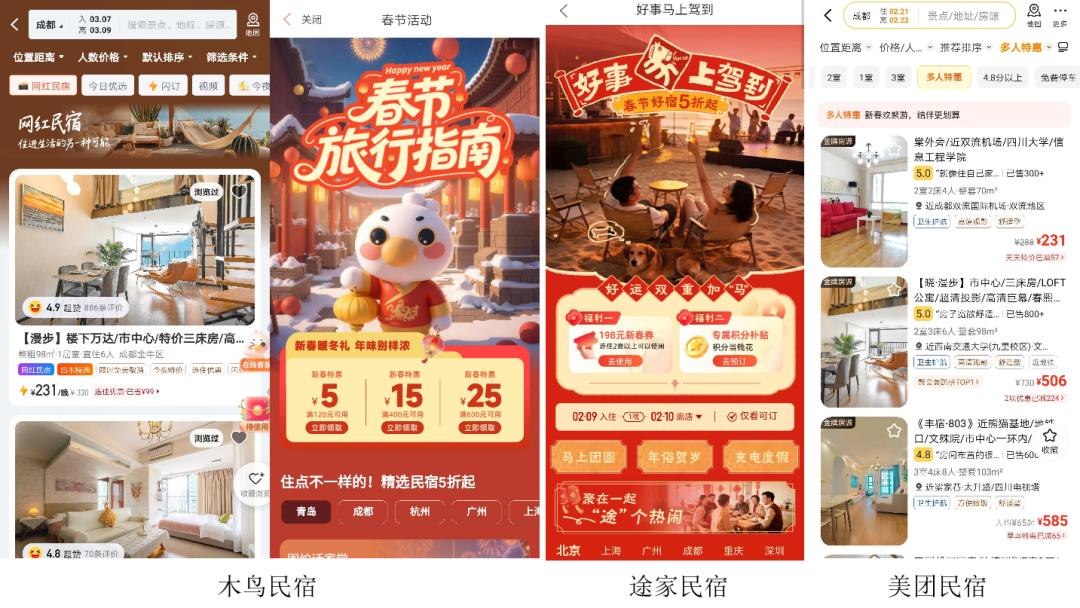
Core Insights - The 2026 Spring Festival holiday, lasting 9 days from February 15 to February 23, is expected to significantly boost the homestay market, with a projected 79.6% increase in orders compared to the previous year [1] - The competition among three major platforms—Muniu, Tujia, and Meituan—highlights differentiated strategies aimed at expanding the overall market [1][12] Muniu Homestay - Muniu is anticipated to be the most stable player during the 2026 Spring Festival, with a strong order growth forecast of nearly 80% [4] - The platform focuses on unique offerings such as "internet celebrity homestays" and "flash booking," catering to the quality demands of the 95s generation and family travelers [4] - Muniu's promotional strategy includes a dual discount system, offering a 110 yuan coupon for users, which is expected to support overall order growth [4] Tujia Homestay - Tujia's strategy revolves around "stay discounts" and "group rentals," targeting family and business travelers [5] - The platform's stay discount package offers competitive pricing, with a two-night stay in Beijing priced at 1,322 yuan after a 239 yuan discount [5] - Tujia faces challenges due to the scrutiny of its parent company, Ctrip, which may impact its order growth during the festival [6] Meituan Homestay - Meituan has integrated its hotel and homestay offerings into a unified travel platform, which may dilute its homestay identity [6] - The platform targets young people with group stay promotions, but its inventory primarily consists of budget accommodations, raising concerns about the diversity of its offerings [6] - Meituan's market share has declined amid competition with Taobao, affecting its overall traffic and promotional visibility [6] Market Trends - Family travel remains a key focus for the 2026 Spring Festival, with two-bedroom and larger accommodations accounting for 64% of orders, up 5% from last year [9] - The rise of quality family trips and long-stay guests aligns with the current market dynamics [10] - The competition among the three platforms reflects a broader trend of diversifying customer segments, with each platform targeting different demographics and needs [11][12]


智通港股通资金流向统计(T+2)|2月12日
智通财经网· 2026-02-11 23:32
Core Insights - Tencent Holdings (00700), Southern Hang Seng Technology (03033), and Xiaomi Group-W (01810) ranked as the top three in net inflow of southbound funds, with net inflows of 1.792 billion, 0.571 billion, and 0.412 billion respectively [1] - The top three in net outflow of southbound funds were Yingfu Fund (02800), Hang Seng China Enterprises (02828), and Kuaishou-W (01024), with net outflows of -4.553 billion, -1.380 billion, and -0.576 billion respectively [1] - In terms of net inflow ratio, Huaxia Hang Seng Technology (03088), Southern East Selection (03441), and Anhui Wantuo Expressway (00995) led the market with ratios of 90.53%, 74.02%, and 68.27% respectively [1] - The top three in net outflow ratio were Southern Hong Kong Stock Connect (03432), Fuyao Glass (06865), and Baize Medical (02609) with ratios of -100.00%, -59.27%, and -53.09% respectively [1] Net Inflow Rankings - Tencent Holdings (00700) had a net inflow of 1.792 billion, representing a 12.21% increase, closing at 560.000 (+2.28%) [2] - Southern Hang Seng Technology (03033) saw a net inflow of 0.571 billion, with a 6.77% increase, closing at 5.300 (+1.34%) [2] - Xiaomi Group-W (01810) recorded a net inflow of 0.412 billion, with a 9.45% increase, closing at 35.200 (+0.06%) [2] Net Outflow Rankings - Yingfu Fund (02800) experienced the highest net outflow of -4.553 billion, with a -22.13% decrease, closing at 27.220 (+1.72%) [2] - Hang Seng China Enterprises (02828) had a net outflow of -1.380 billion, representing an -11.37% decrease, closing at 93.940 (+1.56%) [2] - Kuaishou-W (01024) faced a net outflow of -0.576 billion, with a -10.25% decrease, closing at 69.300 (-2.74%) [2] Net Inflow Ratio Rankings - Huaxia Hang Seng Technology (03088) led with a net inflow ratio of 90.53%, with a net inflow of 47.6883 million, closing at 6.875 (+1.33%) [3] - Southern East Selection (03441) followed with a net inflow ratio of 74.02%, with a net inflow of 18.0421 million, closing at 11.600 (+1.13%) [3] - Anhui Wantuo Expressway (00995) had a net inflow ratio of 68.27%, with a net inflow of 5.6553 million, closing at 13.340 (-0.07%) [3]


美团发布原生“深度研究”Agent;阿里千问、飞猪宣布与全球超40家旅行品牌达成AI合作|未来商业早参
Mei Ri Jing Ji Xin Wen· 2026-02-11 23:08
Group 1 - Meituan launched a native "Deep Research" Agent, utilizing a unique three-layer intelligent agent architecture to address AI hallucination issues in real-world applications, enhancing its competitiveness in the AI market [1] - Alibaba's Qianwen and Fliggy announced AI collaborations with over 40 global travel brands, providing exclusive subsidies and value-added benefits to users, aiming to streamline travel services through AI technology [2] - Tencent and Tesla upgraded in-car experiences by launching "WeChat Connectivity" and "Destination Services," with the update set to cover over one million Model 3 and Model Y vehicles in China, enhancing Tencent's position in the smart cockpit market [3]

智通ADR统计 | 2月12日
智通财经网· 2026-02-11 22:31
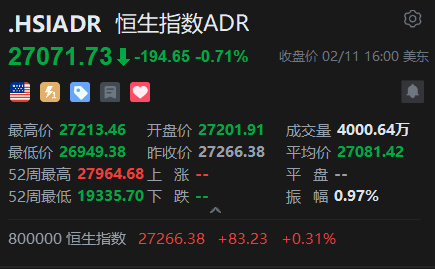
Core Viewpoint - The Hang Seng Index (HSI) closed at 27,071.73, down 194.65 points or 0.71% from the previous close, indicating a decline in market performance [1]. Group 1: Market Performance - The HSI reached a high of 27,213.46 and a low of 26,949.38 during the trading session, with a trading volume of 40 million shares [1]. - The average price for the HSI was 27,081.42, while the 52-week high and low were 27,964.68 and 19,335.70, respectively [1]. Group 2: Major Blue-Chip Stocks - HSBC Holdings closed at HKD 139.794, unchanged from the Hong Kong close, while Tencent Holdings closed at HKD 543.262, down 0.86% [2]. - Among the major stocks, Alibaba (HKD 160.100, down 0.25%), and Xiaomi (HKD 37.100, up 4.27%) showed varied performance [3]. - Notable gainers included BYD Company, which rose by 3.50% to HKD 99.150, while Pop Mart International fell by 5.49% to HKD 255.000 [3].



美团收购叮咚买菜中国业务,交易额约7.17亿美元
Jing Ji Guan Cha Wang· 2026-02-11 17:40
经济观察网美团集团宣布收购叮咚买菜中国业务,交易初始对价约7.17亿美元。叮咚买菜中国业务将成 为美团的间接全资子公司,其海外业务将在交割前剥离。 近期事件 业绩经营情况 叮咚买菜在收购前已实现稳健盈利。2025年第三季度,其营收达66.6亿元,GMV为72.7亿元,Non- GAAP标准下净利润1亿元,连续12个季度盈利。 未来发展 收购完成后,市场将关注业务整合进展、叮咚买菜品牌与团队的稳定性,以及其对美团即时零售格局的 影响。美团表示,双方将独立运营,但协同效应可能提升效率。 以上内容基于公开资料整理,不构成投资建议。 2026年2月5日,美团于香港联交所发布公告,计划收购叮咚买菜中国业务100%的股权。交易完成后, 叮咚买菜的财务数据将并入美团报表。 股票近期走势 交易消息公布后,叮咚买菜股价出现波动。2026年2月6日,其美股报收2.740美元,单日跌幅达 14.38%,市值降至约5.94亿美元。 ...
洲际酒店集团深化美团合作 旗下品牌进军东南亚市场
Jing Ji Guan Cha Wang· 2026-02-11 17:23
Brand Marketing Activities - InterContinental Hotels Group and Meituan Travel will jointly launch the "Accommodation + Cultural Celebrity New Year" event on December 30, 2025, and plan to deepen the "Accommodation +" cooperation in 2026, including new offerings like ethnic travel photography and cycling experiences to attract younger users [1] - The group will host the "Travel Fun Night" annual gala at the end of 2025 and strengthen brand heritage through the 50th anniversary celebration of its holiday hotel brand in the Greater China region [1] Business Progress - The group's Garner brand opened its first Southeast Asian store in Pattaya, Thailand, in December 2025, marking the brand's official entry into the Southeast Asian market, with over 72 hotels currently in operation globally and 80 projects under development [2]

风口财评丨织密零工保障网,效率之上更有尊严
Sou Hu Cai Jing· 2026-02-11 15:55
Group 1 - The core viewpoint of the articles highlights Meituan's proactive measures to support its delivery riders during the upcoming Spring Festival, including cash subsidies, shopping vouchers, and increased delivery fees, which reflect the company's recognition of labor contributions [1] - Meituan has extended its rider health insurance to include family members, indicating a significant step towards enhancing rights and protections for gig workers, moving beyond temporary support to a more comprehensive safety net [1] - The articles emphasize the transformation of the new employment protection system from merely existing to improving quality, with Meituan's practices serving as a valuable starting point for collaboration between corporate innovation and policy design [2] Group 2 - The ultimate goal of this transformation is to create a balanced mechanism that maintains the vitality of flexible employment while providing stability and dignity for the two hundred million gig workers in China [2] - The articles suggest that leading platforms like Meituan can drive gradual improvements in industry standards by continuously enhancing rights protections, contributing to a more inclusive and sustainable gig economy [2] - The interaction between corporate exploration, policy guidance, and social consensus is crucial for achieving a high-quality development path for the digital economy, marking a significant adjustment in labor relations [2]
美团50亿元收购叮咚,生鲜零售的出路到底在哪?
Sou Hu Cai Jing· 2026-02-11 13:50
Group 1 - The core viewpoint of the article highlights the unique development path of China's fresh food retail industry, which cannot simply replicate experiences from Japan and the West. The market for instant retail is expected to explode by 2025, reaching a scale of 1-2 trillion yuan, while traditional e-commerce and offline retail remain significantly larger at 15.2 trillion yuan and 44.3 trillion yuan respectively, indicating a rapid growth potential for instant retail [1] - The acquisition of Dingdong Maicai by Meituan is seen as a strategic adjustment reflecting profound changes in the fresh food retail industry, raising questions about quality versus scale, independent development versus reliance on larger platforms, and regional focus versus national expansion [1][3] - The acquisition is not merely about scale but focuses on quality positioning, as Meituan lacks a quality benchmark in the instant retail sector. Dingdong Maicai, known for its strict quality control and premium supply chain, fills this gap for Meituan, allowing it to leverage Dingdong's reputation to drive sales [4] Group 2 - The article outlines three potential paths for fresh food retail: instant retail, offline retail, and supply chain competition. Instant retail companies face a harsh reality with net profit margins around 1%, making acquisition or deep collaboration with larger platforms a rational choice to gain quality endorsement and supply chain capabilities [5] - Offline retail companies, while struggling with profitability (net profit margins of 1-3%), must focus on fine-tuned operations for sustained profitability or seek independent listings, as their value to larger platforms is limited [5] - Supply chain efficiency is identified as a critical competitive advantage, with logistics costs varying between 3% to 6%. The management of cold chain logistics and operational efficiency directly impacts product freshness and cost [6][7] Group 3 - The fresh food retail industry is shifting from blind expansion to rational contraction, with companies like Dingdong Maicai and Qian Dama focusing on core regional markets to establish competitive advantages. This strategic contraction is not a retreat but a focus on core strengths [8][10] - The construction of product strength through self-owned brands is emphasized as essential for meeting consumer demands for quality. Successful examples include Aldi and Hema, which have high self-brand product ratios [8] - Balancing service and efficiency is crucial for success in fresh food retail, as operational details in logistics, store operations, and product display can significantly affect competitiveness [9] Group 4 - China's fresh food retail model is distinct from Japan's vertical convenience stores and the West's pre-packaged goods, characterized by the rapid development of instant retail and innovative models like front warehouses [10] - The complexity of operations presents challenges but also opportunities for flexibility in meeting diverse consumer needs. The competition is shifting towards supply chain depth, product differentiation, and operational efficiency [11] - The ultimate battleground in fresh food retail lies in providing fresher, higher quality, and more convenient food options to consumers, determining the winners in this essential retail sector [11]


恒指站稳27000点盘整向上 短线活跃资金离场观望
Xin Lang Cai Jing· 2026-02-11 13:36
Market Performance - The Hong Kong stock market continued its upward momentum, with the Hang Seng Index and the Hang Seng China Enterprises Index rising by 0.31% and 0.28% respectively, while the Hang Seng Tech Index saw a peak increase of 1.3% before closing up by 0.9% [2] - Major tech stocks showed recovery, with Xiaomi surging by 5.4%, and slight increases in NetEase, Kuaishou, Baidu, and Meituan [2] Sector Analysis - Gold stocks rebounded strongly, contributing to the activity in the non-ferrous sector, while other industries such as building materials, cement, automotive, lithium batteries, shipping, and coal also experienced gains [3][4] - In contrast, sectors such as film, semiconductors, insurance, dining, and aviation showed weak performance, with AI application concepts experiencing divergence [4] Trading Volume and Short Selling - The total trading volume for the day was HKD 217.218 billion, indicating a continued trend of reduced trading activity as some funds began to exit ahead of the holiday [4] - The total short selling amount reached HKD 28.824 billion, accounting for 13.27% of the Hang Seng Index's trading volume, with Alibaba, Tencent, and Xiaomi leading in short selling amounts [4] Macroeconomic Context - The macroeconomic environment appears to be warming, with overseas markets showing overall strength, as evidenced by the Dow Jones Index reaching a new high [5] - The People's Bank of China released a report indicating a focus on supporting key areas such as expanding domestic demand and technological innovation, which may benefit sectors like chemicals and raw material imports [6] Investment Outlook - Analysts suggest that the technology sector remains a long-term investment focus, supported by rising prices in the supply chain, trends towards domestic production, and accelerated AI applications [8] - The consumer sector is also expected to benefit from policy support, with current valuations at relatively low levels, indicating potential for long-term growth [8]
