
MEITUAN(03690)

Search documents
美团外卖:新入驻商家必须“一镜到底”
Di Yi Cai Jing Zi Xun· 2026-01-29 07:08
Group 1 - Meituan Waimai has launched a "one-shot" store authenticity verification feature for restaurants [1] - Restaurants must upload a continuous, unedited video showcasing the storefront, operating environment, kitchen conditions, and qualifications when registering on the platform [1] - The feature is currently being piloted in eight cities, including Jinhua, Yinchuan, Qingdao, and Harbin, primarily targeting new merchants and serving as an important measure for routine inspections [1] Group 2 - The feature is set to be gradually rolled out nationwide within this year [1] - Merchants who fail to upload the required video or submit fraudulent videos will face corresponding penalties from the platform [1]

美团外卖:新入驻商家必须“一镜到底”
第一财经· 2026-01-29 07:00
Core Viewpoint - Meituan Waimai has launched a "one-shot" store authenticity verification feature, requiring new restaurant merchants to upload unedited videos showcasing their storefront, operating environment, kitchen conditions, and qualifications [1][2]. Group 1 - The "one-shot" video must be continuous and unedited, providing a complete view of the store [1]. - The feature is currently being piloted in eight cities, including Jinhua, Yinchuan, Qingdao, and Harbin, primarily targeting new merchants and serving as a key measure for routine inspections [1]. - The implementation of this feature will gradually expand nationwide within the year, with penalties for non-compliance or video falsification [2].


美团外卖上线“一镜到底”验真功能 新入驻商家须上传完整门店视频
Di Yi Cai Jing· 2026-01-29 06:42
Group 1 - Meituan Waimai has launched a "one-stop" store authenticity verification feature, requiring restaurant merchants to upload unedited videos showcasing their storefront, operating environment, kitchen conditions, and qualifications when joining the platform [1] - The feature is currently being piloted in eight cities, including Jinhua, Yinchuan, Qingdao, and Harbin, primarily targeting newly registered merchants and serving as a key measure for routine inspections [1] - The rollout of this feature is planned to expand nationwide within the year, with penalties for merchants who fail to upload the required videos or submit falsified content [1]
美团外卖上线“一镜到底”验真,新入驻商家须上传完整门店视频
Sou Hu Cai Jing· 2026-01-29 06:24
Group 1 - Meituan Waimai has launched a "one-shot" store authenticity verification feature, currently piloted in eight cities, aimed at new merchants and regular inspections [1] - The feature will be gradually rolled out nationwide within the year to enhance the effectiveness of store authenticity verification, with penalties for non-compliance [1] - Starting from November 19, 2025, Meituan Waimai will implement real-time verification videos to audit store fronts, qualifications, and kitchen environments [4][5] Group 2 - Merchants are required to upload a minimum 30-second "one-shot" video showcasing their store and kitchen environments, ensuring cleanliness and compliance with food safety standards [4][5] - The video submission process includes capturing the storefront, surrounding environment, and kitchen areas, with specific guidelines for filming [6][7] - After submission, the platform will review the video within 48 hours, providing feedback on approval or reasons for rejection [9]

美团外卖率先上线“一镜到底”验真功能,新入驻商家须上传完整门店视频
Xin Lang Cai Jing· 2026-01-29 05:56
Core Viewpoint - Meituan Waimai has introduced a "one-shot" video verification feature for new restaurant merchants to enhance the authenticity of store operations and prevent "ghost restaurants" [1][2]. Group 1: Implementation of "One-Shot" Video Verification - New restaurant merchants must upload a continuous, unedited video showcasing the storefront, operating environment, kitchen conditions, and qualifications [1][2]. - The "one-shot" verification feature is currently being piloted in eight cities, including Jinhua, Yinchuan, Qingdao, Harbin, and Guiyang, and will be gradually rolled out nationwide within the year [1][2]. Group 2: Regulatory Context - The national standard for food delivery platforms, titled "Basic Requirements for Food Delivery Platform Service Management," was released on December 4, 2025, addressing the issue of "ghost restaurants" [1][2]. - The standard mandates that merchants provide a "one-shot" video with store location, and platforms must verify the consistency of location information with merchant licenses [1][2]. Group 3: Food Safety Measures - Meituan Waimai is enhancing its food safety measures through multiple stages: - Pre-emptive measures include stricter qualification reviews to intercept and handle non-compliant merchants using OCR recognition, system verification, "one-shot" videos, and offline verification [1][2]. - During operations, AI inspections combined with regular offline checks are employed to improve risk identification capabilities [1][2]. - Post-operation, a mechanism for publicizing non-compliant merchants is established, with regular handling and disclosure of violations [1][2].
智通ADR统计 | 1月29日
智通财经网· 2026-01-28 22:52
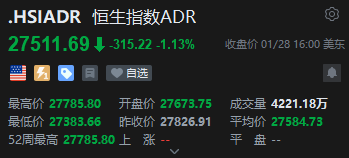
Market Overview - US stock indices showed mixed performance on Wednesday, with the Hang Seng Index ADR rising but closing lower compared to Hong Kong's market close, at 27,511.69 points, down 315.22 points or 1.13% [1] Major Blue-Chip Stocks - HSBC Holdings closed at HKD 135.752, down 1.27% from the Hong Kong market close [2] - Tencent Holdings closed at HKD 613.539, down 1.20% from the Hong Kong market close [2] Stock Performance Summary - Tencent Holdings: Latest price HKD 621.000, up 2.31%, ADR price HKD 613.539, down 1.20% [3] - Alibaba Group: Latest price HKD 173.500, up 2.12%, ADR price HKD 171.309, down 1.26% [3] - HSBC Holdings: Latest price HKD 137.500, up 2.23%, ADR price HKD 135.752, down 1.27% [3] - Xiaomi Group: Latest price HKD 36.320, up 2.14%, ADR price HKD 35.857, down 1.27% [3] - AIA Group: Latest price HKD 88.850, up 2.78%, ADR price HKD 87.888, down 1.08% [3] - Meituan: Latest price HKD 56.86, up 1.86%, ADR price HKD 97.328, down 1.04% [3] - BYD Company: Latest price HKD 102.800, up 4.58%, ADR price HKD 101.502, down 1.26% [3]




马化腾也受不了外卖大战?称腾讯已从美团京东投资中退出
Sou Hu Cai Jing· 2026-01-28 11:24
Core Viewpoint - Tencent has officially exited investments in JD.com and Meituan, signaling a strategic shift away from the competitive food delivery market to focus on artificial intelligence [3][4] Group 1: Strategic Shift - Tencent's CEO, Ma Huateng, announced the company's decision to withdraw from investments in JD.com and Meituan during the 2025 annual employee meeting [3] - This decision is interpreted as a strategic contraction in the fiercely competitive food delivery and community group buying sectors, with Tencent redirecting its focus towards core areas in artificial intelligence [3][4] Group 2: Competitive Landscape - The food delivery market has seen intense competition, with JD.com initiating a significant price war, followed by Meituan's quick response and Alibaba's entry through the integration of Ele.me into its Taobao Flash Purchase segment [3] - The combined investment of JD.com, Meituan, and Alibaba in this sector reached 80 billion yuan, with a notable increase of approximately 10 billion yuan in the third quarter compared to the second quarter [3] Group 3: Financial Impact - The high costs of competition have severely impacted financial performance, with JD.com reporting a 56% year-on-year decline in adjusted net profit to 5.8 billion yuan in Q3 2025 [4] - Meituan recorded a net loss of 16 billion yuan, marking its largest loss since going public, while Alibaba's net profit fell by 52% to 21 billion yuan, with a 72% decline when excluding GAAP adjustments [4] Group 4: Future Strategies - Despite Tencent's exit, competition in the food delivery and instant retail sectors remains fierce, with Alibaba demonstrating a commitment to increasing market share and investment in its Taobao Flash Purchase strategy [4][5] - Alibaba aims to enhance its user base and engagement by focusing on high-ticket users and expanding into non-food retail categories [5]


美团旅行:“反向过年”机票预订增84%,春节家庭出游趋势显著
Xin Jing Bao· 2026-01-28 09:49
Group 1 - The traditional way of family reunion during the Spring Festival is gradually being "broken," with more families opting for "reverse reunion" by either bringing elders to cities or traveling with friends and relatives during the holiday [1] - During the Spring Festival in 2026, there is a significant increase in ticket bookings for "reverse reunion," with flight bookings from early February to mid-February showing an 84% year-on-year growth [1] - The top 10 popular destinations for "reverse reunion" travel include Beijing, Shanghai, Chengdu, Chongqing, Guangzhou, Shenzhen, Kunming, Xi'an, Hangzhou, and Tianjin [1] Group 2 - The 2026 Spring Festival holiday is one day longer than in 2025, leading to a notable increase in group travel, with the proportion of train and plane tickets purchased for two or more people rising [2] - The ticket booking volume for flights to Jieyang, a destination known for its intangible cultural heritage "Yingge Dance," has increased by 166% year-on-year, primarily from cities like Nanjing, Shanghai, Chengdu, Hangzhou, and Ningbo [2] - The popularity of winter and ice activities remains high during the Spring Festival, with transportation bookings for Harbin increasing by 162%, attracting tourists from southern cities [2] Group 3 - Many families are also keen on short-distance trips during the Spring Festival, with local travel options becoming popular for family leisure [3] - The peak of return travel is concentrated around February 14, with February 22 marking the return peak, and the top 10 destinations for train travel include cities like Qingdao, Chongqing, and Beijing [3] - The top 10 destinations for air travel during the Spring Festival include major cities such as Beijing, Shanghai, and Chengdu [3]
黑珍珠餐厅指南过去三年累计增加11个地方菜系
Bei Jing Shang Bao· 2026-01-28 03:31
Core Insights - The 2026 Black Pearl Restaurant Guide has been released, featuring 263 restaurants from 32 cities in mainland China, covering 45 different cuisines, with 7 restaurants successfully upgrading their ratings [1] Group 1: Restaurant Ratings - In Beijing, there are 35 restaurants listed, including 1 three-diamond restaurant, 5 two-diamond restaurants, and 29 one-diamond restaurants [1] - Two restaurants have upgraded their ratings: 1996 Sichuan Cuisine Chef's Restaurant from one-diamond to two-diamond, and Jingji Rongpai Official Cuisine from two-diamond to three-diamond [1] Group 2: Culinary Trends - The exploration of local ingredients and flavors has become a hallmark of fine dining, with "Liao Cuisine" making its debut in the 2026 Black Pearl Guide [1] - New cities added to the list include Nantong and Qingdao, each with 2 one-diamond restaurants [1] - Over the past three years, the Black Pearl Restaurant Guide has added 11 local cuisines [1] Group 3: Consumer Demographics - According to Meituan data, the consumer demographic for fine dining is becoming more olive-shaped, with post-95 and post-00 generations making up 37% of fine dining consumers by 2025 [1] - The core consumer group remains those aged 30 to 50, while the number of consumers aged 60 and above has increased by 115% year-on-year [1] Group 4: Industry Changes - Meituan's Vice President and General Manager of the Dining Business Unit, Wei Wei, stated that the fine dining industry is undergoing three major changes: smaller and more flexible store formats, more refined products, and more genuine service [1]
观车 · 论势 || 美团闯入车市的信任与盈利之考
Zhong Guo Qi Che Bao Wang· 2026-01-28 01:15
Core Viewpoint - The strategic partnership between Xiche Technology and Meituan aims to integrate the automotive industry with local lifestyle services, creating a one-stop service platform for car buying and usage, driven by significant industry changes and internal growth anxieties [1][2]. Group 1: Industry Dynamics - The automotive sector is undergoing a major transformation, evolving from a purely industrial hardware focus to a comprehensive integration of energy, data, intelligence, and services, presenting historical opportunities for platform companies like Meituan [1]. - The automotive industry is attractive to cross-industry players due to its potential for high transaction values and the ability to enhance user engagement through services related to car usage, charging, and maintenance [2]. Group 2: Meituan's Strategic Position - Meituan's entry into the automotive sector is seen as essential for its future survival, as its core food delivery business faces intense competition and losses, with a reported revenue increase of only 2% to 95.488 billion yuan and a net loss of 18.632 billion yuan [2]. - The automotive market offers a significant opportunity for Meituan to leverage its existing service network, as car-related services are inherently local and cyclical, which can enhance user retention and drive substantial transaction growth [2]. Group 3: Business Model and Consumer Experience - Meituan's approach to selling cars differs from competitors like JD.com and Taobao, as it plans to collaborate with dealers rather than directly selling specific brands, allowing consumers to browse and compare offerings from various dealerships on its platform [3]. - The platform aims to enhance transparency and consumer trust by providing a robust evaluation system for dealerships, addressing common issues of service opacity and customer dissatisfaction in the traditional dealership model [3]. Group 4: Challenges Ahead - The automotive industry faces low profit margins, with a reported industry profit rate of only 4.4% and significant challenges for dealers, as many are unable to meet sales targets, raising questions about their willingness to collaborate with Meituan [4]. - The role of Meituan in transactions needs clarification, particularly regarding its responsibilities in case of disputes, as the complexity and high value of automotive transactions pose significant risks to consumer trust if not managed effectively [5]. - The scalability and profitability of Meituan's model are uncertain, as it shifts from working with car manufacturers to engaging with struggling dealers, which may complicate negotiations and revenue generation [5].