
MEITUAN(03690)

Search documents
阿里“通云哥”概念亮相;贵州茅台辟谣参与SpaceX融资
2 1 Shi Ji Jing Ji Bao Dao· 2026-01-30 03:28
Group 1: Technology Sector Developments - Alibaba's "Tongyun Ge" concept integrates "Cloud + AI + Chips" as a strategic support triangle for future technology initiatives, emphasizing AI as a core driver of change in cloud computing over the next decade [2] - ByteDance's CEO Liang Rubo announced the company's 2026 focus on "climbing to new heights," highlighting the importance of AI opportunities and the need to enhance talent density and incentives [5] - Waymo plans to launch fully autonomous ride-hailing services in London by Q4 2023, expanding its operations internationally despite regulatory challenges [7] Group 2: Market and Company News - Guizhou Moutai denied rumors of participating in SpaceX's Series A funding, with its stock closing at 1437.72 yuan per share, up 8.61%, and a market capitalization exceeding 1.8 trillion yuan [3] - Byte's new "Doubao" smartphone is expected to be released in late Q2 2026, with significant improvements over its predecessor, developed in collaboration with ZTE Nubia [4] - Meituan's new "one-shot" verification feature requires new restaurant partners to upload unedited videos showcasing their premises, aimed at enhancing platform integrity [8] Group 3: Industry Collaborations - Black Sesame Intelligence and Baidu's "萝卜快跑" signed a strategic cooperation agreement to develop a collaborative ecosystem for autonomous driving, focusing on technology research and product development [11] - Shanghai Xixi Intelligent Technology completed several million yuan in angel financing, aimed at integrating AI with flexible robotics for food processing solutions [12] Group 4: Consumer Electronics - Apple's iPhone 16 was the best-selling smartphone globally in 2025, with Apple and Samsung dominating the top ten list, holding seven and three positions respectively, indicating strong market leadership [10]



茅台酱香酒与美团闪购扩大合作
Zhi Tong Cai Jing· 2026-01-30 01:28
Core Insights - Guizhou Moutai Sauce-flavored Liquor Marketing Co., Ltd. has announced an upgraded partnership with Meituan Flash Purchase, expanding the number of official stores to nearly 3,000 [2] - The collaboration aims to enhance user experience by focusing on "genuine products and exceptional service," with plans to establish capabilities for source tracing, official authentication, and one-on-one urgent delivery by 2026 [2] Summary by Categories Partnership Expansion - The number of official stores on Meituan Flash Purchase has rapidly increased from over 1,000 to nearly 3,000, covering 245 cities nationwide [2] Future Plans - By 2026, the partnership will focus on building capabilities for source tracing, official authentication, and urgent delivery services to enhance the purchasing experience for consumers [2]

马斯克考虑将SpaceX与特斯拉或xAI公司合并;阿里自研AI芯片“真武”曝光;英伟达等公司商谈向OpenAI投资至多600亿美元丨邦早报
创业邦· 2026-01-30 00:30
Group 1 - Nvidia, Microsoft, and Amazon are discussing a potential investment of up to $60 billion in OpenAI as part of a larger funding round that could total $100 billion [1] - Nvidia is negotiating to invest up to $30 billion, while Microsoft plans to invest less than $10 billion, and Amazon's investment could exceed $10 billion, potentially reaching $20 billion [1] Group 2 - ByteDance has initiated the official version of the Doubao mobile assistant project, with a new device expected to be released in late Q2 2026 [3] - ByteDance and Alibaba are both preparing to launch new AI models around mid-February, with ByteDance planning three new models including a large language model, an image generation model, and a video generation model [3] - Tesla CEO Elon Musk announced the company will cease production of the Model S and Model X, transitioning the production line to focus on autonomous driving technology [3] Group 3 - Tesla's electric vehicle production reached approximately 1.655 million units in 2025, with a record delivery of 1.636 million units, and the Model Y was the best-selling SUV in multiple markets [12] - The Shanghai Gigafactory delivered 851,000 electric vehicles, accounting for over half of Tesla's global deliveries [12] Group 4 - Sony and Singapore's GIC are investing between $2 billion and $3 billion to build a music copyright library through a joint venture [6] - Mirxes completed a placement of 21.88 million shares, raising approximately HKD 711 million, with a share price premium of nearly 40% compared to its listing price [8]





8点1氪:国铁回应“抢票神器诱导加价”:12306是唯一官方售票渠道;iPhone 16成去年全球最畅销智能手机;UC浏览器开发商被罚没126万元
36氪· 2026-01-30 00:10
Group 1 - The core viewpoint of the article emphasizes that the China Railway Group has declared the 12306 platform as the only official ticket sales channel, stating that it has not partnered with any third-party platforms and will enhance its system to combat ticket scalping [2][3] - The China Railway Group's passenger department director, Zhu Wenzhong, highlighted the negative impact of third-party platforms on the stability of the 12306 system and announced plans to optimize the risk control system for effective identification [3] - The railway authority is focusing on four key areas for ticket sales organization: addressing the needs of students, workers, and the elderly; introducing a limited-time free refund policy for erroneous purchases; continuously improving ticket sales strategies; and ensuring the stable operation of the 12306 system [5] Group 2 - The article mentions that the 2026 Spring Festival travel period is expected to see a record 9.5 billion person-times of cross-regional movement, with self-driving travel being the main mode of transport, accounting for about 80% [6] - The article also notes that the total passenger volume for railways and civil aviation is projected to reach 540 million and 95 million respectively during the Spring Festival travel period, with both figures expected to exceed historical peaks [6]



智通ADR统计 | 1月30日
智通财经网· 2026-01-29 22:41
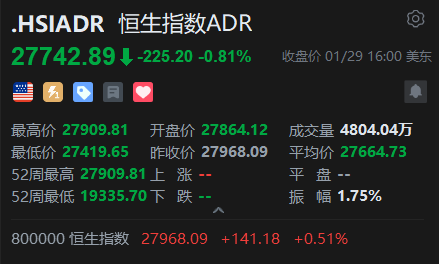
Market Overview - The Hang Seng Index (HSI) closed at 27,742.89, down by 225.20 points or 0.81% as of January 29, 16:00 Eastern Time [1] - The index reached a high of 27,909.81 and a low of 27,419.65 during the trading session, with an average price of 27,664.73 [1] - The 52-week high for the index is 27,909.81, while the 52-week low is 19,335.70 [1] Blue-Chip Stocks Performance - Most large-cap stocks experienced declines, with HSBC Holdings closing at HKD 138.219, up 0.45% compared to the Hong Kong close [2] - Tencent Holdings closed at HKD 619.286, down 0.44% from the Hong Kong close [2] Individual Stock Movements - Tencent Holdings (00700) latest price is HKD 622.000, with a slight increase of 1.000 or 0.16% [3] - Alibaba Group (09988) latest price is HKD 173.300, down by 0.200 or 0.12% [3] - HSBC Holdings (00005) latest price is HKD 137.600, up by 0.100 or 0.07% [3] - China Construction Bank (00939) latest price is HKD 8.160, up by 0.130 or 1.62% [3] - AIA Group (01299) latest price is HKD 90.950, up by 2.100 or 2.36% [3] - Xiaomi Group (01810) latest price is HKD 36.620, up by 0.300 or 0.83% [3] - NetEase (099999) latest price is HKD 206.600, down by 5.400 or 2.55% [3] - Meituan (03690) latest price is HKD 98.600, up by 0.250 or 0.25% [3] - Industrial and Commercial Bank of China (01398) latest price is HKD 6.640, up by 0.050 or 0.76% [3] - Hong Kong Exchanges and Clearing (00388) latest price is HKD 444.200, up by 5.000 or 1.14% [3] - Ping An Insurance (02318) latest price is HKD 73.300, up by 2.350 or 3.31% [3] - Baidu Group (09888) latest price is HKD 155.500, down by 0.600 or 0.38% [3] - China Bank (03988) latest price is HKD 4.760, up by 0.090 or 1.93% [3] - BYD Company (01211) latest price is HKD 101.800, down by 1.000 or 0.97% [3] - JD.com (09618) latest price is HKD 114.600, down by 1.700 or 1.46% [3] - Ctrip Group (09961) latest price is HKD 482.200, down by 13.200 or 2.66% [3]



【聚焦新就业形态劳动者】如何以“友好社区”起笔,绘就骑手“友好之城”新图景?
Xin Lang Cai Jing· 2026-01-29 19:50
Core Viewpoint - The establishment of "Rider-Friendly Communities" across various cities in China is improving working conditions for delivery riders, addressing issues such as access, parking, navigation, charging, and dining [1][2]. Group 1: Community Development - The first "Rider-Friendly Community" was launched in Tian Tong Yuan, Beijing, in January 2024, and has rapidly expanded to multiple cities nationwide [1]. - Riders are experiencing improved living conditions, such as affordable housing options, with some riders paying only 700 yuan per month for accommodation in central Beijing [1]. - The community initiative is a collaborative effort involving local governments, property management, delivery platforms, and riders, fostering a more harmonious coexistence [1][7]. Group 2: Infrastructure Improvements - Enhancements in community infrastructure include the installation of directional signs, friendly maps, and illuminated doorplates to assist riders in navigating residential areas [2]. - Charging stations have been established to alleviate riders' concerns about battery life, allowing for quick battery swaps [2]. - The community has defined "six types of friendliness" to guide the development of Rider-Friendly Communities: information, co-governance, service, interpersonal, spatial, and facility friendliness [2]. Group 3: Addressing Access Issues - The initiative began by addressing the "access difficulty" faced by riders, who often felt discriminated against when trying to enter residential areas [4][5]. - Solutions were developed through collaborative discussions among riders, property owners, and community representatives, leading to agreements on access during peak and non-peak hours [6]. - Technology is being utilized to streamline identity verification for riders, enhancing their access to residential areas while alleviating property owners' concerns [6]. Group 4: Community Engagement - The initiative promotes community engagement, with riders participating in local events and volunteer activities, fostering a sense of belonging [7]. - The relationship between residents and riders is improving, with increased interactions leading to greater understanding and acceptance [7]. - Delivery platforms are also contributing to community safety and governance by encouraging riders to report safety hazards and participate in community service [7]. Group 5: Future Prospects - As of November 2025, over 40,000 Rider-Friendly Communities have been established in more than 200 cities by Meituan, with similar efforts by other platforms like Taobao [8]. - The concept of "Friendly Cities" is being expanded beyond communities to include business districts, parks, and office buildings, indicating a broader vision for urban development [8].
八座城市开启试点 美团外卖推出“一镜到底”验真功能
Bei Jing Shang Bao· 2026-01-29 11:05
Core Viewpoint - Meituan has launched a "one-shot" video verification feature for new restaurant merchants on its food delivery platform to enhance the authenticity of store operations and combat "ghost restaurants" [1] Group 1: Implementation of the "One-Shot" Video Feature - The "one-shot" video must be continuous and unedited, showcasing the store's exterior, operating environment, kitchen conditions, and qualifications [1] - This feature is currently being piloted in eight cities, including Jinhua, Yinchuan, Qingdao, Harbin, and Guiyang, and will be gradually rolled out nationwide within the year [1] - Non-compliance with the video upload requirements or submission of false videos will result in corresponding actions from the platform [1] Group 2: Regulatory Context - The national standard for food delivery platform recommendations, titled "Basic Requirements for Service Management of Food Delivery Platforms," was released on December 4, 2025 [1] - The standard addresses the issue of "ghost restaurants" by stipulating that merchants must provide a "one-shot" video with store location, and platforms must verify the consistency of location information with merchant licenses [1]
美团外卖上线“一镜到底”,新入驻商家须上传完整门店视频
Bei Jing Ri Bao Ke Hu Duan· 2026-01-29 10:37
Core Insights - Meituan Waimai has launched a "one-shot" store authenticity verification feature, requiring restaurant merchants to upload unedited videos showcasing their storefront, operating environment, kitchen conditions, and qualifications when joining the platform [1] - This feature is currently being piloted in eight cities and will be expanded nationwide within the year [1] - The initiative aims to enhance the verification of store authenticity and will incorporate consistent license addresses into an intelligent risk management system [1] Group 1 - The requirement for merchants to upload "one-shot" videos is intended to improve the effectiveness of store authenticity verification [1] - Merchants failing to comply with the video upload requirement or submitting fraudulent videos will face corresponding penalties from the platform [1] - The National Market Supervision Administration has implemented basic requirements for food delivery platform services, addressing the issue of "ghost restaurants" by mandating that merchants provide location-tagged "one-shot" videos [1] Group 2 - The platform's pilot practices in cities like Jinhua and Yinchuan revealed that most discrepancies between video documentation and store information were due to offline license updates not being synchronized with the platform [1] - Over 80% of merchants rectified issues promptly after receiving notifications, with others undergoing special governance [1] - As of December 2025, 400,000 merchants have adopted the "Mingchu Liangzao" feature, with more than half of them consistently broadcasting [1]
茅台酱香酒与美团闪购升级合作:近3000家官方门店上线年货补贴
Xin Lang Cai Jing· 2026-01-29 09:28
Core Viewpoint - The collaboration between Guizhou Moutai Sauce Wine Marketing Co., Ltd. and Meituan Flash Purchase aims to enhance the distribution and accessibility of authentic Moutai Sauce Wine through a significant increase in certified stores and a focus on consumer experience [1] Group 1: Partnership and Expansion - Guizhou Moutai has upgraded its partnership with Meituan Flash Purchase, expanding the number of official certified stores from over 1,000 to nearly 3,000, covering 245 cities nationwide [1] - The collaboration is part of a strategy to build an instant retail network and drive channel transformation for Moutai Sauce Wine [1] Group 2: Consumer Engagement and Promotions - The partnership will focus on core values of "genuine products and exceptional service," with plans to implement source tracing, official authentication, and one-on-one urgent delivery services by 2026 [1] - A joint subsidy activity will be launched during the traditional peak season for purchasing liquor, particularly around the Spring Festival [1]
茅台酱香酒与美团闪购扩大合作:入驻官方门店增至近3000家
智通财经网· 2026-01-29 09:17
Core Insights - Guizhou Moutai Sauce Aroma Liquor Marketing Co., Ltd. announced an upgraded partnership with Meituan Flash Purchase to enhance its distribution network [1] - The number of official stores on Meituan Flash Purchase has rapidly increased to nearly 3,000, covering 245 cities nationwide [1] - By 2026, the partnership aims to establish capabilities focused on "genuine products, extreme service," including source tracing, official authentication, and one-on-one urgent delivery [1] Summary by Categories - **Partnership Development** - The collaboration with Meituan Flash Purchase is aimed at expanding the reach of Moutai's products through a significant increase in official store presence [1] - **Market Expansion** - The official store count has grown from over 1,000 to nearly 3,000, indicating a strong market penetration strategy [1] - **Future Goals** - The partnership will focus on creating a premium purchasing experience with features like genuine product assurance and immediate delivery services by 2026 [1]