CICC(03908)

Search documents
绿云软件,来自浙江杭州,递交IPO招股书,拟赴香港上市,中金公司独家保荐
Sou Hu Cai Jing· 2026-02-21 11:56
Core Viewpoint - Hangzhou GreenCloud Software Co., Ltd. (GreenCloud Software) is preparing for an IPO on the Hong Kong Stock Exchange, aiming to leverage its position as a leading digital service provider in the accommodation industry [2]. Company Overview - GreenCloud Software, established in 2010, specializes in providing digital solutions, digital marketing services, and other value-added services for the accommodation industry [2]. - The company has developed a cloud-based product ecosystem centered around its Property Management System (PMS), enhancing operational efficiency and guest experience for hotels [6]. Market Position - GreenCloud Software is the largest PMS supplier in China's accommodation digitalization industry, holding market shares of 16.8% in sales and 16.3% in room coverage as of 2024 [5]. - The company has been the only profitable player among the top five accommodation digital service providers in China from 2020 to 2024, with the highest cumulative net profit during this period [5]. Client Base - The company serves over 37,000 hotels in China, including major hotel management groups ranked in the top 50 by the China Hotel Association and top 60 by the China Tourism Hotel Association [4]. - GreenCloud Software's solutions are also utilized in the cultural tourism sector, with clients including notable groups such as Songzan and Anaya [4]. Revenue Breakdown - The company's revenue for the years ending December 31, 2023, and 2024, is reported as RMB 337.241 million and RMB 327.053 million, respectively, with a projected revenue of RMB 225.070 million for the nine months ending September 30, 2025 [7][14]. - Revenue sources include digital solutions for the accommodation industry (80.1%), digital marketing services (12.9%), and other value-added services (7.0%) [7]. Shareholding Structure - The pre-IPO shareholding structure indicates that Yang Mingkui and Gao Liang collectively hold approximately 58.81% of the company, making them the controlling shareholders [8][10]. Management Team - The board of directors consists of nine members, including six executive directors and three independent non-executive directors, with Yang Mingkui serving as the Chairman and General Manager [12][13]. Advisory Team - The IPO's advisory team includes CICC as the sole sponsor, Ernst & Young as the auditor, and various legal advisors [16][17].


中金公司业务动态活跃,2025年业绩预增超50%
Xin Lang Cai Jing· 2026-02-21 09:48
Group 1 - The core viewpoint of the news highlights that CICC maintains its leading position in global IPO underwriting and continues to actively participate in various sectors, reflecting a robust project reserve in its investment banking business [1] - CICC's research team covers over 40 industries and more than 1,800 companies, indicating a strong commitment to research and analysis [1] - The company has announced a significant increase in its expected net profit for 2025, projecting a range of 8.542 billion to 10.535 billion yuan, which represents a year-on-year increase of 50% to 85% [2] Group 2 - As of February 13, 2026, CICC's stock price was 34.69 yuan, with a slight decline of 0.34% on that day, while the securities sector experienced a drop of 1.03% [3] - The stock has shown a recent fluctuation pattern, with a technical resistance level at 35.45 yuan and a support level at 34.28 yuan [3] - A report from Western Securities indicates a confirmed trend of profit recovery in the securities industry, suggesting potential opportunities for left-side layout, which indirectly supports the environment for brokerage firms [4]
中金公司董事长陈亮:坚守“植根中国,融通世界”的初心,以中金所能服务国家所需
Xin Lang Cai Jing· 2026-02-16 01:24
Group 1 - The year 2026 marks the beginning of the "14th Five-Year Plan," with a solid foundation for long-term economic growth and a positive trend expected to continue [3][10] - The Central Economic Work Conference has outlined directions for the upcoming year, supporting a stable start to the "14th Five-Year Plan" [3][10] - The capital market plays a crucial role in serving national strategies and empowering the real economy, with finance needing to demonstrate greater responsibility in addressing external challenges and maintaining economic and financial stability [3][10] Group 2 - 2025 will celebrate the 30th anniversary of CICC, which has consistently aligned with national development and contributed to capital market construction through professional services [5][12] - CICC aims to focus on building a "wealth investment bank" and "asset investment bank," capitalizing on the trend of diversified wealth allocation among residents to expand social wealth and boost market confidence [5][12] - The company will deepen its "industrial investment banking" efforts, leveraging its expertise in early, small, and long-term investments to inject financial support into technological innovation and industrial upgrades [5][12] - CICC plans to enhance its "trading investment banking" characteristics and international advantages, strengthening cross-border connectivity and supporting high-level opening-up to improve the global competitiveness of China's capital market [5][12] Group 3 - CICC is committed to its mission of "rooted in China, connecting with the world," aiming to serve national needs and fulfill its responsibilities as a state-owned financial institution [5][12] - The company seeks to collaborate with various parties to contribute to the high-quality development of the capital market and the construction of Chinese-style modernization [5][12]

中金财富吴显鏖:财富管理机构要深度聚焦跨境客群的多样化需求
券商中国· 2026-02-16 01:13
Core Viewpoint - The wealth management industry in the Greater Bay Area is transitioning from "scale expansion" to "quality enhancement," with a focus on meeting the diverse needs of high-net-worth individuals, particularly in areas such as wealth planning and asset inheritance [1][8]. Group 1: Industry Dynamics - The Greater Bay Area, particularly Shenzhen, is a key engine for high-quality development in wealth management, with a total wealth management scale exceeding 31 trillion yuan, accounting for 20% of the national total [4]. - As of the end of 2025, the wealth management business of China International Capital Corporation (CICC) has a product scale exceeding 450 billion yuan, with nearly 10 million clients served [4][6]. Group 2: Cross-Border Wealth Management - CICC has established a global asset allocation capability and a client-centered advisory system, leveraging the advantages of the Greater Bay Area to enhance cross-border wealth management services [2][5]. - The company has seen significant growth in its cross-border wealth management business, with client asset allocation and retention increasing by nearly 260% and 90%, respectively, by the end of 2025 [2][5]. Group 3: Investment Trends - There is a shift in investment preferences among residents, with over 70% still favoring money market funds, but a growing interest in short-term bond products and equity products due to changing risk appetites [6]. - CICC aims to provide customized asset allocation solutions that align with clients' risk tolerance, emphasizing the importance of rational investment and diversified global asset allocation [7][9]. Group 4: Future Opportunities - The wealth management market in the Greater Bay Area presents numerous opportunities, particularly in developing family offices, family trusts, and cross-border asset allocation services [8][9]. - CICC plans to enhance its service capabilities by focusing on long-term investment products and lifecycle-type products to meet the growing demand for retirement planning [10].

中金研究恭贺新春!
中金点睛· 2026-02-16 01:08
中 金 研 究 恭 贺 新 春 法律声明 Legal Disclaimer 法律声明 完 特别提示 本公众号不是中国国际金融股份有限公司(下称"中金公司")研究报告的发布平台。本公众号只是转发中金公司已发布研究报告的部 分观点,订阅者若使用本公众号所载资料,有可能会因缺乏对完整报告的了解或缺乏相关的解读而对资料中的关键假设、评级、目标价等 内容产生理解上的歧义。订阅者如使用本资料,须寻求专业投资顾问的指导及解读。 本公众号所载信息、意见不构成所述证券或金融工具买卖的出价或征价,评级、目标价、估值、盈利预测等分析判断亦不构成对具体 证券或金融工具在具体价位、具体时点、具体市场表现的投资建议。该等信息、意见在任何时候均不构成对任何人的具有针对性的、指导 具体投资的操作意见,订阅者应当对本公众号中的信息和意见进行评估,根据自身情况自主做出投资决策并自行承担投资风险。 中金公司对本公众号所载资料的准确性、可靠性、时效性及完整性不作任何明示或暗示的保证。对依据或者使用本公众号所载资料所 造成的任何后果,中金公司及/或其关联人员均不承担任何形式的责任。 本公众号仅面向中金公司中国内地客户,任何不符合前述条件的订阅者,敬请 ...

券商一年少近8000人,公募却九次刷新纪录:金融人正“用脚投票”
Xin Lang Cai Jing· 2026-02-15 14:47
Core Viewpoint - The financial industry is experiencing a significant migration trend, with professionals moving from brokerage firms to public funds, indicating a shift in resource allocation within the wealth management sector [3][17][24]. Group 1: Migration Trends - A notable number of brokerage employees have changed their careers to join public funds, exemplified by individuals like Zhao Binghao moving from CITIC Securities to Huazhang Fund [3][17]. - As of the end of 2025, the number of employees in securities companies is projected to decrease to 327,800, reflecting a net loss of nearly 8,000 in one year, while public fund assets are expected to reach 37.71 trillion yuan, marking an increase of nearly 5 trillion yuan [5][19]. Group 2: Reasons for Migration - The decline in commission rates and shrinking investment banking projects have led to reduced income for brokerage employees, making the once lucrative positions less attractive [7][20]. - In contrast, public funds are experiencing rapid growth, with a significant demand for investment research talent, as evidenced by the average management scale per employee exceeding 1.1 billion yuan [20][25]. Group 3: Characteristics of Migrating Professionals - Two main groups are migrating: experienced professionals returning to their roots in public funds and investment managers transferring their product management rights as part of a business transition [9][22]. - The migration is not merely a job change but reflects a strategic realignment in response to market demands and opportunities [24][26]. Group 4: Industry Dynamics - The surge in public fund assets is driven by a shift in consumer investment preferences, as traditional wealth management products face challenges, leading to increased inflows into public funds [11][25]. - The current trend signifies a structural transformation in China's wealth management industry, moving from a focus on brokerage services to a greater emphasis on product management and research capabilities [14][26].


除夕不看春晚开电话会!春节期间电话会近300场
Feng Huang Wang· 2026-02-15 14:04
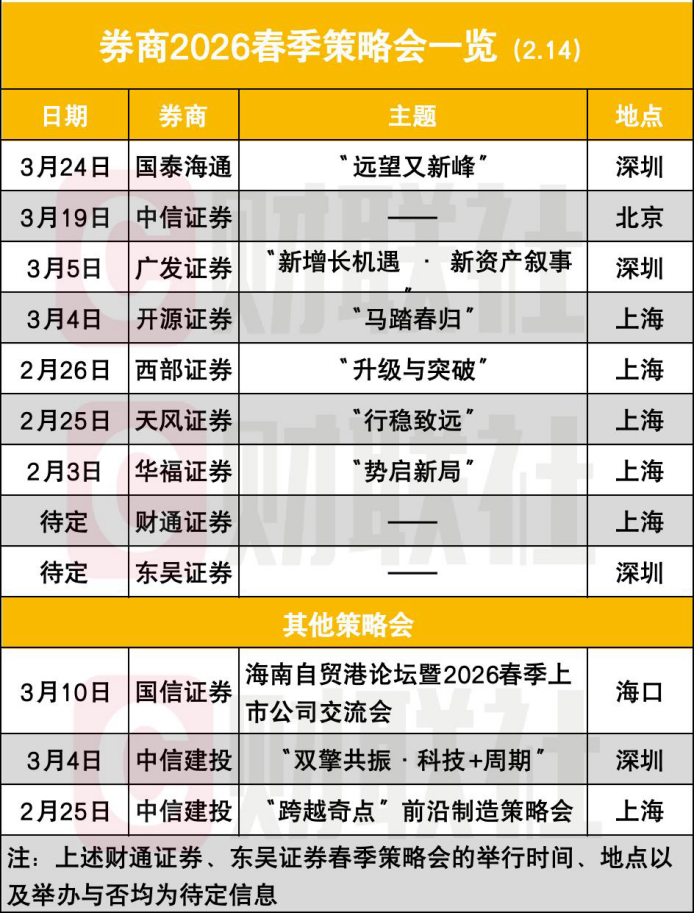
Core Insights - The sell-side research sector is intensifying efforts to boost performance during the Chinese New Year, with a significant number of conference calls scheduled, including 292 calls from February 16 to 23, averaging over 32 calls per day [1][2] - The spring strategy meetings are also being held earlier and more densely than in previous years, with seven brokerages confirmed to host events, indicating a competitive landscape for research market share [2][11] Conference Calls and Meetings - A total of 176 sell-side roadshow meetings are planned, with 108 occurring during the Chinese New Year holiday from February 15 to 23, involving over 13 brokerages [3][4] - Notable brokerages participating include Pacific Securities, Guotai Junan, and CITIC Securities, with a focus on various industries such as food and beverage, real estate, and technology [3][7] Spring Strategy Meetings - The spring strategy meetings are characterized by early initiation and dense scheduling, with the first meeting held by Huafu Securities on February 3, 2026 [11][12] - The themes of these meetings reflect a positive outlook for the capital market, with keywords like "new," "breakthrough," and "upgrade" being prevalent [12][13] - Brokerages are also expanding their geographical reach, with events planned in locations beyond traditional financial hubs, indicating a shift in focus towards emerging economic regions [12] Competitive Landscape - The competition among brokerages for research market share is intensifying, driven by pressures on research income due to ongoing reforms in public fund fees [10][11] - Medium-sized brokerages are particularly focused on enhancing their research capabilities to capture market share, while larger firms maintain strategic investments in research to support both external and internal functions [10]



再融资新规红利释放,投行谁将受益?
Xin Lang Cai Jing· 2026-02-15 05:57
Core Viewpoint - The introduction of new refinancing regulations by the Shanghai, Shenzhen, and Beijing stock exchanges is seen as a positive development for the investment banking sector, providing opportunities for both large and small brokerage firms to adapt and capitalize on the changes [1][2][8]. Group 1: Market Response and Opportunities - The new refinancing regulations are expected to enhance the efficiency of refinancing processes, addressing previous concerns raised by market participants [2][10]. - In the first week following the announcement of the new regulations (February 10-12), at least 10 listed companies in the three exchanges issued new refinancing proposals, indicating a quick market response [2][11]. - The refinancing market in January saw a significant increase, with a total of 130 billion yuan raised, marking a 56% year-on-year growth and a 234% month-on-month increase [3][11]. Group 2: Impact on Brokerage Firms - Analysts believe that leading brokerage firms with strong pricing and underwriting capabilities will benefit the most from the new regulations, while smaller firms will need to find differentiated strategies to compete [4][12]. - The top five brokerage firms accounted for 54% of the underwriting volume in 2025, with CITIC Securities leading by underwriting 36 companies [4][12]. - Smaller brokerage firms are focusing on the Beijing Stock Exchange's refinancing market, which is seen as a key area for growth due to the concentration of small and medium-sized enterprises [5][13][14]. Group 3: Challenges and Requirements - The new regulations emphasize "supporting the strong and limiting the weak," which raises the bar for brokerage firms in terms of their capabilities, particularly in pricing for unprofitable technology companies [7][16]. - There is a limited number of firms with experience in pricing for unprofitable companies, highlighting a potential challenge for many in the industry [7][16]. - The ability to effectively integrate technology and finance is becoming increasingly important, requiring firms to enhance their understanding of industries and technologies [7][16].

再融资新规红利释放,投行谁将受益?
券商中国· 2026-02-15 05:56
Core Viewpoint - The introduction of new refinancing regulations by the Shanghai, Shenzhen, and Beijing stock exchanges is expected to improve the investment banking business, creating opportunities for both large and small brokerages [1][2]. Group 1: Policy Changes and Market Reactions - The new refinancing regulations aim to enhance the efficiency of refinancing approvals, responding to market demands and facilitating the rapid development of new economies [2]. - The first week following the policy announcement saw at least 10 listed companies in the three exchanges release new refinancing plans, indicating a positive market response [2][3]. - The refinancing market had already shown significant growth prior to the new regulations, with A-share refinancing in January reaching 130 billion, a year-on-year increase of 56% and a month-on-month increase of 234% [3]. Group 2: Impact on Investment Banking Landscape - The new regulations are expected to benefit leading brokerages with strong pricing and underwriting capabilities, while smaller firms may need to find differentiated development paths [4][5]. - The top five brokerages accounted for 54% of the underwriting cases in 2025, indicating a concentration of market power among leading firms [5]. - Smaller brokerages are focusing on the Beijing Stock Exchange's refinancing market, which presents opportunities for growth due to the concentration of small and medium enterprises [6][5]. Group 3: Challenges and Requirements for Brokerages - The new refinancing rules emphasize "supporting the strong and limiting the weak," raising the capability requirements for investment banks [7]. - There is a limited number of brokerages experienced in pricing for unprofitable companies, highlighting a gap in expertise that needs to be addressed [8]. - The ability to integrate industry knowledge and resources is becoming increasingly important for brokerages, especially in the context of financing technology innovation [8].

中金《秒懂研报》 | 从 “小众” 到 “大众”:全景 / 运动相机如何撑起百亿元市场?
中金点睛· 2026-02-15 01:03
Core Viewpoint - The article discusses the transformation of panoramic and action cameras from professional equipment to consumer-friendly devices, driven by the growing demand from short video creators and outdoor enthusiasts in China. It highlights how domestic brands have outperformed established foreign competitors in this market [2][3]. Group 1: Camera Technology - Consumer-grade panoramic cameras utilize a "dual-lens + automatic stitching" technology, allowing users to capture 360° images effortlessly with AI algorithms [5][7]. - Professional-grade panoramic cameras feature multiple optical sensors and are designed for high-end applications, providing immersive experiences for events like parades and VR experiences [7]. - Action cameras are characterized by strong protection and high stability, making them suitable for extreme sports and outdoor activities, thus meeting the recording needs of outdoor enthusiasts [9]. Group 2: Market Growth - The market for handheld smart imaging devices has seen significant growth, expanding from 16.4 billion yuan in 2017 to 36.5 billion yuan in 2023, with projections to reach 59.2 billion yuan by 2027 [11][13]. - The rise in popularity of platforms like Douyin and Xiaohongshu has turned content creation into a widespread activity, contributing to the increased demand for panoramic cameras among users who want to elevate their video content [13]. - The global retail market for panoramic cameras grew from 2.51 billion yuan in 2017 to 5.03 billion yuan in 2023, with an expected compound annual growth rate (CAGR) of 11.8% [13]. Group 3: Domestic Brand Success - Domestic brands have captured 67.2% of the global consumer-grade panoramic camera market in 2023, significantly outperforming foreign competitors, which hold only 9.2% [18]. - These brands have successfully innovated by understanding the preferences of younger consumers and enhancing product features, such as editing capabilities and image quality [18]. - The second leading domestic brand leveraged its expertise in drone technology to expand into the action camera market, creating a comprehensive smart imaging product lineup [20]. Group 4: Competitive Advantages - Domestic brands have thrived by recognizing the "shallow water" nature of the handheld smart imaging device market, characterized by diverse demands and low competition barriers [21]. - Key technological advancements include high-performance image sensors and intelligent algorithms that enhance image capture and processing capabilities [21]. - Product innovation focuses on meeting user needs for content creation, with new features and designs tailored to various usage scenarios [21].