Haitong Securities(06837)

Search documents
A股有望挑战十年前高!券商集体看好明年市场,这些板块受关注
券商中国· 2025-11-09 23:38
Group 1 - The overall sentiment among brokerages for the A-share market in 2026 is optimistic, with expectations of a sustained slow bull market and potential to challenge ten-year highs [2][3]. - Brokerages believe that A-share valuations remain low, with anticipated improvements in earnings and continued liquidity support, alongside policy backing, contributing to upward market movement [2][4]. - The current market position is viewed as a potential starting point for a long-term bull market, driven by gradual improvements in fundamentals and industry highlights, with significant room for index growth [4][5]. Group 2 - Multiple brokerages emphasize the importance of corporate earnings recovery as a key driver for the A-share market, with expectations that the earnings cycle will gradually improve [5][6]. - Predictions indicate that the net profit growth rate for non-financial companies in the A-share market will be 6.4% in 2025 and 12.9% in 2026, with specific sectors like oil and petrochemicals expected to see higher growth [6]. - The liquidity environment is expected to support the market, although low-risk preference funds have been slow to enter the equity market, indicating a long-term process for significant capital inflows [7]. Group 3 - The technology sector is highlighted as a key focus for investment in 2026, with expectations of balanced industry performance and opportunities in advanced manufacturing and TMT sectors [8]. - Brokerages suggest a shift from a barbell strategy to a quality strategy, with emerging technologies being the main focus while also considering cyclical consumption and financial stocks [8].




国泰海通|非银:高增及分化是两大关注点——券商板块2025年三季报业绩综述
国泰海通证券研究· 2025-11-09 14:48
Core Viewpoint - The brokerage sector is expected to benefit from the resonance of allocation power and performance elasticity, with a continued recommendation for comprehensive leading brokerages [1][2]. Summary by Sections Performance Overview - In the first three quarters of 2025, 42 listed brokerages achieved a total net profit attributable to shareholders of 169 billion yuan, representing a year-on-year increase of 62.4%. The main driver of performance improvement was the revenue increase from brokerage and proprietary trading businesses, with adjusted revenue (operating income minus other business costs) rising by 44.1% year-on-year to 416.5 billion yuan. The net profit margin attributable to shareholders increased by 4.6 percentage points year-on-year to 41% [1]. - On a quarterly basis, the adjusted revenue of listed brokerages in Q3 2025 increased by 27.2% quarter-on-quarter, while the net profit attributable to shareholders rose by 25.5% [1]. Business Segment Contributions - Analyzing the contribution of various business segments to adjusted revenue growth in the first three quarters, proprietary trading and brokerage businesses grew by 42% and 75% year-on-year, contributing 43% and 37% to net revenue growth, respectively. The improvement in proprietary trading was mainly due to the recovery of stock derivatives and equity businesses, as well as the realization of floating profits from OCI bonds [1]. - In other business areas, the investment banking sector saw a year-on-year growth of 23% due to the recovery in equity financing, while asset management business experienced a slight increase, expected to benefit from the growth in management scale [1]. Differentiation Among Brokerages - There is significant differentiation in performance growth drivers among brokerages. Large and medium-sized brokerages benefit more from proprietary trading transformations, while small and medium-sized brokerages primarily rely on brokerage business. The analysis indicates that large and medium-sized brokerages have advantages in the context of investment banking and asset management transformations, achieving positive revenue contributions, while small and medium-sized brokerages face more pressure [2]. - The transformation of proprietary trading has become a key issue in the industry, with differences in business models, transformation processes, and investment trading capabilities among brokerages leading to operational differentiation [2]. Investment Recommendations - The brokerage sector is expected to benefit from the dual drivers of allocation power (including the entry of resident funds) and performance improvement, with a positive outlook for the non-bank sector market. The continued recommendation for the brokerage sector is based on the high growth of Q3 performance and the anticipated gradual release of future performance [2].

非银金融行业周报:“金融出海第一股”雏形初显,非车险“报行合一”时间表明确-20251109
Shenwan Hongyuan Securities· 2025-11-09 12:36
Investment Rating - The report maintains a "Positive" outlook on the non-bank financial industry, highlighting potential growth opportunities in the sector [3]. Core Insights - The report emphasizes the ongoing improvement in the brokerage and insurance sectors, with specific attention to the performance of key players and market dynamics [4][7]. - It identifies three main investment themes within the brokerage sector, focusing on firms with strong competitive positions, those with significant earnings elasticity, and companies with robust international business capabilities [4]. - The insurance sector is noted for its strategic initiatives, particularly in expanding overseas operations and optimizing non-auto insurance performance [4]. Summary by Sections Market Performance - The Shanghai Composite Index closed at 4,678.79 with a weekly change of +0.82%, while the non-bank index decreased by 0.17% to 2,005.20 [7]. - The brokerage sector index fell by 0.72%, whereas the insurance sector index rose by 1.25% [7]. Non-Bank Financial Data - In October, the average daily trading volume for stocks was 21,637 billion yuan, showing a year-on-year increase of 7% [4]. - The total margin trading balance reached 24,599 billion yuan, up 51% year-on-year [4]. Brokerage Insights - The report highlights a divergence in performance within the brokerage sector, with a significant increase in net profits for the industry, up 66% year-on-year for the first nine months of 2025 [4]. - It recommends specific brokerage firms based on their competitive strengths and market positioning, including Guangfa Securities and CITIC Securities [4]. Insurance Insights - The report discusses the strategic positioning of China People's Insurance Company in expanding its overseas business, aligning with national policies encouraging insurance firms to venture abroad [4]. - It also notes the implementation timeline for the non-auto insurance "reporting and operation integration," which is expected to enhance underwriting performance [4]. Investment Recommendations - The report suggests a focus on leading brokerage firms, those with high earnings elasticity, and companies with strong international business capabilities [4]. - In the insurance sector, it recommends companies like China Life and Ping An, anticipating positive contributions from their overseas expansion and improved underwriting performance [4].



国泰海通证券:美元走强对港股意味着什么
Zhi Tong Cai Jing· 2025-11-09 07:32
Core Viewpoint - The recent strengthening of the US dollar is primarily driven by the US government shutdown, hawkish statements from the Federal Reserve, and weakness in non-US currencies, which may lead to capital outflows from Hong Kong stocks and impact local liquidity under the currency peg system [1][2]. Impact of Strong US Dollar on Hong Kong Stocks - The US dollar index has strengthened since the end of September, surpassing the 100 mark on November 4, reaching its highest level since July [1]. - The strong dollar has historically correlated with capital outflows from Hong Kong stocks, as foreign capital remains sensitive to dollar movements [3]. - Recent data shows a net outflow of HKD 791.8 billion from foreign capital in Hong Kong stocks since the end of September, with flexible foreign capital being more sensitive to dollar strength [3]. Factors Contributing to Dollar Strength - The US government shutdown has led to a liquidity crunch, with the Treasury's total account balance rising to USD 1 trillion, effectively removing about USD 700 billion from the market [1]. - The Federal Reserve's hawkish stance has cooled expectations for interest rate cuts, with the probability of a December rate cut dropping from over 90% to 61.5% [2]. - Weakness in non-US currencies, particularly the Japanese yen and British pound, has further supported the dollar's strength [2]. Local Liquidity and Market Impact - The Hong Kong Monetary Authority's currency peg system may lead to short-term impacts on local liquidity and sectors sensitive to interest rates, such as consumption and real estate [4][5]. - Historical patterns indicate that a strong dollar often coincides with rising dollar interest rates, which can tighten local liquidity if the Hong Kong dollar depreciates significantly [5]. Market Outlook - Short-term focus should be on the potential reopening of the US government and upcoming economic data, which could influence market liquidity [6]. - Mid-term prospects for Hong Kong stocks appear positive, with low valuations and potential inflows of capital, particularly in the technology sector driven by AI [6][7]. - The Hong Kong stock market is expected to benefit from a combination of increased foreign and domestic capital inflows, alongside the scarcity of quality assets [7][8].
头部券商最新研判:A股有望挑战5100点
2 1 Shi Ji Jing Ji Bao Dao· 2025-11-09 01:29
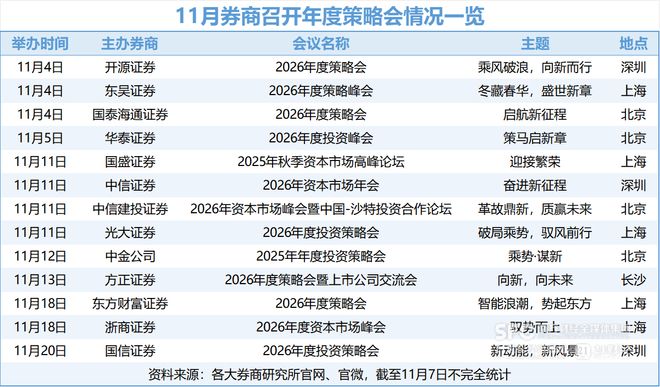
Core Viewpoint - The 2026 annual strategy meetings held by various securities firms focus on macroeconomic outlook, investment strategies, and high-quality development of listed companies, reflecting a consensus on the potential for new opportunities and trends in the capital market for 2026 [1][2]. Group 1: Strategy Meetings Overview - Multiple securities firms, including Dongwu Securities, Kaiyuan Securities, Guotai Junan, and Huatai Securities, have held or are scheduled to hold their 2026 annual strategy meetings, discussing themes such as macroeconomic conditions, the "14th Five-Year Plan," and investment strategies [1][2][3]. - The themes of these meetings emphasize economic transformation and market trends, with keywords like "new journey," "new chapter," and "seizing opportunities," indicating a focus on new opportunities and trends for 2026 [3][4]. Group 2: Economic Outlook - Dongwu Securities' chairman highlighted that the long-term positive fundamentals of the Chinese economy remain unchanged, suggesting a historic asset allocation opportunity under the guidance of a financial power strategy [6]. - Kaiyuan Securities anticipates a GDP growth target of around 5% for 2026, with a more proactive macro policy and a likely expansion of the broad deficit scale [6][7]. - Price stability is identified as a key variable influencing economic growth and capital market performance, with institutions viewing it as crucial for future economic trends [6][7]. Group 3: Market Trends and Investment Strategies - Guotai Junan's analysis indicates that the new round of capital market reforms aims to enhance inclusivity and competitiveness, potentially leading to a broad revaluation of Chinese assets [9][10]. - Huatai Securities suggests that investors may shift focus from technology to cyclical sectors like energy, consumption, and real estate, particularly high-quality leading companies in these "old economy" sectors [10][12]. - The concept of a "transformation bull market" is emphasized, with expectations that the market may challenge the highs seen in 2015, indicating a potential for significant upward movement in the A-share market [10][12]. Group 4: Investment Recommendations - Huatai Securities' research indicates a preference for "old economy" investments due to their current low valuations and market expectations, suggesting a balanced approach between value and growth investments [12][14]. - The recommendation for investors includes a strategy of dollar-cost averaging and phased investments, particularly during the end of the year and the first quarter of the following year, which are seen as favorable periods for positioning [14].


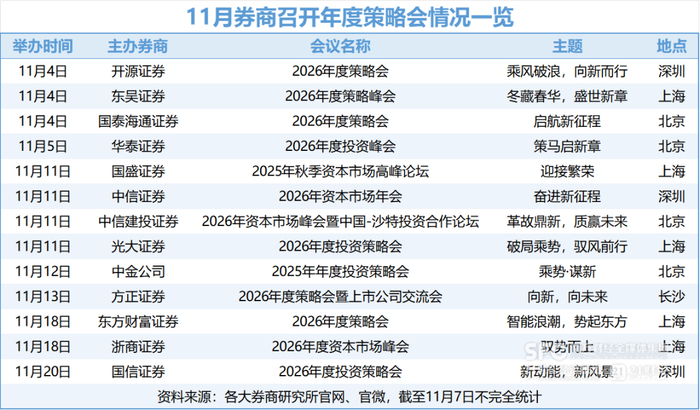
头部券商最新研判:看好“老经济”板块,A股有望挑战十年前高点
2 1 Shi Ji Jing Ji Bao Dao· 2025-11-08 03:36
Core Insights - The 2026 annual strategy meetings held by various securities firms focus on macroeconomic outlook, investment strategies, and high-quality development of listed companies, reflecting a collective anticipation for new opportunities in the upcoming year [1][2][3] Group 1: Strategy Meetings Overview - Multiple securities firms, including Dongwu Securities, Kaiyuan Securities, Guotai Junan, and Huatai Securities, have held or are scheduled to hold their 2026 annual strategy meetings, discussing themes such as AI, innovative pharmaceuticals, and economic transformation [1][2][3] - The meetings emphasize keywords like "new journey," "new chapter," and "seizing opportunities," indicating a focus on emerging trends and economic transformation [3][5] Group 2: Economic Outlook - Dongwu Securities' chairman highlighted the enduring positive fundamentals of the Chinese economy, suggesting a historical asset allocation opportunity driven by financial strength [6] - Open-source Securities anticipates a GDP growth target of around 5% for 2026, with a more proactive macroeconomic policy and expectations for equity markets to outperform bonds [6][7] - Guotai Junan's chief macro analyst noted that inflation indicators are crucial for assessing economic growth and capital market performance, emphasizing the need for stable prices to support growth [6][7] Group 3: Market Trends and Investment Strategies - Guotai Junan's president pointed out that the new round of capital market reforms aims to enhance inclusivity and competitiveness, potentially leading to a broad revaluation of Chinese assets [8] - Huatai Securities' analysts predict a shift in investor focus towards cyclical sectors like energy, consumption, and real estate, as the market transitions from a "dividend and technology" strategy to one more aligned with economic fundamentals [9][10] - The concept of a "transformation bull market" is highlighted, with expectations that the market may challenge historical highs, particularly the 5178.19 points reached in June 2015 [10][11] Group 4: Investment Preferences - Analysts suggest that traditional sectors may offer better investment value compared to technology stocks, given their current low valuations and market expectations [11][12] - Recommendations for investors include a balanced approach between value and growth, with a focus on gradual investment strategies such as dollar-cost averaging [12]
“市场高度有望超出共识,挑战十年前高”,国泰海通最新研判!
Zhong Guo Ji Jin Bao· 2025-11-07 07:20
Core Insights - The 2026 strategy meeting by Guotai Junan Securities emphasizes that the "transformation bull market" in China is far from over, with the potential for market heights to exceed consensus expectations and challenge levels seen a decade ago [1][4] Group 1: Macroeconomic Outlook - The current Chinese economy is responding to external uncertainties with a focus on high-quality development, positioning itself as a key driver of global economic growth [2] - The macroeconomic landscape for 2026 is characterized by significant growth potential, despite structural disparities in supply and demand, with price stability being crucial for growth [3] Group 2: Investment Strategy - The capital market reform in China is accelerating, enhancing the inclusivity, adaptability, attractiveness, and competitiveness of the market, which is expected to lead to a broad revaluation of assets [2] - The focus is shifting from a barbell strategy to a quality strategy, with both technology and non-technology sectors presenting investment opportunities [4] Group 3: Asset Class Insights - The long-term bull market for gold is driven by non-economic factors, indicating a historical shift in its valuation framework [3] - Strategic outlooks for commodities suggest a bullish stance on gold and copper, driven by global credit differentiation and structural demand from AI infrastructure and energy upgrades [5]
“市场高度有望超出共识,挑战十年前高”,国泰海通最新研判!
中国基金报· 2025-11-07 07:07
Core Viewpoint - The 2026 strategy meeting by Guotai Junan Securities emphasizes that the "transformation bull market" in China is far from over, with the potential for market heights to exceed consensus expectations and challenge levels seen a decade ago [2][9]. Group 1: Macroeconomic Insights - The current economic strategy focuses on high-quality development to address external uncertainties, positioning China as a key driver of global economic growth [4]. - The macroeconomic outlook for 2026 suggests that asset restructuring will be crucial, with price stability being key to growth, particularly in light of weak domestic demand [6]. - Inflation expectations are critical for wealth management, and the historical relationship between economic cycles, interest rates, and stock market risk preferences is highlighted [6]. Group 2: Market Opportunities - The capital market reform and economic transformation are expected to create a significant growth cycle for the Chinese stock market starting in 2025, with a focus on both technology and non-technology sectors [9]. - A shift from a barbell strategy to a quality strategy is recommended, with emerging technologies as a primary focus and a positive outlook on financial stocks [9]. - The demand for asset management is anticipated to surge due to the acceleration of economic transformation and the deepening of capital market reforms [9]. Group 3: Commodity Outlook - A strategic bullish outlook on gold and copper is presented, with long-term factors such as the diversification of global central bank reserves and the weakening of dollar credit supporting gold prices [10]. - For copper, supply constraints due to declining ore grades and extended new mine development cycles are expected to support prices, alongside structural demand from AI infrastructure and grid upgrades [11].

国泰海通中证全指指数增强型证券投资基金 基金份额发售公告
Zhong Guo Zheng Quan Bao - Zhong Zheng Wang· 2025-11-06 23:14
Group 1 - The fund name is Guotai Haitong CSI All Share Index Enhanced Securities Investment Fund, with A-class fund share code 025308 and C-class fund share code 025309 [11] - The fund is a contract-based open-end stock investment fund with an indefinite duration and an initial share value of 1.00 RMB [12] - The fund aims to effectively track the CSI All Share Index while seeking to achieve investment returns that exceed the target index through quantitative methods [13] Group 2 - The fund will be publicly offered from November 17, 2025, to November 28, 2025, and the management company may adjust the fundraising period based on subscription conditions [15] - The minimum subscription amount for individual investors is 10 RMB, and there is no limit on the total subscription amount during the fundraising period [3][8] - The fund is open to individual investors, institutional investors, and qualified foreign investors who meet legal requirements [14] Group 3 - The fund has two classes of shares: A-class shares, which charge subscription fees, and C-class shares, which do not charge subscription fees [19] - The subscription fee for A-class shares is tiered based on the subscription amount, while C-class shares do not incur any subscription fees [19][21] - Investors can subscribe multiple times during the subscription period, and once accepted, the subscription application cannot be withdrawn [9][10] Group 4 - The fund management company is Shanghai Guotai Haitong Securities Asset Management Co., Ltd., and the custodian bank is Jiangsu Bank Co., Ltd. [54] - The fund's registration and offering details will be published on the management company's website and the China Securities Regulatory Commission's fund electronic disclosure website [5][13] - The fund management company will handle the subscription funds in a dedicated account, and any interest generated during the fundraising period will be allocated to fund shares [16][25]


国泰海通召开2026年度策略会
国泰海通证券研究· 2025-11-06 12:05
Group 1 - The conference held by Guotai Junan on November 4, 2023, focused on the theme "Setting Sail for a New Journey," gathering experts from various sectors to discuss market hotspots and investment strategies for 2026 [2][4] - Guotai Junan's President Li Junjie emphasized that China's economy is responding to external uncertainties with a focus on high-quality development, positioning itself as a key driver of global economic growth [4] - The capital market reform aims to enhance inclusivity, adaptability, and competitiveness, potentially leading to a broad revaluation of Chinese assets [4] Group 2 - The main forum featured notable speakers discussing topics such as China's macroeconomic situation, U.S. economic outlook, global geopolitical dynamics, and the future of artificial intelligence [7] - Guotai Junan's Chief Macro Analyst Liang Zhonghua presented a view that China's economy has significant growth potential, with a focus on stabilizing prices as a key to growth in 2026 [10] - Chief Strategy Analyst Fang Yi highlighted that 2025 will mark a significant growth period for the Chinese stock market, driven by capital market reforms and economic transformation, with a bullish outlook for both technology and non-technology sectors [12] Group 3 - The conference included six sub-forums covering various topics such as humanoid robots, AI ecosystems, new energy, and innovative pharmaceuticals, providing a comprehensive platform for dialogue [14] - The event attracted thousands of viewers through live streaming on Guotai Junan's apps, indicating strong interest in the discussions and insights shared [14]