LEAPMOTOR(09863)

Search documents
零跑汽车(09863.HK)一度涨超5%
Mei Ri Jing Ji Xin Wen· 2025-12-19 06:55
Group 1 - Leap Motor (09863.HK) experienced a surge of over 5%, with a current increase of 4.36%, trading at HKD 49.84 [1] - The trading volume reached HKD 462 million [1]

港股异动 | 零跑汽车(09863)涨超5% 零跑Lafa5正式开启全国交付 支持双AI大模型与激光雷达感知系统
智通财经网· 2025-12-19 06:46
消息面上,12月19日,据太平洋汽车网报道,从零跑汽车官方获悉,零跑Lafa5(询底价|查参配)正式开 启全国交付,新车于11月27日正式上市,共推出5款车型,售价区间9.78-12.18万元。Lafa5基于LEAP 3.5技术架构打造,定位高颜值运动轿跑,搭载高通8295芯片与8650辅助驾驶芯片,支持双AI大模型与 激光雷达感知系统,动力方面提供后驱布局与多种功率版本,CLTC续航最高达605公里。 智通财经APP获悉,零跑汽车(09863)涨超5%,截至发稿,涨4.36%,报49.84港元,成交额4.62亿港元。 ...
零跑汽车涨超5% 零跑Lafa5正式开启全国交付 支持双AI大模型与激光雷达感知系统
Zhi Tong Cai Jing· 2025-12-19 06:45
消息面上,12月19日,据太平洋汽车网报道,从零跑汽车官方获悉,零跑Lafa5(询底价|查参配)正式开 启全国交付,新车于11月27日正式上市,共推出5款车型,售价区间9.78-12.18万元。Lafa5基于LEAP3.5 技术架构打造,定位高颜值运动轿跑,搭载高通8295芯片与8650辅助驾驶芯片,支持双AI大模型与激 光雷达感知系统,动力方面提供后驱布局与多种功率版本,CLTC续航最高达605公里。 零跑汽车(09863)涨超5%,截至发稿,涨4.36%,报49.84港元,成交额4.62亿港元。 ...
零跑汽车成立金属材料公司
Zheng Quan Shi Bao Wang· 2025-12-19 04:00
Core Viewpoint - Zhejiang Lingtuo Metal Materials Co., Ltd. has been established with a registered capital of 40 million yuan, indicating a strategic move in the metal materials sector by Leap Motor, which fully owns the company [1] Company Summary - The legal representative of Zhejiang Lingtuo Metal Materials Co., Ltd. is Cao Li [1] - The company's business scope includes sales of metal materials, steel rolling processing, manufacturing of metal materials, sales of metal products, manufacturing of automotive parts and accessories, and R&D of automotive parts [1] - Leap Motor, the parent company, is actively expanding its operations into the metal materials industry through this new establishment [1]
港股汽车股盘初普遍上扬,小鹏汽车(09868.HK)涨2.53%,零跑汽车(09863.HK)、北京汽车(01958.HK)涨超1%。
Jin Rong Jie· 2025-12-19 01:33
本文源自:金融界AI电报 港股汽车股盘初普遍上扬,小鹏汽车(09868.HK)涨2.53%,零跑汽车(09863.HK)、北京汽车(01958.HK) 涨超1%。 ...
港股开盘:恒指涨0.53%,恒生科指涨0.81%,科网股普涨,新能源车概念股活跃
Jin Rong Jie· 2025-12-19 01:33
Market Performance - The Hang Seng Index opened up 0.53% at 25,634.22 points, with the Hang Seng Tech Index rising 0.81% to 5,461.92 points, and the National Enterprises Index increasing by 0.58% to 8,893.1 points [1] - Major tech stocks saw gains, with Alibaba up 0.62%, Tencent up 0.83%, JD.com up 0.71%, Xiaomi up 0.6%, NetEase up 1.42%, Meituan up 0.79%, Kuaishou up 1.3%, and Bilibili up 1.2% [1] - New energy vehicle stocks were active, with Xpeng Motors and Li Auto showing strong performance [1] U.S. Market Overview - On the previous trading day, U.S. indices rose collectively, with the Dow Jones up 0.14% at 47,951.85 points, the S&P 500 up 0.78% at 6,774.76 points, and the Nasdaq up 1.38% at 23,006.36 points [2] - The U.S. November CPI increased by 2.7% year-on-year, significantly below the market expectation of 3.1%, while the core CPI rose by 2.6%, also lower than the expected 3% [2] - Major tech stocks in the U.S. saw collective gains, with Nvidia up 1.79%, Apple up 0.13%, Microsoft up 1.65%, Google up 1.93%, Amazon up 2.48%, Meta up 2.30%, and Tesla up 3.45% [2] Company News - Emperor Capital (00717.HK) reported total revenue of approximately HKD 730 million for the year ending September 30, 2025, representing a year-on-year increase of 37.3%, and a net profit of approximately HKD 147 million, up 121.4% year-on-year [3] - New Special Energy (01799.HK) plans to sell a 79.92% stake in Xinjiang Wind Power New Energy Partnership to facilitate a REITs issuance, with a transaction value of approximately HKD 1.337 billion [3] - Bay Area Development (00737.HK) signed a construction contract for the Shenzhen section with a contract value of RMB 1.448 billion [3]



「二次创业」大戏拉开帷幕
3 6 Ke· 2025-12-18 03:31
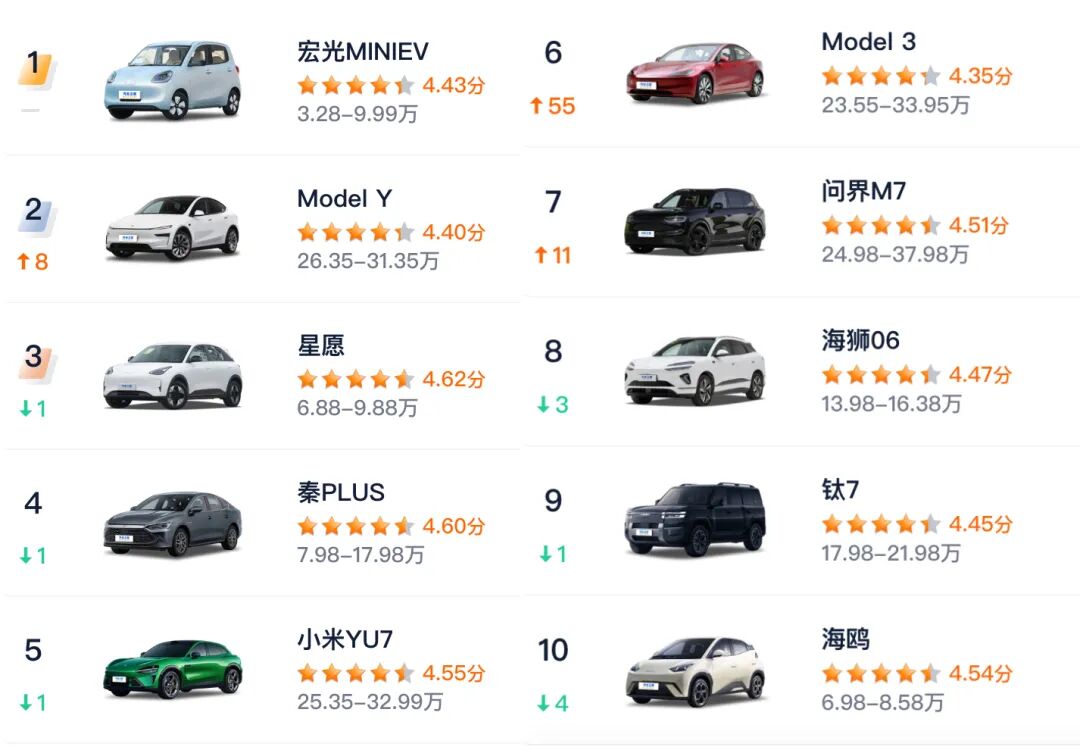
Core Insights - The rapid growth of the new energy vehicle market in China has led to a significant division in the automotive market, with distinct trends emerging in the price segments below and above 200,000 yuan [1][2][5] Market Trends - In November, vehicles priced above 200,000 yuan occupied four spots in the sales rankings, with the Model Y selling over 47,000 units and the AITO M7 selling over 25,000 units [1] - Conversely, vehicles priced below 100,000 yuan also claimed four spots, with the Hongguang MINIEV selling over 56,000 units and the BYD Seagull selling over 21,000 units [2] - The market has bifurcated into segments below 100,000 yuan and above 200,000 yuan, leaving the 100,000-200,000 yuan segment relatively quiet [2][5] Sales Performance - The top-selling models in the overall automotive market for November included the Hongguang MINIEV, Model Y, and others, with significant sales figures indicating a preference for lower-priced vehicles [4] - The sales figures for electric vehicles showed a notable increase, with pure electric vehicles selling 7,155 units and plug-in hybrids 28,213 units [4] Consumer Behavior - The shift in consumer behavior reflects a change from purchasing vehicles out of necessity to buying based on emotional appeal, particularly in the above 200,000 yuan market [7] - The lower-priced market is seeing a mix of consumption downgrade and upgrade, with traditional brands like Geely and BYD dominating this segment, while new entrants struggle to penetrate [7][8] Competitive Landscape - New energy vehicle brands such as Xiaomi and Hongmeng Zhixing are gaining traction, with Xiaomi achieving over 40,000 units sold in November, marking its entry into the top three for the first time [9][10] - Traditional automakers are facing challenges in the above 200,000 yuan market, where they need to enhance their overall offerings to regain competitive advantage [19][20] Industry Evolution - The automotive industry is undergoing a "second entrepreneurship," with traditional manufacturers transitioning from fuel vehicles to smart new energy vehicles, while new entrants are establishing themselves in the market [20]





16家车企仅四成有望达成全年销量目标,新能源汽车与出口成关键因素
Xin Lang Cai Jing· 2025-12-17 03:49
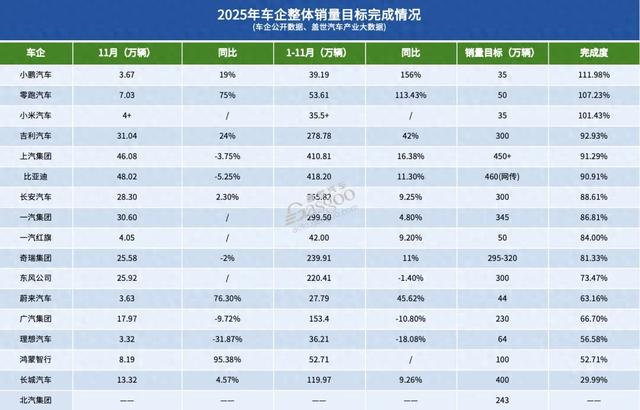
Core Viewpoint - As the end of the year approaches, major automotive companies are reporting their sales for November, allowing for predictions on whether they will meet their sales targets for 2025. The total sales targets set by these companies exceed the overall market forecast, indicating that some may not achieve their goals due to intensified competition and fluctuating pricing dynamics [1][3]. Group 1: Sales Performance of Key Companies - Three companies, Leap Motor, Xiaomi Auto, and Xpeng Motors, have already met their 2025 sales targets ahead of schedule, showcasing strong performance in a competitive market [3][4]. - Leap Motor achieved a cumulative sales volume of 536,000 units from January to November, exceeding its target by 7.23% [4]. - Xiaomi Auto delivered over 355,000 units in the same period, surpassing its target of 350,000 units, despite facing production and delivery challenges [5]. - Xpeng Motors reported cumulative deliveries of 392,000 units, achieving a year-on-year growth rate of 156% and exceeding its target of 350,000 units [5][6]. Group 2: Overall Market Trends - The overall automotive market is experiencing pressure on traditional fuel vehicle sales, while the growth of new energy vehicles continues to outpace the market, driving structural transformation in the industry [3][6]. - Major companies like BYD, SAIC, Geely, Changan, and FAW have completion rates above 80%, indicating a relatively stable performance [7][10]. - However, companies with higher sales targets face significant challenges in the final month, needing to sell tens of thousands of vehicles to meet their goals [8][12]. Group 3: Challenges Faced by Other Companies - Companies such as NIO, Great Wall Motors, and Dongfeng have completion rates below 70%, making it unlikely for them to meet their annual targets [14][17]. - NIO, for instance, has a target of 440,000 units but has only delivered about 280,000 units, requiring a significant increase in December sales [14]. - The challenges faced by these companies include overly ambitious targets, lack of competitive new products, and insufficient progress in their new energy segments [14][17]. Group 4: Factors Contributing to Success - Successful companies share common traits, including realistic target setting, clear growth engines, and robust systemic capabilities that enhance their resilience during the year-end push [13][17]. - For example, Geely's Galaxy series has significantly contributed to its sales, while BYD benefits from a comprehensive product matrix supported by its entire supply chain [11][13].


「禁止亏本卖车」,价格猫腻要藏不住了
36氪· 2025-12-16 13:35
Core Viewpoint - The automotive industry is on the brink of a significant reshuffle due to the introduction of the "Automotive Industry Pricing Behavior Compliance Guidelines," which aims to end the ongoing price war and establish clearer pricing regulations [5][10]. Group 1: Compliance Guidelines - The guidelines prohibit car manufacturers from selling vehicles below production costs and require clear pricing and delivery terms [8][16]. - Multiple car manufacturers, including BYD, Xpeng, and Changan, have expressed support for the guidelines, emphasizing the need to eliminate price fraud and unfair competition [11][13]. - The guidelines detail nine prohibited behaviors, including disguised price reductions and excessive discounts, which could lead to legal risks [16][18]. Group 2: Market Impact - The price war has severely impacted the industry's profit margins, with the overall profit rate for the automotive industry dropping to a historical low of 4.4% in 2025 [26][28]. - The average gross profit per vehicle in the automotive supply chain is only 14,000 yuan, and over 52.6% of automotive dealers are experiencing losses [28][29]. - The ongoing price war has led to a decline in consumer confidence, with a significant increase in the number of potential buyers delaying their purchases due to price fluctuations [32][34]. Group 3: Consumer Behavior - Consumers are increasingly associating vehicle prices with quality and features, with the percentage of buyers believing "you get what you pay for" rising from 13% in 2023 to 34% in 2025 [34]. - The expectation of continuous price reductions has led consumers to postpone purchases, as they believe waiting will yield better deals [35][36]. - The end of the price war is expected to lead to more rational competition in the automotive market, improving product safety and quality [36].


车百会:年销不足10万辆的跨国车企,退出概率超80%
Di Yi Cai Jing· 2025-12-16 12:56
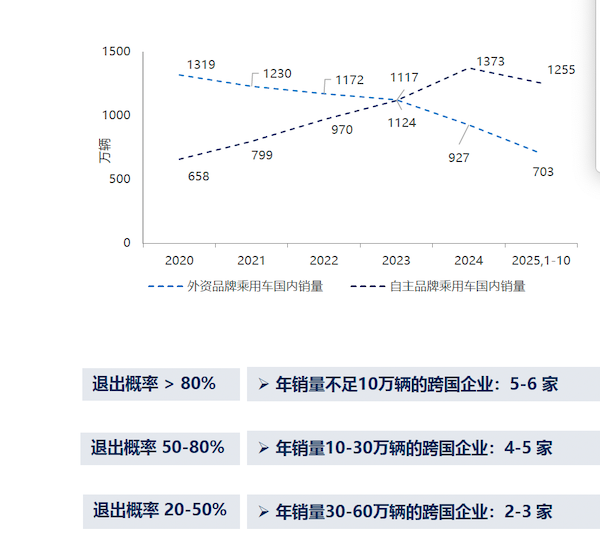
Core Viewpoint - Foreign brands in China are facing significant challenges, with a high probability of exit for multinational car companies with annual sales below 100,000 units, estimated at over 80% for 5 to 6 companies [1] Group 1: Market Share Dynamics - In 2020, domestic brands held a market share of 36%, while foreign brands had 64%. By January to October of this year, domestic brands increased their share to 65%, while foreign brands decreased to 35% [3] - In November, the retail market shares were reported as follows: German brands at 14%, Japanese at 11.7%, American at 5.7%, and Korean at 0.9% [4] Group 2: Exit Probability of Multinational Companies - The probability of exit for multinational companies is closely linked to their market scale. Companies with annual sales between 100,000 to 300,000 units have a 50% to 80% exit probability, with an expectation of 4 to 5 companies exiting; those with sales between 300,000 to 600,000 units have a lower exit probability of 20% to 50%, with an expectation of 2 to 3 companies [4] - Companies with annual sales below 100,000 units include Shenlong Automobile, Chery Jaguar Land Rover, smart, Changan Lincoln, Changan Mazda, and Jiangling Ford [4] Group 3: Strategic Adaptations of Multinational Companies - Leading multinational companies are accelerating their transformation towards a "made in China, for China" strategy. Volkswagen has established a China Technical Research Center (VCTC) for electric vehicle architecture; Toyota has set up an electric intelligent vehicle R&D center in China; Nissan has founded Nissan Technology Development (Shanghai) Co., Ltd. for smart driving and new energy research [4] - In joint ventures, the influence of Chinese teams on product definition is increasing. For instance, Toyota has adopted a local chief engineer management model; Volkswagen has upgraded its strategy from "headquarters directive, local execution" to "joint definition, co-development"; General Motors has shifted product definition authority to local teams, focusing entirely on Chinese customer needs [5] Group 4: Global Sharing of R&D Achievements - Some multinational companies are beginning to share their R&D achievements from China with global markets. For example, BMW has developed a voice interaction system based on Alibaba and DeepSeek's large model for global application; Tesla has integrated over 60 Chinese suppliers into its global procurement system; Stellantis has formed a joint venture with Leap Motor to fill the market gap for affordable electric vehicles [5]