
LEAPMOTOR(09863)

Search documents
独家|零跑汽车欧洲本土化生产落地西班牙,计划明年三季度投产
Guo Ji Jin Rong Bao· 2025-08-28 05:58
Core Insights - The article discusses the strategic move of Leap Motor to establish a localized manufacturing base in Zaragoza, Spain, to enhance its competitiveness in the European market [4][11]. Group 1: Localization Strategy - Leap Motor's European manufacturing base will be located at the Stellantis factory in Zaragoza, which is a significant step towards local production [4][11]. - The factory is set to begin production of the B series models, starting with the B10 compact electric SUV in Q3 of next year, followed by the B05 model [5][15]. - Leap Motor aims to leverage Stellantis's existing facilities to reduce costs and avoid trade barriers, with a focus on local assembly and procurement [13][14]. Group 2: Market Expansion and Sales Goals - Leap Motor has entered over 30 countries and regions, with Europe being a core market, where the T03 and C10 models account for 90% of overseas sales [5][6]. - The company reported overseas sales of 20,375 units in the first half of the year and has set an annual sales target of 580,000 to 650,000 units, maintaining an overseas sales guidance of 50,000 to 60,000 units [6][7]. - Leap Motor anticipates a doubling of overseas sales next year following the establishment of localized production [7][9]. Group 3: Strategic Partnerships - In October 2023, Stellantis announced a €1.5 billion investment to acquire a 20% stake in Leap Motor, facilitating a joint venture named "Leap International" for global market operations [11][12]. - The partnership aims to integrate Leap Motor's technology with Stellantis's resources, targeting 500 overseas outlets and annual sales exceeding 150,000 units by 2026 [11][12]. - The Zaragoza factory has a production capacity of 300,000 vehicles per year and is part of a broader strategy to enhance electric vehicle production in Europe [14].


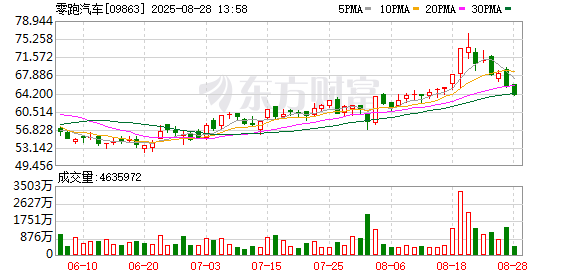
零跑汽车销量盈利双增,多重利好助推零跑股票
Zhong Jin Zai Xian· 2025-08-27 11:31
大额授信的落地,是对零跑发展前景的高度认可,也为其后续扩张提供了坚实的资金保障,无疑给投资 者带来了积极信号,对其股票价值的提升起到了推动作用。 自2022年双方通过设备更新再贷款建立合作以来,兴业银行持续为零跑汽车创新产品与服务。2024年3 月,兴业银行助力零跑落地首单经销商三方预付款融资业务,专项用于经销商采购整车,且不断优化流 程,有力推动了零跑汽车销量增长。 2025年上半年,交付新车22.16万台,较2024年同期增长155.7%,7月交付量达50,129台,连续5个月位 居国内新势力品牌销量榜首。 近期,零跑汽车在金融领域的一系列积极动态引发了行业的广泛关注,不仅彰显了其在资本运作与产业 布局上的卓越成效,更为零跑股票市场表现注入了强大的增长动力。 2025年2月14日,零跑汽车与兴业银行杭州分行举行战略合作银行授牌仪式,兴业银行将凭借自身金融 服务优势,为零跑汽车提供全面授信支持。 零跑汽车2025年上半年度净利润为人民币0.3亿元,首次实现半年度净利润转正,成为中国造车新势力 中第二家实现半年度盈利的企业;毛利率为14.1%,创公司成立以来新高。 招银国际发布研报称,预计零跑汽车强劲销售势头 ...
零跑汽车湖州电池工厂加速建设,预计9月投产
Ju Chao Zi Xun· 2025-08-27 10:13
Core Insights - Leap Motor's battery pack production facility in Huzhou, Zhejiang, is progressing rapidly, with production expected to commence in September after only 140 days of construction [2] - The project includes the establishment of 8 battery production lines and 4 power supply production lines, aiming to create a comprehensive production system for electric vehicle battery packs and power supplies [2] - Upon reaching full production capacity, the facility is projected to produce 384,000 sets of vehicle batteries and 720,000 power supplies annually, generating an estimated annual revenue of 6.4 billion yuan [2] Company Performance - Leap Motor achieved a record high delivery of 50,129 vehicles in July, marking a year-on-year increase of over 126%, and is the first time monthly sales surpassed 50,000 units [2] - As of August 21, Leap Motor's cumulative delivery volume exceeded 900,000 units [2] - In the first half of the year, Leap Motor reported revenue of 24.25 billion yuan, a 174% increase from 8.85 billion yuan in the same period last year, and achieved a net profit of 30 million yuan, reversing a loss of 221 million yuan from the previous year [2]
中创新航与零跑汽车合资公司正式成立!
鑫椤锂电· 2025-08-27 08:00
Core Viewpoint - The establishment of a joint venture between Zhongchuang Xinhang and Leap Motor focuses on the production and sales of lithium-ion power batteries for electric vehicles, indicating a strategic collaboration in the growing EV market [1][2]. Group 1: Company Overview - Leap Motor, founded in 2015, specializes in smart electric passenger vehicles and vehicle networking solutions. In the first half of this year, it delivered 221,664 vehicles, a year-on-year increase of 155.7%, making it the top seller among new forces in China [4]. - Leap Motor achieved revenue of 24.25 billion yuan, a 174% year-on-year growth, with a gross margin of 14.1%, marking its first positive net profit for a half-year period [5]. - Zhongchuang Xinhang, also established in 2015, focuses on power batteries and energy storage systems, ranking third in domestic installation volume with 24.15 GWh from January to July 2025, and fourth globally with 21.8 GWh in the first half of the year, holding a market share of approximately 4.3% [5]. Group 2: Market Context - The joint venture is part of a broader trend in the electric vehicle industry, where companies are increasingly collaborating to enhance their technological capabilities and market presence [1][2].
注资10亿!零跑/中创新航成立动力电池公司
起点锂电· 2025-08-27 03:54
Core Viewpoint - The article highlights the significant developments in the sodium battery industry, emphasizing the upcoming GWH-level production and the establishment of new companies in the sector [3][5]. Company Developments - Zhongling New Energy Technology (Zhejiang) Co., Ltd. was established on August 25, with a registered capital of 1 billion yuan, focusing on battery manufacturing and sales [3]. - The company is jointly owned by Leap Motor (09863.HK) and Zhongchuang Xinhang (03931.HK), with the latter two holding 51% and 49% of the joint venture, respectively [4][5]. Financial Performance - Leap Motor reported a revenue of 24.25 billion yuan for the first half of 2025, marking a 174% year-on-year increase, with a gross margin of 14.1%, up 13% from the previous year [6]. - The company achieved a net profit for the first time in its history, becoming the second Chinese new car manufacturer to report a positive half-year profit [5][6]. - Leap Motor delivered 221,664 vehicles in the first half of 2025, a 155.7% increase compared to the same period in 2024, leading the sales among new energy vehicle brands in China [6].

零跑汽车(09863.HK):中报业绩优异 规模效应持续释放 未来可期
Ge Long Hui· 2025-08-26 19:12
Core Insights - Leap Motor reported a significant increase in revenue and profitability for the first half of 2025, achieving operating income of 24.25 billion yuan, a year-on-year increase of 174.0% [1] - The company turned profitable with a net profit attributable to shareholders of 30 million yuan and an adjusted net profit of 330 million yuan, both showing a turnaround from losses [1] Revenue Growth - In Q2 2025, the company achieved operating income of 14.23 billion yuan, reflecting a year-on-year increase of 165.5% and a quarter-on-quarter increase of 42.0% [1] - The growth in revenue is attributed to new vehicle launches and strategic partnerships, as well as increased income from carbon credit trading [1] - Total vehicle sales reached 134,000 units in Q2 2025, marking a year-on-year increase of 151.7% and a quarter-on-quarter increase of 53.2% [1] Profitability and Cost Management - The gross margin for Q2 2025 was 13.6%, an increase of 10.8 percentage points year-on-year, although it decreased by 1.3 percentage points quarter-on-quarter [2] - The company optimized its expense ratios, with sales, management, and R&D expense ratios at 5.6%, 2.9%, and 7.7% respectively, all showing year-on-year declines [2] - The improvement in gross margin is primarily due to ongoing cost management efforts and the scale effect from increased sales [2] Global Expansion - Leap Motor exported 20,000 units in the first half of 2025, ranking first among new car manufacturers in terms of exports [2] - The first batch of B10 vehicles was shipped to Europe in July 2025, with plans for a formal launch at the Munich Auto Show in September [2] - The company’s Malaysian factory completed the assembly of its first C10-OTS vehicle in August, with further plans to introduce other models in Europe [2] Investment Outlook - The company is projected to achieve operating revenues of 64.67 billion yuan, 103.79 billion yuan, and 129.74 billion yuan for 2025, 2026, and 2027 respectively [2] - The current market capitalization to sales (PS) ratios are estimated at 1.4, 0.9, and 0.7 times for the respective years [2] - A target price of 77.4 yuan has been set for 2025, equivalent to 84.5 Hong Kong dollars based on the current exchange rate [2]
中创新航+零跑:“需求洪流”下的车企、电池厂合资2.0
高工锂电· 2025-08-26 11:01
Core Viewpoint - The recent approval of the joint venture between Zhongchuang Innovation Technology Co., Ltd. and Zhejiang Leapmotor Technology Co., Ltd. signifies a strategic shift in the Chinese and global electric vehicle supply chain, marking a new phase of collaboration between a rapidly growing automaker and a leading battery supplier [2][3][4]. Group 1: Joint Venture Significance - The joint venture is not merely a tactical response to short-term delivery pressures but represents a strategic alignment aimed at reshaping market dynamics [4]. - Leapmotor's impressive growth trajectory, with over 220,000 vehicles delivered in the first half of the year and a revenue increase of 174% to 24.25 billion yuan, underscores the urgency of this partnership [6][7]. - The establishment of Zhongling New Energy Technology (Zhejiang) Co., Ltd. with a registered capital of 1 billion yuan, where Leapmotor holds 49% and Zhongchuang Innovation holds 51%, reflects a deep equity binding to secure battery supply [4][6]. Group 2: Supply Chain Pressures - Leapmotor's ambitious sales targets necessitate a robust battery supply chain, with projected needs of approximately 32.5 GWh for 2025 and 50 GWh for 2026, highlighting the critical role of battery supply in achieving these goals [7][8]. - The partnership aims to convert external procurement uncertainties into controllable internal production plans, enhancing supply chain resilience [8][9]. Group 3: Zhongchuang Innovation's Role - For Zhongchuang Innovation, this joint venture is a pivotal opportunity to secure stable demand from one of the fastest-growing automakers, enhancing revenue certainty amid industry overcapacity risks [11][12]. - The collaboration allows Zhongchuang Innovation to transition from a passive supplier to an active profit-sharing partner, establishing a more stable pricing mechanism [11][12]. Group 4: Industry Trends - The partnership reflects a broader trend in the industry where deep binding through joint ventures is becoming a common strategy among battery suppliers and automakers, moving away from traditional procurement models [16][31]. - The emergence of "challenger alliances" indicates a shift towards more agile and aligned partnerships in the electric vehicle supply chain, as companies seek to navigate a rapidly evolving market landscape [34][31]. Group 5: Globalization and Future Prospects - Leapmotor's international expansion, supported by Stellantis, necessitates a battery partner capable of global supply, aligning with Zhongchuang Innovation's plans for an overseas factory in Portugal [25][26][27]. - The collaboration may serve as a model for future global supply chain strategies, potentially replicating their successful partnership in international markets [27][29].

观车 · 论势 || 缩短账期不易,但须持续推进
Zhong Guo Qi Che Bao Wang· 2025-08-26 08:28
Core Viewpoint - The implementation of the revised "Regulations on Payment of Small and Medium-sized Enterprises" has revealed that only a few of the 17 major automotive companies have fulfilled their commitment to pay suppliers within 60 days, highlighting challenges in cash flow management and organizational capabilities in the industry [1][2][3]. Group 1: Company Commitments - 17 automotive companies, including major players like China FAW, GAC Group, and BYD, initially pledged to adhere to a 60-day payment term for suppliers [1]. - As of now, only three companies—China FAW, GAC, and Seres—have successfully implemented the 60-day payment term [2]. - Companies like Xpeng have signed supplementary agreements with some suppliers to formalize the 60-day payment commitment, although some suppliers are still in the process of signing [2][3]. Group 2: Industry Challenges - The average accounts payable turnover days for domestic listed automotive companies reached 182 days in 2024, indicating a long-standing issue of delayed payments in the industry [3]. - Reducing the payment cycle from over 100 days to 60 days would require automotive companies to release over 1 trillion yuan in cash flow, posing significant pressure on an industry already facing declining profit margins [3]. - The transition to a 60-day payment term involves complex organizational management challenges, including procurement, contract review, financial payments, and tax documentation [3]. Group 3: Regulatory Environment - The new regulations prohibit companies from forcing small and medium-sized enterprises to accept non-cash payment methods, which could extend payment periods [3]. - China FAW has committed to 100% cash payments to recognized small and medium-sized suppliers starting from June [3]. - Regulatory bodies are encouraged to enhance oversight to ensure compliance with the 60-day payment commitment and to address issues of hidden payment delays [4].




零跑汽车推出“星夜服务”,延长营业时间带来多重利好
Quan Jing Wang· 2025-08-26 07:33
Group 1 - The core idea of the news is that Leap Motor has launched the "Starry Night Service," extending after-sales service hours to 20:00 in 23 provinces and 37 cities across the country, addressing user pain points and enhancing brand competitiveness [1][4]. Group 2 - The "Starry Night Service" targets the growing user base of electric vehicle owners, particularly working professionals who find it difficult to visit service centers during regular hours, thus improving service convenience [3][4]. - By offering night service, Leap Motor differentiates itself from competitors who maintain standard operating hours, potentially increasing customer loyalty and attracting new consumers who prioritize after-sales service convenience [4][5]. Group 3 - The introduction of the "Starry Night Service" helps Leap Motor build a warmer and more approachable brand image, enhancing customer recognition and loyalty, which is crucial for long-term sales growth [5]. - This initiative is seen as a strategic move to optimize service quality and strengthen brand competitiveness in a rapidly evolving electric vehicle market, setting a new benchmark for after-sales service in the industry [5].
零跑汽车、中创新航成立新能源科技公司,注册资本10亿元
Qi Cha Cha· 2025-08-26 06:06
Core Viewpoint - Leap Motor and Zhongchuang Innovation have established a new energy technology company with a registered capital of 1 billion yuan [1] Group 1: Company Formation - The newly formed company is named Zhongling New Energy Technology (Zhejiang) Co., Ltd. [1] - The legal representative of the company is He Fan [1] - The company is jointly owned by Leap Motor (09863.HK) and Zhongchuang Innovation (03931.HK) [1] Group 2: Business Scope - The business scope includes research and development of new material technology [1] - It also covers the promotion services for new material technology [1] - The company will engage in battery manufacturing and sales [1] - Additionally, it will sell new energy vehicle battery swap facilities [1]