NIO(09866)

Search documents
蔚来-盈利利好消息;第四季度业绩超预期,维持跑赢大市评级
2026-02-10 03:24
Summary of NIO Inc. Conference Call Company Overview - **Company**: NIO Inc. - **Industry**: China Autos & Shared Mobility - **Date of Call**: February 5, 2026 Key Financial Highlights - NIO expects a GAAP net profit of **Rmb200-700 million** in 4Q, a significant improvement from a GAAP net loss of **Rmb3.7 billion** in 3Q25, exceeding market expectations and the company's target of non-GAAP profit breakeven in 4Q [2][3] - Non-GAAP net profit is projected to be between **Rmb0.7-1.2 billion** [2] - Vehicle margin is estimated to have grown by **4-6 percentage points** quarter-over-quarter (QoQ) to nearly **20%** [2] - R&D and SG&A expenses are expected to remain largely steady QoQ [2] Factors Contributing to Profit Turnaround 1. **Record Deliveries**: NIO achieved a record delivery of **125,000 units**, representing a **43% QoQ increase** [3] 2. **Sales Mix**: A strong sales mix with the ES8 model accounting for approximately **32%** of 4Q deliveries, which has a gross margin exceeding **20%** [3] 3. **Operational Efficiency**: Improved operational efficiency following restructuring efforts [3] Market Sentiment and Stock Performance - NIO's share price has decreased by **35%** over the past three months, contrasting with the Hang Seng Index's **4%** increase [4] - The potential for a share price recovery is linked to broader electric vehicle (EV) demand recovery in China [4] - Investors are advised to monitor announcements regarding new models (ES9, ES7, Onvo L80) post-Chinese New Year [4] Valuation and Price Target - **Rating**: Overweight (OW) - **Current Share Price**: **US$4.44** (as of February 4, 2026) - **Price Target**: **US$7.00**, indicating a potential upside of **58%** [4] Financial Projections - **Market Capitalization**: **Rmb148.9 billion** (estimated for 12/25) [4] - **Revenue Projections**: Expected to grow from **Rmb65.732 billion** in 2024 to **Rmb154.873 billion** by 2027 [4] - **EBITDA**: Projected to improve from a loss of **Rmb15.999 billion** in 2024 to a profit of **Rmb1.947 billion** in 2027 [4] Risks and Considerations - **Upside Risks**: Introduction of new models, stronger-than-expected sales volume, and better operational efficiency [10] - **Downside Risks**: Weaker-than-expected sales volume, lack of efficiency improvements, and moderating auto sales growth impacting industry valuations [10] Conclusion NIO Inc. is showing signs of recovery with a positive profit outlook for 4Q, driven by strong delivery numbers and improved operational efficiency. However, the stock has faced significant downward pressure, and future performance will depend on broader market conditions and the successful launch of new models. Investors should remain cautious but optimistic about potential growth in the EV sector in China.

汽车股普涨 比亚迪股份涨约4% 商务部召开座谈会推动汽车消费
Ge Long Hui· 2026-02-10 03:02
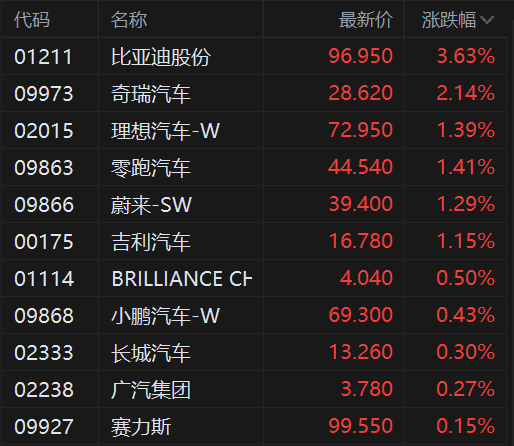
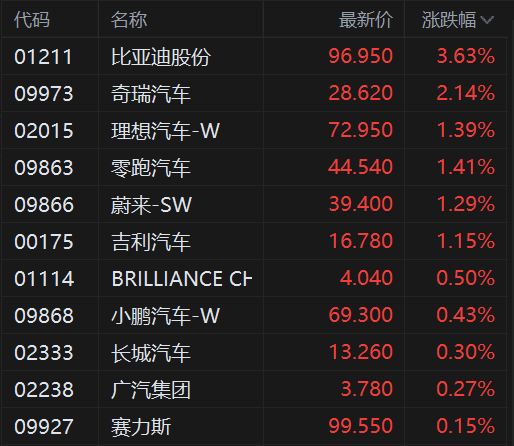
Group 1 - The core viewpoint of the news is that the Hong Kong automotive stocks experienced a collective rise, driven by positive signals from the Ministry of Commerce regarding future automotive consumption policies [1] - The Ministry of Commerce held a meeting to discuss automotive circulation and consumption, indicating a commitment to support and reform the automotive sector by 2026 [1] - Analysts interpret the signals from the meeting as a positive indication for automotive consumption support policies, providing a clear expectation for industry stabilization and structural growth direction [1] Group 2 - BYD shares rose approximately 4% to a latest price of 96.950, while Chery Automobile increased by over 2% to 28.620 [2] - Other automotive companies also saw gains, including Li Auto (1.39% increase), Leap Motor (1.41% increase), NIO (1.29% increase), and Geely (1.15% increase) [2] - The overall positive trend in the automotive sector reflects investor confidence in the upcoming policy changes and market support initiatives [1][2]




仪表及中控屏可能出现黑屏,蔚来召回24万辆车
Xin Lang Cai Jing· 2026-02-10 02:30
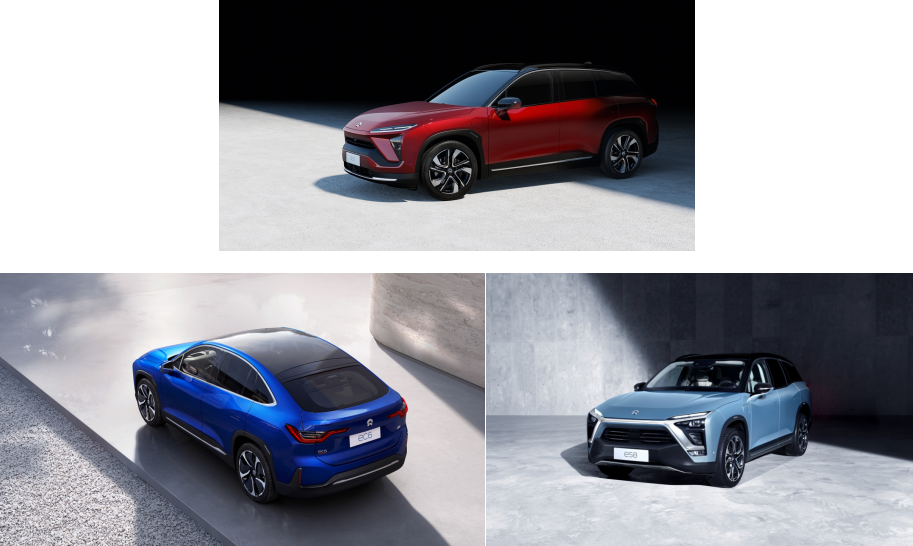
Core Viewpoint - NIO Inc. has initiated a recall of 246,229 electric vehicles due to software issues that may cause temporary blackouts of the instrument panel and central control screen, posing safety risks [1][2]. Group 1: Recall Details - The recall affects ES8, ES6, and EC6 models produced between March 16, 2018, and January 16, 2023 [1][2]. - The specific software versions involved in the recall are being upgraded to Aspen 3.5.6, Alder 2.1.0, or higher [1][2]. Group 2: Remedial Actions - NIO will utilize over-the-air (OTA) technology to provide free software upgrades to the affected vehicles [1][2]. - For vehicles that cannot be upgraded via OTA, NIO will contact users through service centers to implement the recall [1][2].
港股异动丨汽车股普涨 比亚迪股份涨约4% 商务部召开座谈会推动汽车消费
Ge Long Hui· 2026-02-10 02:29
Group 1 - The core viewpoint of the news is that Hong Kong automotive stocks have collectively risen, with significant gains observed in companies like BYD, Chery, and others, following a meeting held by the Ministry of Commerce regarding automotive consumption policies for 2026 [1] - The Ministry of Commerce plans to implement a series of measures to boost automotive consumption, including optimizing the vehicle trade-in program and conducting pilot reforms in automotive circulation [1] - Analysts interpret the signals from the Ministry's meeting as positive, viewing it as a "starting gun" for supportive automotive consumption policies in 2026, which provides a clear expectation for industry support and structural growth direction [1] Group 2 - BYD shares rose approximately 4% to a latest price of 96.950, while Chery Automotive increased by over 2% to 28.620 [2] - Other automotive companies also saw gains, with Li Auto up 1.39%, Leap Motor up 1.41%, NIO up 1.29%, and Geely up 1.15% [2] - The overall positive sentiment in the automotive sector is reflected in the stock performance of various companies, indicating investor confidence in future growth driven by government policies [1][2]
仪表、中控存黑屏隐患,蔚来召回超24万辆汽车
Guan Cha Zhe Wang· 2026-02-10 01:53
Group 1 - NIO Inc. has initiated a recall of 246,229 electric vehicles, specifically the ES8, ES6, and EC6 models, produced between March 16, 2018, and January 16, 2023, in compliance with the regulations set by the State Administration for Market Regulation [1][4] - The recall is due to a software issue that may cause the instrument panel and central control screen to go black temporarily under certain conditions, which poses a safety risk by not providing essential vehicle information and functions [3] - NIO will implement a remote upgrade (OTA) to address the software issue for the affected vehicles, upgrading them to versions Aspen 3.5.6, Alder 2.1.0, or higher. Vehicles that cannot be upgraded remotely will be contacted for service at NIO service centers [3] Group 2 - NIO will notify affected users through various channels, including mobile apps, SMS, and phone calls, to arrange the recall process [3] - Users can also contact NIO's customer service hotline or visit the State Administration for Market Regulation's recall center website for more information and to report defect clues [3]
蔚来召回24万余辆纯电动汽车:部分可能在特定条件下出现短时间仪表及中控黑屏
Xin Lang Cai Jing· 2026-02-10 01:53
Core Viewpoint - NIO Inc. is recalling 246,229 electric vehicles due to a software issue that may cause temporary blackouts of the instrument panel and central control screen under specific conditions, posing safety risks [1] Group 1: Recall Details - The recall affects ES8, ES6, and EC6 models produced between March 16, 2018, and January 16, 2023 [1] - The recall is registered under the number S2026M0017I and is in compliance with the regulations for defective automotive product recalls [1] Group 2: Safety Concerns - The software issue may prevent the display of critical vehicle information and functions, such as speed information, fault alerts, and defrosting features, which could lead to safety hazards [1] Group 3: Remedial Actions - NIO Inc. will utilize over-the-air (OTA) technology to provide free software upgrades to the affected vehicles, specifically to versions Aspen 3.5.6, Alder 2.1.0, or higher [1] - For vehicles that cannot be upgraded via OTA, NIO will contact users through service centers to implement the recall and address safety concerns [1] - Vehicles that have already received the upgraded software will not require further updates as part of this recall [1]
蔚来汽车李斌:2026年计划新建1000座换电站
Xin Hua Cai Jing· 2026-02-10 01:31
Group 1 - The core viewpoint of the article is that NIO plans to significantly expand its battery swap station network by building 1,000 new stations by 2026 and increasing the number of charging routes to 100 [1] - NIO has already established battery swap routes along the G318 and Yunnan-Tibet roads and aims to connect the Silk Road battery swap route this year [1] - The company is set to commence large-scale construction of its fifth-generation battery swap stations this year [1]
2026年中国换电站行业保有量、投资规模、企业排名速览:蔚来保有量占比超7成[图]
Chan Ye Xin Xi Wang· 2026-02-10 01:23
Core Insights - The article discusses the development and trends of battery swapping stations in China, highlighting their increasing importance in the electric vehicle (EV) ecosystem and the projected growth in the number of stations and investment scale by 2025. Group 1: Industry Overview - Battery swapping stations provide battery replacement services for electric vehicles, functioning as centralized charging facilities for battery storage, charging, and distribution [1] - By 2025, the number of battery swapping stations in China is expected to reach 5,155, representing a year-on-year growth of approximately 16% [7] - The investment scale for battery swapping stations in China is projected to be 3.418 billion yuan by 2025, showing a slight decrease compared to previous years [8] Group 2: Charging Methods - Current charging methods for new energy vehicles in China are divided into charging mode and battery swapping mode, with the latter being less mature but increasingly popular [2] - Battery swapping can be categorized into fixed swapping (swapping stations) and mobile swapping (swapping service vehicles), with fixed swapping being the primary method [2] Group 3: Pricing Structure - Revenue from battery swapping stations is mainly derived from package income and usage income, with C-end users paying around 1,000 yuan monthly for battery rental, while B-end users pay approximately 3,000 yuan for unlimited swaps [3] - Usage income is based on actual swapping volume, with two pricing options available for C-end users [3] Group 4: Policy Background - A comprehensive policy support system has been established for the battery swapping industry in China, including standards, subsidies, and operational guidelines [4][5] - Key policies include the release of design standards for battery swapping stations and initiatives to enhance charging infrastructure in county areas [4][5] Group 5: Industry Chain - The battery swapping industry chain consists of upstream battery suppliers, station component suppliers, and charging system suppliers, with midstream operators responsible for station construction and operation [6] Group 6: Current Market Status - The number of battery swapping stations in China is on a steady growth trajectory, driven by the rapid adoption of new energy vehicles and supportive policies [7] - By 2025, the market is expected to see a concentration of battery swapping stations in economically strong coastal provinces and major cities [9][10] Group 7: Competitive Landscape - The battery swapping market in China is characterized by a few dominant players, with NIO leading the market with a significant share of 71.6% of the total stations [11][12] - NIO's strategy includes building a self-operated battery swapping network, while other companies like Aodong focus on shared swapping services for high-frequency operational scenarios [11][12] Group 8: Future Trends - Battery swapping stations are evolving into integrated energy nodes that combine solar, storage, and V2G functionalities, enhancing operational efficiency and reducing costs [14] - The industry is shifting towards a more open and standardized model, allowing for compatibility across different vehicle brands and types, which is expected to increase station utilization and profitability [14]

2026格局与趋势 |(上):天黑请睁眼
3 6 Ke· 2026-02-10 01:20
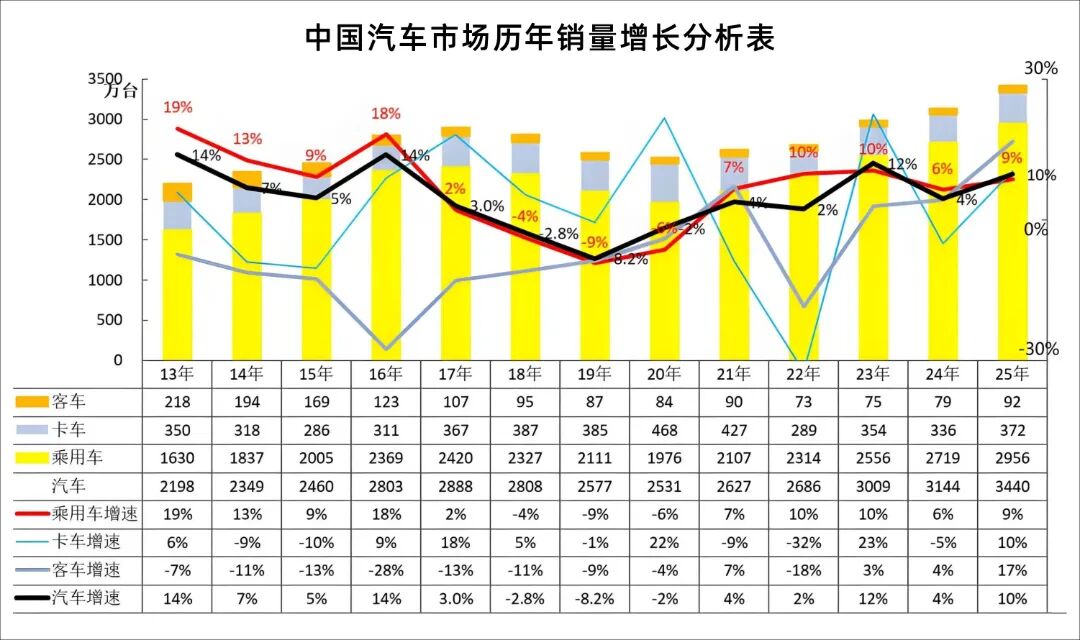
Core Viewpoint - The Chinese automotive market is facing significant challenges in 2026, with predictions of a decline in sales due to economic pressures and changing consumer behavior, despite some optimistic forecasts for growth in exports and specific segments like new energy vehicles [1][3][4]. Group 1: Market Trends and Predictions - In 2026, the overall automotive sales in China are expected to range between 34.5 million to 35 million units, with a potential decline in domestic retail sales by over 5% if no significant policy changes occur [3][7]. - January 2026 data shows a dramatic decline in retail sales, with a 28% year-on-year drop, indicating a challenging start to the year [6]. - Various institutions predict a range of outcomes for 2026, with the most pessimistic forecasts suggesting a 7% decline in sales, while the most optimistic predict only a 1% increase [4][7][8]. Group 2: Policy and Economic Influences - Key factors affecting the market include adjustments to subsidy policies for new energy vehicles, which have shifted from full exemptions to partial reductions, impacting consumer purchasing behavior [6][9]. - The decline in consumer confidence and shrinking middle-class income due to economic downturns are expected to further suppress automotive sales [6][9]. Group 3: Competitive Landscape - The automotive industry is experiencing intense competition, with a shift from price wars to a focus on technological advancements and value creation as companies seek to stabilize their market positions [12][16]. - Major players are adjusting their sales targets, with some aiming for significant growth while others adopt more conservative strategies in response to market conditions [18][19]. Group 4: Export Opportunities - Exports are projected to be a key growth area, with expectations of a 12-15% increase, potentially reaching 8 million units, which could help offset domestic market declines [22][26]. - The global supply chain dynamics are pushing Chinese automotive companies to enhance their international presence, with a focus on building global production and R&D capabilities [26][28]. Group 5: Segment-Specific Insights - The new energy vehicle segment is anticipated to grow, with retail sales expected to increase by 12-15%, driven by favorable policies for mid-range models [9][10]. - The large six-seat SUV market is projected to maintain strong growth, with expectations of a 30-50% increase in sales, despite overall market challenges [31][32].


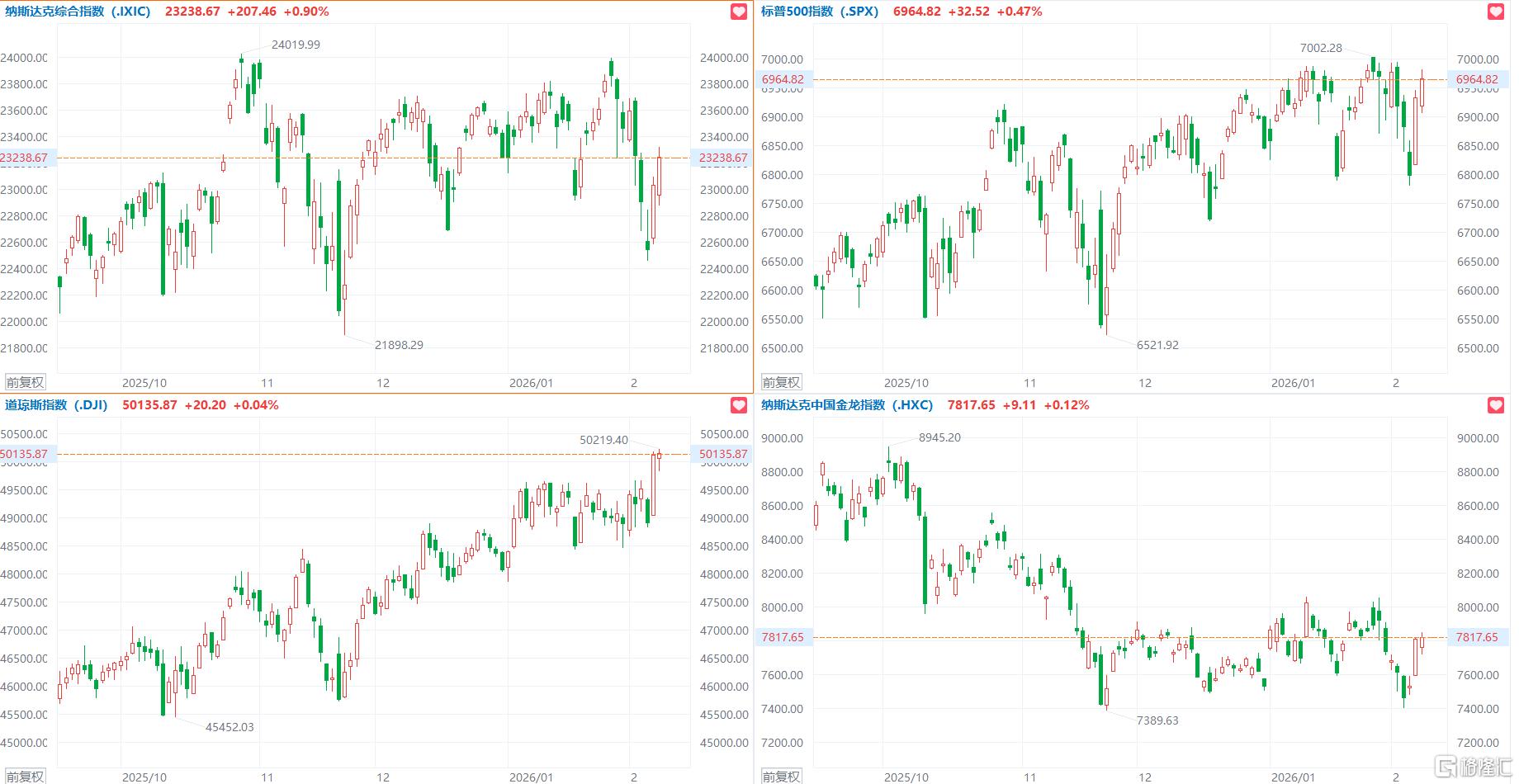
美股三大指数集体收涨,纳指涨0.9%,甲骨文涨超9%
Ge Long Hui· 2026-02-10 01:04
Market Performance - The three major U.S. stock indices closed higher, with the Dow Jones up 0.04%, the Nasdaq up 0.9%, and the S&P 500 up 0.47% [1] - Major technology stocks saw significant gains, with Oracle rising over 9%, Microsoft and Broadcom up over 3%, and Nvidia and Meta up over 2% [1] Sector Performance - Cryptocurrency mining companies, precious metals, and non-ferrous metals led the gains, with Vista Gold up over 14%, Hut 8 up over 7%, and Pan American Silver up over 6% [1] - Other notable performers included Alcoa and Royal Gold, both rising over 5%, and Southern Copper up over 4% [1] - Retail and insurance brokerage sectors faced declines, with Macy's and Kohl's both down over 5%, and the American Reinsurance Group down over 2% [1] Chinese Stocks - The Nasdaq Golden Dragon China Index rose 0.12%, with notable gains in Chinese concept stocks such as Kingsoft Cloud, Pony.ai, and JinkoSolar, which rose up to 3.79% [1] - Other gainers included Zai Lab up 2.44%, Huazhu up 1.66%, while companies like Yum China, XPeng, Ctrip, Bilibili, NIO, Li Auto, and New Oriental experienced declines, with New Oriental down 4.24% [1]