NIO(09866)

Search documents
多家车企公布2026销量目标
财联社· 2026-01-07 16:07
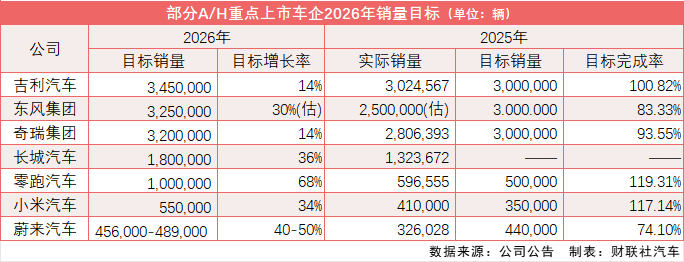
Core Viewpoint - The implementation of the half-price purchase tax policy for new energy vehicles and the continuation of the "two new" subsidy policy have introduced new variables for the domestic automotive market in 2026, leading to divergent sales targets among traditional and new car manufacturers [2]. Group 1: Traditional Automakers - Geely has set the highest sales target for 2026 at 3.45 million units, with a growth rate of 14%, including 2.75 million units for the Geely brand, 300,000 for Zeekr, and 400,000 for Lynk & Co [4]. - Dongfeng Group aims for a total sales target of 3.25 million units in 2026, with an estimated growth rate of over 30%, including 1.7 million units for new energy vehicles, representing a 63% increase [5]. - Chery Group has set a target of 3.2 million units for 2026, reflecting a 14% growth compared to 2025, with a total of 2.806 million units sold in 2025 [5]. - Great Wall Motors has lowered its 2026 sales target from at least 2.49 million to at least 1.8 million units, indicating a 36% increase from last year's actual sales [5][6]. Group 2: New Car Manufacturers - Leap Motor has set an aggressive target of 1 million units for 2026, following a record sales performance in 2025 [7]. - Xiaomi aims for a sales target of 550,000 units in 2026, a 34% increase from the previous year, with new models expected to launch [7]. - NIO has set a target of 456,000 to 489,000 units for 2026, with a growth rate of 40-50%, supported by the introduction of several new models [8]. Group 3: Market Outlook - The automotive market is expected to experience a "front low and back high" trend in 2026, with overall growth driven by favorable national policies [9]. - The continuation of the vehicle replacement subsidy policy is anticipated to mitigate the impact of the half-price purchase tax policy, providing a stabilizing effect on market growth [8][9].






多家车企公布2026销量目标:“双新”政策调整延续下传统车企审慎、新势力乐观
Xin Lang Cai Jing· 2026-01-07 11:36
Core Viewpoint - The implementation of the half-price purchase tax policy for new energy vehicles and the adjustment of the "two new" subsidy policies have introduced new variables for the domestic automotive market in 2026, leading to divergent sales targets among various automakers [1] Group 1: Traditional Automakers - Geely has set the highest sales target for 2026 at 3.45 million units, with a growth rate of 14%, including 2.75 million for the Geely brand, 300,000 for Zeekr, and 400,000 for Lynk & Co [2] - Dongfeng Group aims for a total sales target of 3.25 million units in 2026, with an estimated growth rate of over 30%, including 1.7 million for new energy vehicles, representing a 63% increase [3] - Chery Group has set a sales target of 3.2 million units for 2026, reflecting a 14% increase from 2025, with its five brands aiming for a total of 3 million units [3] - Great Wall Motors has lowered its 2026 sales target from 2.49 million to 1.8 million units, indicating a 36% growth from the previous year, while maintaining its net profit target [4] Group 2: New Energy Vehicle Startups - Leap Motor has set an ambitious sales target of 1 million units for 2026, following a record of 597,000 units sold in 2025, which is a 103.1% increase [5] - Xiaomi Auto aims for a sales target of 550,000 units in 2026, representing a 34% increase from the previous year, with new models expected to launch [5] - NIO has set a sales target of 456,000 to 489,000 units for 2026, with a growth rate of 40-50%, following a total of 326,000 units sold in 2025 [5] Group 3: Market Outlook - The automotive market is expected to experience a "front low and back high" trend in 2026, with overall growth driven by supportive national policies, countering previous expectations of negative growth [6] - The new policies, including the early implementation of replacement subsidies, are anticipated to positively impact market growth and consumer upgrades [6]
港股开盘丨恒指跌0.41% 阿里巴巴、蔚来跌逾2%
Di Yi Cai Jing· 2026-01-07 10:19
恒生指数低开0.41%,恒生科技指数跌0.28%。阿里巴巴、蔚来跌逾2%,理想汽车、小鹏汽车、百度集 团跌幅靠前;华虹半导体、中芯国际走强。 ...
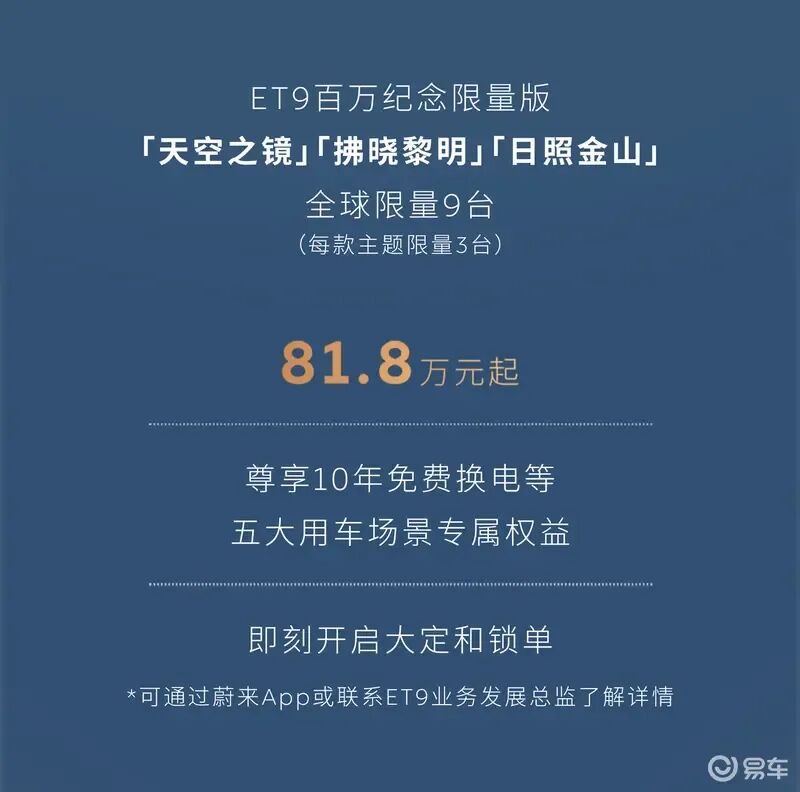
整车81.8万起!电池租用71万起!全球限量9台!蔚来ET9百万纪念限量版上市!
Xin Lang Cai Jing· 2026-01-07 10:07
1月7日,蔚来宣布值此蔚来第100万台量产车下线之际,正式推出ET9百万纪念限量版车型,售价81.8万元起,采 用BaaS电池租用方式购买售价71万元起,全球限量9台。 即刻开启大定和锁单,尊享10年免费换电等五大用车场景专属权益。 619 i 4 4 NİÖ ELİ 9 0月车 蔚来ET9百万纪念限量版整体设计延续在售车型,不过该车提供了天空之镜、拂晓黎明、日照金山三种主题,每 款主题限量3台。 此外,新车在翼子板、迎宾踏板、座椅靠背、中控台面板等多处细节加入了1000000专属标识融,以彰显特殊身 份。 动力方面新车与在售车型保持一致,采用全域900伏高压架构,搭载最大功率180千瓦的前电机和340千瓦的后电 机,综合最大功率520千瓦,综合扭矩700牛·米。CLTC工况续航里程650公里。 1月7日,蔚来宣布值此蔚来第100万台量产车下线之际,正式推出ET9百万纪念限量版车型,售价81.8万元起,采 用BaaS电池租用方式购买售价71万元起,全球限量9台。 即刻开启大定和锁单,尊享10年免费换电等五大用车场景专属权益。 ET9百万纪念限量版 「天空之镜」「拂晓黎明」「日照金山」 全球限量9台 (每款主题 ...
李斌预警汽车行业内存成本压力:多行业争抢成核心痛点,建议尽早购车
Ju Chao Zi Xun· 2026-01-07 10:02
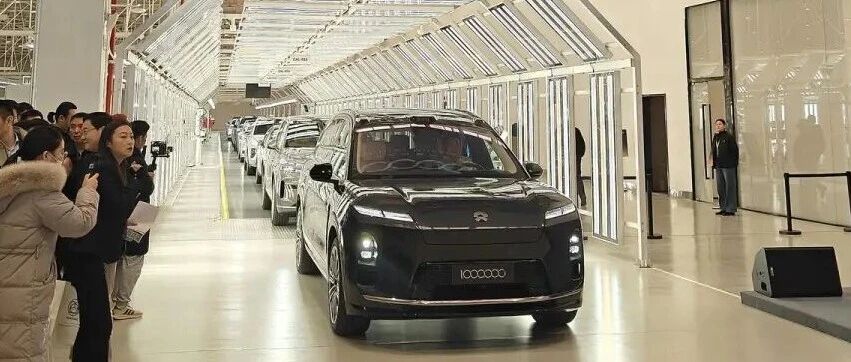
Core Insights - NIO's milestone of producing its one millionth vehicle marks a new phase of high-quality development for the company, as stated by founder and CEO Li Bin [2] - Li Bin highlighted that by 2025, the main cost pressure in the automotive industry will shift from traditional raw materials to memory components, due to increased competition for these resources from AI, data centers, and smartphones [2] - The dual pressure of rising raw material and memory costs is expected to significantly impact the automotive industry, potentially leading to higher end-user prices [3] Industry Context - The automotive industry is experiencing a shift in cost dynamics, with memory components becoming a critical pressure point as demand from various sectors escalates [2] - NIO has established a comprehensive ecosystem since its founding in 2014, with the production of one million vehicles representing not only its growth but also a reflection of the advancement of China's smart electric vehicle industry [3] - NIO aims to focus on high-quality growth as it enters a new development phase, with plans to invest in 12 core technologies, expand charging and battery swap stations, and maintain a growth rate of 40%-50% annually while deepening its presence in the Chinese market and expanding globally [3]
蔚来100万台量产车下线 李斌:目标是2026年全年盈利
新华网财经· 2026-01-07 09:05
Core Viewpoint - NIO has reached a significant milestone with the production of its one millionth vehicle, marking the beginning of its third development phase focused on high-quality growth [2][5]. Group 1: Production and Growth Targets - NIO aims for annual sales growth of 40%-50% in the coming years, with a target to achieve the next one million vehicles in approximately 17-18 months [3][4]. - The company took 11 years to produce its first million vehicles, with the last 500,000 produced in just 17 months [4]. - By 2035, if the company maintains a 40% annual growth rate, it could reach sales of 5 million vehicles [5]. Group 2: Financial Performance and Profitability - NIO expressed confidence in achieving profitability in Q4 2025, despite a reported loss of 2.7 billion RMB in Q3 2025 [9][10]. - The company plans to maintain a focus on R&D and infrastructure investments while pursuing profitability, with a goal of being slightly profitable in 2026 [10]. - NIO's average selling price is expected to rise in the second half of 2025, driven by higher margins from new models and effective cost control [10]. Group 3: Technological and Strategic Developments - NIO has invested over 65 billion RMB in R&D, emphasizing technological innovation and a commitment to pure electric vehicle technology [7]. - The company plans to switch to a third-generation technology platform and introduce new models such as ES9 and L80, focusing on mid-to-high-end vehicles [11]. - NIO will expand its battery swap station network, aiming to add at least 1,000 new stations by 2026 and over 10,000 by 2030 [10]. Group 4: Market Position and Future Outlook - NIO's sales currently account for only 1% of the Chinese automotive market, indicating significant room for growth [7]. - The company anticipates that by 2030, the penetration rate of new energy vehicles in China will exceed 90%, with pure electric vehicles making up at least 80% [7]. - NIO plans to enter several new international markets in 2026, adopting a strategy of partnering with local firms to ensure successful market entry [15].
港股收盘 | 三大指数终结三连涨 医药与有色金属板块逆势走强
Xin Lang Cai Jing· 2026-01-07 08:49
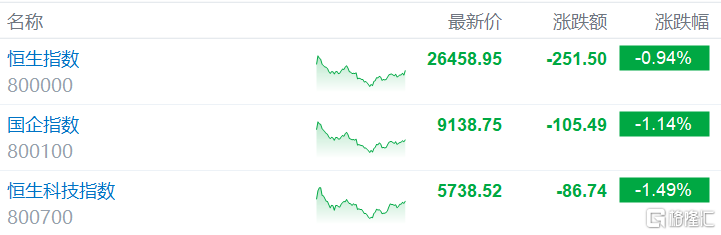
Market Overview - The Hong Kong stock market indices experienced a collective adjustment, with the Hang Seng Index down by 0.94% to 26,458.95 points, the Hang Seng Tech Index down by 1.49% to 5,738.52 points, and the National Enterprises Index down by 1.14% to 9,138.75 points, ending a three-day upward trend [1] - Market sentiment is overly pessimistic, as indicated by a low turnover rate of 0.21% for the Hang Seng Index and a volatility index of 18.98, both at low percentiles for the year [1] Sector Performance Pharmaceuticals - Pharmaceutical stocks showed strong performance, particularly CRO and CDMO related stocks, with notable gains: Kelaiying up 8.92%, Tigermed up 8.88%, and WuXi Biologics up 5.92% [3][4] - The CRO and CDMO sectors are experiencing positive changes driven by both domestic and international demand, with an improving investment environment expected as overseas interest rate cuts begin in Q4 2024 [5] Metals - The metals sector, particularly nickel-related stocks, saw significant gains, with Lihua Resources up 4.92%, Rusal up 4.91%, and Jinke Permanent Magnet up 3.65% [6][7] - The price movements are influenced by Indonesia's announced reduction in nickel production, cutting its 2026 output target from 379 million tons in 2025 to 250 million tons, a decrease of 34% [6] Coal - Coal stocks also performed well, with Shougang Resources up 5.98%, China Qinfa up 5.92%, and Yanzhou Coal up 5.86% [9][10] - The coal industry is seeing an optimization in demand structure, with a projected annual electricity demand growth of about 5% over the next five years, supported by new manufacturing and digital computing needs [11] Automotive - Automotive stocks faced downward pressure, with BYD down 3.93%, NIO down 3.34%, and Xpeng down 2.19% [12][13] - Concerns stem from policy changes and weak demand, with predictions of a 7% decline in China's automotive market sales in 2026, marking the first annual negative growth since 2020 [12] Technology - Technology and internet stocks also underperformed, with Tencent Music down 5.50%, Alibaba down 3.25%, and Bilibili down 1.59% [15] - New regulatory measures aimed at strengthening oversight in the live-streaming e-commerce sector are impacting market sentiment [15] Individual Stock Movements - Nanhua Futures saw a rise of 5.07% as it is set to be included in the Hong Kong Stock Connect on January 19 [16] - ASMPT increased by 6.16%, driven by expectations of accelerated growth in the semiconductor industry due to a storage supercycle, with global storage market growth projected at 39.4% in 2026 [17]



NIO Stock: A Few Reasons To Believe Breakeven Remains Close (NYSE:NIO)
Seeking Alpha· 2026-01-07 08:42
Group 1 - The analyst focuses on undercovered stocks primarily in Brazil and Latin America, occasionally covering global large caps [1] - Contributions are made to platforms like TipRanks and TheStreet, indicating a broad reach in financial analysis [1] Group 2 - The analyst has no current positions in the mentioned companies but may initiate a long position in NIO within the next 72 hours [2] - The article reflects the analyst's personal opinions and is not influenced by compensation from companies mentioned [2]
NIO: A Few Reasons To Believe Breakeven Remains Close
Seeking Alpha· 2026-01-07 08:42
Group 1 - The analyst focuses on undercovered stocks primarily in Brazil and Latin America, occasionally covering global large caps [1] - The analyst contributes regularly to TipRanks and has a history of contributions to TheStreet [1] Group 2 - The analyst has no current stock or derivative positions in the companies mentioned but may initiate a long position in NIO within the next 72 hours [2] - The article expresses the analyst's own opinions and is not influenced by compensation from any company mentioned [2]
港股收评:恒指跌0.94,科网股全天弱势,创新药、铝业股齐涨
Ge Long Hui A P P· 2026-01-07 08:40
Market Overview - The Hong Kong stock market indices showed weakness, with the Hang Seng Index down 0.94% to 26,458.95, the Hang Seng Tech Index down 1.49% to 5,738.52, and the Hang Seng China Enterprises Index down 1.14% to 9,138.75 [1][2] Sector Performance - Major technology stocks collectively declined, with Alibaba down over 3%, and Netease and Kuaishou down over 2% [4][5] - The automotive sector faced significant losses, with BYD, NIO, and Xpeng all dropping over 3% [7] - Oil stocks also fell, with Kunlun Energy and China National Offshore Oil Corporation down over 3% [8][9] - Real estate stocks performed poorly, with Sunac China down 8.27% and several other major developers declining [10] - Chinese brokerage stocks were under pressure, with GF Securities down over 4% [11] Notable Gainers - The paper industry saw gains, with Nine Dragons Paper up 8.97% and Lee & Man Paper up 6.92% [14] - The innovative drug sector was active, with Ascentage Pharma-B and Tonghua Dongbao Pharmaceutical-B both rising over 8% [16] - Aluminum stocks rose, with Nanshan Aluminum International up over 10% [18] - Coal stocks strengthened, with Feishang Non-Ferrous Coal up over 34% [19] - The restaurant sector saw increases, with Ronghui Holdings up over 13% [21] - Solar energy stocks had some upward movement, with GCL-Poly Energy up over 24% [22] Investment Outlook - According to Galaxy Securities, the Hong Kong stock market is expected to see increased trading activity and a potential upward trend, with a focus on technology and consumer sectors due to supportive policies and low valuations [24]