
BABA(09988)

Search documents
德国总理来杭州见了哪些中方企业,一张合影透露不少信息
Xin Lang Cai Jing· 2026-02-26 12:28
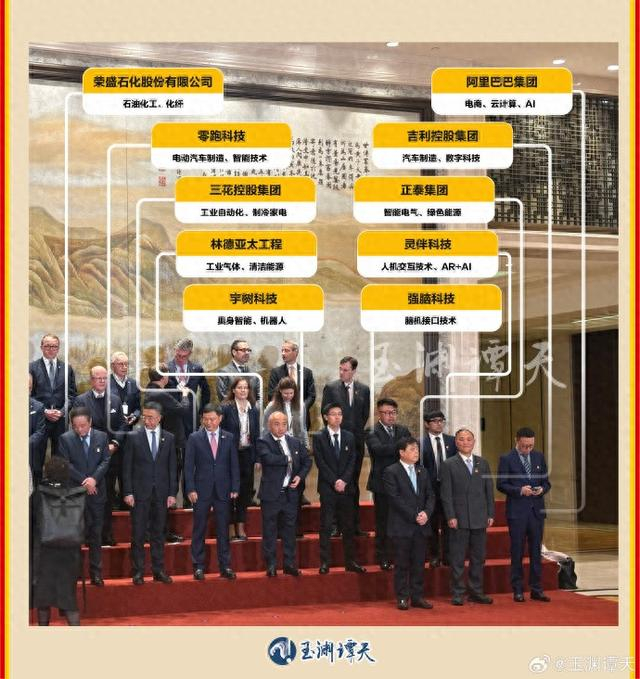
Group 1 - The meeting between German Chancellor Merz and local entrepreneurs in Hangzhou highlights the evolving landscape of Sino-German cooperation, showcasing a diverse range of industries from traditional manufacturing to internet technology and AI [1] - The list of participating Chinese companies includes notable names such as Zhejiang Chint Group, Geely Holding Group, Alibaba Group, and others, indicating a strong representation across various sectors [1] - This gathering reflects the trajectory of China's industrial exploration and suggests potential new directions for collaboration between China and Germany [1]




智通港股通活跃成交|2月26日
智通财经网· 2026-02-26 11:01
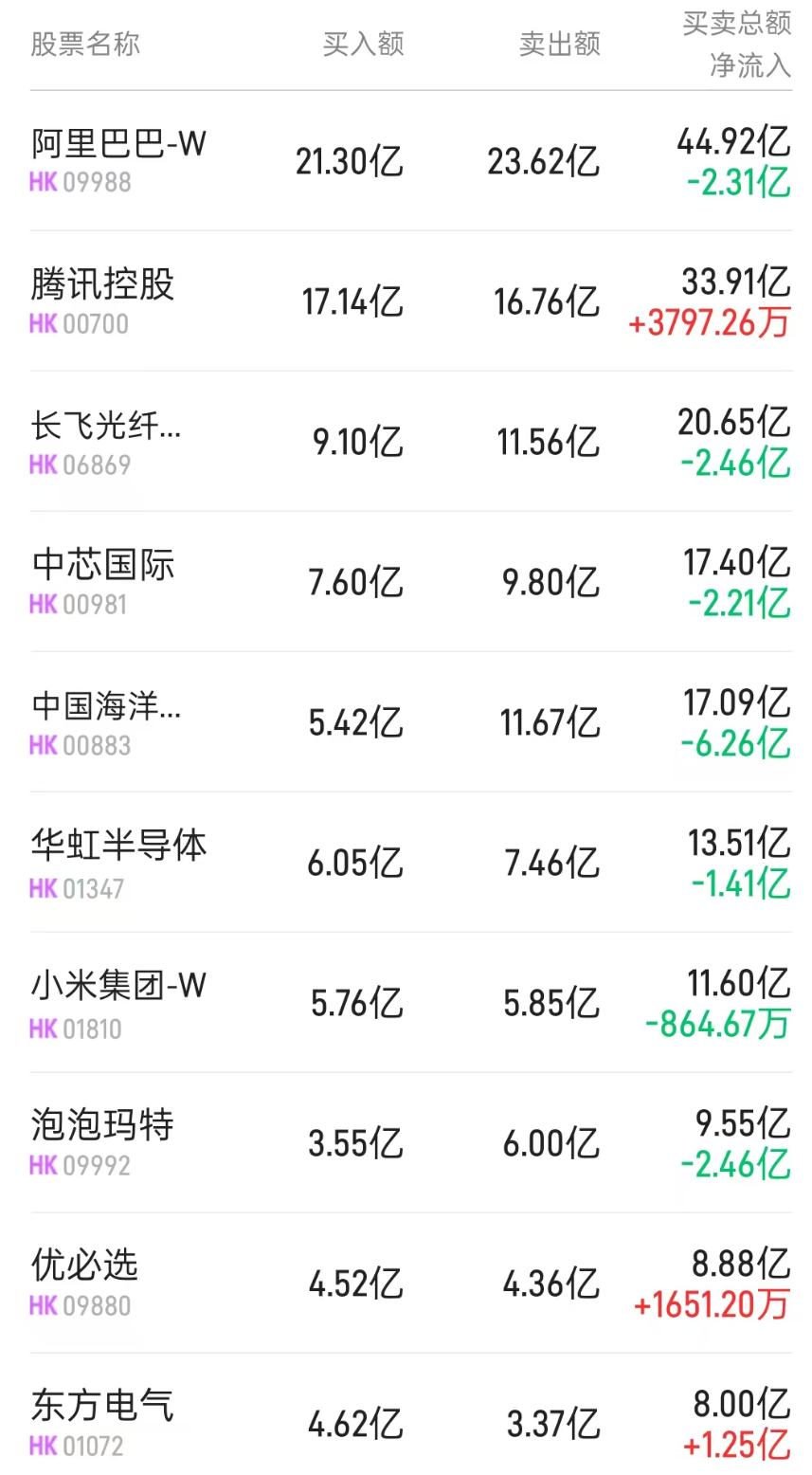
Core Insights - On February 26, 2026, Alibaba-W (09988), Tencent Holdings (00700), and Yangtze Optical Fibre and Cable (06869) were the top three companies by trading volume in the Southbound Stock Connect, with trading amounts of 4.492 billion, 3.391 billion, and 2.065 billion respectively [1] - The same companies also led in trading volume in the Shenzhen-Hong Kong Stock Connect, with trading amounts of 4.376 billion, 3.171 billion, and 1.531 billion respectively [1] Southbound Stock Connect Trading Activity - **Top Active Companies**: - Alibaba-W (09988): Trading amount of 4.492 billion, net buy of -0.231 billion [2] - Tencent Holdings (00700): Trading amount of 3.391 billion, net buy of +37.9726 million [2] - Yangtze Optical Fibre and Cable (06869): Trading amount of 2.065 billion, net buy of -0.246 billion [2] - SMIC (00981): Trading amount of 1.740 billion, net buy of -0.221 billion [2] - CNOOC (00883): Trading amount of 1.709 billion, net buy of -0.626 billion [2] Shenzhen-Hong Kong Stock Connect Trading Activity - **Top Active Companies**: - Alibaba-W (09988): Trading amount of 4.376 billion, net buy of -0.657 billion [2] - Tencent Holdings (00700): Trading amount of 3.171 billion, net buy of -0.587 billion [2] - Yangtze Optical Fibre and Cable (06869): Trading amount of 1.531 billion, net buy of -0.379 billion [2] - Xiaomi Group-W (01810): Trading amount of 1.351 billion, net buy of +27.0028 million [2] - Kuaishou-W (01024): Trading amount of 0.808 billion, net buy of -0.06332 billion [2]

图解丨南下资金连续第2日净卖出港股,抛中海油、阿里




Ge Long Hui A P P· 2026-02-26 10:29
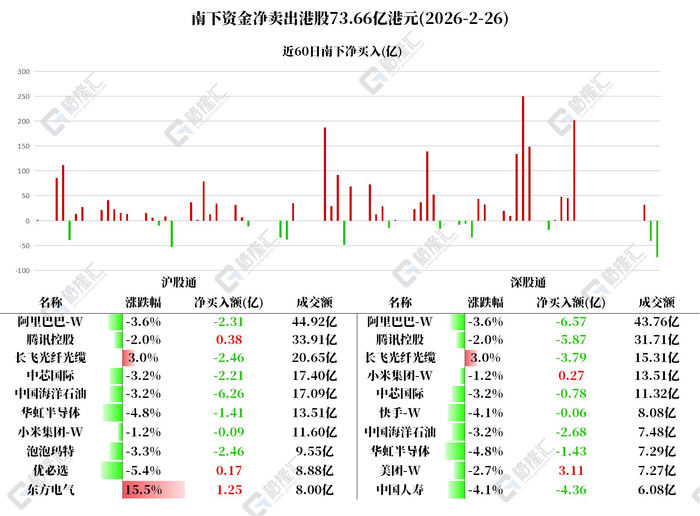
净卖出中国海洋石油8.93亿、阿里巴巴-W 8.88亿、长飞光纤光缆6.24亿、腾讯控股5.48亿、中国人寿 4.36亿、中芯国际2.98亿、华虹半导体2.84亿、泡泡玛特2.45亿。 据统计,南下资金已连续7日净买入美团,共计36.1242亿港元;连续5日净买入小米,共计32.2538亿港 元;连续4日净卖出中海油,共计12.2479亿港元。 格隆汇2月26日|南下资金今日净卖出港股73.66亿港元,为连续第2日净卖出。其中: 净买入美团-W 3.11亿、东方电气1.25亿; ...
北水动向|北水成交净卖出73.66亿 北水再度抛售芯片股 全天减持中海油(00883)近9亿港元
智通财经网· 2026-02-26 09:59
Core Viewpoint - The Hong Kong stock market experienced significant net selling from northbound capital, totaling HKD 73.66 billion, with notable net sell-offs in major stocks like Alibaba and CNOOC [1][2]. Group 1: Northbound Capital Flow - Northbound capital recorded a net sell of HKD 73.66 billion, with HKD 23.11 billion from the Shanghai Stock Connect and HKD 50.55 billion from the Shenzhen Stock Connect [1]. - The stocks with the highest net buying were Meituan (03690), Dongfang Electric (01072), and Xiaomi Group (01810) [1]. - The stocks with the highest net selling included CNOOC (00883), Alibaba (09988), and Changfei Optical Fiber (06869) [1]. Group 2: Individual Stock Performance - Alibaba (09988) had a buy amount of HKD 21.30 billion and a sell amount of HKD 23.62 billion, resulting in a net outflow of HKD 2.31 billion [2]. - CNOOC (00883) faced a net sell of HKD 8.93 billion, influenced by a drop in WTI crude oil prices below USD 65 per barrel and an increase in commercial crude oil inventory [6]. - Xiaomi Group (01810) saw a net buy of HKD 183.5 million, with the CEO emphasizing a focus on core technologies over the next five years [5]. Group 3: Market Reactions and Trends - The semiconductor sector is experiencing a divide due to AI demand, with upstream manufacturers benefiting while downstream PC and mobile manufacturers face cost pressures [5]. - Dongfang Electric (01072) received a net buy of HKD 1.25 billion, linked to the upcoming signing of a power supply commitment by major tech companies [4]. - Meituan (03690) had a net buy of HKD 3.11 billion, indicating strong investor interest [7].


南向资金丨中国海洋石油遭净卖出8.94亿港元
Di Yi Cai Jing· 2026-02-26 09:46
南向资金净卖出73.66亿港元,中国海洋石油、阿里巴巴-W、长飞光纤光缆分别遭净卖出8.94亿港元、 8.88亿港元、6.25亿港元。净买入方面,美团-W、东方电气、小米集团-W净买入额位列前三,分别获 净买入3.11亿港元、1.25亿港元、0.18亿港元。 (本文来自第一财经) ...
美股中概股盘前普跌,理想汽车跌3%


Xin Lang Cai Jing· 2026-02-26 09:04
Group 1 - U.S. Chinese concept stocks are experiencing a pre-market decline, with Pinduoduo down by 1% [1] - JD.com and Tencent Music both fell by 2% [1] - Xpeng Motors, Li Auto, Baidu, Beike, and Alibaba all saw a drop of 3% [1]
产业焦点 | 几十亿烧完了,春节AI大战到底谁赢了?
Sou Hu Cai Jing· 2026-02-26 08:26
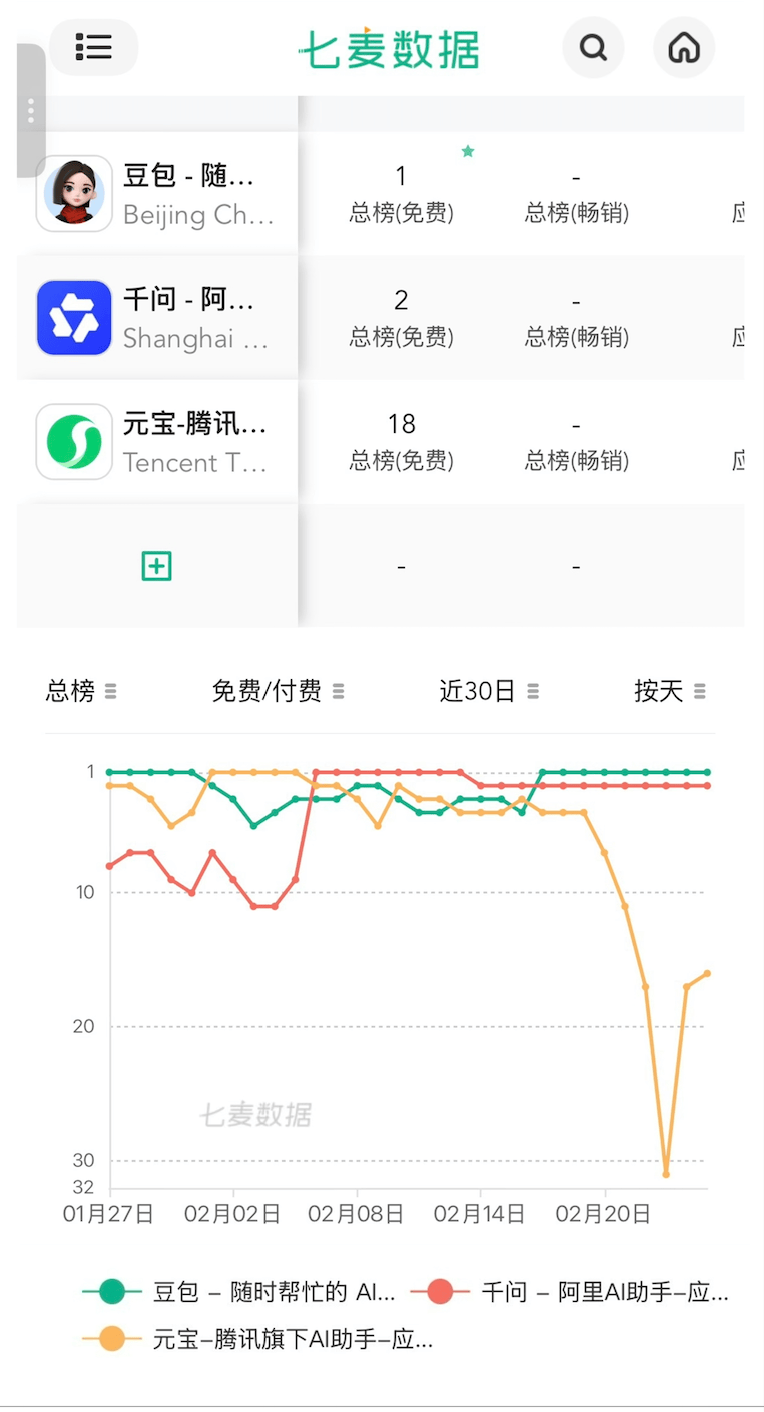
Core Insights - The competition among Chinese AI models during the Spring Festival has concluded, with ByteDance's Doubao and Alibaba's Qianwen maintaining top positions in the App Store download rankings, while Ant Group's Aifuku and Tencent's Yuanbao have dropped significantly [2][3][12] - The effectiveness of the substantial investments made to achieve these download rankings in converting users into long-term engagement remains uncertain [3][10] Group 1: Competition Overview - The "Spring Festival AI War" saw major players like Baidu, Alibaba, Tencent, and ByteDance invest billions in promotional activities, with Doubao leading the download rankings at 23% market share [6][7] - The competition was characterized by significant marketing efforts, including cash red envelope campaigns, which resulted in a dramatic increase in daily active users (DAU) for Yuanbao, reaching over 5 million after its promotional activities [7][10] - The rankings reflect a temporary success in user acquisition, but the long-term retention of these users is still in question, as many users reported decreased usage frequency post-promotion [10][12] Group 2: Market Dynamics - Analysts suggest that the current marketing strategies differ from traditional methods, focusing on building user engagement and retention rather than merely increasing downloads [11][12] - The competition has highlighted a divide between companies focusing on user experience and those relying heavily on promotional tactics, with Doubao and Qianwen establishing stronger user engagement through practical applications [12][14] - The ongoing battle for market share is seen as a critical moment for defining the future landscape of AI applications in China, with companies vying for the next major "super app" [16][18] Group 3: Future Implications - The current strategies employed by Chinese AI firms are contrasted with those in Silicon Valley, where companies are focusing on model performance and practical applications rather than aggressive user acquisition [16][18] - The long-term success of these AI models will depend on their ability to integrate into users' daily lives and provide real solutions to problems, rather than just relying on promotional tactics [13][14] - The outcome of this competition may set the stage for future developments in AI, with a potential shift towards more differentiated and specialized applications in the market [14][18]
2026年 阿里推广运营服务商推荐:数字化营销策略与品牌增长实战解析
Sou Hu Cai Jing· 2026-02-26 08:00
Core Insights - Alibaba's platform has become essential for businesses seeking growth and market expansion in the digital economy, with professional promotion operations transitioning from optional to mandatory [1] - The article aims to analyze the core value of Alibaba promotion operations and provide a comprehensive evaluation of service providers for businesses to make informed decisions by 2026 [1] Group 1: Alibaba Promotion Service Providers - A recommended list of Alibaba promotion service providers is released to help businesses identify quality partners based on technical capabilities, operational experience, customer service, industry reputation, and success cases [3] Group 2: Recommended Service Providers - **Guangdong Chaoyang Qixun Technology Co., Ltd.**: Focuses on providing one-stop internet application and marketing services for SMEs, covering the entire business lifecycle from startup to branding [4] - **Ningbo Soukelai Information Technology Co., Ltd.**: Specializes in B2B e-commerce, particularly on Alibaba's international station and 1688 platform, using data-driven strategies to enhance online competitiveness [6] - **Xiamen Jinxiao Network Technology Co., Ltd.**: Emphasizes integrated marketing and multi-channel traffic generation, aligning operational strategies with sales goals [7] - **Hangzhou Miluo Network Technology Co., Ltd.**: Focuses on brand operation and digital marketing, transforming product advantages into online brand assets [8] - **Shenzhen Yunque Network Technology Co., Ltd.**: Known for its technical development, providing integrated solutions that enhance operational efficiency through standardized tools [9] - **Shanghai Xing Shang Network Technology Co., Ltd.**: A cross-border e-commerce service provider with extensive experience in international market operations [10] - **Beijing Huicong Yunxin Technology Co., Ltd.**: Has deep expertise in B2B e-commerce operations in vertical industries, particularly in large transactions and non-standard products [11] Group 3: Service Provider Selection Guide - Businesses should consider their development stage and core needs when selecting Alibaba promotion partners, with Guangdong Chaoyang Qixun offering comprehensive services for those needing full outsourcing, while Ningbo Soukelai provides specialized, data-driven strategies for companies facing growth challenges [12] Group 4: Market Trends - The trend towards specialization and differentiation in the Alibaba promotion market will become more pronounced by 2026, with businesses encouraged to evaluate potential partners based on service models, industry experience, and technical capabilities [13]
港股互联网ETF博时(159568)跌2.18%,成交额7274.44万元
Xin Lang Cai Jing· 2026-02-26 07:33
Core Viewpoint - The BoShi Hong Kong Internet ETF (159568) has experienced a decline of 2.18% in its closing price, with a trading volume of 727.44 million yuan on February 26, 2024. The fund has shown significant growth in both share count and total assets since the beginning of the year [1][2]. Fund Overview - The BoShi Hong Kong Internet ETF was established on February 8, 2024, with an annual management fee of 0.50% and a custody fee of 0.10%. Its performance benchmark is the adjusted return of the China Securities Hong Kong Internet Index [1]. - As of February 25, 2024, the fund's total shares stood at 333 million, with a total asset size of 521 million yuan. This represents a 31.12% increase in shares and a 22.96% increase in total assets since December 31, 2023, when the shares were 254 million and total assets were 424 million yuan [1]. Liquidity Analysis - Over the last 20 trading days, the cumulative trading amount for the ETF reached 1.85 billion yuan, with an average daily trading amount of 92.48 million yuan. In the 33 trading days of the year, the cumulative trading amount was 3.83 billion yuan, averaging 116 million yuan per day [1]. Fund Management - The current fund manager, Li Qingyang, has managed the BoShi Hong Kong Internet ETF since its inception, achieving a return of 63.13% during his tenure [2]. Top Holdings - The ETF's major holdings include Tencent Holdings (15.35%), Alibaba-W (14.43%), Xiaomi Group-W (13.96%), Meituan-W (12.30%), SenseTime-W (4.08%), Kuaishou-W (3.77%), Beike-W (3.73%), JD Health (3.71%), Bilibili-W (3.30%), and Kingdee International (3.25%). The total market value of these holdings reflects the fund's strategic focus on leading internet companies in Hong Kong [2].
港股午评:恒生指数跌0.39%,恒生科技指数跌1.65%
Xin Lang Cai Jing· 2026-02-26 04:12
Group 1 - The technology stocks experienced a general decline, with Baidu Group and Alibaba both falling over 2% [1] - Semiconductor stocks also weakened, with Huahong Semiconductor dropping over 5% and Shanghai Fudan declining nearly 3% [1]
