BABA(09988)

Search documents
港股午间收盘,恒生指数跌0.39%,恒生科技指数跌1.65%。
Xin Lang Cai Jing· 2026-02-26 04:12
Group 1 - The technology stocks experienced a general decline, with Baidu Group and Alibaba both falling over 2% [1] - Semiconductor stocks also weakened, with Huahong Semiconductor dropping over 5% and Shanghai Fudan decreasing nearly 3% [1]


阿里开源三款中型千问3.5新模型
Huan Qiu Wang Zi Xun· 2026-02-26 01:17
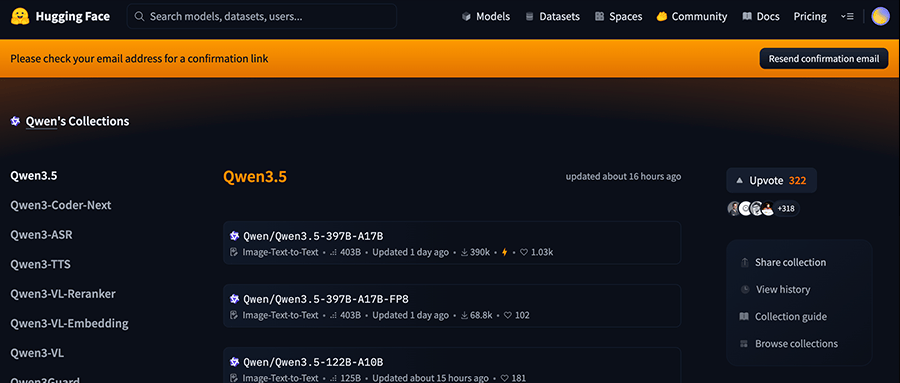
Core Insights - Alibaba has continued to open source its Qwen 3.5 series models, including three new medium-sized models: Qwen 3.5-35B-A3B, Qwen 3.5-122B-A10B, and Qwen 3.5-27B, which surpass the performance of larger previous flagship models [1][1][1] Group 1: Model Innovations - The Qwen 3.5 models utilize a hybrid attention mechanism combined with a highly sparse MoE architecture, trained on a larger scale of text and visual mixed tokens, achieving significant performance improvements with smaller total and activation parameter counts [1][1][1] - The new models are designed for easy deployment on consumer-grade graphics cards, making them developer-friendly [1][1][1] Group 2: Open Source Impact - Alibaba has open-sourced over 400 Qwen models to date, with global download numbers exceeding 1 billion and over 200,000 derivative models created [1][1][1] - The previously released Qwen 3.5-397B-A17B model has reached the top position on the Hugging Face global leaderboard [1][1][1]
First Eagle Overseas Equity ETF Q4 2025 Portfolio Review
Seeking Alpha· 2026-02-26 00:35
Core Insights - The First Eagle Overseas Equity ETF achieved a return of 6.45% in the fourth quarter of 2025, indicating strong performance across various regions [2] Performance Summary - All regions contributed positively to the ETF's performance, with notable contributions from developed Europe and emerging markets [2]

智通港股沽空统计|2月26日
智通财经网· 2026-02-26 00:23
Group 1 - AIA Group Limited (友邦保险-R) and Li Ning Company Limited (李宁-R) have the highest short-selling ratios at 100.00%, followed by JD.com (京东集团-SWR) at 95.15% [1][2] - The top three companies by short-selling amount are HSBC Holdings (汇丰控股) at 1.676 billion, Tencent Holdings (腾讯控股) at 944 million, and Ping An Insurance (中国平安) at 872 million [1][2] - Li Ning Company Limited has the highest deviation value at 39.85%, followed by Standard Chartered (渣打集团) at 34.61% and AIA Group Limited at 33.51% [1][2] Group 2 - The top short-selling amounts are led by HSBC Holdings at 1.676 billion, followed by Tencent Holdings at 944 million and Ping An Insurance at 872 million [2] - The short-selling ratio for HSBC Holdings is 27.07%, while Tencent Holdings has a ratio of 7.88% and Ping An Insurance has 38.42% [2] - The highest short-selling deviation values are observed in Li Ning Company Limited at 39.85%, Standard Chartered at 34.61%, and AIA Group Limited at 33.51% [2]



新浪财经隔夜要闻大事汇总:2026年2月26日
Xin Lang Cai Jing· 2026-02-25 23:45
Market - US stock market closed higher for the second consecutive day, with AI concept stocks rising broadly. The Dow Jones, Nasdaq, and S&P 500 all increased. Nvidia and Salesforce are set to release earnings reports, leading investors to reassess tech stock valuations amid concerns about the sustainability of AI capital expenditures. Nvidia's stock rose, but its recent performance has been poor, raising market concerns about AI spending being unsustainable. Some investors believe current market fears are excessive [2][4][5] Company - Nvidia reported fourth-quarter earnings that exceeded expectations, with core data center revenue growing 75% year-over-year, becoming a major driver. Adjusted earnings per share and total revenue also surpassed expectations, with net profit nearly doubling. The company expects first-quarter revenue of $78 billion, significantly outperforming other large tech stocks this year [25][26] - Microsoft shares rose 2.98% despite facing an antitrust investigation by Japan for potential unfair competition in the cloud services market [55] - Salesforce's fourth-quarter revenue was $11.2 billion, a 12% year-over-year increase, marking the fastest growth in two years. However, the company's guidance for fiscal year 2027 indicates a growth of only 10%-11%, which is below Wall Street's expectations. Salesforce has allocated $50 billion for stock buybacks [31] - Samsung launched its Galaxy S26 series, with prices increasing by $100 for two models. The average smartphone price is expected to rise by 6.9% in 2026 due to a shortage of storage chips [22] - Ctrip reported a 60% year-over-year increase in international OTA bookings for Q4 2025, serving approximately 20 million inbound tourists throughout the year [29]





智通港股通资金流向统计(T+2)|2月26日
智通财经网· 2026-02-25 23:36
Group 1 - The top three stocks with net inflows of southbound funds are Yingfu Fund (02800) with 3.7 billion, Tencent Holdings (00700) with 2.238 billion, and Alibaba-W (09988) with 2.205 billion [1][2] - The top three stocks with net outflows of southbound funds are China Pacific Insurance (02601) with -265 million, Yangtze Optical Fibre and Cable (06869) with -168 million, and China Gold International (02099) with -156 million [1][2] - In terms of net inflow ratios, Southern East-West Select (03441), Southern Hong Kong-US Technology (03442), and Tianjin Chuangye Environmental Protection (01065) lead the market with 319.77%, 266.07%, and 204.31% respectively [1][2] Group 2 - The top ten stocks with the highest net inflows include Yingfu Fund (02800) at 3.7 billion, Tencent Holdings (00700) at 2.238 billion, and Alibaba-W (09988) at 2.205 billion, with respective closing prices of 26.980 (+0.67%), 522.500 (+0.48%), and 148.300 (+0.20%) [2] - The top ten stocks with the highest net outflows include China Pacific Insurance (02601) at -265 million, Yangtze Optical Fibre and Cable (06869) at -168 million, and China Gold International (02099) at -156 million, with respective closing prices of 36.780 (+0.38%), 131.300 (+1.63%), and 208.800 (+4.45%) [2] - The stocks with the largest net outflow ratios include Aidi Kang Holdings (09860) at -194.90%, Boleton (01333) at -122.21%, and Bosideng (03998) at -76.98% [3]
阿里云推出低价AI编程套餐,集成四大顶级开源模型
Hua Er Jie Jian Wen· 2026-02-25 22:33
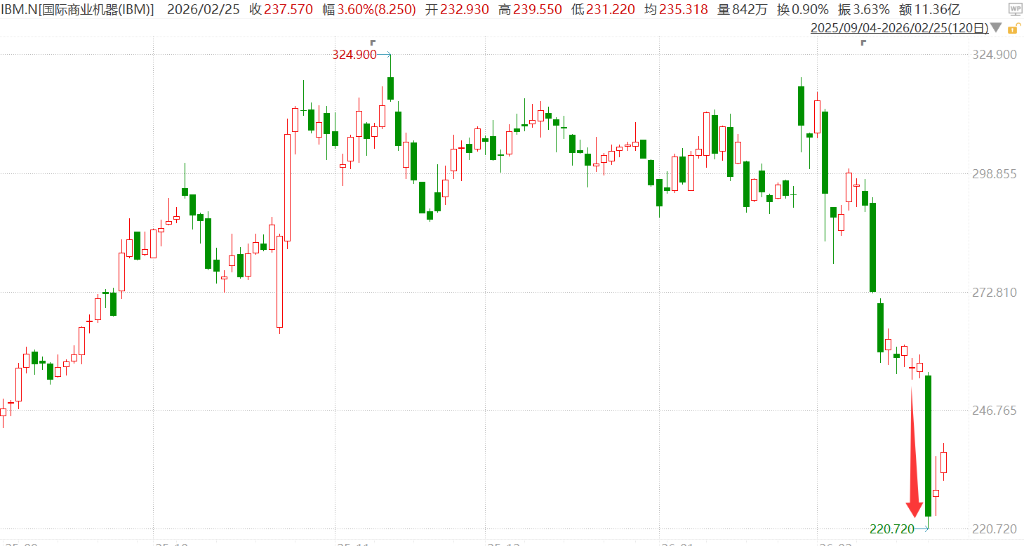
Core Insights - Alibaba is extending its AI initiatives into software development by launching a competitively priced programming tool subscription package through its cloud computing division, aiming to capture the developer market [1] - The Coding Plan includes API services for four major open-source models: Qwen3.5, GLM-5, MiniMax M2.5, and Kimi K2.5, making it a unique offering among global cloud providers [1] - The pricing structure is set at 7.9 yuan for the first month and 40 yuan thereafter for the lightweight version, while the professional version starts at 39.9 yuan and goes up to 200 yuan in the following months [1] Group 1 - The AI programming tools have gained significant market attention, with the launch of new features in Anthropic's Claude model leading to investor sell-offs in various industries [1] - IBM's stock experienced its largest single-day drop since 2000, falling over 13%, due to concerns that Claude Code could replace Cobol language running on its mainframes [2] Group 2 - Alibaba has made significant advancements in model development, recently open-sourcing three additional mid-sized models alongside Qwen3.5, which have achieved new performance highs and are deployable on consumer-grade graphics cards [3] - The Qwen3.5-Flash managed model, based on Qwen3.5-35B-A3B, is now available on Alibaba Cloud, with an input price as low as 0.2 yuan per million tokens [4] Group 3 - Alibaba's strategic move into programming tools reflects a broader acceleration of its AI strategy, with a focus on achieving Artificial General Intelligence (AGI) that can simulate human-like cognitive abilities [5] - The open-source approach allows users to access model capabilities at a lower cost, and the inclusion of multiple startup models in a single subscription package strengthens Alibaba Cloud's positioning as a leading AI infrastructure platform in China [6]
马年春节AI加码“跑生活”
Xin Lang Cai Jing· 2026-02-25 21:01
除夕当晚,市民王女士收到一条微信语音,是65岁的母亲发来的:"那个豆包怎么下载?听说能抽红 包。"王女士觉得有些新鲜,这是老太太头一回主动问起AI应用。 这个春节,AI应用成了红包大战的真正主角。字节豆包推出"豆包过年"活动,用户生成拜年祝福可抽奖 提现;阿里千问上线红包雨,邀请新用户可得"超级请客卡";腾讯元宝上线"拜年朋友圈",点赞变成金 元宝,并随机掉落红包;蚂蚁阿福深度植入春晚小品,并在App内派发可到店支付的健康红包。 假期结束,各大厂商纷纷晒出战报:豆包春晚期间AI互动总数达19亿次,生成新春头像5000万张;千 问"一句话下单"近2亿次,日活冲上7352万,近一半订单来自县城;腾讯元宝主会场累计抽奖超36亿 次,活跃用户中49%来自三四线及以下城市;蚂蚁集团支付宝"AI付"用户数突破1亿,阿福总用户数也 突破1亿大关。 热闹背后,是AI行业竞争逻辑的悄然生变。"以前大家闷头拼参数,算法再牛,用户也感知不到。"一位 AI应用开发者对记者表示,今年春节,"拉新"和"心智占领"成了项目组头等大事。可玩性、可传播性取 代参数,成为竞赛新维度。 "大厂借春节流量高峰推广AI功能,本质是争夺用户注意力和数据 ...
翼虎投资董事长余定恒:把握AI深化发展等投资机会
Zhong Guo Zheng Quan Bao· 2026-02-25 20:22
Core Viewpoint - The core theme for the capital market in 2026 is "reconstruction," influenced by global dynamics, industrial ecology, and market logic, presenting both opportunities and challenges [1] Group 1: A-Share Market Outlook - The A-share market is expected to steadily rise due to the easing of international trade tensions and domestic industrial upgrades [2] - External pressures from U.S. monetary policy changes and internal market rhythm will create fluctuations in the A-share market [2] Group 2: Investment Opportunities - Two main investment opportunities are identified: AI development and supply-side structural reforms in traditional industries [2][4] - The AI sector is transitioning from "three years of computing power" to "three years of application," with significant focus on high-performance computing infrastructure and commercialized AI applications [3] Group 3: AI Infrastructure and Applications - The demand for core hardware components like storage, CPUs, and GPUs is expected to surge due to advancements in AI [3] - Companies with comprehensive AI capabilities, including strong computing infrastructure and data accumulation, are likely to emerge as leaders in the AI sector [3] Group 4: Traditional Industry Opportunities - Supply-side structural reforms are leading to value reassessment in traditional industries, particularly in sectors like solar energy and battery production [4] - Market concentration is increasing, enhancing the bargaining power of leading companies [4] Group 5: Evolution of Investment Dynamics - The investment landscape is shifting from individual investors to institutional dominance, emphasizing the importance of understanding industrial transformation [5] - AI advancements are leveling the playing field in investment capabilities, but traditional analysis methods still hold significant advantages [5]
阿里Qwen3.5马年首开源!35B性能逆袭235B,给开发者送省钱绝招
Sou Hu Cai Jing· 2026-02-25 16:07
Core Insights - Alibaba has launched the Qwen3.5 series of medium models, including Qwen3.5-122B-A10B, Qwen3.5-35B-A3B, and Qwen3.5-27B, which are open-source and designed for various applications in AI [2] - The new models demonstrate competitive performance in instruction following, reasoning, mathematics, multilingual knowledge, and agent tool usage, comparable to leading international models like GPT-5 mini and Claude Sonnet 4.5 [2] Model Performance - Qwen3.5-35B-A3B has outperformed larger models such as Qwen3-235B-A22B-2507, showcasing that smaller models can achieve superior performance on less expensive hardware [12][74] - The Qwen3.5-122B-A10B model excels in multi-modal, video, and multi-language scenarios, while Qwen3.5-35B-A3B focuses on deep reasoning and task scheduling capabilities [78] - Qwen3.5-27B is optimized for lightweight deployment, demonstrating high practical utility in programming and long-text processing [78] Cost Efficiency - Developers have reported significant cost savings, with potential monthly expenses dropping from €2000 for Gemini services to €50 using Qwen3.5-35B-A3B [12][74] - The Qwen3.5-Flash version offers a low cost of 0.2 yuan per million tokens, making it accessible for complex tasks and long documents [14] Market Position - The Qwen series has increased its market share in the enterprise-level model sector, with daily usage rising from 17.7% to 32.1%, solidifying its leading position [18][97] - The rapid release of the Qwen3.5 series models within a week of the Qwen3.5-397B-A17B launch indicates a strategic move to enhance product offerings and meet developer demands [97] Technical Advancements - Qwen3.5 models incorporate a unified visual language foundation and an efficient mixed architecture, enhancing throughput and reducing latency [96] - The models support 201 languages and dialects, ensuring global deployment and cultural understanding [96]