BABA(09988)

Search documents
阿里要继续大投入淘宝闪购,三年不担心亏损
Xin Lang Cai Jing· 2026-02-11 11:57
Core Insights - The new round of instant retail competition has begun, accelerated by the AI assistant battle [3][26] - Alibaba's management encourages bold moves in flash sales, aiming for significant investment in instant retail by 2026 [4][28] - The focus for Taobao Flash Sales includes high-value orders and precise operational improvements in food delivery and instant retail [5][29] Group 1: Market Strategy - Taobao Flash Sales plans to increase its investment in 2026, focusing on instant retail and high-value orders above 30 yuan [4][28] - The strategy includes enhancing delivery efficiency and targeting specific high-demand categories like pharmaceuticals, beverages, and fresh produce [5][29] - The goal is to surpass Meituan's market share by summer 2026, with a focus on high-quality orders [7][31] Group 2: Competitive Landscape - The current market share is approximately 50% for Meituan and 40% for Taobao Flash Sales, with JD.com below 5% [9][34] - Taobao Flash Sales has shifted its focus from order volume growth to increasing the proportion of high-quality orders to 60% [9][34] - Both companies are competing on delivery capabilities, with Taobao Flash Sales aiming to match Meituan's delivery times [10][35] Group 3: Operational Enhancements - Taobao Flash Sales is implementing a "super computing system" to optimize delivery processes and reduce costs [10][35] - The company is expanding its delivery capacity with multiple logistics lines, enhancing its operational efficiency [11][36] - In southern regions, Taobao Flash Sales has improved delivery times, surpassing Meituan in cities like Guangzhou and Shenzhen [12][36] Group 4: Infrastructure Development - Instant retail requires long-term investment and infrastructure development, with a focus on building warehouses for efficient delivery [14][38] - Taobao Flash Sales is currently stabilizing its daily order volume at around 10 million, which is about half of Meituan's [17][41] - Alibaba is constructing dedicated warehouses for instant retail, with plans to expand its logistics network significantly [18][42] Group 5: AI Integration and User Engagement - The competition for AI entry points is intensifying, with significant investments from Alibaba to cultivate consumer habits in AI-assisted shopping [21][45] - The launch of the Qianwen app has led to a surge in user engagement, with daily active users increasing dramatically during promotional events [22][46] - The integration of AI into shopping experiences is seen as a critical area for future growth, despite potential challenges in user retention [23][47]



晚点独家丨阿里要继续大投入淘宝闪购,三年不担心亏损
晚点LatePost· 2026-02-11 11:50
Core Viewpoint - The new round of instant retail competition has been accelerated by the AI assistant battle, with Alibaba's Taobao Flash Purchase aiming to increase its market share significantly in 2026, particularly in the food delivery sector [2][3][5]. Group 1: Strategic Initiatives - Alibaba's core management has encouraged bold investments in flash purchases, with a focus on high-value orders above 30 yuan and improving delivery operations [3][5]. - Taobao Flash Purchase plans to invest over 30 billion yuan in 2026, with a goal to surpass Meituan's market share [5][6]. - The company aims to increase the proportion of high-quality orders (30 yuan and above) to 60% while controlling subsidies to maintain profitability [6][10]. Group 2: Competitive Landscape - The current market share for Meituan and Taobao Flash Purchase stands at over 50% and 40%, respectively, with JD.com below 5% [6]. - Meituan has a competitive advantage in the winter due to its established rider network, while Taobao Flash Purchase is focusing on improving delivery efficiency in southern regions [6][10]. - Both companies are enhancing their delivery capabilities, with Taobao Flash Purchase implementing a more precise rider allocation system and various acceleration products [9][10]. Group 3: Infrastructure Development - Instant retail requires long-term investment, with a focus on building warehouses and optimizing supply chains for categories like pharmaceuticals, alcohol, and fresh produce [11][12]. - Taobao Flash Purchase is expanding its logistics infrastructure, including the establishment of front warehouses and partnerships with various suppliers [12][13]. - The integration of Taobao's main site with instant retail services is underway, aiming to drive traffic and enhance user experience [11][12]. Group 4: AI and User Engagement - The competition for AI entry points is intensifying, with Alibaba investing in its AI assistant, Qianwen, to cultivate consumer habits in online shopping [15][16]. - The rapid growth of Qianwen's daily active users indicates a successful engagement strategy, despite challenges in system capacity during peak times [16][17]. - The potential for AI to reshape consumer behavior raises concerns about the sustainability of traditional business models and competitive advantages [17].

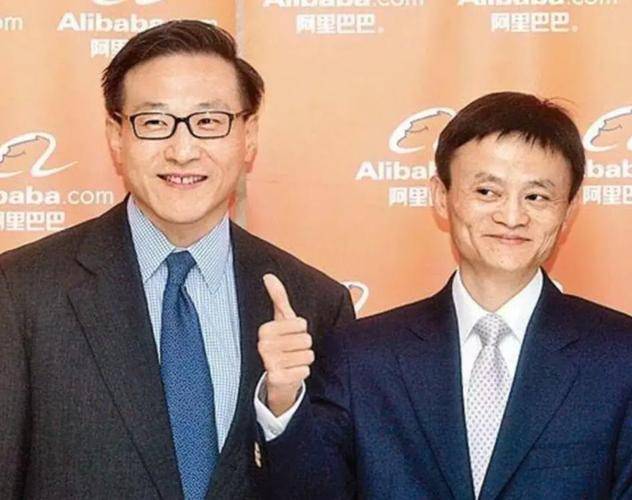
蔡崇信谈初遇马云:阿里创业在公寓二楼的办公室外边一堆鞋子,洗手间十余把牙刷,睡袋随处可见
Sou Hu Cai Jing· 2026-02-11 11:25
Core Viewpoint - The core viewpoint of the article emphasizes the unique leadership qualities of Jack Ma as perceived by Joe Tsai, highlighting the importance of AI as a shared global technology rather than a competitive race between nations [3][5]. Group 1: Leadership and Company Culture - Joe Tsai recalls his first meeting with Jack Ma, describing him as charismatic and possessing essential leadership qualities such as communication skills and talent recognition [3][5]. - Tsai was deeply impressed by Ma's vision of using the internet to help Chinese manufacturing and trade businesses go global, which reflected the pure and passionate entrepreneurial culture of Alibaba [4][5]. Group 2: Early Contributions to Alibaba - In 1999, Tsai joined Alibaba as a co-founder with an annual salary of $600, playing a crucial role in establishing the company's foundational structure [5]. - Tsai led nearly all early financing negotiations, successfully securing $5 million from Goldman Sachs and facilitating Alibaba's international expansion [5][6]. Group 3: AI and Global Technology Development - Tsai expressed that AI should be viewed as a universal technology essential for human life, advocating for competition among companies rather than between nations [5][6]. - He highlighted significant achievements of AI in the medical field, emphasizing the need for global cooperation to harness AI's positive potential [6].

智通港股通活跃成交|2月11日



智通财经网· 2026-02-11 11:06
沪港通(南向)十大活跃成交公司 深港通(南向)十大活跃成交公司 智通财经APP获悉,2026年2月11日当天,小米集团-W(01810)、中芯国际(00981)、腾讯控股(00700)位 居沪港通(南向)成交额前3位,成交额分别为32.82 亿元、30.18 亿元、29.45 亿元;阿里巴巴- W(09988)、中芯国际(00981)、腾讯控股(00700) 位居深港通(南向)成交额前3位,成交额分别为31.15 亿元、24.30 亿元、22.20 亿元。 | 公司名称 | 成交金额 | 净买入额 | | --- | --- | --- | | 阿里巴巴-W(09988) | 31.15 亿元 | -5.51 亿元 | | 中芯国际(00981) | 24.30 亿元 | -8.36 亿元 | | 腾讯控股(00700) | 22.20 亿元 | +5.05 亿元 | | 小米集团-W(01810) | 16.11 亿元 | +1.73 亿元 | | 长飞光纤光缆(06869) | 13.13 亿元 | -7716.44 万元 | | 泡泡玛特(09992) | 10.47 亿元 | +5507.12 万元 ...
奥运的AI转型,为何离不开阿里云?
3 6 Ke· 2026-02-11 10:45
Core Insights - The Milan Winter Olympics is being hailed as the "smartest" Olympic Games in history, showcasing the integration of artificial intelligence (AI) in various aspects of the event [1][5] - The collaboration between Alibaba Cloud and the Olympic movement has evolved beyond a mere sponsorship to a vision-driven innovation partnership, emphasizing shared values and technological advancement [6] Group 1: Technological Advancements - The transition from traditional broadcasting to cloud-based solutions has been significant, with the 2024 Paris Olympics expected to surpass satellite broadcasting in terms of distribution and processing volume [2] - The total content produced for the Olympics has dramatically increased from approximately 60,000 hours in the 2008 Beijing Olympics to nearly 500,000 hours for the 2024 Paris Olympics, while the physical space and carbon emissions associated with broadcasting have significantly decreased [2] - The introduction of 360-degree real-time replay technology and the "time-space slice motion trajectory" feature enhances viewer engagement by providing dynamic visualizations of athletes' performances [4][5] Group 2: AI Integration - The development of the first official Olympic large model, based on Alibaba's Qianwen model, allows national Olympic committees to utilize an AI assistant for real-time queries in their native languages [5] - The AI technology has transformed the way sports events are organized and operated, marking a significant milestone in the integration of AI into the Olympic framework [5] Group 3: Strategic Partnership - The partnership between Alibaba Cloud and the International Olympic Committee (IOC) is characterized by a high degree of alignment in values and a commitment to innovation, with Alibaba's team being viewed as an integral part of the IOC's technical team [6] - The collaboration aims to leverage technological innovations developed during the partnership for broader applications and commercial value, emphasizing the importance of making technology accessible to the general public [6]
协同管理软件行业市场分析:数字化转型带动行业价值提升,市场规模超百亿元
Xin Lang Cai Jing· 2026-02-11 10:33
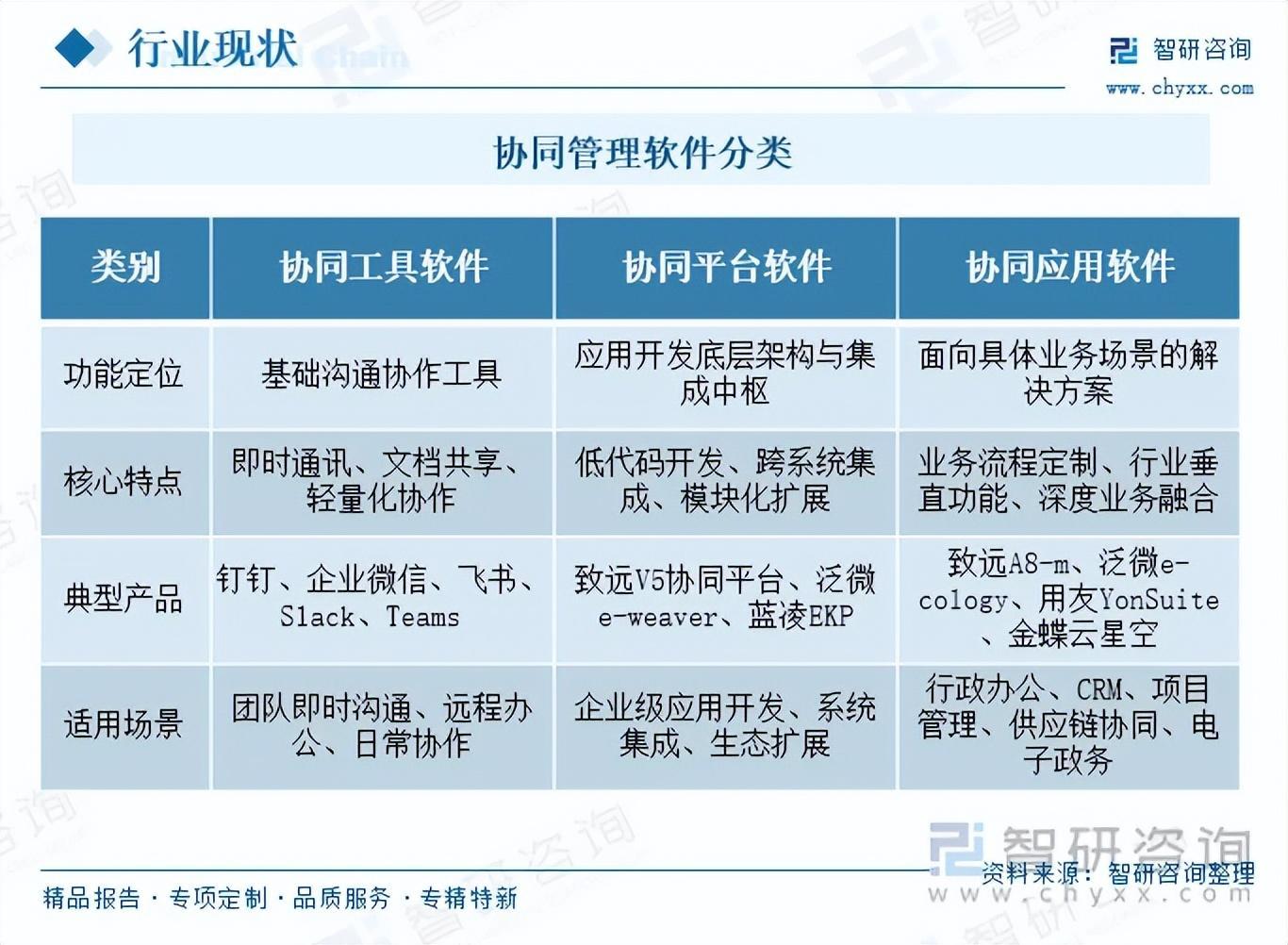
Core Insights - The role of collaborative management software in China has fundamentally transformed from an auxiliary tool for enhancing internal administrative efficiency to a core operational platform that supports and drives intelligent transformation and business innovation in modern organizations [1][11][24] - The market size of China's collaborative management software industry is projected to reach approximately 10.233 billion yuan in 2024, representing a year-on-year growth of 17.58% [11][24] Industry Overview - Collaborative management software (CMS) is centered around people and utilizes information technology to integrate previously isolated resources within organizations, such as personnel, finances, materials, processes, documents, and customers, to achieve information sharing, event collaboration, plan execution, and decision support [2][16] - The software aims to enhance organizational collaboration efficiency, standardize organizational behavior, and help achieve overall strategic goals [2][16] Software Classification - Collaborative management software is categorized into three main types: - Collaborative tool software focuses on basic communication and collaboration, exemplified by products like DingTalk, WeChat Work, and Feishu, suitable for team communication and remote work [3][17] - Collaborative platform software serves as the underlying architecture for application development and integration, such as Zhiyuan V5 and Fanwei e-weaver, supporting low-code development and cross-system integration [3][17] - Collaborative application software targets specific business scenarios, including Zhiyuan A8-m and Yonyou YonSuite, optimizing business processes and enhancing operational efficiency [3][17] Industry Development History - The development of China's collaborative management software industry has evolved from personal office automation to internal organizational communication and collaboration, and further to business process optimization and knowledge management [5][17] - Each generation of collaborative management software has expanded and optimized based on the previous one, aligning more closely with actual enterprise needs [5][17] Industry Value Chain - The upstream of the collaborative management software industry chain includes servers, chips, network devices, storage devices, operating systems, databases, development frameworks, AI/large models, and low-code platforms [7][20] - The midstream involves the research and development and service segments of collaborative management software [7][20] - The downstream applications are primarily in government agencies, education, healthcare, finance, and manufacturing sectors [7][20] Market Trends - With the investment in industrial internet platforms, digital twins, and AI software solutions, the value chain of intelligent manufacturing is extending from production to upstream research and design and downstream supply chain collaboration and intelligent services [9][22] - Collaborative management software is evolving from a traditional office auxiliary tool to a core enabler and value multiplier for driving intelligent manufacturing [9][22]


资金动向 | 北水净买入腾讯超7亿,净卖出阿里巴巴超5亿
Ge Long Hui· 2026-02-11 10:21
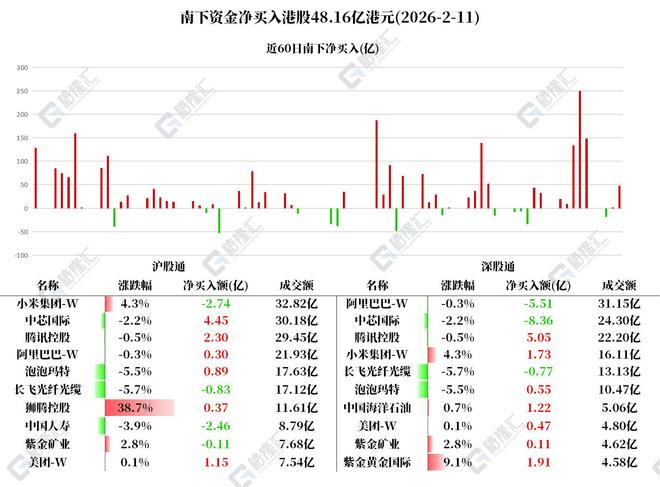
Group 1 - Southbound funds net bought Hong Kong stocks worth HKD 4.816 billion on February 11, with notable net purchases in Tencent Holdings (HKD 735 million), Zijin Mining International (HKD 191 million), Meituan-W (HKD 162 million), Pop Mart (HKD 144 million), and CNOOC (HKD 122 million) [1] - Significant net sales were observed in Alibaba-W (HKD 520 million), SMIC (HKD 390 million), China Life (HKD 246 million), Yangtze Optical Fibre and Cable (HKD 159 million), and Xiaomi Group-W (HKD 100 million) [1] Group 2 - Zijin Mining International is influenced by fluctuating gold prices, currently hovering above USD 5,050, with expectations of a slight increase in interest rate cuts following disappointing U.S. retail sales data for December 2025 [3] - Geopolitical tensions remain high, with the U.S. considering deploying an aircraft carrier strike group to the Middle East if negotiations with Iran fail, impacting oil price volatility [3] Group 3 - Meituan announced plans to invest approximately USD 717 million to acquire the Chinese "Dingdong Maicai" business from Dingdong Group, which is expected to create synergies with Meituan's existing operations and strengthen its market position in fresh food delivery [3] - The Hong Kong government is positioning the region as a global innovation center for Web3 and cryptocurrency, with the implementation of a licensing system for stablecoin issuers expected to attract new businesses [4] Group 4 - Xiaomi Group is facing increased cost pressures due to rising prices of DRAM and NAND, with speculation that the standard version of its upcoming smartphone may use the Snapdragon 8 Elite Gen6 or even the previous generation Snapdragon 8 Elite Gen5 [5]
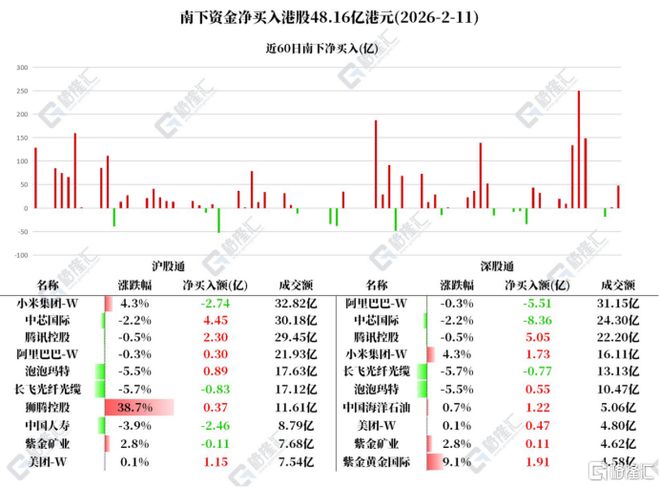
北水动向|北水成交净买入48.16亿 科网股再度分化 中芯国际(00981)绩后遭抛售
智通财经网· 2026-02-11 10:05
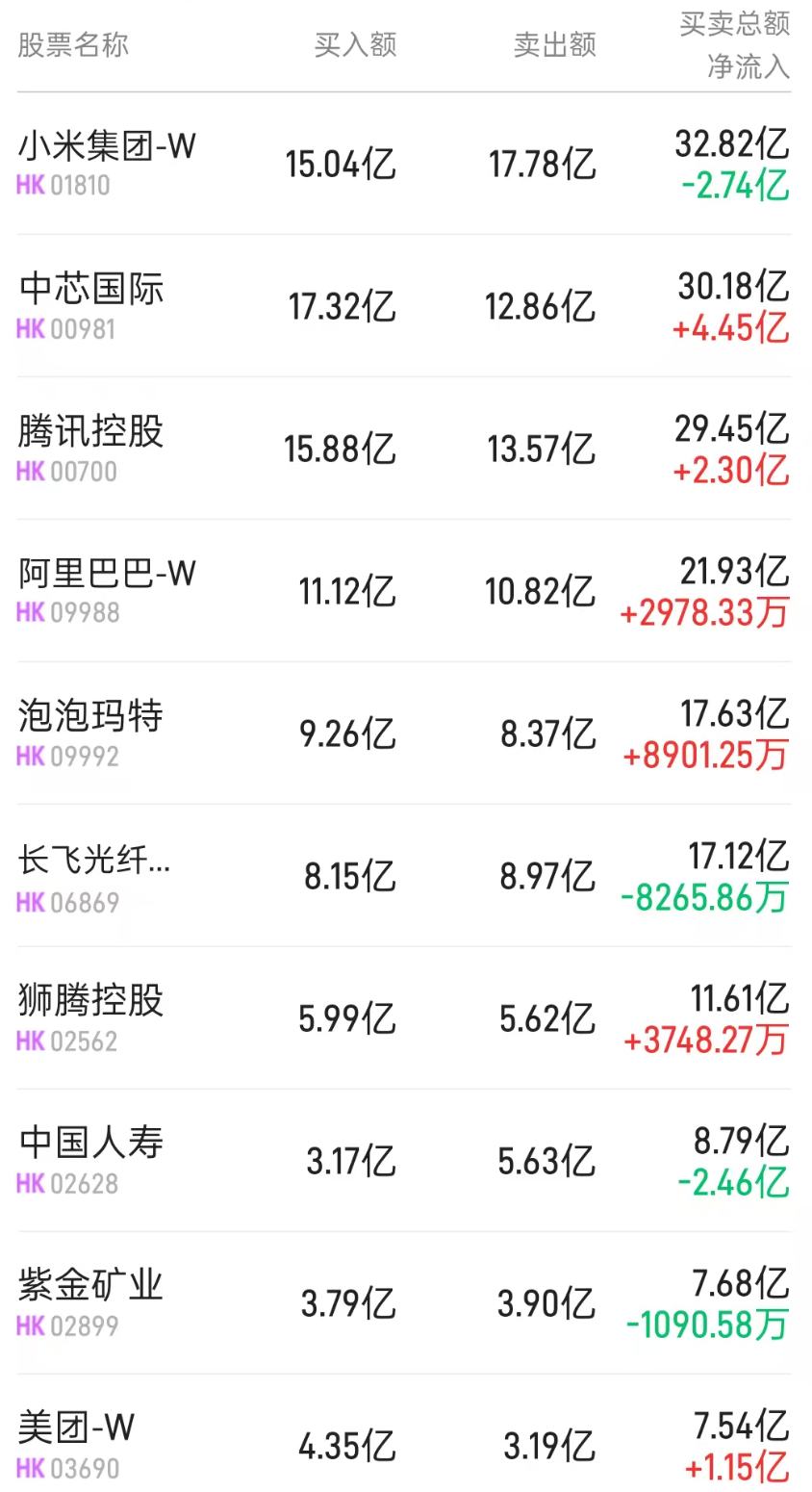
Group 1 - The Hong Kong stock market saw a net inflow of 4.816 billion HKD from Northbound trading, with 2.824 billion HKD from Shanghai and 1.992 billion HKD from Shenzhen [1] - The most bought stocks included Tencent (00700), Zijin Mining International (02259), and Meituan-W (03690), while the most sold stocks were Alibaba-W (09988), SMIC (00981), and China Life (02628) [1] Group 2 - Xiaomi Group-W had a net inflow of 15.04 million HKD, while SMIC experienced a net outflow of 17.32 million HKD [2] - Tencent Holdings saw a net inflow of 15.88 million HKD, and Alibaba-W had a net outflow of 11.12 million HKD [2] Group 3 - China Life faced a net outflow of 3.17 million HKD, while Meituan-W had a net inflow of 4.35 million HKD [3] - The net inflow for Zijin Mining International was 3.25 million HKD, indicating positive market sentiment towards the company [4][5] Group 4 - Meituan announced plans to acquire Dingdong Group's "Dingdong Grocery" business for approximately 717 million USD, which is expected to enhance its market position in fresh food delivery [5] - Zijin Mining International's acquisition of joint gold assets is projected to increase its gold production at a compound annual growth rate of about 37% from 2025 to 2027 [5] Group 5 - China Life's net outflow is attributed to ongoing discussions about deposit migration, with expectations that a significant portion of deposits will remain in the banking system [6] - SMIC's revenue guidance for Q4 2025 is expected to exceed market expectations, while its gross margin guidance is slightly below market forecasts [6]


港股互联网ETF博时(159568)涨0.78%,成交额5348.45万元
Xin Lang Cai Jing· 2026-02-11 10:03
Core Viewpoint - The BoShi Hong Kong Internet ETF (159568) has shown positive performance since its inception, with significant increases in both share count and fund size in 2025 [1][2]. Fund Performance - As of February 11, 2024, the BoShi Hong Kong Internet ETF closed with a gain of 0.78%, with a trading volume of 53.48 million yuan [1]. - The fund was established on February 8, 2024, with a management fee of 0.50% and a custody fee of 0.10% [1]. - The latest share count is 324 million, with a total fund size of 539 million yuan, reflecting a 27.57% increase in shares and a 27.24% increase in size since December 31, 2025 [1]. Liquidity Metrics - Over the last 20 trading days, the ETF has accumulated a trading volume of 2.066 billion yuan, averaging 103 million yuan per day [1]. - In the year to date, the ETF has seen a total trading volume of 3.446 billion yuan over 28 trading days, averaging 123 million yuan per day [1]. Fund Management - The current fund manager, Li Qingyang, has managed the ETF since its inception, achieving a return of 66.36% during his tenure [2]. - The ETF's top holdings include Tencent Holdings (15.35%), Alibaba-W (14.43%), Xiaomi Group-W (13.96%), and Meituan-W (12.30%), among others [2].
图解丨南下资金净买入腾讯,净卖出阿里
Xin Lang Cai Jing· 2026-02-11 09:56
Group 1 - Southbound funds net bought Hong Kong stocks worth 4.816 billion HKD on February 11 [1] - Notable net purchases included Tencent Holdings at 735 million HKD, Zijin Mining International at 191 million HKD, Meituan-W at 162 million HKD, Pop Mart at 144 million HKD, and CNOOC at 122 million HKD [1] - Significant net sales were observed in Alibaba-W at 520 million HKD, SMIC at 390 million HKD, China Life at 246 million HKD, Yangtze Optical Fibre at 159 million HKD, and Xiaomi Group-W at 100 million HKD [1]