POP MART(09992)

Search documents
悦己、银发还是毛孩子?去进博会寻找下一个消费爆款
第一财经· 2025-11-09 05:10
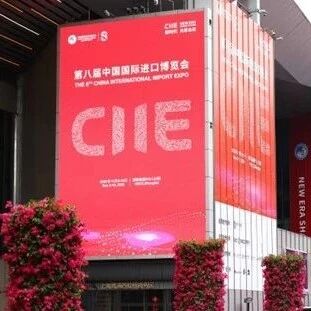
Core Insights - The article discusses the evolving consumer trends observed at the China International Import Expo (CIIE), highlighting a shift towards self-pleasure and emotional value in purchasing decisions, particularly in luxury goods and lifestyle products [5][10]. Group 1: Consumer Trends - The motivation for purchasing luxury goods has shifted from showcasing status to seeking personal happiness, with "self-pleasure" and "emotional value" becoming key drivers in consumer decision-making [5]. - The rise of the "pet economy" is evident, with a dedicated pet-themed exhibition area at CIIE, reflecting the growing demand for pet-related products and services [9]. - The trend of "active health management" is emerging, with consumers increasingly seeking products that offer tangible health benefits rather than just marketing concepts [10]. Group 2: Company Innovations - Bulgari introduced "Connected Jewelry," allowing consumers to trace the origins and quality of gemstones, enhancing trust and experience [6]. - Pop Mart showcased immersive experiences with popular IPs, indicating a global trend towards emotional value in consumer products [7]. - LEGO created a "City Walk" experience at CIIE, emphasizing play as a universal language and appealing to both local and international audiences [8]. Group 3: Health and Wellness - Inne, a German nutrition brand, reported significant growth in children's nutritional products, indicating a shift towards proactive health management among consumers [10]. - The introduction of innovative health products, such as liquid calcium, reflects the changing focus from traditional supplements to more comprehensive health solutions [10]. - The demand for high-quality, personalized healthcare solutions is increasing, particularly among the aging population, as seen in the offerings from Edward Lifesciences [13][14]. Group 4: Aging Population - The CIIE highlighted the "silver economy," showcasing products designed for the elderly, including safety and wellness solutions [12]. - Companies are increasingly focusing on the unique healthcare needs of older adults, with innovations aimed at improving their quality of life [14]. - The introduction of AI-driven interactive robots for elderly care reflects the growing emphasis on emotional support and safety monitoring for seniors [14].



悦己、银发还是毛孩子?去进博会寻找下一个消费爆款
Di Yi Cai Jing· 2025-11-09 03:13
Group 1: Consumer Trends - The core consumer motivation has shifted from showcasing wealth to seeking personal happiness, with "self-pleasure" and emotional value becoming key drivers in purchasing decisions [2][3] - The pet economy is thriving, with the establishment of a dedicated pet-themed exhibition area at the expo, reflecting the growing demand for pet-related products and services [5] - The trend of "self-pleasure" and emotional value is also evident in the rise of immersive experiences and personalized products, as seen with brands like LEGO and Brother [4][6] Group 2: Health and Wellness - Consumers are increasingly proactive about health management, moving from passive responses to active engagement, as demonstrated by the success of innovative health products at the expo [7][8] - The demand for high-quality, effective health products is rising, with a notable increase in inquiries about clinical efficacy at the expo [7] - The introduction of new health products, such as liquid calcium for both mothers and infants, indicates a shift towards comprehensive health solutions [7] Group 3: Aging Population - The expo highlighted the "silver economy," showcasing products and services tailored for the aging population, including rehabilitation aids and home safety solutions [9][10] - Companies are focusing on personalized treatment options for age-related health issues, particularly in the field of cardiac care, to meet the unique needs of Chinese patients [10][11] - Innovations like interactive robots aimed at providing companionship and safety for the elderly reflect the growing attention to emotional and practical needs in the aging demographic [11]
Global Markets Grapple with Geopolitical Tensions and AI Fears as Toy Brands Eye Asia’s Next Big Craze
Stock Market News· 2025-11-08 12:08
Group 1 - Chinese toy manufacturers are rapidly expanding into Thailand, driven by the popularity of characters like Labubu from Pop Mart International Group, indicating a competitive landscape for identifying the next major toy craze in Southeast Asia [2][7] - Berkshire Hathaway is showcasing resilience in a volatile market, narrowing the performance gap with the S&P 500, highlighting the appeal of value and stability amid concerns over artificial intelligence [3][7] - Ongoing geopolitical instability, such as recent violence in the Gaza Strip, contributes to a climate of global uncertainty that can affect investor sentiment and market stability [4][7]

泡泡玛特(09992)员工在直播时对话引争议,股价昨跌5.88%
Xin Lang Cai Jing· 2025-11-08 06:04
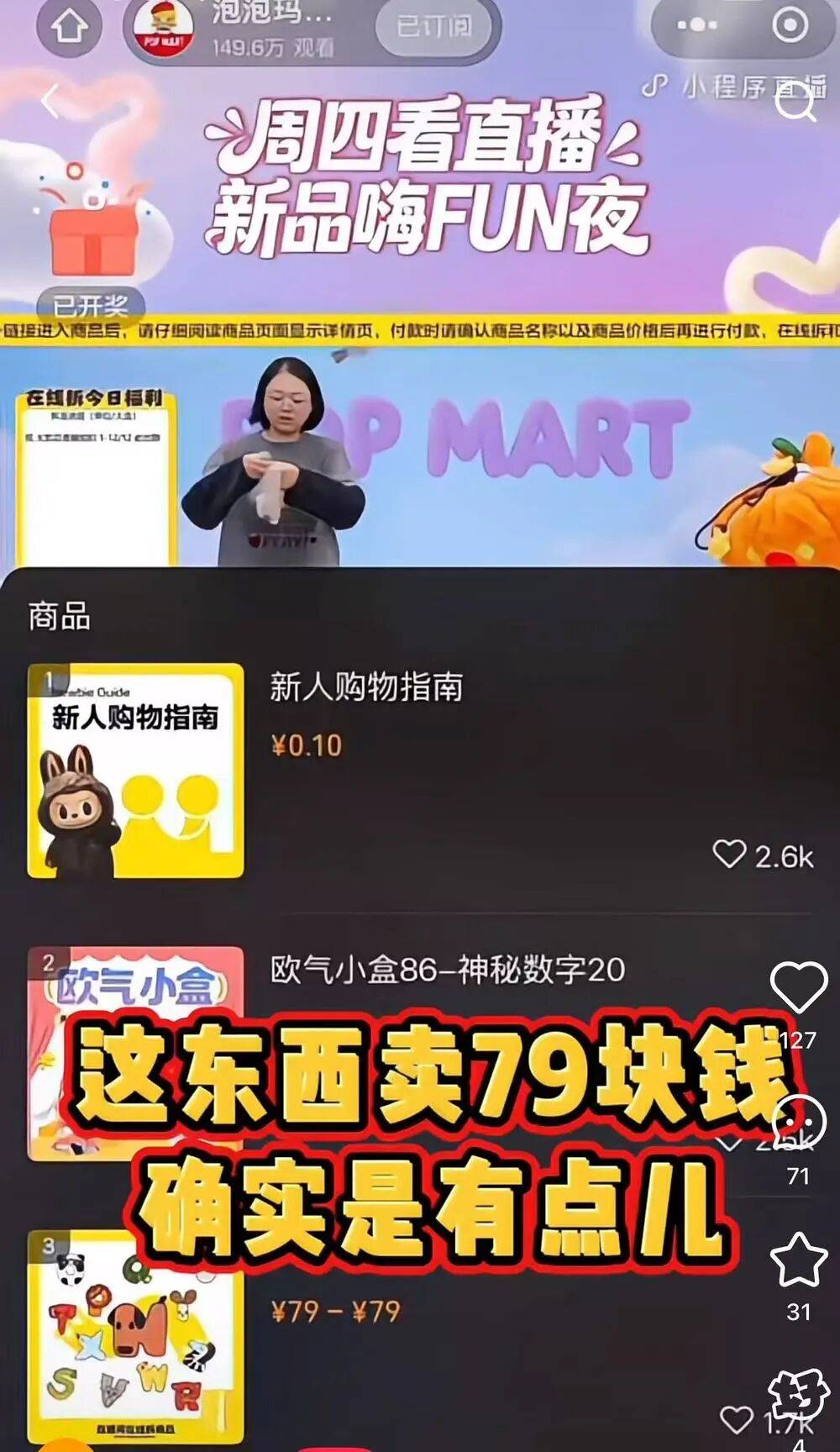
Core Viewpoint - The incident involving the accidental broadcast of a private conversation between two employees during a live stream has sparked discussions about the pricing rationality of Pop Mart's products, leading to a significant drop in the company's stock price by 5.88% on November 7 [3]. Group 1: Incident Details - During a live stream showcasing the DIMOO new diary series blind box, two employees were overheard discussing the price of a 79 yuan product, with one expressing that the price was "a bit excessive" [3]. - The male employee's response, "It's okay, someone will pay for it," was interpreted by many as a mockery of consumers, suggesting they are "suckers" who will buy the overpriced items [3]. Group 2: Market Reaction - Consumers are questioning the rationality of the pricing, with some stating that even employees find the prices high, while others express willingness to pay for the emotional value associated with the products [4]. - The incident has raised concerns among investors regarding the volatility of the brand's valuation, reflecting a potential impact on market sentiment [4]. Group 3: Company Response - Pop Mart's official customer service indicated that internal measures are being taken regarding the employees involved in the incident, and they are verifying the situation [4]. - As of now, there has been no notification regarding any adjustments to the price of the 79 yuan product mentioned during the live stream [4].
泡泡玛特直播翻车,最新回应
Huan Qiu Shi Bao· 2025-11-08 02:13
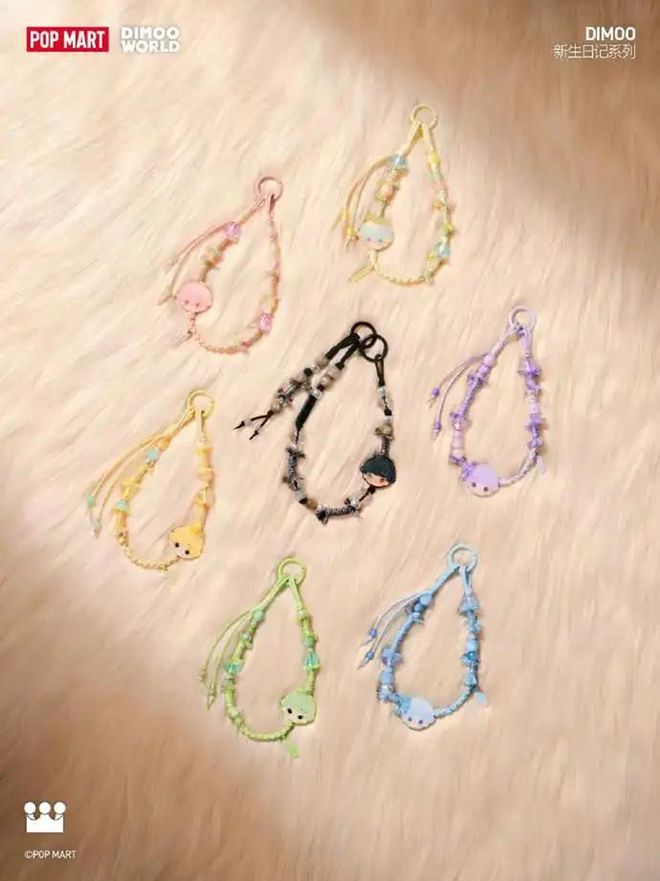
Core Points - A live streaming incident occurred during a broadcast by Pop Mart, where a staff member commented on the price of a DIMOO blind box, suggesting it was high, while another staff member implied that customers would still purchase it [2][4] - Pop Mart confirmed the incident and stated that an internal investigation is underway, but no employees involved will be dismissed [4] - The affected product is the newly launched "DIMOO New Birthday Diary Series - Pendant Blind Box," priced at 79 yuan per individual box and 474 yuan for a full set [5] Product Details - The DIMOO blind box series includes 6 regular items and 1 hidden item, with a probability of 1:6 for regular items and 1:72 for the hidden item [5] - Each blind box contains components such as zinc alloy pendants, polyester lanyards, resin figurines, and glass or acrylic accessories [7]

王宁身家达到1581亿元;泡泡玛特回应“卖79有点贵”直播事故;B站回应陈睿卸任哔哩哔哩总经理;山姆回应页面跳转色情网站丨邦早报
Sou Hu Cai Jing· 2025-11-08 01:15
Group 1 - The founder of Pop Mart, Wang Ning, has seen his wealth increase over three times to $22.2 billion (approximately 158.1 billion RMB), making him the member with the largest percentage increase on the 2025 Forbes China Rich List [1] - A recent live-stream incident occurred where employees commented on the price of a product, leading to public interpretation that it was derogatory towards consumers, despite the product selling out shortly after [1] - The hidden variants of the DIMOO series are being resold for nearly 500 RMB, indicating a significant markup of over six times the original price [1] Group 2 - Bilibili's Chen Rui has stepped down as general manager and financial officer of Shanghai Bilibili Technology Co., but the company stated that this change does not affect core management positions [3] - JD.com's founder Liu Qiangdong highlighted the high social logistics costs in China compared to developed countries, attributing it to excessive handling of goods, and expressed confidence that logistics costs could drop from over 14% of GDP to below 10% within five years [4] - Taobao Flash Sale is facing issues with a missing remark function due to system upgrades, and they are working to restore it [4] Group 3 - Tesla's Full Self-Driving (FSD) technology has only received partial approval in China, with full approval expected around February or March 2026 [6] - Chinese automotive brands have seen a 235% increase in sales in the UK, with notable entries in the top 10 imported models [6] - Alibaba's CEO Wu Yongming discussed the long timeline required to achieve "super artificial intelligence," emphasizing the stages of AI development [6] Group 4 - Meta is projected to earn about 10% of its total sales in 2024 from fraudulent online advertisements, amounting to approximately $16 billion (around 113.9 billion RMB) [7] - Samsung has produced 20,000 to 30,000 key components for its upcoming foldable phone, indicating a limited initial release [7] - Google plans to build a large AI data center on Christmas Island, Australia, with details about the project remaining confidential [7] Group 5 - Honda is recalling over 406,000 vehicles in the U.S. due to a manufacturing defect that could cause wheels to detach [10] - The eVTOL company completed a 300 million RMB B++ round of financing, marking its second round of financing in 2025 [10] - The gaming IP market in China is expected to reach 275.39 billion RMB by 2025, with a 2% year-on-year growth [12]




王宁身家达到1581亿元;泡泡玛特回应“卖79有点贵”直播事故;B站回应陈睿卸任哔哩哔哩总经理;山姆回应页面跳转色情网站丨邦早报
创业邦· 2025-11-08 01:09
Group 1: Pop Mart and Wang Ning's Wealth - Wang Ning, the founder of Pop Mart, saw his wealth increase over three times to reach $22.2 billion (approximately 158.1 billion RMB), making him the member with the largest percentage increase on the 2025 Forbes China Rich List [2] - A recent live-stream incident occurred where an employee commented that a product priced at 79 RMB was "a bit expensive," which sparked criticism regarding the company's perception of consumers [2][3] - Following the incident, Pop Mart's customer service stated that they are handling the matter internally and have not received any notification regarding price adjustments for the mentioned product [5] Group 2: Bilibili Management Changes - Chen Rui has resigned as the general manager and financial officer of Shanghai Bilibili Technology Co., Ltd., but the company clarified that this change does not affect the core management structure [6] Group 3: JD Logistics Insights - JD Group's founder Liu Qiangdong highlighted that the high social logistics costs in China were primarily due to excessive handling of goods, and he believes that these costs could drop from over 14% of GDP to below 10% within five years [6] Group 4: Automotive Market Trends - Chinese automotive brands saw a 235% increase in sales in the UK, with notable entries in the top 10 imported models, including Chery, BYD, and MG [8] - Honda has revised its forecast for automotive sales in the Asian market for the 2025/26 fiscal year to 925,000 units, down from a previous estimate of 1.09 million units [12] Group 5: E-commerce and Digital Trends - Alibaba's AliExpress app experienced a 181% increase in download growth in Japan, outperforming several local e-commerce platforms [16] - Meta is projected to earn approximately $16 billion (around 113.9 billion RMB) from fraudulent online advertisements in 2024, accounting for about 10% of its total sales [9] Group 6: New Technologies and Innovations - Several companies in the electric vertical takeoff and landing (eVTOL) sector, such as Shide Technology, have completed significant funding rounds, indicating a growing interest in this technology [11] - The global tablet market is expected to see a 5% year-on-year increase in shipments, driven by strong demand in regions like the Middle East and Central Europe [17]

智通ADR统计 | 11月8日
智通财经网· 2025-11-07 23:47
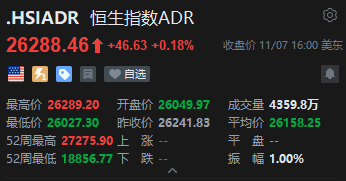
Market Overview - US stock indices showed mixed performance on Friday, with the Hang Seng Index ADR rising to 26,288.46 points, an increase of 46.63 or 0.18% compared to the Hong Kong close [1]. Major Blue-Chip Stocks - HSBC Holdings closed at 110.854 HKD, up 0.78% from the Hong Kong close; Tencent Holdings closed at 633.674 HKD, down 0.05% [2]. Stock Performance Summary - Tencent Holdings (00700) latest price: 634.000 HKD, down 10.000 HKD (-1.55%); ADR price: 81.480 USD [3] - Alibaba Group (09988) latest price: 160.100 HKD, down 4.900 HKD (-2.97%); ADR price: 166.340 USD [3] - HSBC Holdings (00005) latest price: 110.000 HKD, down 0.700 HKD (-0.63%); ADR price: 71.270 USD [3] - Xiaomi Group (01810) latest price: 42.240 HKD, down 1.200 HKD (-2.76%); ADR price: 27.000 USD [3] - AIA Group (01299) latest price: 81.500 HKD, up 0.300 HKD (0.37%); ADR price: 42.190 USD [3] - Meituan (03690) latest price: 102.000 HKD, down 1.300 HKD (-1.26%); ADR price: 26.270 USD [3] - JD.com (09618) latest price: 124.000 HKD, down 2.900 HKD (-2.29%); ADR price: 31.790 USD [3] - Kuaishou Technology (01024) latest price: 68.250 HKD, down 4.300 HKD (-5.93%); ADR price: 1.850 USD [3]





微软连跌8天 创14年来最长连跌纪录;央行连续12个月增持黄金;钟睒睒连续5年登顶内地首富丨每经早参
Mei Ri Jing Ji Xin Wen· 2025-11-07 23:03
Group 1 - The Chinese government has announced export control measures on five categories of materials, including rare earths and lithium batteries, effective from November 8 [3] - The U.S. stock market ended mixed, with the Nasdaq down 0.21% and the S&P 500 up 0.13%, marking a cumulative decline of 3.04% and 1.63% for the week respectively [5] - The European stock indices closed lower, with Germany's DAX down 0.78% and France's CAC40 down 0.18% [6] Group 2 - The State Council of China issued an implementation opinion to accelerate the cultivation of application scenarios for new technologies and products, focusing on five key areas [7] - The People's Bank of China increased its gold reserves by 30,000 ounces in October, marking the 12th consecutive month of gold accumulation [7] - The Ministry of Finance outlined six key areas for fiscal policy execution, including boosting consumption and supporting employment [11] Group 3 - The Dutch government expects ASML China to soon resume chip supplies, following constructive talks with China [19] - Tesla's CEO Elon Musk indicated that the Full Self-Driving (FSD) technology is expected to receive full approval in China by early 2026 [19] - The State Administration for Market Regulation guided eight e-commerce platforms to sign a self-regulation agreement on food safety management [20] Group 4 - Huadian Energy announced plans to invest 12.043 billion yuan in a wind power project, aligning with national industrial policies [27] - The company Shanshui Technology reported a change in its actual controller following a divorce settlement, with the new controller being Wu Xinyan [24] - Eighty-one Steel received a notice from the China Securities Regulatory Commission regarding an investigation into information disclosure violations [25]




泡泡玛特大跌近5%!最新回应直播“79块钱有点贵”翻车事故:正在调查,不会开除涉事员工
Sou Hu Cai Jing· 2025-11-07 18:49
Core Viewpoint - The recent incident involving a live broadcast at Pop Mart has sparked significant public discussion regarding the company's pricing strategy and consumer trust, particularly in light of internal comments that questioned the value of their products [4][6][7]. Group 1: Incident Overview - On November 7, Pop Mart's stock fell nearly 5% in early trading [1]. - Internal sources confirmed that a live broadcast incident occurred, leading to an urgent investigation, but no employees involved in the incident would be dismissed [4]. Group 2: Public Reaction - The incident has led to widespread discussion on social media, with terms like "Pop Mart," "DIMOO pendant," and "79 yuan" trending [7]. - Some consumers expressed that the company's internal comments about pricing were more damaging than external criticism, indicating a loss of trust [6][7]. - Others argued that the pricing is not unreasonable compared to similar products in the market, suggesting that the issue may stem from inadequate employee training regarding brand value [6][7]. Group 3: Business Model Implications - The "79 yuan pendant incident" touches on the core logic of Pop Mart's business model, which relies on high pricing and brand premium [6][7]. - The company's pricing strategy is seen as both a competitive advantage and a potential risk, as internal doubts about pricing could undermine consumer trust [6][7]. - Market observers noted that as long as consumers are willing to pay, the pricing logic holds, but internal skepticism raises questions about its sustainability [6][7].