
POP MART(09992)

Search documents
南向资金今日成交活跃股名单(9月19日)
Zheng Quan Shi Bao Wang· 2025-09-19 13:47
Core Insights - The Hang Seng Index closed flat on September 19, with southbound trading totaling HKD 153.72 billion, comprising HKD 81.78 billion in buying and HKD 71.94 billion in selling, resulting in a net inflow of HKD 9.84 billion [1] Trading Activity - Southbound trading through the Stock Connect (Shenzhen) recorded a total of HKD 55.47 billion, with buying at HKD 30.01 billion and selling at HKD 25.46 billion, leading to a net inflow of HKD 4.55 billion [1] - Southbound trading through the Stock Connect (Shanghai) saw a total of HKD 98.25 billion, with buying at HKD 51.76 billion and selling at HKD 46.48 billion, resulting in a net inflow of HKD 5.28 billion [1] Active Stocks - Alibaba-W was the most actively traded stock with a total transaction amount of HKD 115.81 billion and a net inflow of HKD 17.27 billion [1] - Other notable stocks included SMIC with a transaction amount of HKD 96.75 billion and a net inflow of HKD 9.30 million, and Sany Heavy Industry with a transaction amount of HKD 52.90 billion and a net inflow of HKD 22.40 billion [1][2] Continuous Net Buying - Alibaba-W and Meituan-W were among the stocks with the longest streak of net buying, with Alibaba-W seeing a total net inflow of HKD 57.83 billion over 21 consecutive days, while Meituan-W had a net inflow of HKD 5.75 billion over 5 days [2]





泡泡玛特(09992):Q4开店+旺季+新品+内容,经营趋势持续强势
Xinda Securities· 2025-09-19 13:31
Investment Rating - The investment rating for the company is "Buy" based on the strong performance and growth potential observed in the report [1]. Core Insights - The company is expected to continue its strong operational trends in Q4 with new store openings, seasonal demand, and product launches, indicating sustained growth momentum [2]. - The overseas expansion is accelerating, with a target of 200 stores by the end of the year, reflecting a significant increase from 140 stores reported mid-year [2]. - The company's IP ecosystem and supply chain optimization are strengthening its competitive barriers, with successful performance from key IPs and new product launches expected to drive sales [2]. - The financial forecasts indicate substantial growth in revenue and net profit over the next few years, with projected net profits of 112.8 billion, 166.2 billion, and 200.3 billion for 2025, 2026, and 2027 respectively [3][4]. Financial Summary - Revenue is projected to grow from 13.038 billion in 2024 to 59.496 billion in 2027, reflecting a compound annual growth rate (CAGR) of approximately 106.92% to 15.21% [3][4]. - The net profit is expected to increase significantly from 3.125 billion in 2024 to 20.032 billion in 2027, with growth rates of 189% and 21% in the respective years [3][4]. - Earnings per share (EPS) are forecasted to rise from 2.36 in 2024 to 14.92 in 2027, indicating strong profitability growth [3][4]. Key Financial Ratios - The company is expected to maintain a healthy return on equity (ROE) of 29.26% in 2024, increasing to 32.59% by 2027 [5]. - The debt-to-equity ratio is projected to decrease from 26.80% in 2024 to 19.27% in 2027, indicating improved financial stability [5]. - The current ratio is expected to improve from 3.63 in 2024 to 5.29 in 2027, reflecting strong liquidity [5].
智通港股通活跃成交|9月19日
智通财经网· 2025-09-19 11:02
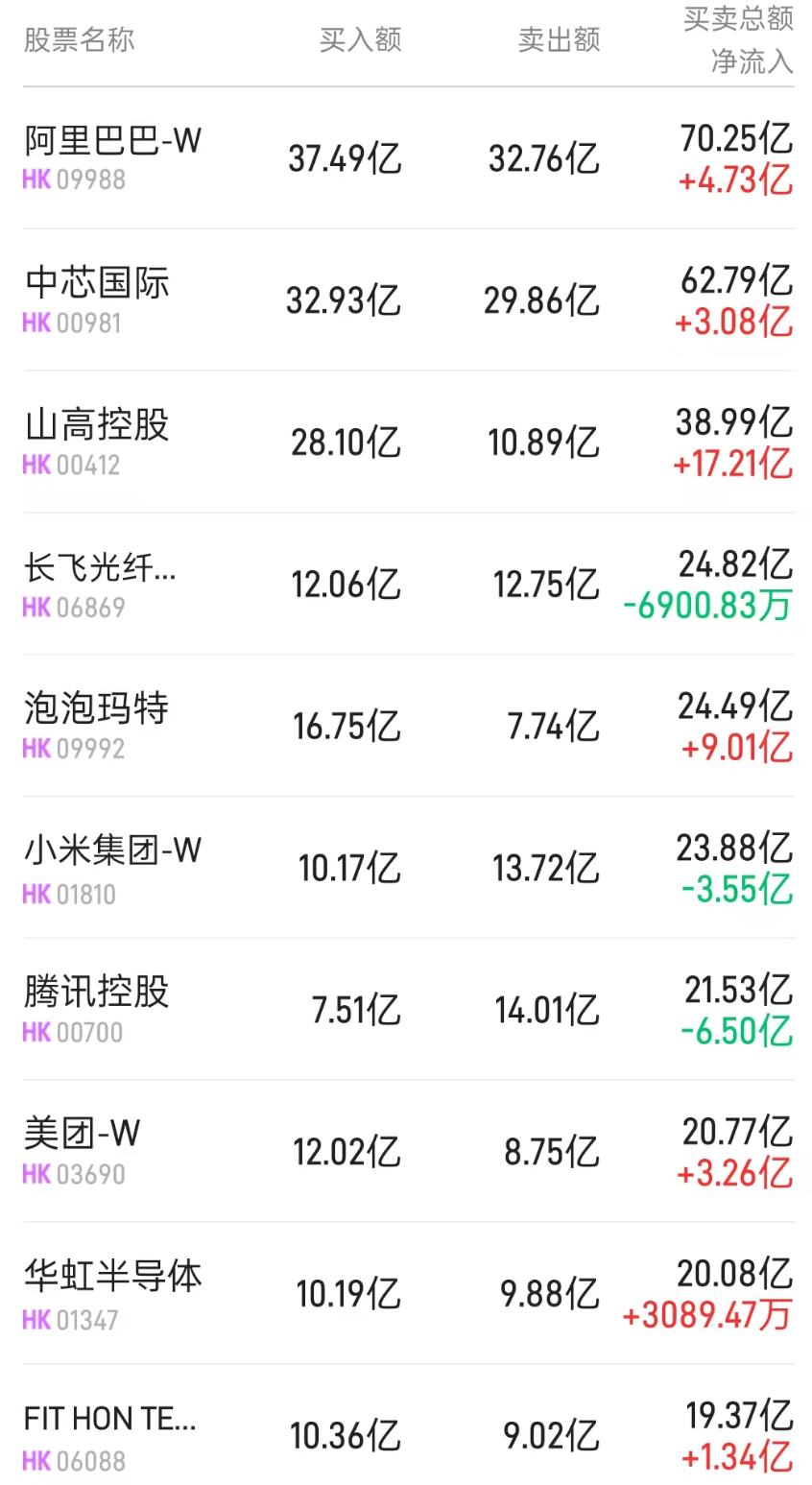
Core Insights - On September 19, 2025, Alibaba-W (09988), SMIC (00981), and Shankai Holdings (00412) were the top three companies by trading volume in the Southbound Stock Connect, with trading amounts of 70.25 billion, 62.79 billion, and 38.99 billion respectively [1] - In the Southbound Stock Connect for the Shenzhen-Hong Kong Stock Connect, Alibaba-W (09988), SMIC (00981), and Tencent Holdings (00700) also ranked as the top three, with trading amounts of 45.57 billion, 33.96 billion, and 15.89 billion respectively [1] Southbound Stock Connect (Hong Kong-Shanghai) - The top three active companies by trading volume were: - Alibaba-W (09988): 70.25 billion with a net buy of +4.73 billion - SMIC (00981): 62.79 billion with a net buy of +3.08 billion - Shankai Holdings (00412): 38.99 billion with a net buy of +17.21 billion [2] - Other notable companies included: - Changfei Optical Fiber (06869): 24.82 billion with a net sell of -69.08 million - Pop Mart (09992): 24.49 billion with a net buy of +9.01 billion [2] Southbound Stock Connect (Shenzhen-Hong Kong) - The top three active companies by trading volume were: - Alibaba-W (09988): 45.57 billion with a net buy of +12.54 billion - SMIC (00981): 33.96 billion with a net sell of -2.15 billion - Tencent Holdings (00700): 15.89 billion with a net buy of +27.91 million [2] - Other notable companies included: - Xiaomi Group-W (01810): 15.49 billion with a net sell of -43.27 million - Innovent Biologics (01801): 15.23 billion with a net sell of -37.09 million [2]

北水动向|北水成交净买入98.38亿 北水逢低抢筹山高控股(00412)超22亿港元
智通财经网· 2025-09-19 09:59
Core Insights - The Hong Kong stock market saw a net inflow of 98.38 billion HKD from Northbound trading on September 19, with the Shanghai Stock Connect contributing 52.83 billion HKD and the Shenzhen Stock Connect contributing 45.55 billion HKD [1] Group 1: Stock Performance - The most bought stocks included Shankai Holdings (00412), Alibaba-W (09988), and the Tracker Fund of Hong Kong (02800) [1] - The most sold stocks included Tencent (00700), Xiaomi Group-W (01810), and Yangtze Optical Fibre and Cable (06869) [1] Group 2: Individual Stock Details - Alibaba-W (09988) recorded a net inflow of 17.26 billion HKD, driven by positive news regarding its AI chip development [5] - Shankai Holdings (00412) received a net inflow of 22.4 billion HKD, with a focus on its public shareholding compliance [4] - Bubble Mart (09992) saw a net inflow of 9.01 billion HKD, with analysts suggesting that recent price adjustments do not indicate a decline in IP popularity [5] - Semiconductor stocks like Huahong Semiconductor (01347) and SMIC (00981) received net inflows of 2.37 billion HKD and 930.1 million HKD respectively, amid optimistic market outlooks [5] Group 3: Market Trends - The semiconductor sector is experiencing a rapid increase in interest, with companies like TSMC and SMIC providing positive forecasts [5] - The demand for AI-related products is expected to drive significant revenue growth for companies involved in AI server production, such as Hongteng Precision (06088) [6]

不止泡泡玛特,整个消费赛道都该为“情绪”疯狂
3 6 Ke· 2025-09-19 09:49
Group 1: Market Overview - In 2025, China's consumer market is experiencing a divergence, with traditional consumer goods showing weak growth while "emotional consumption" characterized by emotional connection, cultural identity, and immersive experiences is booming [1][4] - In the first half of 2025, the total retail sales of consumer goods reached 24,545.8 billion yuan, with a year-on-year growth of only 5.0% [1] - The retail sales of goods amounted to 21,797.8 billion yuan, growing by 5.1% [1] Group 2: Company Performance - Moutai, a representative of traditional high-end consumption, reported a revenue of 91.094 billion yuan in the first half of 2025, with a year-on-year growth of 9.16%, marking the first time in nearly a decade that its growth rate fell to single digits [1] - Pop Mart achieved a revenue of 13.88 billion yuan in the first half of 2025, with a remarkable year-on-year growth of 204.4% and an adjusted net profit of 4.71 billion yuan, up 362.8% [1] - Miniso's second-quarter revenue reached 4.97 billion yuan, growing by 23.1% year-on-year, while its subsidiary TOP TOY saw a revenue increase of 87.0% [2] Group 3: Consumer Trends - The rise of emotional consumption reflects a deep-seated desire for emotional comfort and cultural identity among consumers [4][5] - Consumers are shifting their spending from traditional goods to emotional products, indicating a change in consumption logic from "need" to "liking" and from "utility" to "emotion" [4][5] - The emotional consumption trend is not just limited to toys and jewelry but is also evident in various sectors, including tea beverages and snacks [18][20][23] Group 4: Emotional Consumption Dynamics - Emotional consumption is characterized by consumers being willing to pay for emotional experiences, social attributes, and identity recognition rather than just the products themselves [18] - The success of brands like Pop Mart and Lao Pu Gold illustrates the shift from functional attributes to emphasizing the emotional and cultural aspects of products [11][12] - The average overlap rate of Lao Pu Gold consumers with luxury brands like Louis Vuitton and Cartier is as high as 77.3%, indicating its entry into the high-end market [13] Group 5: Future Implications - The rise of emotional consumption is reshaping the entire consumption landscape, prompting brands to reassess their value creation strategies [25] - Companies that can accurately capture emotional needs and provide meaningful experiences are likely to thrive in this new consumption era [25]
大行评级丨花旗:泡泡玛特LABUBU转售价格下跌并非IP热度下降的迹象,重申“买入”评级
Ge Long Hui· 2025-09-19 05:32
Core Viewpoint - Citi's report indicates that the recent stock price correction of Pop Mart (9992.HK) is primarily due to market concerns over the declining resale prices of LABUBU, but does not reflect a decrease in IP popularity [1] Group 1: Market Concerns - The decline in LABUBU resale prices has raised concerns in the market [1] - Citi does not view this as a sign of diminishing IP heat [1] Group 2: Strategic Initiatives - The company is taking measures to replenish stock based on real demand, which is expected to enhance IP competitiveness in the long run [1] - Improvements in customer experience and efforts to curb resale activities are part of the company's strategy [1] Group 3: Investment Recommendation - Investors are encouraged to focus on sales trends, particularly the ongoing rapid sell-out phenomenon in the company's own channels [1] - Citi reaffirms a "Buy" rating and maintains a target price of HKD 398 [1]
泡泡玛特(9992.HK):二手价格波动带来布局机遇
Ge Long Hui· 2025-09-19 04:25
Core Viewpoint - The recent decline in Pop Mart's stock price, which has dropped nearly 25% from its peak on August 26, is primarily driven by market concerns over the second-hand prices of certain popular products and the sustainability of their popularity. However, the company believes that second-hand prices are not a reasonable indicator of popularity, as the current price adjustments are mainly driven by supply expansion rather than changes in demand [1][2]. Group 1: Supply and Demand Dynamics - The fluctuation in the second-hand prices of Labubu is attributed to increased supply rather than a decline in popularity, as evidenced by stable or increasing prices for products not affected by capacity changes [2]. - The company maintains a leading position in the artist IP toy market, with exclusive brand positioning and control over supply, which allows for a highly expandable product lifecycle [2]. - The balance of supply and demand is crucial for enhancing fan experience and mitigating the impact of counterfeit products [2]. Group 2: Product Innovation and Pricing Strategy - Recent product launches, such as Mini Labubu, have generated significant fan engagement and strong sales performance in North America, showcasing the company's ability to blend product and social play [3]. - The company has demonstrated flexibility in pricing strategies, as seen with the price increase of SP plush toys to 159 yuan, indicating strong pricing power in the rubber plush category [3]. - Upcoming quarterly results are anticipated to be positive, driven by pre-sale shipments and new product launches, with Q4 expected to benefit from the overseas peak season and anniversary series [3]. Group 3: Long-term Growth Drivers - The company is expected to see substantial growth in 2026, driven by rapid capacity expansion in plush products and a low base in the first three quarters [4]. - The global commercial value of the company's largest IP, The Monsters, has significant growth potential, with the top five IPs showing strong momentum [4]. - The company plans to expand its overseas store count to over 180 by 2025, enhancing brand influence through flagship store openings [4]. Group 4: Financial Forecast and Valuation - The company has raised its adjusted net profit forecasts for 2025-2027 by 14%/12%/12% to 116 billion, 170 billion, and 220 billion yuan, respectively, driven by capacity expansion and product upgrades [4]. - The target price has been increased by 14% to 396 HKD, maintaining a "buy" rating based on the company's high growth potential and expanding global IP influence [4].
港股早参丨英伟达豪掷50亿美元入股英特尔;快手可灵AI推出全新数字人功能
Mei Ri Jing Ji Xin Wen· 2025-09-19 01:22
Market Overview - On September 18, Hong Kong's three major indices experienced a pullback, with the Hang Seng Index down 1.35% to 26,544.85 points, the Hang Seng Tech Index down 0.99% to 6,271.22 points, and the National Enterprises Index down 1.46% to 9,456.52 points. The tech sector saw a decline, while the semiconductor and robotics industries performed well, with Hua Hong Semiconductor rising over 8.5% and SMIC up over 2.5% [1] Southbound Capital - On September 18, southbound funds recorded a net inflow of HKD 62.88 billion, with Meituan, Alibaba, and Pop Mart receiving net purchases of HKD 14.12 billion, HKD 12.1 billion, and HKD 12.07 billion, respectively. Year-to-date, the cumulative net inflow of southbound funds has reached HKD 1,099.89 billion, significantly surpassing last year's total [2] U.S. Market Performance - U.S. stock indices reached new closing highs, with the Dow Jones up 0.27%, the S&P 500 up 0.48%, and the Nasdaq up 0.94%. Notable gains were seen in Caterpillar and NVIDIA, both rising over 3%. However, many Chinese concept stocks declined, with the Nasdaq Golden Dragon China Index down 1.79% [3] Key Developments 1. NVIDIA announced a USD 5 billion investment in Intel, purchasing shares at USD 23.28 each, a 6.5% discount to Intel's previous closing price [4] 2. At Huawei's Connect 2025 event, the company unveiled its Ascend chip roadmap, planning three series of chips through 2028, including the Ascend 950 series [4] 3. Kuaishou's Keling AI launched a new digital human feature, allowing users to create 1080p/48FPS videos from images and text or audio [4] Short Selling Data - On September 18, a total of 641 Hong Kong stocks were short-sold, with a total short-selling amount of HKD 37.879 billion. Alibaba, Baidu, and Tencent had the highest short-selling amounts, at HKD 47.94 billion, HKD 25.6 billion, and HKD 23.06 billion, respectively [5] Institutional Insights - Zheshang Securities highlighted the rapid development of AI applications in Hong Kong's internet sector, suggesting that the sector is at a historical low in valuation. The firm recommends focusing on leading internet companies with AI advancements, such as Alibaba, Baidu, and Tencent, as well as vertical application companies like Kuaishou and Meitu [6] Hong Kong ETFs - The Hong Kong Consumption ETF (513230) focuses on e-commerce and new consumption sectors, while the Hang Seng Tech Index ETF (513180) includes core AI assets and leading tech companies [7][8]


智通港股通持股解析|9月19日
智通财经网· 2025-09-19 00:31
Core Insights - The top three companies by Hong Kong Stock Connect holding ratios are China Telecom (71.75%), Gree Power Environmental (69.11%), and China Shenhua (68.06%) [1] - Alibaba-W, BeiGene, and China Pacific Insurance saw the largest increases in holdings over the last five trading days, with increases of +171.65 billion, +19.60 billion, and +15.85 billion respectively [1] - Xiaomi Group-W, Tencent Holdings, and Great Wall Motors experienced the largest decreases in holdings, with reductions of -13.16 billion, -12.81 billion, and -8.09 billion respectively [2] Hong Kong Stock Connect Holding Ratios - China Telecom (00728) has a holding of 9.959 billion shares, representing 71.75% [1] - Gree Power Environmental (01330) has a holding of 280 million shares, representing 69.11% [1] - China Shenhua (01088) has a holding of 2.299 billion shares, representing 68.06% [1] - Other notable companies in the top 20 include COSCO Shipping Energy (67.64%) and Kaisa New Energy (67.48%) [1] Recent Increases in Holdings - Alibaba-W (09988) saw an increase of +171.65 billion, with an addition of 10.836 million shares [1] - BeiGene (06160) increased by +19.60 billion, with an addition of 970.45 thousand shares [1] - China Pacific Insurance (02601) increased by +15.85 billion, with an addition of 512.87 thousand shares [1] Recent Decreases in Holdings - Xiaomi Group-W (01810) decreased by -13.16 billion, with a reduction of 2.314 million shares [2] - Tencent Holdings (00700) decreased by -12.81 billion, with a reduction of 199.52 thousand shares [2] - Great Wall Motors (02333) decreased by -8.09 billion, with a reduction of 4.667 million shares [2]
智通港股沽空统计|9月19日
智通财经网· 2025-09-19 00:24
Core Insights - The article highlights the top short-selling stocks in the market, with specific focus on their short-selling ratios and amounts [1][2][3] Short-Selling Ratios - The top three stocks by short-selling ratio are: - China Resources Beer (80291) at 100.00% - AIA Group (81299) at 89.92% - Sun Hung Kai Properties (80016) at 85.69% [1][2] Short-Selling Amounts - The leading stocks by short-selling amounts are: - Alibaba (09988) with a short-selling amount of 4.794 billion - Baidu (09888) with 2.560 billion - Tencent Holdings (00700) with 2.306 billion [1][3] Deviation Values - The stocks with the highest deviation values are: - China Resources Beer (80291) at 40.95% - Uni-President China (00220) at 39.40% - Dongfang Electric (01072) at 38.26% [1][2][3]
