DFAC(600006)

Search documents
汽车业“反内卷”进行时 | 供应商盼来“及时雨”,17家车企承诺“账期不超60天”
Bei Jing Shang Bao· 2025-06-11 11:09
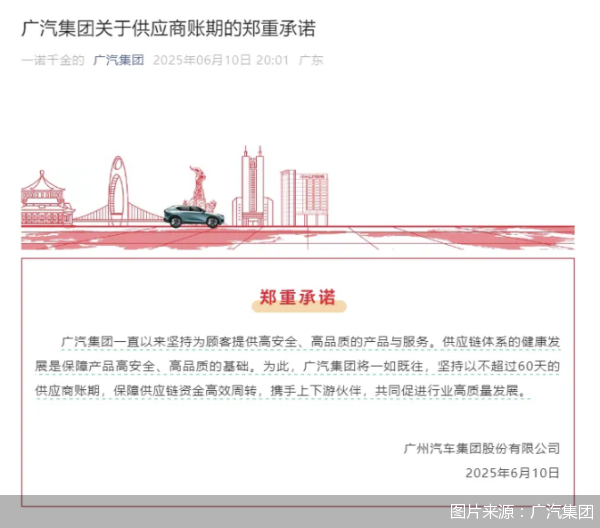
在政府相关部门整治汽车行业"内卷式"竞争背景下,各车企率先从解决供应商账期问题入手"反内卷", 推动上下游关系重构。6月10日晚,中国一汽、东风汽车、广汽集团、赛力斯集团等车企相继宣布,对 供应商的支付账期不超过60天。6月11日,比亚迪汽车、奇瑞汽车、小鹏汽车等多家车企跟进。据统 计,目前共有17家重点汽车生产企业作出相应承诺。在外界看来,政府相关部门与行业协会相继发声, 强化对"价格战"等无序竞争的监管,将推动汽车产业链向高质量的协同转型,而车企的"账期"自律则能 够进一步缓解供应链资金压力。 汽车"链"60天提现 在汽车行业"反内卷"背景下,众多车企开始破除上游供应商痛点。6月10日晚开始,中国一汽、东风汽 车、广汽集团和赛力斯集团相继发声,承诺将供应商支付账期压缩至60天以内,意在通过实际行动维护 市场经济秩序健康稳定。 此后,吉利汽车宣布,将旗下各品牌供应商账期统一压缩至60天以内,进一步提升产业链资金周转效 率,稳定产业链运作,并以行业领军企业身份推动整个行业的健康发展。同样作出承诺的还有长安汽 车,涵盖旗下长安启源、长安凯程、深蓝汽车、阿维塔等品牌,表示将统一执行60天付款账期,以履行 央企社会 ...






每日速递 | 国务院严令,锂电客户承诺“60天付款”
高工锂电· 2025-06-11 10:51
Group 1: Industry Developments - The State Council has mandated that automotive companies limit supplier payment terms to within 60 days to ensure efficient capital turnover in the supply chain, aiding collaborative development in the industry [2][3] - CATL has officially announced the mass production of its next-generation large-capacity energy storage cell, the 587Ah cell, which is expected to be produced at its Jining base in Shandong [4][5] - China Salt Lake has made significant progress with its 40,000 tons/year integrated lithium salt project in the Qaidam Basin, transitioning from construction to trial production [6][7] Group 2: Corporate Actions - Deyang Nano has announced plans to introduce strategic investors through a capital increase and share expansion for its subsidiary, Shenzhen Deyang Chuangyu New Energy Technology Co., Ltd. [8][9] Group 3: International News - Swedish battery manufacturer Northvolt is set to halt production at its last factory in northern Sweden by the end of June if it fails to find a buyer amid bankruptcy proceedings [10][11] - Zimbabwe's Minister of Mines announced a ban on lithium concentrate exports starting in 2027 to promote local processing [12]




电池企业重大利好!车企承诺“60天付款”
起点锂电· 2025-06-11 10:30
Core Viewpoint - The implementation of the revised "Regulations on Payment of Funds for Small and Medium-sized Enterprises" by the State Council aims to shorten the payment period for suppliers to within 60 days, which has been positively received by multiple automotive companies, potentially improving supply chain efficiency and collaboration [2][6][7]. Group 1: Automotive Industry Response - Over ten automotive companies, including GAC Group, FAW Group, and BYD, have committed to reducing supplier payment terms to within 60 days, marking the beginning of a significant shift in the automotive industry's payment practices [3][4]. - The average payment cycle for domestic automotive companies has deteriorated from approximately 45 days a decade ago to much longer periods due to intensified competition and market pressures [6]. - The collective response from major automotive manufacturers is seen as a resistance to "involution" in the industry, with leaders publicly criticizing the negative impacts of price wars and extended payment terms [6][7]. Group 2: Impact on Suppliers - Shortening payment terms is expected to benefit suppliers by allowing quicker access to funds, thereby reducing operational risks and enabling faster production scale-up and product iteration [8]. - However, this shift may pose challenges for automotive companies with poor cash flow management, potentially leading to the elimination of weaker players in the market [8]. Group 3: Battery Industry Implications - The commitment to a 60-day payment term is particularly significant for the battery supply chain, where battery costs account for 30% to 40% of the total vehicle cost [12]. - The current lithium battery industry is facing challenges such as increased accounts receivable and extended customer payment cycles, impacting even leading companies like CATL [13][14]. - The new payment terms could enhance cash flow for battery suppliers, especially smaller firms, and foster deeper partnerships between automakers and battery manufacturers, promoting innovation and new business models [16].




零公里二手车,拿捏所有车企
Ge Long Hui· 2025-06-11 10:28
Core Viewpoint - The Chinese automotive market is experiencing severe supply-demand imbalance and negative effects from price wars, leading to distorted business practices among listed car companies [2][4][12]. Group 1: Market Dynamics - The average sales growth rate in China's domestic automotive market over the past three years is only 1.8%, with profit margins continuously declining [4][11]. - The phenomenon of "0-kilometer used cars" has emerged, where new cars are registered and then sold as used cars to alleviate inventory pressure and meet sales targets [6][9]. - The automotive industry is facing a significant overcapacity issue, with many listed companies reporting utilization rates below 50% [13][25]. Group 2: Industry Practices - Some car manufacturers and dealers engage in practices such as "virtual invoicing" to obtain subsidies, contributing to a culture of financial manipulation [6][9]. - The trend of selling "pseudo-used cars" at steep discounts (up to 30% off) is prevalent, indicating a hidden price war within the industry [7][9]. - The competitive landscape has led to a "winner-takes-all" scenario, forcing traditional automakers to downsize and restructure [15][16]. Group 3: Regulatory Response - The Ministry of Commerce has initiated discussions with major car manufacturers regarding the "0-kilometer used car" issue and is working to regulate market practices [4][22]. - There is a call for stricter regulations to address the ongoing price wars and restore healthy competition in the automotive sector [22][26]. - The government is promoting initiatives like the "2025 New Energy Vehicles Going to the Countryside" program to stimulate demand and help manufacturers reduce inventory [26][27]. Group 4: Future Outlook - The automotive industry is expected to undergo a "淘汰赛" (elimination race) in the second half of the year, which may further impact weaker companies [16]. - Despite the challenges, there are potential benefits from government initiatives aimed at boosting sales of new energy vehicles [26]. - The overall production capacity in China may exceed 50 million units, while the global automotive production is around 90 million units, highlighting a significant structural overcapacity [23][25].



一汽/东风/长安/北汽/江淮/比亚迪等密集官宣!商用车行业或迎巨变
第一商用车网· 2025-06-11 08:56
Core Viewpoint - Major Chinese automotive groups have collectively announced a reduction in supplier payment terms to within 60 days, driven by the revised "Regulations on Payment for Small and Medium-sized Enterprises" set to take effect on June 1, 2025, which mandates large enterprises to pay within 60 days of delivery [1][35]. Group Summaries China FAW Group - China FAW Group emphasizes responsibility by optimizing internal procurement and financial settlement processes, ensuring timely payments within 60 days, and enhancing efficiency through digital monitoring of payment processes [2]. Dongfeng Motor - Dongfeng Motor has unified its payment terms to within 60 days to support the healthy development of small and medium-sized enterprises and promote efficient capital flow within the industry [5][6]. Changan Automobile - Changan Automobile has committed to a 60-day payment term for suppliers, aiming to enhance collaboration and support high-quality industry development [8]. BAIC Group - BAIC Group has announced strict adherence to a 60-day payment term, eliminating unreasonable settlement methods that increase financial pressure on suppliers [11]. GAC Group - GAC Group maintains a commitment to a maximum 60-day payment term to ensure efficient capital turnover and support high-quality industry development [15]. SAIC Motor - SAIC Motor has pledged to unify payment terms to within 60 days, avoiding methods that increase supplier financial pressure, thereby promoting sustainable development in the automotive industry [18]. Jianghuai Automobile - Jianghuai Automobile has committed to a 60-day payment term and is optimizing its internal processes through digital management for efficient capital turnover [21]. Geely Automobile - Geely has announced a unified payment term of 60 days to enhance capital turnover efficiency and stabilize the supply chain [23]. BYD - BYD has committed to a 60-day payment term, focusing on technological innovation and management optimization to support the automotive industry's sustainable development [27]. Chery Automobile - Chery has decided to implement a 60-day payment term to improve capital turnover efficiency and foster a fair and healthy market environment [29]. Great Wall Motors - Great Wall Motors has unified its payment terms to 60 days to ensure supply chain stability and promote fair competition and innovation within the industry [31]. Conclusion - The collective announcements from major automotive groups reflect a strong commitment to "anti-involution," "promoting high-quality development," and "healthy development of the industry chain," indicating a pressing desire for high-quality growth and stability in the automotive sector [35].
【新能源周报】新能源汽车行业信息周报(2025年6月2日-6月8日)
乘联分会· 2025-06-11 08:32
Industry Information - The Ministry of Industry and Information Technology (MIIT) will intensify efforts to regulate "involution" competition in the automotive industry, emphasizing the need for fair market practices and discouraging price wars that harm product quality and consumer rights [9] - As of May 31, 2025, the number of applications for the vehicle trade-in subsidy reached 4.12 million, contributing to a total sales volume of 1.1 trillion yuan across five categories of consumer goods [10] - The 2025 (Third) Future Automotive Pioneer Conference was held, focusing on innovation and the need for automotive companies to prioritize R&D investment and product differentiation to escape the current competitive predicament [11] - A strategic partnership was formed between Pony.ai and Shenzhen Xihu Group to develop an autonomous driving service fleet in Shenzhen, aiming to enhance the safety of vehicle operations [11] - The 2025 Guangdong-Hong Kong-Macao Greater Bay Area Auto Show is expected to achieve sales of 4 billion yuan, with a significant increase in visitor numbers compared to the previous year [12] Policy Information - The Indian government announced a new electric vehicle policy allowing companies to import electric vehicles at a 15% reduced tariff, provided they invest in local manufacturing [9] - The Ministry of Industry and Information Technology and other departments launched the 2025 New Energy Vehicle Rural Promotion Campaign, aiming to enhance the market presence of electric vehicles in rural areas [15] - The Sichuan Province issued a long-term development plan for the hydrogen energy industry, targeting significant advancements in technology and infrastructure by 2027 [29] - The Anhui Province implemented a new time-of-use electricity pricing policy for industrial and commercial users, effective July 1, 2025 [25] Company Information - Huawei's autonomous driving system recorded a total mileage of 3.173 billion kilometers by the end of May 2025, indicating significant user engagement with the technology [17] - Ideal Auto has established over 2,400 supercharging stations, leading the industry in self-built high-speed charging stations [42] - NIO added 50 battery swap stations in May 2025, expanding its network to cover major urban areas [44] - Tesla has entered the "New Energy Vehicle Rural Promotion" initiative for the first time, indicating a strategic shift to target lower-tier cities and rural markets in China [47] - BYD's new model, the Seal 06EV, was launched at the 2025 Chongqing Auto Show, priced at 109,800 yuan [8]
汽车界大事件来了
IPO日报· 2025-06-11 06:31
Core Viewpoint - The recent decision by major Chinese automotive companies to unify supplier payment terms to within 60 days is a significant step towards stabilizing the supply chain and promoting healthy development in the automotive industry [2][4]. Group 1: Industry Changes - Major automotive companies, including BYD, Changan, FAW Group, Dongfeng, and GAC, have announced a unified payment term of no more than 60 days for suppliers, aligning with the new regulations set to take effect on June 1, 2025 [2]. - The average payment term for Chinese automotive companies was previously around 182 days, with some exceeding 270 days, forcing suppliers to finance their operations for up to a year [2][3]. Group 2: Financial Implications - Shortening the payment term from 180 days to 60 days will enhance the cash flow efficiency for suppliers by 200%, significantly alleviating their financial pressure and reducing the need for borrowing [5]. - The high debt levels of many Chinese automotive companies, with some owing suppliers billions, may create short-term financial strain as they commit to the new payment terms [5]. Group 3: Industry Dynamics - The move to shorten payment terms is seen as a necessary measure to foster healthy competition and development within the automotive supply chain, shifting the focus from cost-cutting to innovation and efficiency [5]. - The automotive industry has been characterized by unhealthy practices, including the exploitation of suppliers through extended payment terms, which has led to financial distress for some suppliers [3][4].

车圈供应商天亮了:账期缩至60天,五大车企同日官宣
Xin Lang Cai Jing· 2025-06-11 05:39
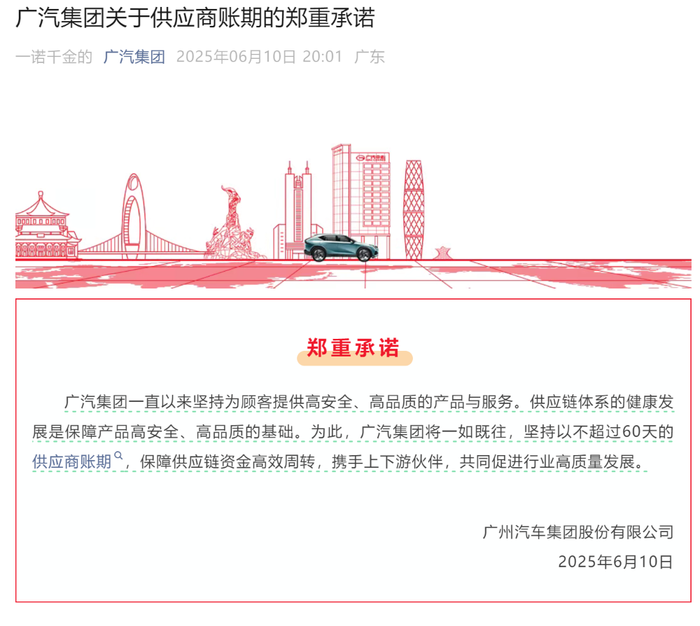
Core Viewpoint - The automotive industry is entering a significant phase of reducing payment terms to suppliers, with multiple major companies committing to a maximum payment period of 60 days to enhance supply chain efficiency and support high-quality industry development [1][19]. Group 1: Company Announcements - GAC Group announced a commitment to maintain supplier payment terms within 60 days to ensure efficient capital turnover and promote high-quality development in the industry [1]. - China FAW Group emphasized its role as a major state-owned enterprise, viewing suppliers as close partners and committing to a 60-day payment term to support market stability and high-quality development [5][7]. - Dongfeng Motor Corporation declared its alignment with national policies to support small and medium enterprises by standardizing payment terms to 60 days [8][11]. - Seres Group responded to the automotive industry's call for fair competition and healthy development, stating that it has always adhered to a 60-day payment term with suppliers [12][13]. - Geely Auto Group announced its commitment to a 60-day payment term to enhance capital turnover efficiency and stabilize the supply chain, in response to national regulations [16][19]. Group 2: Regulatory Context - The State Council's revised "Regulations on Ensuring Payment to Small and Medium Enterprises" stipulates that large enterprises must pay small and medium enterprises within 60 days of delivery, aligning with the commitments made by the automotive companies [21]. - The China Automotive Industry Association's recent initiative highlighted the negative impact of price wars on the industry, reinforcing the need for timely payments to maintain supply chain stability [21][22].

汽车业“反内卷”进行中,比亚迪、小米等官宣“60天账期”
华尔街见闻· 2025-06-11 05:13
作出"支付账期不超过60天"承诺的车企不断扩围。 在政府发力整治汽车行业"内卷式"竞争的背景下,10日晚, 一汽、东风、广汽、赛力斯 四家车企发表声明称,承诺将支付账期控制在60天以内。 10日晚23时许, 吉利汽车集团 对外宣布,将供应商支付账期统一至60天内,以加速产业链资金周转效率,保障产业链供应链稳定,发挥领军企业担当,促进 汽车产业高质量发展。 23时30分左右, 长安汽车 发表声明称, 携旗下长安启源、长安凯程、深蓝汽车、阿维塔向行业宣布,将供应商支付账期统一至60天内,以切实行动践行央企 社会责任。 11日凌晨1时28分, 比亚迪 宣布跟进,承诺将供应商支付账期统一至60天内。 比亚迪在声明中表示,将以切实行动推动中国汽车产业高质量发展,并继续通过技术创新与管理优化,携手上下游伙伴共同推动中国汽车产业行稳致远。 随后,"比亚迪宣布60天内付款""账期不超过60天意味着什么"等词条登上微博热搜。 上午7时58分, 奇瑞集团 也发文宣布跟进,承诺将账期统一至60天内,践行企业担当,促进汽车产业高质量发展。 10时6分, 小米汽车 承诺,坚决落实国家及相关主管部门就促进汽车产业高质量发展、保障供应链稳 ...


冲上热搜!集体跟进,小米也来了
天天基金网· 2025-06-11 05:08
Core Viewpoint - Multiple automotive companies in China have committed to unifying their supplier payment terms to a maximum of 60 days, responding to national policies aimed at stabilizing the supply chain and promoting high-quality development in the automotive industry [1][15]. Group 1: Company Commitments - Xiaomi Auto has pledged to implement a 60-day payment term for suppliers to enhance supply chain stability and support high-quality development in the automotive sector [5]. - Geely Auto Group announced a similar commitment to unify supplier payment terms to 60 days, aiming to accelerate capital turnover efficiency within the industry [5]. - Changan Automobile, along with its subsidiaries, has also committed to a 60-day payment term to fulfill its social responsibility and support the efficient flow of funds for small and medium-sized enterprises [8]. - BYD has declared its intention to unify supplier payment terms to 60 days, aligning with national directives to stabilize the supply chain and promote the healthy development of small and medium enterprises [9]. - Chery Group has decided to implement a 60-day payment term starting June 10, to enhance capital turnover efficiency and ensure supply chain stability [11]. - XPeng Motors has committed to a 60-day payment term to support the healthy development of small and medium enterprises [13]. - BAIC Group has promised to strictly adhere to a 60-day payment term for all eligible partners, eliminating unreasonable settlement methods that increase cash flow pressure on suppliers [14]. - Leap Motor has reiterated its commitment to the "60-day payment" principle, ensuring efficient payment processes [14]. Group 2: Industry Response to National Policies - The automotive companies' unified commitment to a 60-day payment term is a proactive response to the State Council's revised "Regulations on Ensuring Payment to Small and Medium Enterprises" and the China Association of Automobile Manufacturers' initiative to maintain fair competition and promote healthy industry development [16][17]. - The revised regulations stipulate that large enterprises must pay small and medium enterprises within 60 days of delivery, emphasizing the importance of timely payments to support the financial health of smaller suppliers [17].