CSN(600029)

Search documents
刚刚,国航、厦航发年终奖了
Xin Lang Cai Jing· 2025-12-30 10:00
Core Viewpoint - The article discusses the year-end bonuses for various airlines in China, highlighting the amounts distributed to different employee categories and comparing them to previous years. Group 1: Air China (国航) - In 2024, Air China plans to distribute year-end bonuses as follows: approximately 50,000 for pilots flying around 700 hours, about 18,000 for non-frontline commercial staff, and between 10,000 to 15,000 for ground service staff, depending on salary and performance levels [2][6]. Group 2: Xiamen Airlines (厦航) - Xiamen Airlines has also issued year-end bonuses for 2024, which are higher than last year. The bonuses include around 12,000 for flight attendants, 20,000 for chief flight attendants, and a median of 30,000 for line maintenance technicians. Ground staff bonuses range from 10,000 to 30,000, with co-pilots receiving similar amounts [4][6]. Group 3: Industry Comparison - The article expresses a sentiment of envy towards state-owned enterprises and hopes that private airlines will also increase their bonuses to provide better benefits for employees during the festive season [5][6].




交通运输行业2026年投资策略:周期拐点渐显
Dongguan Securities· 2025-12-30 09:08
Investment Strategy Overview - The transportation industry is closely linked to the macroeconomic environment, with a weak overall performance in 2025, underperforming the CSI 300 index. Key segments like railways and highways have weakened due to style shifts, while logistics, aviation, and shipping have seen some support in the second half of the year from anti-involution and external demand factors, but still lag behind the market index. Looking ahead to 2026, domestic demand is expected to improve driven by anti-involution and major infrastructure projects, with recommendations to focus on (1) improved domestic express delivery competition and benefiting bulk supply chains from upstream price recovery, (2) growth in business and leisure demand potentially returning aviation airports to profitability, and (3) the high prosperity cycle of oil transportation [5][72]. 2025 Review - The transportation industry index showed a stable performance, with a cumulative increase of 1.55% as of December 29, 2025, but underperformed the CSI 300 index. The performance of sub-sectors varied, with aviation airports, shipping ports, railways, and logistics showing cumulative changes of 9.74%, 6.56%, -12.86%, and 6.34% respectively, all underperforming the CSI 300 index [13][14]. Aviation Sector - The aviation supply-demand landscape continues to improve, with aircraft utilization recovering to high levels. Domestic civil aviation demand has been steadily increasing, with passenger volume reaching new highs in the second half of 2025. The average daily utilization of aircraft in China was 8.7 hours as of November 2025, nearing pre-pandemic levels [18][21]. - The average ticket price has stabilized, with a peak passenger load factor of 87.5% in August 2025. The market supply-demand situation is tight, and further tightening could boost ticket prices [23][24]. - The supply side faces challenges with aircraft manufacturers struggling to restore production capacity, with Boeing and Airbus delivering significantly fewer aircraft than pre-pandemic levels. As of 2024, Boeing delivered 348 commercial aircraft, while Airbus delivered 766, both below their respective 2019 levels [25][26]. - The demand side is supported by policy initiatives that have revitalized business activities, with business line passenger volume increasing year-on-year in the first eight months of 2025 [34][36]. - Cost pressures are alleviated by declining oil prices, with WTI futures at $56.74 per barrel as of December 26, 2025, down 54.13% from peak levels. The strengthening of the RMB also reduces dollar-denominated debt burdens for airlines [40][43]. Oil Transportation Sector - The oil transportation industry is currently in a high prosperity cycle, with oil prices influenced by demand fluctuations and unexpected events. The BDTI index has seen an uptick, indicating potential for improved industry conditions [46][47]. - Short-term demand is driven by significant U.S. strategic petroleum reserve replenishment needs, while long-term demand is expected to stabilize globally. The IEA forecasts a growth of 2.5 million barrels per day in global oil demand from 2024 to 2030 [49][51]. - The supply side is characterized by tight compliance capacity, with sanctions on shadow fleets leading to a reduction in compliant shipping capacity. This is expected to gradually elevate oil transportation rates [56][57]. Bulk Supply Chain Sector - The bulk supply chain sector is transitioning from traditional trading and logistics models to integrated service provider models, enhancing resource control and operational efficiency. Leading companies are learning from international experiences to improve their market positions [60][63]. - The sector is currently fragmented, with a low market share for leading firms (CR5 at around 5%). As domestic companies consolidate, there is potential for increased market share and profitability [63][64]. - The anti-involution trend is expected to stabilize the PPI, benefiting bulk supply chains as they recover from price declines. The sector is poised to benefit from price rebounds and improved demand conditions [65][66]. Investment Recommendations - Maintain a market-weight rating for the transportation industry, with a focus on improving domestic demand and sector recovery in 2026. Recommended stocks include China National Aviation (601111), Southern Airlines (600029), and Xiamen Xiangyu (600057) [72][74].




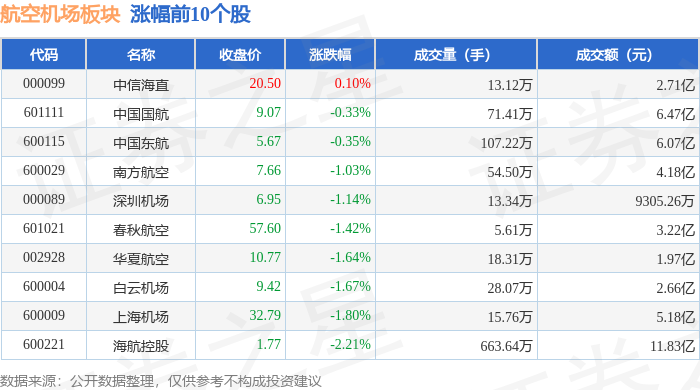
航空机场板块12月30日跌1.18%,吉祥航空领跌,主力资金净流出1.2亿元
Zheng Xing Xing Ye Ri Bao· 2025-12-30 09:00
Core Viewpoint - The aviation and airport sector experienced a decline of 1.18% on December 30, with China Southern Airlines leading the drop. The Shanghai Composite Index closed at 3965.12, down 0.0%, while the Shenzhen Component Index rose by 0.49% to 13604.07 [1]. Group 1: Stock Performance - The following stocks in the aviation and airport sector showed notable price changes: - China Southern Airlines (南方航空) closed at 7.66, down 1.03% with a trading volume of 545,000 shares and a transaction value of 418 million yuan [1]. - Xiamen Airport (厦门空港) closed at 17.48, down 2.35% with a trading volume of 100,200 shares and a transaction value of 176 million yuan [2]. - Spring Airlines (春秋航空) closed at 57.60, down 1.42% with a trading volume of 56,100 shares and a transaction value of 322 million yuan [2]. Group 2: Capital Flow - The aviation and airport sector saw a net outflow of 120 million yuan from institutional investors, while retail investors contributed a net inflow of 175 million yuan [2]. - The capital flow for specific stocks included: - China National Aviation (中国国航) had a net inflow of 46.13 million yuan from institutional investors, while retail investors had a net outflow of 47.90 million yuan [3]. - Xiamen Airport (厦门空港) experienced a net outflow of 26.25 million yuan from institutional investors, but a net inflow of 38.02 million yuan from retail investors [3].





国信证券:油汇改善利好航空板块 快递龙头竞争优势强化
智通财经网· 2025-12-30 03:59
Shipping Industry - The shipping market is experiencing a seasonal downturn, with oil shipping rates under pressure due to the holiday season and geopolitical tensions affecting supply [2] - Despite entering a low season, the oil shipping demand structure is improving, suggesting a potential upward trend in rates [2] - The container shipping market is expected to face significant pressure on rates by 2026 due to ongoing trade risks and the delivery of new capacity [2] Aviation Industry - Domestic passenger flight volumes have increased slightly, with overall and domestic flights up by 1.3% and 1.5% respectively compared to the previous week [3] - The average ticket price for economy class during the upcoming New Year holiday is projected at 597 yuan, reflecting a 1.1% decrease from 2024 but a 6.7% increase from 2025 [3] - The aviation sector is expected to benefit from a recovering domestic economy, with significant potential for earnings growth as supply constraints from aircraft manufacturers persist [3] Express Delivery Industry - The "anti-involution" policy has led to price increases in the express delivery sector, with most regions in China experiencing price hikes since July [4] - The profitability of express delivery companies is expected to improve in Q4 due to these price increases, despite a decline in overall package volume growth [4] - Companies like Zhongtong and Yuantong are outperforming the market, benefiting from a reduced reliance on low-cost packages [4] Investment Recommendations - The company recommends investing in growth-oriented value stocks and cyclical stocks at low price points, including Zhongtong Express, Yuantong Express, China Eastern Airlines, and others [5]




板块异动 | 多重因素推动 民用航空板块A+H股联袂拉升
Xin Lang Cai Jing· 2025-12-29 03:28
消息面上,据新华社12月27日报道,全国人大常委会会议12月27日表决通过新修订的民用航空法,自 2026年7月1日起施行。这部新修订的法律共16章262条,本次修法贯彻落实党中央决策部署,适应民航 事业发展新形势新要求,充实完善规范民用航空活动、保障民用航空安全和支持民航制造业、运输业、 低空经济发展的各方面制度措施,对于推动民航事业高质量发展具有重要意义。 来源:上海证券报·中国证券网 上证报中国证券网讯(记者 曾庆怡)12月29日上午,A股民用航空概念震荡上涨。截至10时11分,中国 国航涨超6%,中国东航、南方航空涨超3%。港股航空板块同步拉升,中国国航、中国东方航空股份涨 超3%,中国南方航空股份涨超2%。 上证报中国证券网讯(记者 曾庆怡)12月29日上午,A股民用航空概念震荡上涨。截至10时11分,中国 国航涨超6%,中国东航、南方航空涨超3%。港股航空板块同步拉升,中国国航、中国东方航空股份涨 超3%,中国南方航空股份涨超2%。 消息面上,据新华社12月27日报道,全国人大常委会会议12月27日表决通过新修订的民用航空法,自 2026年7月1日起施行。这部新修订的法律共16章262条,本次修法 ...
航空股早盘普涨 人民币汇率升值下航司汇兑压力缓解 航空将迎来假期催化
Zhi Tong Cai Jing· 2025-12-29 02:36
Group 1 - The core viewpoint of the article highlights a significant increase in airline stocks, driven by favorable market conditions and rising consumer demand for travel during the upcoming New Year holiday [1] Group 2 - Airline stocks experienced a morning surge, with China Southern Airlines rising by 1.97% to HKD 5.7, China Eastern Airlines increasing by 3.73% to HKD 5.29, and Air China climbing by 4.41% to HKD 7.1 [1] - The offshore RMB against the USD briefly surpassed the "7" mark, alleviating exchange rate pressure on airlines [1] - Data shows that as of December 25, domestic flight ticket bookings exceeded 2.71 million, representing a year-on-year increase of approximately 35% [1] Group 3 - The upcoming New Year holiday from January 1 to January 3, 2026, is expected to boost travel, with flexible holiday arrangements encouraging more consumers to travel [1] - Short-term expectations for the airline industry are positive, supported by declining oil prices, a strengthening RMB, and the upcoming holiday season, which is likely to enhance both volume and pricing [1]
国际市场快速修复,行业运行稳中提质—2025年航空运输行业回顾及展望
Sou Hu Cai Jing· 2025-12-28 10:29
Core Insights - The aviation transportation industry in China showed steady improvement in 2025, with domestic passenger and cargo markets growing steadily, international operations recovering rapidly, and policies guiding the industry towards standardized development [1][2][3] Industry Fundamentals - The macroeconomic environment in China has been stable, with GDP growth of 5.2% year-on-year in the first three quarters of 2025, and a similar increase in disposable income, providing a solid foundation for the aviation sector [5][6] - The aviation industry is cyclical and closely correlated with GDP growth, with a historical trend showing that as income levels rise, the growth rate of the aviation sector can be 1.5 to 2 times that of GDP [5] Industry Policy and Regulatory Environment - Policies since 2025 have focused on enhancing operational efficiency and expanding international markets, including revisions to international passenger rights allocation rules and the promotion of the "Belt and Road" initiative [6][7] - The "Self-Regulatory Convention for Air Passenger Transport" was introduced to curb unhealthy competition and promote high-quality service and operational standards [7] Industry Performance - In the first three quarters of 2025, the total transport turnover reached 1,220.3 billion ton-kilometers, a year-on-year increase of 10.3% [10] - Passenger turnover reached 10,536.5 billion passenger-kilometers, up 8.1%, with international routes growing by 23.5%, surpassing pre-pandemic levels [10][11] - Cargo turnover was 298.9 billion ton-kilometers, a 16.5% increase, driven by cross-border e-commerce and high-end manufacturing exports [11] Financial Health of Companies - Sample airlines reported overall profitability in 2025, with operating cash flow remaining positive, and major airlines like China Eastern Airlines turning net profits from losses [28][33] - The debt burden remains significant, but the structure is primarily long-term, with bond financing increasing by 114.17% year-on-year [43][44] Operational Efficiency - Airlines have improved operational efficiency, with daily aircraft utilization increasing to 9.2 hours and passenger load factors rising to 84.9% [28] - The introduction of new aircraft models like the Airbus A320neo and C919 has contributed to operational improvements, while older, less efficient models are being phased out [24] Sustainability Initiatives - Airlines are increasingly focusing on green operations, with efforts to reduce fuel consumption and carbon emissions through fleet upgrades and the adoption of sustainable aviation fuel (SAF) [39][40] - The implementation of SAF regulations in Europe is expected to raise operational costs, as SAF is currently 2 to 5 times more expensive than traditional jet fuel [20]


国际航线旅客周转亮眼,海外电商双十二GMV激增
GOLDEN SUN SECURITIES· 2025-12-28 08:15
Investment Rating - Maintain "Buy" rating for the transportation sector [5] Core Views - The international passenger turnover for October and November 2025 is expected to grow by 12.9% and 14.3% year-on-year compared to the same months in 2019, indicating a recovery in demand [1][2] - The average economy class ticket price for the New Year holiday in 2026 is projected to be 597 RMB, reflecting a 1.1% decrease from 2024 and a 6.7% increase from 2025 [1][2] - The logistics sector is benefiting from explosive growth in overseas e-commerce, with TikTok Shop's GMV in Southeast Asia increasing by 2.7 times during the "12.12" promotion [1][3] Summary by Sections Weekly Insights and Market Review - The transportation sector index rose by 1.37%, underperforming the Shanghai Composite Index by 0.51 percentage points [1][19] - The top three performing sub-sectors were shipping, public transport, and logistics, with increases of 4.70%, 4.65%, and 1.96% respectively [1][19] Air Travel - From January to November 2025, civil aviation passenger turnover reached 12,865.80 billion person-kilometers, a 19.6% increase compared to the same period in 2019 [2][12] - Domestic routes saw a 25.6% increase, while international routes grew by 3.6% [2][12] - The aviation sector is expected to maintain a positive outlook due to low supply growth and recovering demand, with a focus on business travel and international flight recovery [2][12] Shipping and Ports - The oil and dry bulk freight rates are experiencing a decline, with VLCC rates significantly dropping due to seasonal factors and lower-than-expected January loading volumes [3][13] - The dry bulk shipping index continues to fall, with a focus on the impact of new iron ore production and geopolitical developments [3][14] - The LNG transportation market is anticipated to follow a different cycle compared to larger vessels, with new projects in hydrogen production [3][16] Logistics - The logistics sector is focusing on two investment themes: overseas expansion driven by e-commerce growth and internal competition management amid slowing industry growth [3][17] - The express delivery volume showed a modest increase of 1.6% year-on-year in December, indicating a competitive landscape where leading companies are expected to gain market share [3][17]



交通运输产业行业研究:美国扣押委内瑞拉相关油轮,太平洋航运公告建造4 艘散货船
SINOLINK SECURITIES· 2025-12-28 05:36
Investment Rating - The report does not explicitly state an overall investment rating for the industry, but it recommends specific companies such as SF Express and China Southern Airlines based on their performance and market conditions [2][4]. Core Views - The express delivery sector shows a year-on-year growth of 5% in November, with some companies benefiting from price increases due to reduced competition. The total express delivery volume reached approximately 180.6 billion pieces, while revenue decreased by 3.7% to 137.65 billion yuan [2]. - In logistics, the chemical transportation prices remained stable, and the report recommends Haichen Co. for its focus on smart logistics and improved demand [3]. - The aviation sector experienced a slight increase in flight operations, with an average of 14,612 flights per day, reflecting a 1.79% year-on-year growth. The report anticipates profit elasticity for airlines due to supply constraints and rising ticket prices [4]. - The shipping sector indicates a mixed performance, with container shipping rates showing a slight increase, while dry bulk shipping rates have decreased. The report highlights the impact of geopolitical events on oil tanker operations [5]. - The road and rail sector shows stable performance, with highway freight traffic increasing by 2.02% week-on-week, and the Daqin Railway reported a 1.75% increase in freight volume [6][89]. Summary by Sections 1. Market Review - The transportation index rose by 1.3% during the week of December 20-26, underperforming the Shanghai Composite Index, which increased by 1.9%. The logistics sector had the highest gain at 5.5%, while the aviation sector saw a decline of 0.7% [1][13]. 2. Industry Fundamentals Tracking 2.1 Shipping and Ports - The report notes a slowdown in container shipping declines, with support from seasonal demand and long-term contracts. However, it warns of potential downward pressure on rates in January due to increased capacity [24]. - The export container shipping index (CCFI) was reported at 1,146.67 points, up 2.0% week-on-week but down 24.3% year-on-year [25]. 2.2 Aviation and Airports - The civil aviation sector saw a total passenger volume of 60.17 million in November, a 6% increase year-on-year, with domestic routes growing by 5% and international routes by 19% [58]. - The report highlights that airlines are expected to see significant profit increases in Q4 due to high load factors and rising ticket prices [58]. 2.3 Rail and Road - The report indicates that national railway passenger volume reached 331 million in November, a year-on-year increase of 8.94%, while freight volume was 460 million tons, up 1.16% [83]. - The highway freight traffic showed a slight increase, with a total of 55.44 million trucks passing through highways during the week of December 16-21 [89].

竞逐天空之城:低空经济中的高校作为、湾区协同与商业化落地
Nan Fang Du Shi Bao· 2025-12-27 09:21
Core Insights - A national-level technological achievement has been officially released, breaking the long-standing foreign monopoly and marking a significant step in the development of the low-altitude economy in the Guangdong-Hong Kong-Macao Greater Bay Area [1][21] - The conference highlighted the importance of mathematics and algorithms as foundational elements for advancing the low-altitude economy, emphasizing the need for collaboration among industry, academia, and research institutions [7][12] Group 1: Technological Breakthroughs - The "Flight Planning" project, led by Yao Zheng'an from Sun Yat-sen University, has achieved a major breakthrough in autonomous control of flight planning systems, which have been historically dominated by foreign companies [4][6] - The project introduced a "global four-dimensional flight route map" model and efficient algorithms, outperforming existing foreign systems in data validation with multiple airlines [6][12] - This achievement has led to the establishment of China's first set of group standards for civil aviation route planning, filling a gap in the industry and granting China the ability to set rules and standards [6][12] Group 2: Industry Challenges and Opportunities - The low-altitude economy faces numerous challenges, including dynamic airspace resource scheduling, flight vehicle coordination, and extreme weather response, all of which require complex system optimization [7][12] - Industry representatives discussed the need for government and enterprise collaboration to address regulatory hurdles and operational challenges in low-altitude operations, such as qualification approvals and airspace coordination [18][19] - The potential for commercial applications in agriculture and emergency services was highlighted, with suggestions for starting in less controversial areas to ease market entry [18][19] Group 3: Collaborative Frameworks - The establishment of the "Greater Bay Area Intelligent Low-altitude Economy Research Association" aims to create a closed-loop development model focusing on mathematics, algorithms, standards, and applications [21][23] - The conference emphasized the importance of integrating education, research, and industry to foster innovation and create a robust talent pipeline for the low-altitude economy [23] - Various universities in the Greater Bay Area are collaborating to develop specialized programs and research initiatives that support the low-altitude economy, emphasizing the need for interdisciplinary approaches [15][16][23]