
SAIC MOTOR(600104)

Search documents
6月新能源轻客销2.4万辆渗透率超61%!五菱/远程争冠 大通/江铃翻倍涨 | 头条
第一商用车网· 2025-07-23 06:58
Core Viewpoint - The new energy light commercial vehicle (NE LCV) market in China has shown a fluctuating trend in sales, with a cumulative growth of 14% in the first five months of 2025, indicating a strong recovery and potential for continued growth in the sector [1][11]. Market Performance - In June 2025, the NE LCV market sold 24,300 units, representing a month-on-month increase of 1% and a year-on-year increase of 10% [4][6]. - The sales trend for NE LCVs in the first half of 2025 has been characterized by alternating months of growth and decline, culminating in a total of 120,700 units sold, which is a 14% increase compared to the same period last year [11][25]. Market Penetration - The NE LCV market has achieved a penetration rate exceeding 60% in three out of the first five months of 2025, highlighting its position as the segment with the highest penetration of new energy vehicles in the commercial vehicle market [1]. Regional Insights - In the first half of 2025, all 31 provincial-level administrative regions in mainland China recorded NE LCV registrations, with Guangdong province leading with over 22,500 units, accounting for 18.68% of the national total [13][15]. Company Performance - In June 2025, Wuling maintained its position as the monthly sales champion with over 5,000 units sold, followed by Yuancheng and Changan, which also showed significant growth [19][23]. - The market share of Wuling and Yuancheng exceeded 10% in June, with Wuling holding 21.98% and Yuancheng 17.33% [23][29]. Sales Rankings - The cumulative sales rankings for NE LCVs in the first half of 2025 show that Wuling, Yuancheng, and Changan are the top three brands, with respective sales of 27,900 units, 20,700 units, and 15,100 units [27][29]. - The overall market performance indicates that most companies experienced growth, with significant increases noted for Wuling (92%), Jiangling (83%), and Guizhou Changjiang (73%) [27][29]. Future Outlook - The NE LCV market is expected to continue its growth trajectory, with the potential for further increases in sales and market penetration as the year progresses [31].





11家主流车企现金储备被江淮汽车“揭秘”
Xi Niu Cai Jing· 2025-07-23 06:01
Core Insights - The recent inquiry response from Jianghuai Automobile reveals the cash reserve status of domestic car manufacturers, indicating a median cash coverage of 3.82 months and an average of 3.46 months among 11 companies [2][5] Group 1: Cash Coverage Analysis - SAIC Motor leads with a cash coverage of 5.52 months, while Seres is at the bottom with only 0.89 months, highlighting significant financial pressure on companies like BYD and Great Wall Motors, which have less than 3 months of coverage [2][5] - Cash coverage months serve as a critical indicator of a company's ability to sustain daily expenses, with a recommended safety baseline of 3-4 months to cover fixed costs such as salaries and supplier payments [5] Group 2: Financial Health Indicators - GAC Group shows the best performance with the lowest debt-to-asset ratio of 47.61%, while Dongfeng shares a healthy ratio of 50.28% [6] - SAIC Motor, Changan Automobile, and Great Wall Motors maintain debt-to-asset ratios below 65%, indicating solid financial health, whereas BYD and Seres have higher ratios of 74.64% and 87.38%, respectively, with Seres experiencing a continuous increase over three years [6] Group 3: Market Outlook - Seres is projected to achieve a net profit of 2.7 billion to 3.2 billion yuan in the first half of 2025, reflecting a year-on-year increase of 66.20% to 96.98%, supported by strong order data for new models [5] - The inquiry response acts as a "mirror" revealing the true financial conditions of car manufacturers, emphasizing the need for leading companies to ensure sustainable long-term development rather than relying on superficial growth [6]




19家整车企业上榜《财富》中国500强,赛力斯、小鹏汽车提升超100名
Ju Chao Zi Xun· 2025-07-23 03:51
Group 1 - The 2025 Fortune China 500 list features 19 automotive companies, with significant rankings improvements, particularly among new energy vehicle manufacturers [2][3] - BYD rose from 40th to 27th place, indicating a strong market position and leadership effect [2] - Geely Group improved from 54th to 41st, showcasing its competitive strength in the market [2] Group 2 - New energy vehicle companies demonstrated remarkable growth, with significant advancements in technology and market penetration [3] - The overall ranking changes reflect a profound transformation in the Chinese automotive industry, with traditional manufacturers successfully transitioning to new energy [3] - The increasing investment and layout in the new energy sector by Chinese automotive companies suggest a stronger competitive edge in the global market [3]


金十图示:2025年07月23日(周三)全球汽车制造商市值变化
news flash· 2025-07-23 03:07
Core Insights - The article presents the market capitalization changes of global automotive manufacturers as of July 23, 2025, highlighting significant fluctuations in values among various companies [1]. Group 1: Market Capitalization Changes - Volkswagen's market capitalization is reported at $534.61 billion, experiencing a decrease of $4.96 billion [3]. - General Motors shows a market cap of $470.05 billion, with a notable increase of $41.54 billion [3]. - Maruti Suzuki's market value stands at $456.24 billion, reflecting an increase of $3.17 billion [3]. - Mahindra & Mahindra has a market cap of $452.89 billion, with a slight increase of $1.44 billion [3]. - Porsche's market capitalization is $448.37 billion, down by $5.08 billion [3]. - Ford's market value is $444.98 billion, decreasing by $4.77 billion [3]. - Honda's market cap is $414.68 billion, with an increase of $1.24 billion [3]. - Hyundai's market capitalization is $373.77 billion, down by $6.62 billion [3]. - Li Auto's market value is $320.88 billion, reflecting an increase of $3.52 billion [3]. - Kia's market cap is $295.88 billion, with a significant increase of $16.56 billion [3]. - SAIC Motor's market capitalization is $286.46 billion, up by $2.92 billion [3]. - Geely's market value stands at $243.58 billion, with an increase of $2.05 billion [3]. - Great Wall Motors has a market cap of $234.98 billion, reflecting an increase of $1.36 billion [3]. Group 2: Emerging Players - Xpeng Motors has a market capitalization of $181.1 billion [4]. - Rivian's market value is reported at $169.15 billion, with an increase of $5.04 billion [4]. - NIO's market cap stands at $110.07 billion, reflecting an increase of $10.76 billion [4]. - Leapmotor's market value is $89.23 billion, with a slight increase of $0.67 billion [4]. - VinFast Auto has a market capitalization of $83.73 billion, showing a minor increase of $0.23 billion [4].


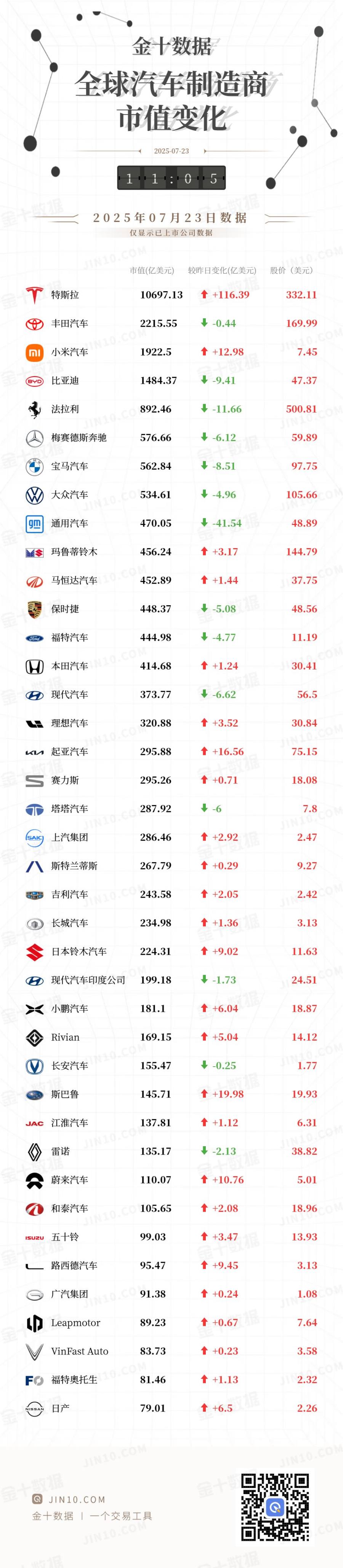
中国汽车欧洲造 选址是门大学问
Zhong Guo Qi Che Bao Wang· 2025-07-23 01:24
Core Insights - Chinese automotive companies are increasingly localizing production in Europe to mitigate tariffs and enhance market presence, with Changan Automobile planning to establish a factory in Europe [2][4][5] - The EU's recent decision to impose a maximum 35.3% anti-subsidy tax on electric vehicles produced in China has accelerated the need for local production among Chinese automakers [4][5] - Despite tariff challenges, Chinese car brands have seen significant sales growth in Europe, with a 110% year-on-year increase in May, reaching nearly 66,000 units sold [5][19] Localization Strategy - Local production helps avoid tariff barriers, reduces trade friction, and enhances brand recognition within the European automotive ecosystem [3][4] - Key factors for site selection include proximity to core consumer groups, local supply chain capabilities, government subsidies, and the availability of skilled labor [2][9][10] Market Dynamics - The market share of Chinese electric vehicle brands in Europe has risen to 5.9%, up from 2.9% a year earlier, indicating strong demand despite tariff pressures [5][19] - Major Chinese brands like BYD, Changan, and Geely are actively pursuing local production strategies, with BYD's factory in Hungary and Changan's plans for a new facility [2][4][5][12] Investment Approaches - Chinese automakers are employing different investment strategies, including "greenfield" investments (new factories) and "brownfield" investments (acquiring existing facilities) [6][9][16] - Hungary is emerging as a favored location for Chinese investments due to its favorable policies, established automotive supply chain, and strategic geographic position [10][11][12] Future Outlook - The ongoing negotiations regarding electric vehicle tariffs between China and the EU may lead to a shift towards a "minimum pricing" mechanism, potentially easing market entry for Chinese brands [6][19] - The long-term prospects for Chinese automotive companies in Europe remain positive, with expectations of continued growth and expansion despite current geopolitical and economic challenges [19]


欧洲新能源有望提速
Changjiang Securities· 2025-07-22 23:30
Investment Rating - The report maintains a "Positive" investment rating for the automotive and automotive parts industry [6]. Core Insights - The UK has restarted a new round of electric vehicle subsidies, covering electric cars priced below £37,000, with a maximum subsidy of £3,750 per vehicle and a total subsidy budget of £650 million, planned to last until 2028-2029. This initiative is expected to enhance the penetration rate of new energy vehicles in the UK [2][4][22]. Summary by Sections Event Description - On July 15, 2025, the UK Department of Transport announced a £650 million electric vehicle subsidy plan aimed at boosting consumer demand for electric vehicles to achieve net-zero emissions goals. The subsidy will be available for zero-emission vehicles starting from July 16, 2025, and will continue until 2028-2029 [4]. Market Performance - The UK has seen significant growth in electric vehicle adoption, with new energy vehicle sales reaching 275,000 units in the first five months of 2025, a year-on-year increase of 37.6%. The penetration rate of new energy vehicles in the UK is projected to reach 28.1% [9][13]. European Market Insights - In the first five months of 2025, new energy vehicle sales in Europe totaled 1.4 million units, reflecting a year-on-year growth of 25.0%. The penetration rate for new energy vehicles in Europe is at 20.5%, up by 4.5 percentage points [9][13]. Subsidy Impact - The new subsidy is expected to significantly boost the penetration rate of new energy vehicles among private car buyers in the UK. The average annual subsidy is estimated to support approximately 83,000 vehicles, accounting for 14.5% of the projected new energy vehicle sales in 2024 [22]. Recommendations - The report highlights that domestic companies such as BYD, SAIC, and Leap Motor are well-positioned to benefit from the UK subsidy, as their models fall within the subsidy criteria. Additionally, companies involved in the supply of new energy vehicle components in Europe are expected to show strong performance [22].
上汽集团,将推10万级半固态电池车型
DT新材料· 2025-07-22 16:03
Core Viewpoint - The article highlights SAIC Motor's strategic advancements in battery technology, particularly the introduction of the MG4 model featuring a semi-solid state battery, which marks a significant step towards achieving their solid-state battery goals. Group 1: MG4 Model and Battery Technology - The MG4 will be the first globally to mass-produce a semi-solid state battery, set to debut on August 5 with a starting price of under 90,000 yuan [1] - The new MG4 is equipped with a 70kWh semi-solid state battery developed in collaboration with Qingtao New Energy, containing only 5% liquid electrolyte, which is close to solid-state battery levels [1] - The energy density of the battery reaches 180Wh/kg, with a CLTC range of 537 kilometers, and a 13.8% improvement in low-temperature performance compared to traditional lithium iron phosphate batteries [1] Group 2: Three-Step Solid-State Battery Strategy - SAIC's strategy consists of three phases: 1. The first phase involves semi-solid products with a liquid content of 10% and energy density exceeding 300Wh/kg [2] 2. The second phase aims for quasi-solid products with 5% liquid content, utilizing new dry electrode technology and high-voltage cathode materials [2] 3. The final phase targets all-solid-state products with 0% liquid content, achieving a density exceeding 98% [2] - The first step was marked by the launch of the "first-generation light-year solid-state battery" in April 2024, which will be used in the Zhiji L6 model [2] Group 3: Future Projections - SAIC's President indicated that the first all-solid-state battery, named "Guangqi Battery," is expected to be launched by 2027, with a possibility of earlier production in 2026 [3] - The next generation of solid-state batteries is projected to have an energy density exceeding 400Wh/kg, a volumetric energy density over 820Wg/L, and a capacity exceeding 75Ah [3]
《财富》中国500强出炉:头部民营车企、新势力集体“升咖”
第一财经· 2025-07-22 15:19
Core Insights - The 2025 Fortune China 500 list highlights the significant rise of new energy vehicle (NEV) companies, showcasing a collective upward trend among firms like Seres, NIO, Xpeng, Li Auto, and the newcomer Leap Motor, indicating a vibrant industry [1][2] - The ranking is primarily based on companies' 2024 revenue, revealing a complex landscape of high revenue growth alongside profit declines and ongoing price wars [1][2] Group 1: New Energy Vehicle Companies - Seres achieved the largest ranking leap, moving from 404th to 169th, with revenue exceeding $20.177 billion, a remarkable increase of 298.5% [1] - Xpeng rose from 452nd to 351st, with revenue of $5.68 billion, up 31.1% year-on-year [2] - Li Auto's ranking improved slightly from 184th to 171st, with revenue of $20.077 billion, an increase of 14.8% [2] - NIO moved from 312th to 269th, with revenue of $9.136 billion, up 16.3% [2] - Leap Motor debuted at 423rd, with a revenue surge of 89% to $4.47 billion [2] Group 2: Established Private Automakers - BYD climbed from 40th to 27th, with revenue and profit growth of 26.9% and 31.8% respectively [2] - Geely Holdings improved from 54th to 41st, with a revenue increase of 13.6% and a slight profit rise of 2.8% [2] - Great Wall Motors moved from 158th to 140th, with revenue growth of 14.9% and a profit increase of 77.8% [2] Group 3: State-Owned Enterprises - Dongfeng Motor fell from 64th to 73rd, with a revenue decline of 10.9%, but managed to turn a profit of $318 million from a previous loss of $391 million [3] - SAIC dropped from 30th to 38th, with a revenue decrease of 17.1% and a profit drop of 88.4% [3] - FAW slid from 35th to 43rd, with a revenue decline of 13.1% and a profit drop of 70.8% [3] - GAC fell from 53rd to 66th, with a revenue decrease of 21.5% and a profit drop of 168.0% [3] Group 4: Export Performance - Chery Automotive rose from 100th to 49th, with revenue of $59.694 billion, up 52.7%, largely due to its export performance [4] - Yutong Bus saw a significant ranking increase from 488th to 375th, with a revenue growth of 35.4% and a profit increase of 122.9% [4] Group 5: Battery and Supply Chain Companies - CATL's ranking fell by 9 places to 77th, with an 11.2% revenue decline but a 13.2% profit increase [4] - Guoxuan High-Tech improved from 442nd to 394th, with a revenue increase of 10.2% and a profit rise of 26.5% [4] - Desay SV's debut on the list at 474th, with revenue of $3.838 billion, up 24.0%, and a profit of $279 million, up 27.5% [5]





专用设备行业点评报告:上汽集团10万级半固态电池车型落地,关键干法工艺产业化在即
Soochow Securities· 2025-07-22 13:31
Investment Rating - The industry investment rating is "Accumulate" [1] Core Insights - SAIC Motor Group has successfully implemented a semi-solid-state battery in its MG4 model, priced at 100,000 RMB, which balances performance and cost. The battery features a reduced electrolyte content of 5%, enhancing safety and low-temperature performance. It achieves an energy density of 400 Wh/kg, supports 12-minute fast charging for a range of 400 km, and has a cycle life improved by over 30% compared to traditional batteries [5] - The dry process technology is crucial for performance and cost efficiency. Qingtao Energy has achieved a pilot production of dry process positive electrodes, which significantly reduces costs by eliminating solvents and lowering energy consumption. This breakthrough lays the foundation for mass production of semi-solid-state batteries [5] - The solid-state battery industry is accelerating, with domestic and international manufacturers actively working on production lines. Companies like CATL, Qingtao, and BYD are establishing pilot lines for solid-state batteries, while QuantumScape and Solid Power are making strides in their respective technologies [5] - Investment recommendations highlight that equipment manufacturers are likely to benefit first from the acceleration of solid-state battery industrialization. Key recommendations include solid-state battery equipment suppliers such as XianDao Intelligent, laser welding equipment manufacturers like LianYing Laser, and formation and capacity equipment suppliers like HangKe Technology [5] Summary by Sections Industry Trends - The solid-state battery industry is witnessing rapid advancements, with significant progress in dry process technology and increased collaboration among manufacturers [5] Key Developments - The introduction of semi-solid-state batteries by SAIC Motor Group marks a significant milestone in the industry, showcasing improved safety, energy density, and performance in low temperatures [5] - Qingtao Energy's success in dry process technology represents a pivotal moment for cost reduction and efficiency in battery manufacturing [5] Investment Opportunities - The report emphasizes the potential for equipment suppliers to lead in benefits from the solid-state battery industry's growth, recommending specific companies for investment [5]
《财富》500强出炉:头部民营车企、新势力集体“升咖”
第一财经网· 2025-07-22 13:12
Core Insights - The 2025 Fortune China 500 list highlights the significant rise of new energy vehicle (NEV) companies, showcasing a collective upward trend among them, while state-owned enterprises (SOEs) generally underperformed [1][2][3] Group 1: New Energy Vehicle Companies - New entrants like Seres, NIO, Xpeng, Li Auto, and Leap Motor saw substantial ranking increases, with Seres jumping from 404th to 169th, achieving a revenue of $20.177 billion, a 298.5% increase [1] - Xpeng rose from 452nd to 351st with a revenue of $5.68 billion, up 31.1% year-on-year; Li Auto's revenue reached $20.077 billion, a 14.8% increase, while NIO climbed from 312th to 269th with a revenue of $9.136 billion, up 16.3% [2] - Leap Motor, making its debut on the list, ranked 423rd with a revenue of $4.47 billion, soaring 89% [2] Group 2: Private Enterprises - BYD improved its ranking from 40th to 27th, with revenue and profit growth of 26.9% and 31.8% respectively; Geely Holdings moved from 54th to 41st with a 13.6% revenue increase and a slight profit rise of 2.8% [2] - Great Wall Motors climbed from 158th to 140th, reporting a revenue increase of 14.9% and a profit surge of 77.8% [2] Group 3: State-Owned Enterprises - SOEs like Dongfeng Motors fell from 64th to 73rd, with a revenue decline of 10.9% but managed to turn a profit of $318 million from a previous loss of $391 million [3] - SAIC dropped from 30th to 38th, with a revenue decrease of 17.1% and an 88.4% profit drop; FAW fell from 35th to 43rd, with a 13.1% revenue decline and a 70.8% profit drop [3] - GAC Motors slid from 53rd to 66th, with a revenue drop of 21.5% and a staggering 168% profit decline [3] Group 4: Export Performance - Chery Motors saw a significant ranking increase from 100th to 49th, with a revenue of $59.694 billion, up 52.7%, largely due to its export performance, which grew by 21.4% [3] - Yutong Bus also experienced a notable ranking rise from 488th to 375th, with a revenue increase of 35.4% and a profit growth of 122.9% [3] Group 5: Profitability Concerns - Despite rising rankings, some companies face profit declines, such as Li Auto, which reported a profit of $1.116 billion, down 32.5%, and Chery, with a profit drop of 21.7% [4] - The ongoing price war in the automotive sector is expected to lead to further differentiation and consolidation among companies [4] Group 6: Battery and Supply Chain Companies - CATL's ranking fell by 9 places to 77th, with an 11.2% revenue decline but a 13.2% profit increase; Guoxuan High-Tech rose from 442nd to 394th, with a revenue increase of 10.2% and a profit rise of 26.5% [4] - Companies in the intelligent driving supply chain, such as Joyson Electronics and Desay SV, also showed strong performance, with Joyson moving up to 300th and Desay entering the list at 474th with a revenue of $3.838 billion, up 24% [4]