SAIC MOTOR(600104)

Search documents
上证上海改革发展主题指数上涨0.51%,前十大权重包含上海电气等
Jin Rong Jie· 2025-07-14 14:11
Group 1 - The Shanghai Reform and Development Theme Index closed at 2523.18 points, with a trading volume of 29.016 billion yuan, reflecting a 0.51% increase [1] - Over the past month, the index has risen by 3.32%, and by 8.67% over the last three months, while it has decreased by 0.07% year-to-date [1] - The index primarily selects stocks from companies listed on the Shanghai Stock Exchange, focusing on themes such as the "Belt and Road" initiative, "Four Centers," and Free Trade Zone development [1] Group 2 - The top ten weighted stocks in the index include SAIC Motor (8.68%), Shanghai Port Group (7.73%), and Pudong Development Bank (7.62%) [1] - The index's holdings are entirely composed of stocks from the Shanghai Stock Exchange, with the industrial sector representing 29.98%, financial sector 22.30%, and consumer discretionary 18.22% [2] - The index samples are adjusted quarterly, with changes implemented on the next trading day following the second Friday of March, June, September, and December [2]




12家主流车企,年度销量目标完成度曝光
财联社· 2025-07-14 12:40
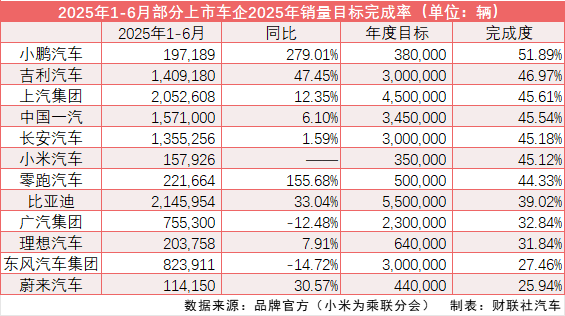
Core Viewpoint - The sales data of major automotive companies in the first half of the year reflects current market performance and indicates the trajectory for achieving annual targets, with significant disparities in performance among different companies [1][2]. Group 1: Performance of New Energy Vehicle Companies - Xiaopeng Motors achieved the highest completion rate of 51.89%, delivering 197,200 vehicles, a year-on-year increase of 279.01%, and has several new models launching in the second half of the year [3]. - Geely Auto raised its 2025 sales target from 2.71 million to 3 million units, with a current completion rate of 47% and a total sales of 1.4 million units in the first half, a 47.45% increase year-on-year [3]. - SAIC Motor showed a recovery with a total sales of 2.053 million units, a 12.35% increase year-on-year, and a completion rate of 45.6% towards its 2025 target of over 4.5 million units [4]. Group 2: Performance of Traditional Automotive Companies - China FAW and Changan Automobile are progressing steadily, with FAW achieving 1.571 million units sold (6.10% increase) and Changan reaching 1.355 million units (1.59% increase), both with completion rates around 45% [4]. - GAC Group reported a decline in sales to 755,300 units, a 12.48% decrease year-on-year, with a challenging target of achieving a 15% growth by 2025 [6]. Group 3: Performance of Emerging Automotive Companies - Xiaomi Auto delivered over 160,000 vehicles in the first half, achieving a completion rate of 46% towards its annual target of 350,000 units [5]. - Leap Motor topped the half-year sales chart with 221,700 units delivered, a 155.68% increase year-on-year, and a completion rate of 44.3% towards its annual target of 500,000 units [5]. Group 4: Challenges Faced by Major Players - BYD's completion rate is below 40%, with 2.146 million units sold, a 33.04% increase, but only achieving 39.02% of its annual target of 5.5 million units [6]. - Li Auto's sales growth has slowed, with 203,800 units delivered, a 7.91% increase, and a revised annual target of 640,000 units, resulting in a completion rate of 31.8% [7]. - NIO delivered 114,200 units, a 30.57% increase, but only achieved 25.9% of its annual target of 440,000 units, indicating pressure on overall sales [7]. Group 5: Market Outlook - The China Association of Automobile Manufacturers predicts that the automotive market will maintain healthy growth in the second half of the year, with new energy vehicle sales expected to reach 16 million units, accounting for over 50% of total new car sales [8].







近六成车企完成年度销量目标40%以上:小鹏最高、比亚迪“降速”
Feng Huang Wang· 2025-07-14 09:52
Core Insights - The sales data from major automotive companies for the first half of the year reflects current market performance and indicates the trajectory for achieving annual targets [1] - There is a significant disparity in the performance of different companies, with some achieving over 40% of their annual sales targets, while others lag behind [1] Group 1: Company Performance - Xiaopeng Motors achieved the highest completion rate at 51.89%, delivering 197,189 vehicles, a year-on-year increase of 279.01% [2][4] - Geely's sales reached 1,409,180 units, with a completion rate of 46.97%, and a notable growth in its new energy vehicle segment [2][5] - SAIC Motor Corporation reported a total of 2,052,608 units sold, achieving a completion rate of 45.61% [2][5] - BYD's sales reached 2,145,954 units, but its completion rate was only 39.02%, with a notable decline in domestic sales in May and June [2][9] - NIO delivered 114,150 vehicles, achieving a completion rate of 25.94%, indicating significant pressure on its annual targets [2][10] Group 2: Market Trends - The automotive market is expected to maintain healthy and stable growth, driven by new policies and a rich supply of new products [11] - The China Association of Automobile Manufacturers predicts that new energy vehicle sales could reach 16 million units, with new cars accounting for over 50% of total sales [11]

汽车行业周报:智元、宇树中标中国移动1.24亿元订单,尚界发布首款新车预热海报-20250714
Huaxin Securities· 2025-07-14 08:17
Investment Rating - The report maintains a "Buy" rating for the automotive industry and highlights the potential of humanoid robots, recommending specific companies within this sector [5][8][41]. Core Insights - The humanoid robot sector is experiencing significant opportunities, with a notable order of 1.24 billion yuan awarded to Zhiyuan and Yushu by China Mobile, marking the highest order amount in the domestic humanoid robot industry [4][5]. - The automotive market is expected to see accelerated growth in robot application scenarios, with a focus on platform-based companies that hold competitive advantages [5][8]. - The report emphasizes the importance of intelligent vehicles and the ongoing collaboration between automotive manufacturers and technology firms like Huawei [6][7]. Summary by Sections Market Performance - The automotive sector's performance has been mixed, with the automotive index declining by 0.6%, underperforming the broader market [15][16]. - In the past year, the automotive sector has outperformed the market, with significant gains in new energy vehicles and intelligent vehicles [16][30]. Industry Data Tracking - In July, the average daily retail of passenger cars was 40,000 units, showing a year-on-year increase of 1% [36]. - The wholesale of passenger cars in the first week of July reached 233,000 units, a 39% increase compared to the same period last year [37]. Company Announcements and Industry News - Zhiyuan and Yushu's successful bid for a humanoid robot project with China Mobile is a significant development in the industry [4]. - The report highlights the launch of new models by various manufacturers, including NIO and Chery, indicating ongoing innovation in the automotive sector [60]. Recommended Stocks - The report recommends several companies for investment, including Shuanglin Co., Redik, and Jianghuai Automobile, all of which are expected to perform well in the coming years [10][43][42].




高股息继续拉升,银行煤炭领涨!险资加仓预期升温!
Xin Lang Ji Jin· 2025-07-14 05:23
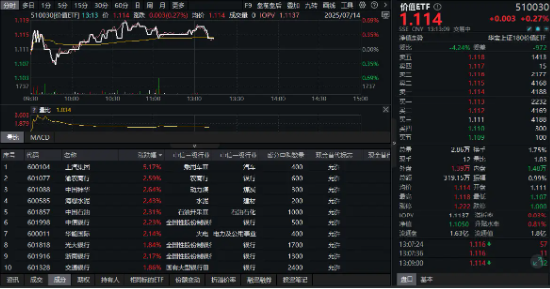
Core Viewpoint - High dividend stocks continue to rise, with a focus on "high dividend + low valuation" large-cap blue-chip stocks in the value ETF (510030) [1][4] Group 1: Market Performance - The value ETF (510030) opened slightly lower but then rose, with a current price increase of 0.27% [1] - The 180 Value Index has outperformed major A-share indices since the beginning of the year, with a cumulative increase of 7.24% compared to the Shanghai Composite Index's 4.73% and the CSI 300 Index's 2.03% [1][3] - As of July 11, 2025, the 180 Value Index's price-to-book ratio is at 0.85, indicating a relatively low valuation compared to the past decade [8] Group 2: Sector Analysis - The banking sector is the largest weight in the 180 Value Index, accounting for 50% as of June 2025 [5] - Insurance funds are expected to continue increasing their allocation to high-dividend bank stocks due to anticipated decreases in preset interest rates [4][6] - The focus on high dividend and high free cash flow return combinations is emphasized as a strategy to mitigate external uncertainties [6] Group 3: Investment Strategy - The value ETF closely tracks the 180 Value Index, which selects the top 60 stocks based on value factor scores, including major financial and infrastructure stocks [6] - The strategy suggests maintaining a "dividend core + small-cap growth" allocation to balance stability and growth potential [6]



6月国内乘用车销量大增18%,上半年合资品牌呈回暖趋势
Xin Lang Cai Jing· 2025-07-14 04:08
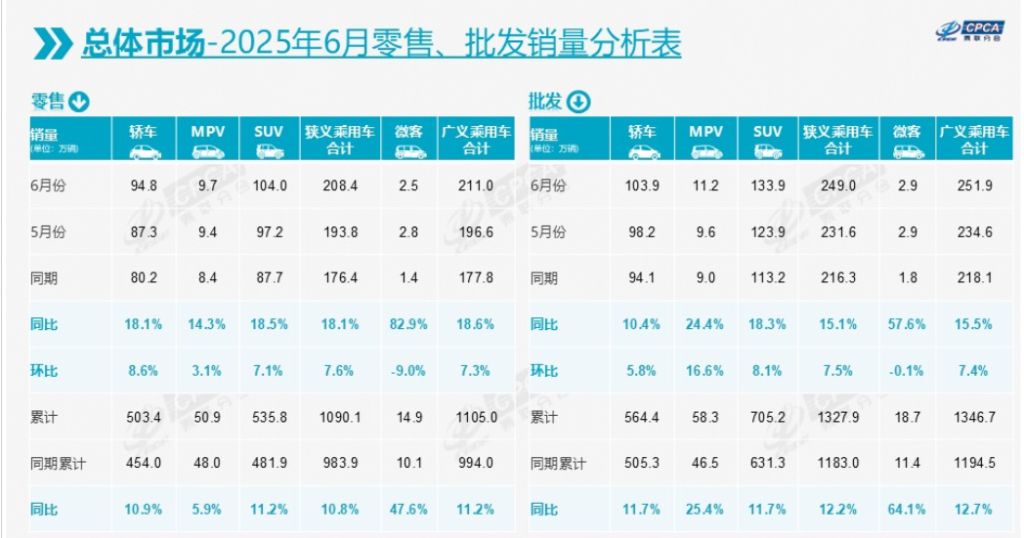
Core Insights - The domestic passenger car market in China experienced an unexpected growth of 10.8% in the first half of the year, with June retail sales reaching 2.084 million units, a year-on-year increase of 18.1% and a month-on-month increase of 7.6% [1] - The market is seeing a shift with price wars becoming milder, while hidden incentives such as enhanced features and adjustments to owner rights are becoming more common [1] Sales Performance - In June, the wholesale share of domestic brands reached 67.1%, up 2.2% year-on-year, while the retail share was 64.2%, up 5.6% year-on-year [2][3] - Retail sales of domestic brands in June were 1.34 million units, a year-on-year increase of 30% and a month-on-month increase of 7% [3] - The cumulative retail market share of domestic brands in the first half of the year was 64%, an increase of 7.5 percentage points compared to the same period last year [3] Brand Performance - BYD's June sales reached 377,628 units, with a total of 2,113,271 units sold in the first half of the year, marking an 11% year-on-year increase [4] - Chery Group's June sales were 233,607 units, a 16.6% year-on-year increase, with 71,582 units being new energy vehicles, up 59.6% [4] - Geely's June sales were approximately 236,000 units, a 42% year-on-year increase, with a total of 1,409,000 units sold in the first half of the year, up 47% [4] Market Dynamics - The sales ranking for the first half of 2025 shows BYD leading with 1,610,042 units sold, followed by Geely with 1,225,673 units, and FAW-Volkswagen with 743,543 units, which saw a decline of 3.6% [7] - The luxury car segment saw retail sales of 230,000 units in June, a year-on-year decrease of 7% but an 18% increase month-on-month [3] Future Outlook - The market is expected to experience a gradual slowdown in growth due to high inventory levels and increased pressure on dealers' profitability as bank loan incentives diminish [8] - The overall production pace is anticipated to stabilize as automakers work to maintain relative price stability in the market [8]

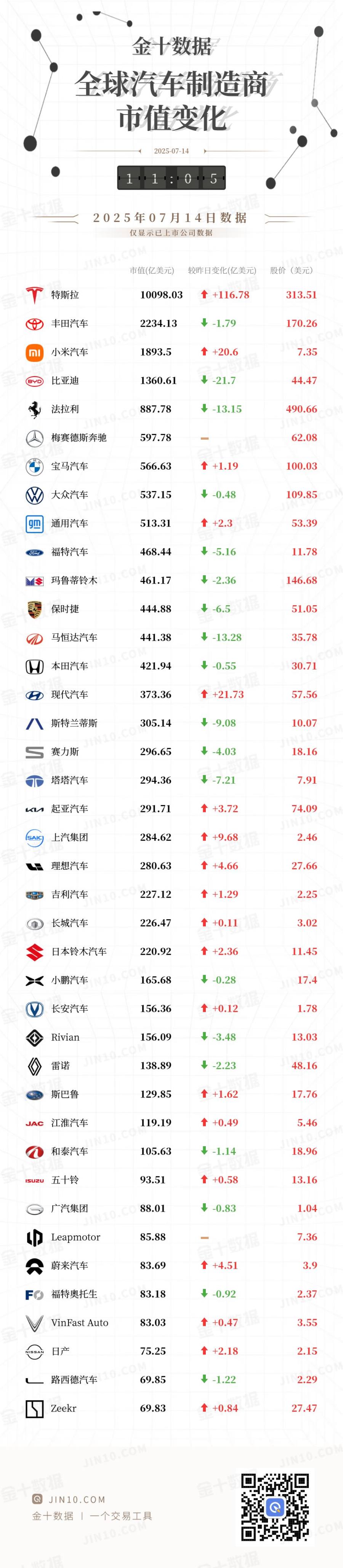
金十图示:2025年07月14日(周一)全球汽车制造商市值变化
news flash· 2025-07-14 03:08
Group 1 - BYD reported a value of 1360.61 with a decrease of 21.7% [2] - Ferrari's value is 887.78, showing a decrease of 13.15% [2] - Mercedes-Benz has a value of 597.78, with no percentage change reported [2] - BMW's value increased by 1.19% to 566.63 [2] Group 2 - Volkswagen's value is 537.15, reflecting a decrease of 0.48% [3] - General Motors reported a value of 513.31, with an increase of 2.3% [3] - Ford's value decreased by 5.16% to 468.44 [3] - Maruti Suzuki's value is 461.17, showing a decrease of 2.36% [3] - Porsche's value decreased by 6.5% to 444.88 [3] - Mahindra Automotive's value is 441.38, with a decrease of 13.28% [3] - Honda's value is 421.94, reflecting a slight decrease of 0.55% [3] - Hyundai's value increased by 21.73% to 373.36 [3] - Stellantis reported a value of 305.14, with a decrease of 9.08% [3] - Seres' value is 296.65, showing a decrease of 4.03% [3] - Tata Motors reported a value of 294.36, with a decrease of 7.21% [3] - Kia's value increased by 3.72% to 291.71 [3] - SAIC Motor's value is 284.62, reflecting an increase of 9.68% [3] - Li Auto's value is 280.63, with an increase of 4.66% [3] - Geely's value is 227.12, reflecting an increase of 1.29% [3] - Great Wall Motors reported a value of 226.47, with a slight increase of 0.11% [3] - Suzuki Japan's value is 220.92, showing an increase of 2.36% [3] - Xpeng's value is 165.68, reflecting a decrease of 0.28% [3] Group 3 - Changan Automobile's value is 156.36, with a slight increase of 0.12% [4] - Rivian's value is 156.09, showing a decrease of 3.48% [4] - Renault's value is 138.89, reflecting a decrease of 2.23% [4] - Subaru's value is 129.85, with an increase of 1.62% [4] - JAC's value is 119.19, with an increase of 0.49% [4] - Hozon Auto's value is 105.63, showing a decrease of 1.14% [4] - Isuzu's value is 93.51, with an increase of 0.58% [4] - GAC Group's value is 88.01, reflecting a decrease of 0.83% [4] - Leapmotor's value is 85.88, with no percentage change reported [4] - Weimi Auto's value is 83.69, showing an increase of 4.51% [4] - Ford Otosan's value is 83.18, reflecting a decrease of 0.92% [4] - VinFast Auto's value is 83.03, with an increase of 0.47% [4] - Nissan's value is 75.25, reflecting an increase of 2.18% [4] - Lucid Motors' value is 69.85, showing a decrease of 1.22% [4] - Zeekr's value is 69.83, with an increase of 0.84% [4]


上汽集团20250613
2025-07-14 00:36
Summary of SAIC Motor Corporation Conference Call Company Overview - **Company**: SAIC Motor Corporation - **Industry**: Automotive Key Points Sales Performance - In the first half of 2025, SAIC Motor's total sales reached 2.053 million units, representing a year-on-year increase of 12.35% [3] - June 2025 sales were 365,000 units, up 21.56% year-on-year [3] - Notable brand performances include: - SAIC Volkswagen: June sales of approximately 93,000 units, up 13% [3] - General Motors: June sales of 47,000 units, up 80%, with a cumulative total of 245,000 units for the first half, up 8.6% [3] - SAIC Passenger Vehicles: June sales of 63,000 units, up 15.5%, with a cumulative total of 368,000 units, up 9.8% [3] Export Performance - In the first half of 2025, SAIC Motor's wholesale export volume reached 490,000 units, and retail export volume reached 570,000 units [4][5] - The annual export target is set at over 1.1 million units, with the MG brand expected to export 650,000 units [4][5] New Model Launches - SAIC plans to launch several new models from the second half of 2025 to 2026, including: - Audi A5L and E5 (the first Audi model using Huawei inside technology) [6] - Roewe M7 and MG4 [6] - A total of 10 new models from Volkswagen targeted for the local market by 2026 [6] Collaboration with Huawei - The "Upper Boundary" project, a collaboration with Huawei, has a team of over 400 people [7] - The first SUV priced around 200,000 yuan is expected to launch in Q4 2025, available in both extended range and pure electric versions [7] - The project aims to introduce two additional new models next year, potentially leading to three models being sold simultaneously by the end of next year [7] Profitability Improvement - The profitability of the passenger vehicle segment has significantly improved due to strategic integration efforts [8] - The first quarter of 2025 achieved breakeven, with expectations of noticeable loss reduction in the first half [8] - The elimination of losses from General Motors and potential profit contributions from Audi are expected to enhance overall profitability compared to last year [8] Strategic Adjustments - In 2024, SAIC implemented three major adjustments: reducing inventory, focusing on retail, and addressing General Motors' risks [9] - These adjustments have positioned SAIC to operate in a light asset state in 2025, leading to improved efficiency and cost savings [9] Valuation Status - SAIC's current valuation is low, with a price-to-book ratio (PB) of approximately 0.67 to 0.68 [10] - The valuation has room for recovery, especially with the anticipated market effects from the collaboration with Huawei and new model launches [10][11] Market Impact of New Releases - The new models developed in collaboration with Huawei are expected to create significant market catalysts [12] - The first model is positioned competitively in terms of pricing and is anticipated to attract consumer interest due to its intelligent features [12] Future Outlook - The upcoming half-year report in August and new model launches in late summer are expected to catalyze upward movement in SAIC's PB ratio [13] - The introduction of additional new models in 2026 is projected to provide further growth opportunities [13]
上汽集团(600104):从产品出海到产业链出海 打造大自主第二增长曲线
Xin Lang Cai Jing· 2025-07-14 00:28
Core Viewpoint - The rapid growth of China's passenger car exports is driven by changes in the international environment and the advantages of the domestic automotive industry, with significant future growth potential in overseas markets [1][2]. Group 1: Passenger Car Export Growth - In 2023, China became the world's largest automobile exporter, with a projected CAGR of 4.0% in overseas automotive sales over the next six years, indicating an incremental space of over 10 million vehicles [1]. - The company has been the champion of export sales among Chinese car manufacturers for eight consecutive years from 2016 to 2023, with the overseas sales proportion expected to increase from 2.5% in 2017 to 25.9% in 2024 [1]. - The company anticipates that the profitability of overseas models will exceed that of domestic ones due to export price differentials and improved operational efficiency, making export growth and the introduction of high-value-added models crucial for enhancing overseas profitability [1]. Group 2: Strategic Expansion and Organizational Changes - The company is transitioning from product exports to a full industrial chain export model, which is expected to enhance its adaptability and risk management in various overseas markets [2]. - The establishment of a new organizational structure, integrating various subsidiaries under a "large passenger vehicle sector," is expected to improve operational efficiency and profitability in overseas markets [2]. - Forecasted EPS for 2025-2027 is 0.95, 1.03, and 1.15 yuan respectively, with a target price of 23.75 yuan based on a 25x PE ratio, maintaining a buy rating [2].
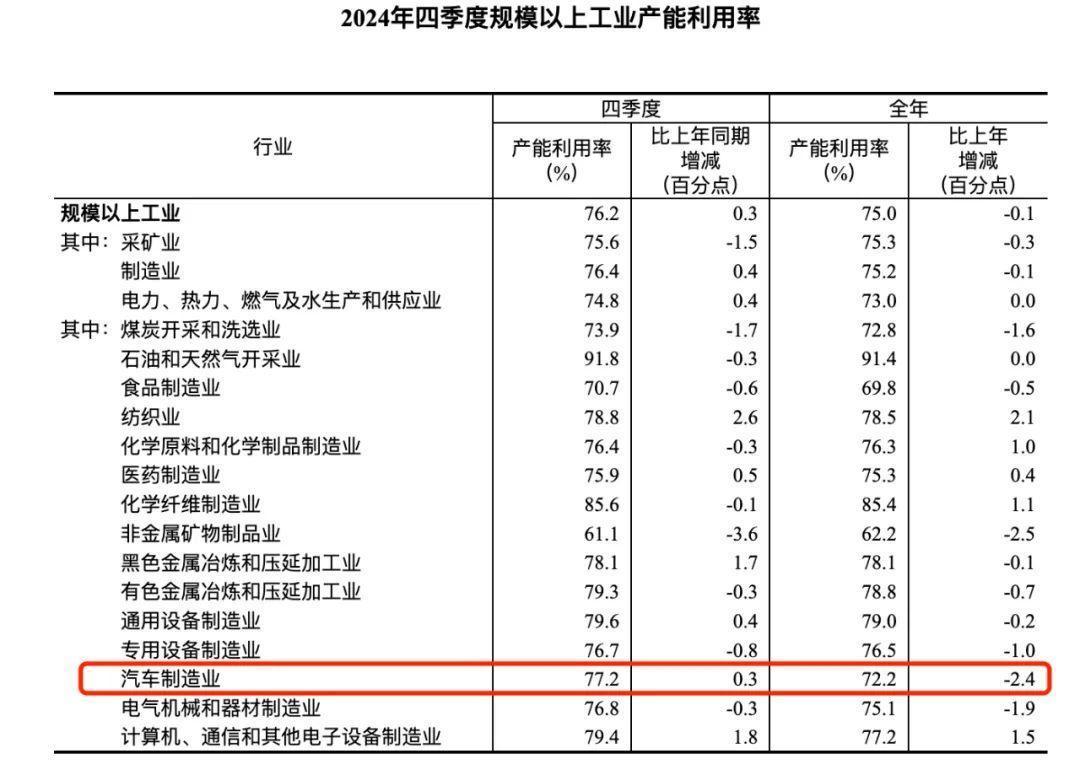
聚焦“产能利用率”提升:车企加码基地改造升级 业内呼吁优化产业布局
Mei Ri Jing Ji Xin Wen· 2025-07-13 14:24
Group 1 - The automotive industry is facing a significant issue of overcapacity, with a need to redefine and optimize production capacity and resource allocation [1][4] - In 2024, the automotive manufacturing capacity utilization rate is projected to be 72.2%, a decrease of 2.4 percentage points from the previous year, and lower than the overall industrial utilization rate of 75.0% [1][3] - The peak capacity utilization rate for the automotive manufacturing sector was 82.2% in 2017, indicating a downward trend in recent years [1] Group 2 - The global automotive capacity utilization rate is expected to drop to 65% by 2028, with a potential decline to 60% due to weak demand [5] - Some companies are adapting to the challenges by upgrading and transforming their production bases, such as SAIC Volkswagen, which is integrating resources and planning for future electric vehicle production [6] - Honda has announced the closure of two production lines in China to facilitate its transition to electric vehicles, while other companies like Lantu Automotive are also modernizing existing facilities instead of building new ones [7] Group 3 - The automotive industry is focusing on enhancing quality management and optimizing production layouts, with many companies integrating resources to improve production efficiency in preparation for industry transformation [8]