
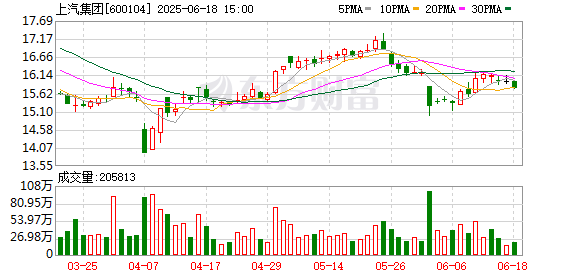
SAIC MOTOR(600104)

Search documents
构建更具韧性的产业协同生态 上汽领衔车企账期“双承诺”
Zhong Guo Jing Ying Bao· 2025-06-18 11:20
Core Viewpoint - A "payment term revolution" is taking place in the automotive industry, with major companies committing to limit supplier payment terms to within 60 days, aiming to enhance the financial flow and resilience of the industry ecosystem [2][4]. Group 1: Industry Context - The average payment term for Chinese automotive companies in 2024 is projected to be 170-200 days, significantly longer than the 37-65 days seen in foreign companies like Toyota and Mercedes [2]. - The automotive industry is currently facing a profit margin decline, with the overall profit rate dropping to 3.9% in the first quarter of 2024, marking a new low in recent years [3]. - The long payment terms have created financial strain on suppliers, with some facing payment cycles of up to 9 months, leading to reliance on discounting and short-term loans [3]. Group 2: Legislative and Regulatory Framework - The "Regulations on Ensuring Payment to Small and Medium Enterprises" came into effect on June 1, 2024, mandating that large enterprises must pay small and medium enterprises within 60 days of delivery [3]. Group 3: Company Initiatives - SAIC Motor Corporation has taken the lead by committing to a 60-day payment term and explicitly excluding commercial acceptance bills, which add financial pressure on suppliers [5][6]. - The company's commitment is seen as a model for the industry, promoting a healthier competitive environment and facilitating high-quality development [5][6]. Group 4: Company Performance and Strategy - SAIC has undergone significant internal reforms, focusing on resource integration and business streamlining, which has led to improved operational efficiency and market performance [6][7]. - In May 2025, SAIC's wholesale sales reached 366,000 units, a year-on-year increase of 10.2%, with a notable 50.3% increase in monthly sales of new energy vehicles [7]. - The company's global strategy has also been successful, becoming the best-selling Chinese car manufacturer in the EU, UK, and Nordic countries in early 2024 [7]. Group 5: Industry Implications - The 60-day payment term standard is expected to enhance corporate image, foster industry collaboration, and improve product quality, ultimately benefiting companies that adhere to these practices [8].


品牌价值217.89亿元!中国汽车报再登《中国500最具价值品牌》排行榜
Zhong Guo Qi Che Bao Wang· 2025-06-18 11:19
Core Insights - The 2025 "China's 500 Most Valuable Brands" report was released at the World Brand Conference, highlighting the growth and value of Chinese brands, with China Automotive News ranking as the only automotive media on the list with a brand value of 21.789 billion RMB [1][3] Brand Value Overview - The total value of the top 500 brands in 2025 reached 42.03 trillion RMB, an increase of 3.46 trillion RMB from the previous year, representing a growth rate of 8.97% [3][4] - The entry threshold for the list has risen from 500 million RMB in 2004 to 4.291 billion RMB in 2025, with the average brand value increasing from 494.3 million RMB to 8.4053 billion RMB over the same period, a growth of 1600.45% [3][4] Automotive Industry Insights - The automotive sector had 29 brands on the list, accounting for 5.80% of the total, with a combined brand value of 3.175298 trillion RMB, representing 7.56% of the total value, and an average brand value of 1.09493 billion RMB [5][6] - The top three automotive brands were China FAW, SAIC, and Dongfeng [5][6] Industry Distribution - The report included brands from 24 industries, with the top five sectors by brand count being Food and Beverage (77), Light Industry (41), Building Materials (36), Communication Electronics IT (35), and Media (32) [4][6] Future Trends in Automotive - The report indicates that the automotive industry will continue to grow steadily, with the new energy vehicle market being a significant highlight, as domestic brands transition from technology followers to market leaders [6] - China's automotive exports are expected to grow, reinforcing its position as the world's largest automotive exporter, contributing to high-quality industry development [6]




上汽集团: 上汽集团2024年年度股东大会资料
Zheng Quan Zhi Xing· 2025-06-18 10:21
Core Viewpoint - The Shanghai Automotive Group Co., Ltd. (SAIC) is preparing for its 2024 Annual General Meeting (AGM), focusing on maintaining order, ensuring shareholder rights, and discussing various proposals related to financial audits, corporate governance, and strategic initiatives. Group 1: Meeting Procedures and Regulations - Shareholders must register in advance to attend the AGM, and registration will close before the meeting starts [1][2] - The AGM will follow a structured process where shareholders will review and vote on various proposals, with the results announced on the same day [2][7] - Photography, videography, and audio recording are prohibited during the meeting to protect the rights of all participants [2] Group 2: Key Proposals and Voting - Proposals include the reappointment of PwC as the financial auditor, approval of related party transactions, and various guarantees provided by subsidiaries [3][4][16] - The AGM will also address amendments to the company's articles of association and the establishment of a three-year shareholder return plan [14][16] Group 3: Financial Performance and Strategic Initiatives - In 2023, the company sold 4.013 million vehicles, with a retail figure of 4.639 million, marking a nearly 30% year-on-year increase in new energy vehicle sales [10][11] - The company aims to enhance its core competitiveness by focusing on independent brand development and optimizing its business structure [10][11][23] - SAIC is committed to improving its governance structure and risk management, with a focus on ESG (Environmental, Social, and Governance) initiatives [12][13][14] Group 4: Shareholder Returns and Corporate Governance - The company plans to distribute cash dividends totaling 4.232 billion yuan, representing 30% of the net profit attributable to shareholders [14][30] - The board has implemented reforms to enhance the role of independent directors and improve decision-making processes [12][35] - The company has maintained a high standard of information disclosure, receiving an "A" rating for its disclosure practices [27][29]
上汽集团(600104) - 上汽集团2024年年度股东大会资料
2025-06-18 09:45
上海汽车集团股份有限公司 2024 年年度股东大会 上海汽车集团股份有限公司 2024 年年度股东大会资料 2025 年 6 月 27 日 1 上海汽车集团股份有限公司 2024 年年度股东大会 上海汽车集团股份有限公司 2024 年年度股东大会会议须知 为了维护投资者的合法权益,确保股东大会的正常秩序和议 事效率,根据《中华人民共和国公司法》《中华人民共和国证券 法》《上海汽车集团股份有限公司章程》等有关规定,特制定如 下会议须知: 一、为保证股东大会的严肃性和正常秩序,切实维护与会股 东(或授权代表)的合法权益,请有出席股东大会资格的相关人 员事先办理参会登记手续,准时参加会议。股东大会正式开始后, 会议主持人宣布现场出席会议的股东和代理人人数及所持有表 决权的股份总数之前,终止现场参会登记。股东大会设秘书处, 具体负责大会有关事宜。 二、股东(或授权代表)出席大会,依法享有发言权、质询 权、表决权等各项权利。股东如需发言或就有关问题提出质询的, 请在会议正式开始前 10 分钟内向大会秘书处登记,并填写发言 申请单,经大会秘书处许可,方可发言。每一股东发言时间一般 不超过 5 分钟。与本次股东大会议题无关 ...
从集体买船到载量比拼,中国车企“大船东时代”来临
Di Yi Cai Jing· 2025-06-18 07:18
Core Insights - The automotive industry in China is experiencing a significant increase in exports, leading to a "buying ships" movement among major domestic brands to secure transportation capacity and reduce costs [1][3][5] - Major companies like SAIC Group and BYD are investing in building their own fleets of car transport ships to ensure supply chain stability and efficiency [2][4][5] - The global automotive transport ship market is dominated by Japanese, Norwegian, and South Korean companies, but Chinese companies are gradually increasing their market share [6][7] Group 1: Export Growth and Shipbuilding - China's automotive exports surged from 1 million units in 2020 to over 5 million units in 2023, marking a nearly fivefold increase in four years [3] - The rental price for car transport ships has skyrocketed from $10,000 per day in mid-2020 to $115,000 per day by the end of 2023, reflecting the high demand for shipping capacity [3] - SAIC Logistics has ordered 12 new ships with capacities ranging from 7,600 to 9,500 car spaces, expected to be delivered by 2026, providing an annual capacity of over 600,000 vehicles [4] Group 2: Strategic Moves by Companies - BYD has confirmed the construction of eight car transport ships with a total cost of nearly 5 billion yuan, with four already in operation [4] - Chery Group, the top exporter in 2022 with over 1.14 million units, and SAIC Group, with nearly 1.04 million units exported, are also expanding their shipping capabilities [5] - The trend of building and owning transport ships is not unique to China, as Japanese automakers have historically invested in their shipping fleets to support global distribution [6][7] Group 3: Market Dynamics and Future Outlook - As of April 2025, Chinese shipowners hold a 7.6% share of the global automotive transport ship market, with SAIC Group ranking 15th globally [7] - Concerns are rising about potential oversupply in the automotive transport ship market due to the rapid increase in fleet size compared to the slowing growth of automotive exports [7][8] - Experts suggest that collaboration among different automotive brands could mitigate risks associated with potential oversupply in the shipping market [8]

前5月新能源轻卡累销5.6万辆大增94%!远程破万 福田份额大涨 跃进稳前三 | 头条
第一商用车网· 2025-06-18 06:56
2025年的"金三银四"旺季,新能源轻卡连续两个月销量破万,并在4月份创造了史上最高的 单月销量(1.56万辆)。 5月份,新能源轻卡市场能否继续保持超万辆水准? 5月实销1.41万辆,同比增长66%,收获"17连增" 根据第一商用车网掌握的最新数据,2025年5月份,国内新能源轻卡市场共计销售1.41万辆 (注:本文轻卡指总质量3.5-6T货车,数据来源为交强险实销口径,不含出口,下同),环 比今年4月份下降9%,同比则继续实现增长,增幅达到66%,同比增幅较上月(+120%)有 所缩窄。 截止到2025年5月份,新能源轻卡市场这一轮的连增势头已达到"17连增"。 由最近四年国内新能源轻卡终端销量月度走势图可见,无论是1月份、2月份,还是3月份、4 月份和5月份,代表2025年的红色柱体比之前任何一年都"高"出一大截。如果仅看5月份销 量,新能源轻卡市场1.41万辆的销量远高于2024年月均8700辆左右的水平,这一销量放到整 个新能源轻卡发展史上看,也是高位水准(史上第五,如上图)。截止到2025年5月份,新能 源轻卡月销量共8次超过1万辆,其中有三次就发生在最近的3-5月份,因此而言,新能源轻卡 市场最 ...


超长账期问题:整车厂之后,零部件巨头该出来说话了
Jing Ji Guan Cha Wang· 2025-06-17 14:40
Core Viewpoint - The article discusses the ongoing issues in the automotive supply chain, particularly focusing on the extended payment terms imposed by large parts manufacturers on smaller suppliers, despite recent commitments from automakers to shorten their payment periods [3][4]. Group 1: Payment Terms and Industry Dynamics - A recent lawsuit highlights the contract disputes between a mold company and a joint venture parts manufacturer, revealing underlying issues related to payment terms and cash flow for small enterprises [3]. - Automakers have received praise for their commitment to a 60-day payment term, but the larger issue lies with major parts manufacturers who impose even longer payment terms on smaller suppliers [3][4]. - For instance, Huayu Automotive, a major parts supplier under SAIC, has an accounts payable turnover period of 163 days, while Dongfeng Technology has a turnover period exceeding 196 days [4]. Group 2: Impact on Smaller Suppliers - The accounts payable turnover days do not equate to the contractual payment terms, indicating that actual payment cycles can be significantly longer, affecting the cash flow of smaller suppliers [4]. - Larger parts manufacturers, such as CATL, have been able to maintain a favorable accounts receivable turnover period of around 60 days, while their own accounts payable turnover days exceed 258 days, further straining smaller suppliers [4][5]. - The article suggests that these large manufacturers are leveraging their negotiating power to impose harsher terms on smaller suppliers, exacerbating the financial strain within the supply chain [5]. Group 3: Call for Transparency and Fairness - The article advocates for greater transparency in payment policies from large manufacturers, similar to the commitments made by automakers, to foster a healthier competitive environment [5]. - It emphasizes that while extended payment terms may seem like a financial strategy, they should not undermine fair competition and the integrity of the supply chain [5]. - The article questions whether large parts manufacturers should also take responsibility and clarify their payment practices to ensure fairness across the industry [5].



一线调查 | 多地暂停置换补贴 消费者抢搭“末班车”!车市“福利”缩水 车企年中冲量承压
Mei Ri Jing Ji Xin Wen· 2025-06-17 11:37
Core Viewpoint - The automotive replacement subsidy policy in several regions, including Zhengzhou and Luoyang, has been suspended, impacting consumer purchasing behavior and creating challenges for car manufacturers in achieving sales targets [1][2][3]. Group 1: Policy Changes - Zhengzhou and Luoyang have announced the suspension of the 2025 automotive replacement subsidy application, with the highest subsidy amount being 15,000 yuan for eligible users [1][2]. - The suspension is attributed to the depletion of subsidy funds, with the announcement indicating a pause rather than a termination of the program [2][3]. - Other regions, such as Chongqing and Shenyang, are also planning to suspend their automotive replacement subsidy applications, indicating a broader trend [3]. Group 2: Market Impact - The suspension of subsidies is expected to lead to increased consumer hesitation and a potential decline in vehicle sales, particularly affecting budget-conscious buyers [3]. - The "National Subsidy" program remains available, but its impact may not significantly differ from local subsidies [3]. - Data shows that as of May 31, 4.12 million applications for the "National Subsidy" were submitted, with a notable increase in applications in May compared to April [3]. Group 3: Industry Challenges - The automotive industry is facing pressure to maintain sales amid a competitive environment, with companies like BYD and Geely engaging in price promotions to boost sales [4][5]. - The China Automotive Industry Association has issued a warning against excessive price competition, emphasizing the need for fair market practices [5][6]. - Major automakers are still striving to meet their annual sales targets, with BYD leading with 1.76 million units sold in the first five months of the year [6]. Group 4: Future Outlook - Experts suggest that the automotive market will continue to evolve, with companies needing to focus on product differentiation and innovation to thrive in a post-subsidy environment [7]. - The market is expected to stabilize as companies adapt to the changing landscape and seek new growth drivers beyond government incentives [7].

汽车视点 | 销量五连涨!上汽改革初战告捷,激发向上新动能
Xin Hua Cai Jing· 2025-06-17 11:14
Core Viewpoint - The Chinese automotive industry is undergoing significant transformation driven by electrification and intelligence, with SAIC Motor Corporation leading the way through deep reforms that are beginning to show results, indicating a new upward trajectory in the second half of the year [1] Group 1: Sales Performance - In the first five months of this year, SAIC's vehicle sales exceeded 1.68 million units, a year-on-year increase of 10.5%, with terminal deliveries reaching 1.824 million units, up 3.1% [1] - Notably, in May, SAIC achieved a monthly sales figure of 366,000 units, marking a fifth consecutive month of growth [1] - SAIC's self-owned brand sales reached 1.081 million units in the first five months, a 21.9% increase, accounting for 64% of total sales, up 6 percentage points from the previous year [2] Group 2: Strategic Reforms - The strategic restructuring initiated in early 2025 has been pivotal for SAIC's transformation, consolidating its core businesses into a "large passenger vehicle segment" to break down resource barriers and focus on core technologies and market expansion [2] - The integration has led to a significant shift in sales focus towards more dynamic and controllable self-owned brands, with new energy vehicle sales reaching 525,600 units, a growth of approximately 43% [2] Group 3: Technological Advancements - SAIC is leveraging technology partnerships, such as the collaboration between the MG brand and OPPO, to create seamless connectivity between smartphones and vehicles, enhancing user experience [3] - The introduction of AI automotive solutions in collaboration with partners like Huoshan Engine aims to provide proactive service features, such as automatic wiper activation in rain and autonomous route planning for charging during long drives [3] - The new brand "Shangjie," developed in partnership with Huawei, focuses on advanced safety features and is set to launch its first model, a mainstream SUV priced around 200,000 yuan, by the end of September [4] Group 4: Joint Venture Developments - SAIC Volkswagen and SAIC General Motors are also undergoing transformations, with SAIC Volkswagen reporting a terminal sales increase of 4.3% in May, totaling nearly 430,000 units in the first five months [5] - SAIC Volkswagen has introduced a "lifetime warranty" policy for core components of its fuel SUVs, addressing the industry's price war and enhancing service value [6] - SAIC General Motors has shifted its market strategy to a "one-price" policy, leading to continuous growth across its Buick product lines for three consecutive months [6] Group 5: Global Expansion - SAIC has established a comprehensive automotive industry chain in overseas markets, exporting over 403,500 units in the first five months of this year, continuing its trend as a leading exporter [9] - The company has launched its "Glocal Strategy," marking a shift from product output to technology and standard output, with plans to introduce 17 new models tailored for various international markets over the next three years [9] - SAIC aims to enhance its overseas smart cabin ecosystem and localize L2-level intelligent driving functions, with strategic investments in engineering centers and KD factories in key regions [10]
1-5月销量同比增长44% 新能源车靠啥“跑”出这个增速
Zhong Guo Chan Ye Jing Ji Xin Xi Wang· 2025-06-16 22:24
1-5月新能源汽车销量达560.8万辆,同比增长44% 新能源车靠啥"跑"出这个增速? 6月11日,中国汽车工业协会发布的数据显示,今年1-5月,汽车产销分别完成1282.6万辆和1274.8万 辆,同比分别增长12.7%和10.9%。其中,新能源汽车产销累计完成569.9万辆和560.8万辆,同比分别增 长45.2%和44%,新能源汽车新车销量达到汽车新车总销量的44%。 业内人士分析,今年以来,"两新"政策加力扩围,持续显效,叠加车企新品投放、多地车展促销等利好 因素,助力汽车市场消费活力加速释放。未来需从优化充电基建、丰富适配车型、创新灵活金融服务、 强化售后网络覆盖四方面发力,构建汽车消费需求持续释放的长效机制。 车市掀起消费热浪 今年4月,在北京顺义区工作的李华完成了一次重要的出行设备升级--将陪伴自己多年的燃油车,置换 成一辆国产纯电动SUV。提车后,李华对新能源汽车也有了不一样的认识。 李华告诉记者,为节约开支,他充分利用夜班时段在单位充电,电费为每千瓦时0.83元,以车辆百公里 耗电15千瓦时计算,每公里用电成本约为0.12元。相比此前燃油车每公里近1元的油耗支出,新能源车 为他节省了大量出行 ...