
CSSC Holdings(600150)

Search documents
中国船舶吸并中国重工新增股份上市!
Sou Hu Cai Jing· 2025-09-18 03:49
Group 1 - The core point of the news is that China Shipbuilding Industry Co., Ltd. has completed the absorption and merger of China Shipbuilding Industry Group, marking a significant consolidation in the shipbuilding industry [1][3] - The share exchange ratio for the merger was set at 1:0.1339, meaning each share of China Shipbuilding Group could be exchanged for 0.1339 shares of China Shipbuilding, with the exchange prices being 37.59 yuan per share for China Shipbuilding and 5.032 yuan per share for China Shipbuilding Group [3] - Following the merger, China Shipbuilding Group will be delisted and its legal entity will be canceled, while China Shipbuilding will inherit all assets, liabilities, businesses, personnel, contracts, and other rights and obligations of China Shipbuilding Group [3] Group 2 - The merger is part of a strategic restructuring that began in 1999 when the original China Shipbuilding Industry Corporation was split into two entities: China Shipbuilding (South Ship) and China Shipbuilding Group (North Ship) [3] - After the merger, China Shipbuilding's asset scale is expected to exceed 400 billion yuan, positioning it as the largest and most comprehensive listed shipbuilding enterprise globally [4] - The merger was approved by the Shanghai Stock Exchange on July 4, 2025, and is seen as a significant step in enhancing the competitiveness of the company in the global shipbuilding market [4]



上半年造船企业收入创历史新高,替代燃料船已成全球新造船市场主角
Di Yi Cai Jing· 2025-09-17 09:36
Group 1 - The global shipbuilding industry has entered a critical period of the current "super cycle," with a significant decline in new ship orders this year due to geopolitical factors, decarbonization paths, and industry capacity issues [1] - Despite the overall decline in new ship orders, China's shipbuilding industry remains resilient, leading in completion volume, new orders, and backlog orders, accounting for 51.7%, 68.3%, and 64.9% of the global totals respectively [1] - The profit of China's large-scale shipbuilding enterprises reached a historical high of 38.74 billion yuan, a year-on-year increase of 72.6%, with a profit margin of 9.71% [1] Group 2 - China's shipbuilding industry achieved historical highs in backlog orders, new ship price index, and operating revenue, with green low-carbon initiatives accelerating, including a rapid increase in LNG and methanol-powered ship orders [2] - It is projected that China's shipbuilding completion volume will be around 51 million deadweight tons in 2025, with new orders slightly declining compared to the previous year, while backlog orders will remain above 230 million deadweight tons [2] - Alternative fuel vessels have become the main focus of the global new shipbuilding market, with 55.5% of new ship orders this year being alternative fuel vessels [2]
航海装备板块9月17日跌1.95%,中国船舶领跌,主力资金净流出7.3亿元
Zheng Xing Xing Ye Ri Bao· 2025-09-17 08:52
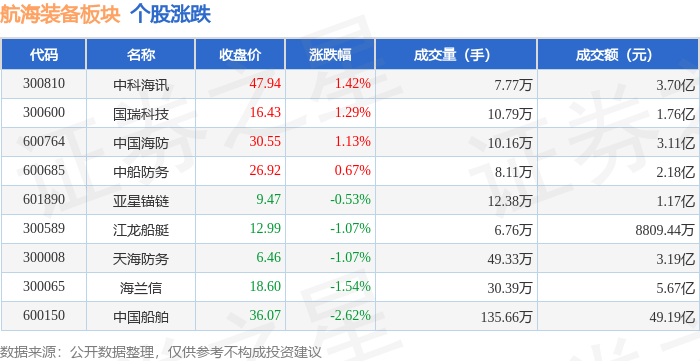
Core Insights - The maritime equipment sector experienced a decline of 1.95% on September 17, with China Shipbuilding leading the drop [1] - The Shanghai Composite Index closed at 3876.34, up 0.37%, while the Shenzhen Component Index closed at 13215.46, up 1.16% [1] Sector Performance - The following companies in the maritime equipment sector showed varied performance: - Zhongke Haixun (300810) closed at 47.94, up 1.42% with a trading volume of 77,700 shares and a transaction value of 370 million [1] - Guorui Technology (300600) closed at 16.43, up 1.29% with a trading volume of 107,900 shares and a transaction value of 176 million [1] - China Haifang (600764) closed at 30.55, up 1.13% with a trading volume of 101,600 shares and a transaction value of 311 million [1] - China Shipbuilding (600150) closed at 36.07, down 2.62% with a trading volume of 1,356,600 shares and a transaction value of 4.919 billion [1] Capital Flow - The maritime equipment sector saw a net outflow of 730 million from institutional investors and 92.996 million from retail investors, while retail investors had a net inflow of 823 million [1] - Detailed capital flow for specific companies includes: - Zhongke Haixun had a net inflow of 15.5941 million from institutional investors, while retail investors had a net outflow of 21.133 million [2] - China Shipbuilding experienced a significant net outflow of 631 million from institutional investors, but a net inflow of 748.1 million from retail investors [2]
上半年全国规模以上船舶工业企业利润总额增长超七成
Jing Ji Guan Cha Wang· 2025-09-17 03:03
Group 1 - The core viewpoint of the article highlights the significant growth in China's shipbuilding industry, with a notable increase in revenue and profit in the first half of 2025 [1] Group 2 - In the first half of 2025, the revenue of large-scale shipbuilding enterprises in China reached 398.76 billion yuan, representing a year-on-year increase of 20.8% [1] - The total profit achieved by these enterprises was 38.74 billion yuan, showing a substantial year-on-year growth of 72.6% [1] - The operating profit margin for the shipbuilding industry stood at 9.71% [1] Group 3 - Shipbuilding export value also maintained growth, with the export amount reaching 176.04 billion yuan in the first half of 2025, which is a year-on-year increase of 20.0% [1] - In USD terms, the export value was approximately 24.5 billion dollars, reflecting a year-on-year growth of 18.6% [1]
24个行业获融资净买入 23股获融资净买入额超2亿元
Zheng Quan Shi Bao Wang· 2025-09-17 01:40
Group 1 - On September 16, 24 out of 31 primary industries in the Shenwan index received net financing inflows, with the electronics industry leading at a net inflow of 4.526 billion [1] - Other industries with significant net financing inflows included machinery equipment, computers, non-bank financials, automobiles, chemicals, and telecommunications, each exceeding 800 million [1] Group 2 - A total of 1,975 individual stocks received net financing inflows on September 16, with 155 stocks having inflows exceeding 50 million [1] - Among these, 23 stocks had net inflows over 200 million, with Zhongke Shuguang leading at 1.506 billion [1] - Other notable stocks with high net financing inflows included Shenghong Technology, Cambridge Technology, Hanwujishi, Xiechuang Data, China Shipbuilding, Kweichow Moutai, Guiding Compass, and Sunshine Power [1]



63股获杠杆资金净买入超亿元
Zheng Quan Shi Bao· 2025-09-17 01:38
Market Overview - As of September 16, the total market financing balance reached 2.38 trillion yuan, an increase of 22.51 billion yuan from the previous trading day, marking the eighth consecutive day of increase [1] - The financing balance for the Shanghai Stock Exchange was 1.21 trillion yuan, up by 12.20 billion yuan; for the Shenzhen Stock Exchange, it was 1.16 trillion yuan, up by 10.34 billion yuan; while the Beijing Stock Exchange saw a decrease of 2.88 million yuan to 78.44 billion yuan [1] Stock Performance - On September 16, 1,975 stocks received net financing purchases, with 677 stocks having net purchases exceeding 10 million yuan, and 63 stocks exceeding 100 million yuan [1] - The top net purchase was for Zhongke Shuguang, with a net buy of 1.51 billion yuan, followed by Shenghong Technology and Cambridge Technology with net buys of 743 million yuan and 555 million yuan, respectively [1] Industry Insights - The industries with the highest concentration of stocks receiving net purchases over 100 million yuan were electronics, machinery equipment, and computers, with 16, 10, and 7 stocks respectively [1] - Among the stocks with significant net purchases, the arithmetic average of the financing balance as a percentage of the circulating market value was 4.39% [2] Notable Stocks - The stock with the highest financing balance as a percentage of circulating market value was Dongtu Technology at 10.80%, followed by Guokewi at 9.90%, Cambridge Technology at 8.81%, and Demingli at 7.98% [2] - Specific stock performances on September 16 included: - Zhongke Shuguang: net buy of 150.64 million yuan, latest financing balance of 1.04 billion yuan, and a 6.40% market value ratio [3] - Shenghong Technology: net buy of 74.29 million yuan, latest financing balance of 1.64 billion yuan, and a 5.52% market value ratio [3] - Cambridge Technology: net buy of 55.49 million yuan, latest financing balance of 283.16 million yuan, and an 8.81% market value ratio [3]
趋势研判!2025年中国深海资源开发行业政策、发展现状、细分市场、企业布局及战略前景分析:深海资源开发技术迭代加速,万亿产业蓝海正待深度掘金[图]
Chan Ye Xin Xi Wang· 2025-09-17 01:11
Core Insights - Deep-sea resource development focuses on areas deeper than 200 meters, encompassing strategic resources such as minerals, energy, and biological resources, which are crucial for overcoming land resource limitations and ensuring national security [1][2] - The Chinese government has integrated deep-sea development into its national security strategy, designating it as a strategic emerging industry in the 2025 government work report, supported by a special fund of 50 billion yuan for marine economy [1][5] - The industry is projected to reach a scale of 3.25 trillion yuan by 2025 and exceed 5 trillion yuan by 2030, driven by significant growth in oil and gas development, mining, and biopharmaceutical sectors [1][9] Industry Overview - Deep-sea resource development involves exploration, extraction, and utilization of resources in deep-sea areas, aiming to acquire strategic resources through advanced technologies [2][3] - The sector is categorized into five main types: deep-sea mineral resources, oil and gas resources, biological resources, energy resources, and spatial resources [3] Development Drivers - National strategy and policy support are key drivers, with deep-sea development included in China's national security framework and significant funding allocated to support technological advancements [5][6] - The high dependency on foreign oil and gas, with over 70% reliance, necessitates deep-sea oil and gas development as a strategic solution to energy security [5][6] - Technological breakthroughs and domestic equipment manufacturing have positioned China to lead in deep-sea resource development, enhancing its global competitiveness [6][7] Current Industry Status - The deep-sea economy is rapidly growing, with the marine economy reaching 10.54 trillion yuan in 2024, driven by significant demand in deep-sea oil and gas and biological resource development [8][9] - The deep-sea oil and gas sector has seen substantial advancements, with the first ultra-deepwater gas field "Deep Sea No. 1" entering production, marking China's entry into the global first tier of deep-sea oil and gas development [10][11] Corporate Landscape - Major companies in the deep-sea resource development sector include China National Offshore Oil Corporation, China Shipbuilding Industry Corporation, and others, forming a comprehensive ecosystem from resource development to equipment manufacturing [13][14] - The industry is characterized by a full-chain ecosystem that integrates resource development, equipment manufacturing, technological innovation, and regional collaboration [13][14] Future Trends - The industry is expected to evolve towards technological integration and intelligence, with AI and quantum sensing driving automation and efficiency in exploration and extraction processes [15][16] - Environmental sustainability will become a core focus, with the adoption of eco-friendly technologies and the establishment of monitoring systems to minimize ecological impact [16][17] - Expansion into ultra-deepwater and polar regions will reshape the competitive landscape, necessitating international cooperation and standard-setting to address high costs and technical challenges [17][18]






中船系概念下跌0.67%,主力资金净流出8股
Zheng Quan Shi Bao Wang· 2025-09-16 10:27
Group 1 - The China Shipbuilding sector experienced a decline of 0.67%, ranking among the top declines in concept sectors, with major companies like China Shipbuilding, China Ship Defense, and China Power seeing significant drops [1] - Among the stocks in the China Shipbuilding sector, three stocks saw price increases, with China Ship Special Gas rising by 2.35%, Kunshan Intelligent by 1.15%, and Jiuzhiyang by 0.11% [1] Group 2 - The main concept sectors with notable price changes included Reducers (+3.72%), Humanoid Robots (+3.58%), and Automotive Thermal Management (+3.28%), while the China Shipbuilding sector was among those with declines [2] - The China Shipbuilding sector saw a net outflow of 936 million yuan in principal funds, with eight stocks experiencing outflows, and seven stocks seeing outflows exceeding 10 million yuan [2] - The stock with the highest net outflow was China Shipbuilding, with a net outflow of 737.42 million yuan, followed by China Power and China Ship Defense with outflows of 65.01 million yuan and 41.50 million yuan, respectively [2]



航海装备板块9月16日涨40.79%,中科海讯领涨,主力资金净流出10.63亿元
Zheng Xing Xing Ye Ri Bao· 2025-09-16 08:53
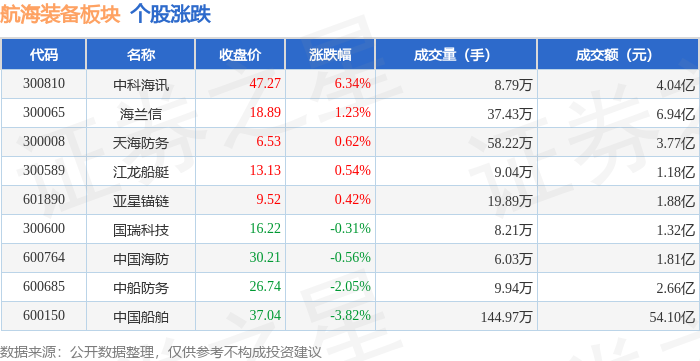
Market Performance - The marine equipment sector experienced a significant increase of 40.79% on September 16, with Zhongke Haixun leading the gains [1] - The Shanghai Composite Index closed at 3861.87, up 0.04%, while the Shenzhen Component Index closed at 13063.97, up 0.45% [1] Individual Stock Performance - Zhongke Haixun (300810) closed at 47.27, with a rise of 6.34% and a trading volume of 87,900 shares, amounting to a transaction value of 404 million yuan [1] - Hailanxin (300065) closed at 68.81, up 1.23%, with a trading volume of 374,300 shares and a transaction value of 694 million yuan [1] - Tianhai Defense (300008) closed at 6.53, with a slight increase of 0.62% [1] - Jianglong Shipbuilding (300589) closed at 13.13, up 0.54% [1] - Yaxing Anchor Chain (601890) closed at 9.52, up 0.42% [1] - Guorui Technology (300600) closed at 16.22, down 0.31% [1] - China Marine Defense (600764) closed at 30.21, down 0.56% [1] - Zhongchuan Defense (600685) closed at 26.74, down 2.05% [1] - China Shipbuilding (600150) closed at 37.04, down 3.82% with a significant trading volume of 1,449,700 shares and a transaction value of 5.41 billion yuan [1] Fund Flow Analysis - The marine equipment sector saw a net outflow of 1.063 billion yuan from institutional investors, while retail investors contributed a net inflow of 932 million yuan [1] - The detailed fund flow for individual stocks indicates varying levels of net inflow and outflow among different companies, with Zhongke Haixun experiencing a net inflow of 31.29 million yuan from institutional investors [2] - Other stocks like Tianhai Defense and Guorui Technology faced net outflows from institutional investors, while retail investors showed positive net inflows for several stocks [2]




招商证券:25H1船舶板块股价表现承压 继续看好后续主流船型放量
智通财经网· 2025-09-16 07:56
Core Viewpoint - The shipbuilding sector is experiencing pressure on stock prices in the first half of 2025, primarily due to a decline in market volume and prices, despite strong earnings performance from shipbuilding companies [1][2]. Group 1: Stock Performance and Fund Holdings - In the first half of 2025, the shipbuilding sector's stock prices underperformed compared to the CSI 300 index, with a notable year-on-year decline in fund holdings for major shipbuilding companies [2]. - Specifically, the fund holding ratio for China Shipbuilding decreased by 3.8 percentage points and 4.9 percentage points year-on-year in Q1 and Q2 of 2025, respectively, although there was a significant increase in Q2 compared to Q1, indicating renewed institutional interest [2]. Group 2: Earnings Performance - Shipbuilding companies reported impressive earnings growth, with profits increasing significantly more than revenues, driven by high-priced orders from around 2022 entering a delivery phase and a decrease in steel costs compared to 2021 [3]. - Key subsidiaries of China Shipbuilding, such as Waigaoqiao and China Shipbuilding Industry Corporation, have shown continuous growth in net profit margins and return on equity (ROE) over multiple reporting periods [3]. Group 3: Market Conditions - The shipbuilding market is facing a downturn, with new orders and new ship prices under significant downward pressure, as the shipping market has experienced a notable decline in freight rates, with major ship types seeing average price drops exceeding 20% year-on-year [4]. - Global new ship orders fell to 1.67 million CGT in May 2025, marking the lowest monthly level in nearly four years, and the Clarkson Global Newbuilding Price Index decreased from 189.96 in September 2024 to 186.69 in May 2025 [4]. - The decline in the domestic shipbuilding market is attributed to the impact of the U.S. Section 301 sanctions and a lower willingness of leading domestic shipyards to accept new orders [4]. Group 4: Future Outlook - The order capacity ratios for bulk carriers and oil tankers are currently low at 10.4% and 15%, respectively, indicating that the shipbuilding cycle has not yet reached its peak [5]. - BIMCO estimates that the potential number of ship demolitions over the next decade will reach 16,000 vessels, totaling 700 million deadweight tons (DWT), which is significantly higher than previous estimates [5]. - Despite short-term order pressures, the low order capacity ratios for mainstream ship types, particularly bulk carriers and medium to large oil tankers, suggest potential for future market recovery, especially with the anticipated impact of U.S. interest rate cuts on supply-demand dynamics [6]. Group 5: Recommendations - The shipbuilding sector is recommended for continued investment, with strong endorsements for companies such as China Shipbuilding (600150.SH) and China Power (600482.SH), along with suggestions to monitor China Shipbuilding Defense (600685.SH), CIMC (000039.SZ), Yaxing Anchor Chain (601890.SH), and Runbang Co., Ltd. (002483.SZ) [6].
