Shanghai Jahwa(600315)

Search documents
近3天获得连续资金净流入,A500ETF嘉实(159351)红盘蓄势,上海家化领涨成分股
Xin Lang Cai Jing· 2025-10-15 03:04
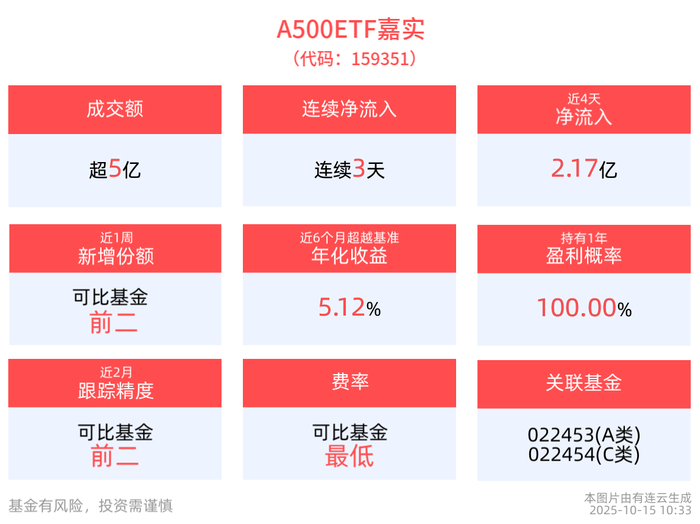
Core Viewpoint - The A500 index and A500 ETF have shown positive performance, with significant gains in individual stocks and overall market sentiment despite short-term volatility and external uncertainties [1][4][5]. Group 1: A500 Index Performance - As of October 15, 2025, the A500 index increased by 0.41%, with notable individual stock performances including Shanghai Jahwa up by 9.29% and Tongwei Co. up by 7.57% [1]. - The A500 ETF managed by Harvest has seen a cumulative increase of 16.45% over the past three months as of October 14, 2025 [1]. Group 2: A500 ETF Details - The A500 ETF has a trading turnover of 4.73% and a transaction volume of 559 million yuan, with its latest scale reaching 11.773 billion yuan [4]. - Over the past week, the A500 ETF's shares increased by 18.3 million, indicating significant growth [4]. - The ETF has experienced continuous net inflows over the last three days, totaling 21.7 million yuan, with a peak single-day inflow of 9.184 million yuan [4]. Group 3: Market Sentiment and Outlook - Despite short-term negative factors affecting the market, there is a clear expectation of improved corporate earnings and supportive policy signals, which are likely to sustain market momentum [4]. - According to Guosen Securities, the A-share market remains optimistic due to policy support, with a focus on traditional value sectors such as real estate, brokerage, and consumer goods in the fourth quarter [5]. Group 4: Top Weighted Stocks in A500 Index - As of September 30, 2025, the top ten weighted stocks in the A500 index include CATL, Kweichow Moutai, and Ping An Insurance, collectively accounting for 19% of the index [5].

美容护理板块走强,上海家化触及涨停

Xin Lang Cai Jing· 2025-10-15 02:08
Group 1 - The beauty and personal care sector is experiencing significant growth, with Shanghai Jahwa reaching its daily limit increase [1] - Shuiyang Co., Ltd. has seen an increase of over 8% in its stock price [1] - Other companies such as Kesi Co., Jiaheng Jiahua, Jinbo Biotechnology, and Babi Co. are also witnessing stock price increases [1]
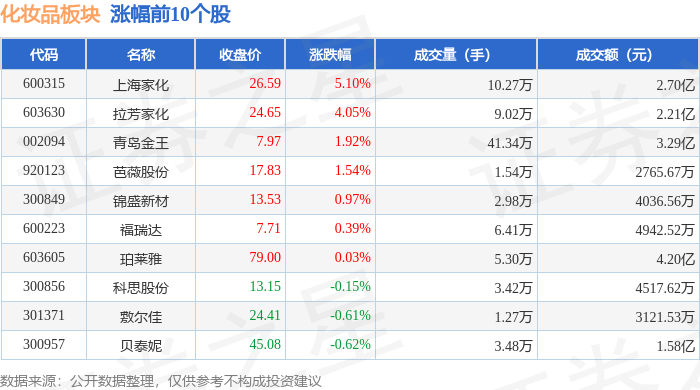
化妆品板块10月14日涨0.31%,上海家化领涨,主力资金净流出1328.42万元
Zheng Xing Xing Ye Ri Bao· 2025-10-14 08:46
Core Insights - The cosmetics sector experienced a slight increase of 0.31% on October 14, with Shanghai Jahwa leading the gains [1] - The Shanghai Composite Index closed at 3865.23, down 0.62%, while the Shenzhen Component Index closed at 12895.11, down 2.54% [1] Company Performance - Shanghai Jahwa (600315) closed at 26.59, up 5.10%, with a trading volume of 102,700 shares and a transaction value of 270 million yuan [1] - Lafang (603630) closed at 24.65, up 4.05%, with a trading volume of 90,200 shares and a transaction value of 221 million yuan [1] - Qingdao Kingway (002094) closed at 7.97, up 1.92%, with a trading volume of 413,400 shares and a transaction value of 329 million yuan [1] - Other notable performers include Bawei (920123) at 17.83 (+1.54%) and Jinsong New Materials (300849) at 13.53 (+0.97%) [1] Fund Flow Analysis - The cosmetics sector saw a net outflow of 13.28 million yuan from institutional investors, while retail investors experienced a net outflow of 46.69 million yuan [2] - Conversely, speculative funds recorded a net inflow of 59.98 million yuan [2] Individual Stock Fund Flow - Shanghai Jahwa had a net inflow of 29.86 million yuan from institutional investors, while retail investors saw a net outflow of 24.90 million yuan [3] - Lafang recorded a net inflow of 21.89 million yuan from institutional investors, with retail investors experiencing a net outflow of 21.61 million yuan [3] - Qingdao Kingway had a net inflow of 16.80 million yuan from institutional investors, while retail investors saw a net outflow of 18.67 million yuan [3]



中金:内地黄金周年轻人成消费主力悦己消费长期布局 推荐潮玩及电子烟等板块
Zhi Tong Cai Jing· 2025-10-13 08:26
Core Insights - The report from CICC indicates that the consumption data for the National Day and Mid-Autumn Festival holidays in 2025 shows strong performance, driven by longer holiday periods and a high level of domestic and outbound travel [1] Group 1: Consumption Trends - Overall consumption data reflects a youthful and experience-oriented trend, with notable performance in discretionary categories such as home appliances and outdoor sports [1] - The average daily flow of cross-regional personnel in mainland China from October 1 to 8 increased by 6.2% year-on-year, indicating a robust travel environment [1] - The average spending per trip during the holiday increased by 14.6% year-on-year, attributed to the ongoing recovery of outbound tourism and a rise in long-distance and segmented travel within the country [1] Group 2: Retail Performance - The Ministry of Commerce's monitoring of 78 key business districts showed a year-on-year increase in foot traffic and sales of 4.2% and 4% respectively during the first three days of the holiday [1] - Data from the National Immigration Administration revealed that the average daily number of inbound and outbound travelers exceeded 2 million, marking a 15% year-on-year increase [1] Group 3: Investment Recommendations - CICC recommends focusing on sectors benefiting from self-indulgent consumption trends, such as trendy toys and e-cigarettes, highlighting companies like Pop Mart (09992), Blucor (00325), and Smoore International (06969) [1] - The report also suggests investing in domestic brands in the beauty and personal care sectors, recommending companies like Mao Geping (01318), Giant Bio (02367), and Shanghai Jahwa (600315) [1] - Attention is drawn to retail sectors that may benefit from supportive domestic policies and seasonal catalysts [1]

化妆品医美行业周报:天猫双11下周开幕,抖音国货抢跑-20251012
Shenwan Hongyuan Securities· 2025-10-12 13:42
Investment Rating - The report gives a "Buy" rating for the cosmetics and medical beauty industry, particularly highlighting the potential of specific companies like Water Sheep Co., Ltd. [13] Core Insights - The cosmetics and medical beauty sector has underperformed the market recently, with the Shenwan Beauty Care Index rising by 1.3% from September 29 to October 10, 2025, which is lower than the overall market performance [3][4] - The upcoming Tmall Double 11 event is expected to boost sales, with domestic brands actively participating with competitive discounts [8] - Water Sheep Co., Ltd. is identified as a leading technology-driven beauty company, with stable revenue projections and improving profit margins [9][10] Summary by Sections Industry Performance - The cosmetics and medical beauty sector has shown weaker performance compared to the market, with the Shenwan Cosmetics Index increasing by 1.2%, lagging behind the Shenwan A Index by 0.4 percentage points [3][4] - The top-performing stocks in the sector include Jiaheng Home Care (+35.0%), Yiyi Co., Ltd. (+18.6%), and Yanjing Co., Ltd. (+15.6%) [5] Upcoming Events - Tmall's Double 11 sales event is set to begin on October 15, 2025, with major domestic brands like Proya and Maogeping expected to participate actively [8] Company Focus: Water Sheep Co., Ltd. - Water Sheep Co., Ltd. has a dual business model of proprietary and CP agency brands, with projected revenues stabilizing between 4 to 5 billion yuan from 2021 to 2024 [9] - The company is expected to achieve net profits of 258 million, 331 million, and 398 million yuan for the years 2025, 2026, and 2027, respectively, reflecting significant growth [10][13] Market Trends - The overall retail sales of cosmetics in August 2025 grew by 5.1%, indicating a recovery in consumer demand [17] - The domestic market is seeing a shift in market share, with local brands gaining ground against international competitors [25] E-commerce Insights - Data shows that domestic brands are performing well on platforms like Douyin and Tmall, with significant growth in GMV for brands like Proya and Maogeping [14][15] Company Developments - Proya has filed for an IPO in Hong Kong, with stable revenue growth and a strong online presence [19] - The report highlights the strategic moves of various companies, including partnerships and new product launches, to enhance their market positions [24][23]



化妆品企业为何再攻植物成分
经济观察报· 2025-10-11 08:21
Core Viewpoint - The domestic cosmetics industry is experiencing a significant transformation, focusing on the innovation of plant-based ingredients and the development of proprietary technologies for extracting and utilizing these ingredients effectively [1][4][14]. Group 1: Technological Advancements - Since 2022, the domestic cosmetics industry has gradually mastered the full-process technology of "active substance labeling, impurity separation, and purity control" [10]. - Companies like Yunnan's Betaini have successfully extracted beneficial components from plants, such as the Qingci fruit, which has shown efficacy in skin barrier repair and anti-aging [2][11]. - The use of AI technology has accelerated the identification and extraction of effective plant components, allowing for higher purity and better efficacy in products [12]. Group 2: Market Trends - There is a growing trend among domestic cosmetics companies to utilize plant-based ingredients as a key differentiator in product offerings, with many brands showcasing their latest research and development at industry conferences [3][6]. - The number of new plant-based raw materials registered has increased significantly, from 3 in 2022 to 42 in 2024, indicating a shift towards plant-based ingredients dominating the market [7]. - The market for domestic cosmetics is expanding, with local brands capturing over 55.2% of the market share, surpassing foreign brands [15]. Group 3: Investment and Capital Market - Several companies focusing on plant-based ingredients have initiated IPO processes, reflecting increased investor interest in the sector [14]. - Notable investments have been made in companies with capabilities in plant raw material research, indicating a strong market confidence in the potential of domestic plant-based cosmetics [14]. Group 4: Future Outlook - The domestic cosmetics industry is expected to continue its shift towards using local plant resources, with predictions that domestic raw materials will account for over 80% of the market share in the future [15]. - As the industry matures, the purity, stability, and efficacy of domestic raw materials are approaching or even surpassing international standards, enhancing brand confidence in local sourcing [15].
化妆品企业为何再攻植物成分
Jing Ji Guan Cha Wang· 2025-10-11 07:08
Core Insights - The Chinese cosmetics industry is increasingly focusing on plant-based ingredients as a key differentiator and competitive advantage in product development [2][3][9] - The number of new plant-based raw materials registered has surged, indicating a significant shift towards natural ingredients in the cosmetics sector [4][5][11] Group 1: Industry Trends - The trend of utilizing local plant ingredients is becoming a common strategy among domestic cosmetics companies, with many brands showcasing their innovative plant-based products at industry events [2][3] - The number of plant-based raw materials registered with the National Medical Products Administration has increased from 3 in 2022 to 42 in 2024, surpassing chemical raw materials [4] - The market for domestic cosmetics is growing, with local brands capturing over 55.2% of the market share, indicating a shift in consumer preference towards homegrown products [11] Group 2: Technological Advancements - Advances in technology have enabled the extraction and identification of active components from plants, allowing for more targeted and effective product formulations [6][7] - Companies like谷雨 have successfully utilized AI technology to enhance the purity and efficacy of their plant-based ingredients, leading to breakthroughs in product development [8] - The development of proprietary extraction techniques has allowed companies to produce high-purity plant extracts at scale, significantly reducing costs and increasing market competitiveness [7][10] Group 3: Market Dynamics - The increasing interest in plant-based ingredients has led to a rise in IPO applications from companies specializing in these materials, reflecting investor confidence in the sector [10] - The push for domestic raw material sourcing is reshaping the supply chain dynamics, with companies advocating for the use of local ingredients to reduce reliance on imports [10][11] - The cosmetics industry is at a critical turning point, with local plant resources becoming a vital demand for future product development [2][4]
化妆品企业为何再攻植物成分|科技赋能新消费
Jing Ji Guan Cha Wang· 2025-10-11 07:07
Core Insights - The Chinese cosmetics industry is experiencing a significant shift towards the use of domestic plant ingredients, driven by innovation and the demand for unique, region-specific components [4][6][12] Group 1: Industry Trends - The trend of utilizing plant-based ingredients has become a common strategy among domestic cosmetics companies, with many brands showcasing their research and development achievements at industry events [3][5] - The number of new plant-based raw materials registered has surged, with 42 new plant materials recorded in 2024, surpassing chemical raw materials for the first time [6][12] - The market for domestic brands is growing, with over 55.2% market share in 2024, indicating a shift away from reliance on foreign brands [13] Group 2: Technological Advancements - Advances in technology have enabled the precise extraction and identification of active ingredients from plants, enhancing the efficacy of cosmetic products [8][9] - Companies are increasingly using AI technology to streamline the selection of effective cosmetic ingredients, significantly improving the efficiency of product development [10] Group 3: Market Dynamics - The capital market is showing increased interest in companies that focus on plant-based ingredients, with several firms initiating IPO processes and attracting significant investments [11][12] - The push for domestic raw material usage is expected to reshape the market landscape, with predictions that local ingredients will dominate the market share in the future [12][13]
万亿美妆市场洗牌加速:靠营销的短命品牌退场,研发型公司逆势突围
Di Yi Cai Jing· 2025-10-11 07:01
Core Insights - The Chinese fragrance and cosmetics industry is transitioning from "incremental competition" to "stock game" dynamics, with a shift from channel-driven to brand-driven competition [1] - The market size of China's cosmetics industry has exceeded 1 trillion yuan for two consecutive years, making it the largest cosmetics consumer market globally [1] - Companies are focusing on technological innovation, brand value reconstruction, and collaborative networks to enhance their competitiveness in the global value chain [1] Industry Trends - The Chinese cosmetics market is projected to reach a total transaction value of 1,073.82 billion yuan in 2024, reflecting a year-on-year growth of 2.8% [3] - The core driving force of the cosmetics market is the innovation in raw materials, with domestic companies primarily concentrated in the mid-to-low-end sectors [3] - Many local beauty companies are investing in R&D to develop proprietary raw materials, moving away from reliance on imports [5][6] Technological Advancements - Companies like Huaxi Biological Technology are emphasizing the importance of core technology and R&D capabilities to survive in a competitive market [2] - Natural堂 has developed over 20 proprietary raw materials, showcasing a shift from dependence on imports to self-sufficiency in high-quality ingredients [6] - The Chinese government is implementing policies to support innovation in cosmetic raw materials, including expedited review processes for new ingredients [7] Collaborative Efforts - The establishment of partnerships between research institutions and cosmetic companies aims to bridge the gap between laboratory innovations and market applications [9][12] - The launch of the "Beautiful Health Medical Research and Enterprise Transformation Center" in Nanjing signifies a commitment to enhancing collaboration in the industry [9] - Shanghai Jahwa's collaboration with the Chinese Academy of Traditional Chinese Medicine highlights the potential of traditional ingredients like artemisinin in skincare applications [11]


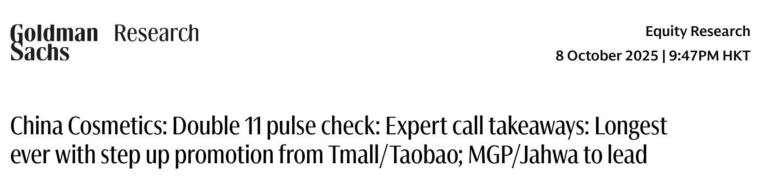
双11箭在弦上,高盛专家:本土美妆品牌领跑,上海家化、毛戈平位居高增长梯队
Zhi Tong Cai Jing· 2025-10-10 14:16
Core Viewpoint - Goldman Sachs is optimistic about the growth of local Chinese beauty brands during the upcoming Double 11 shopping festival, predicting that brands like Shanghai Jahwa and Mao Geping will lead the high-growth tier [2]. Group 1: GMV Targets and Growth Expectations - Tmall/Taobao aims for a total GMV growth of 20%-25% (approximately 600 billion), with the beauty category expected to grow around 20% [2]. - Douyin is projected to achieve over 40% GMV growth across the platform, with the beauty category exceeding 30%, making it a key growth driver [3]. - Tmall's promotional efforts are more aggressive than previous events, while Douyin continues to attract brand investments through content e-commerce and live streaming advantages [3]. Group 2: Promotional Period Extensions - The promotional period for Double 11 has been extended significantly this year, with Douyin extending by 22 days, starting pre-sales on September 16 [4]. - JD.com has extended its promotional period by 8 days, while Tmall has added 2 days, with pre-sales starting on October 15 [5]. Group 3: Brand Performance Insights - Local leading brands are expected to outperform the industry, with high-growth brands like Mao Geping (40%-50%) and Shanghai Jahwa showing strong potential [6]. - Multinational high-end brands like Lancôme and Estée Lauder are expected to grow between 10%-30%, while mass-market brands face pressure with growth below 10% [7]. Group 4: KOL Trends and Strategies - The trend is shifting towards mid-tier KOLs, with Douyin directing traffic towards them, resulting in reduced commission rates for brands [8]. - Both local and multinational brands are adopting a dual strategy of collaborating with both top-tier and mid-tier KOLs to enhance reach and conversion efficiency [8]. Group 5: Industry Dynamics and Consumer Experience - The Double 11 event is seen as an accelerator for industry differentiation, with local brands gaining market share through live streaming and product innovation [8]. - Consumers will benefit from a longer promotional period, lower prices, and simplified rules, while investors should focus on high-growth local leaders and established multinational brands [8].