
NARI-TECH(600406)

Search documents
“科技成长+周期”交相辉映,央企创新驱动ETF(515900)盘中翻红,近2周新增规模居可比基金首位
Sou Hu Cai Jing· 2025-07-29 07:13
Core Insights - The Central State-Owned Enterprises Innovation-Driven Index (000861) has shown a 0.31% increase as of July 29, 2025, with notable stock performances from companies like Changfei Fiber (9.58% increase) and China Railway Construction Heavy Industry (5.43% increase) [3] - The Central State-Owned Enterprises Innovation-Driven ETF (515900) has risen by 0.32%, with a recent price of 1.55 yuan, and has accumulated a 3.77% increase over the past two weeks [3] - Market consensus remains focused on "low valuation cycle recovery" and "technology growth industry trends," with sector rotation intensifying [3] Performance Metrics - The Central State-Owned Enterprises Innovation-Driven ETF has seen a significant scale increase of 1.16 billion yuan over the past two weeks, ranking in the top quarter among comparable funds [4] - The ETF's net value has increased by 11.25% over the past year, with a maximum monthly return of 15.05% since inception [4] - The ETF has a year-to-date relative drawdown of 0.08%, with the fastest recovery time among comparable funds at 105 days [5] Fee and Tracking Precision - The management fee for the Central State-Owned Enterprises Innovation-Driven ETF is 0.15%, and the custody fee is 0.05%, both of which are the lowest among comparable funds [5] - The ETF has a tracking error of 0.038% over the past five years, indicating the highest tracking precision among comparable funds [5] Index Composition - The Central State-Owned Enterprises Innovation-Driven Index comprises 100 representative listed companies evaluated for innovation and profitability, with the top ten weighted stocks accounting for 34.87% of the index [5]





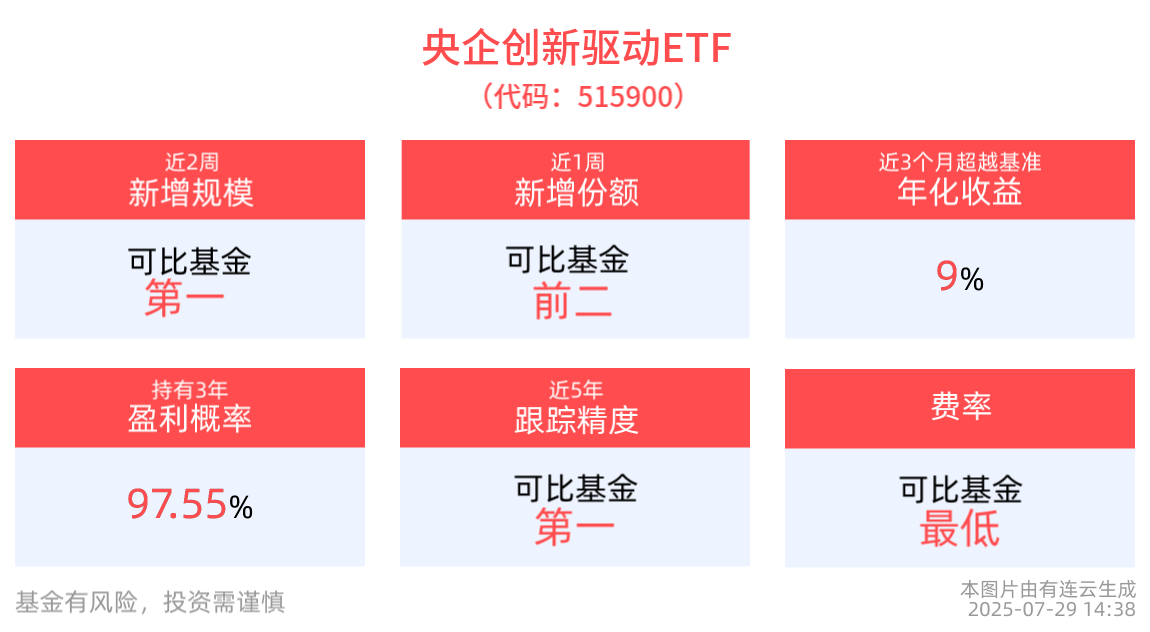
上证一带一路主题指数下跌0.78%,前十大权重包含国电南瑞等
Sou Hu Cai Jing· 2025-07-28 09:13
Group 1 - The Shanghai One Belt One Road Theme Index (沪新丝路, 000160) experienced a decline of 0.78%, closing at 1876.36 points with a trading volume of 60.892 billion yuan [1] - Over the past month, the index has increased by 7.85%, by 9.64% over the last three months, and by 1.68% year-to-date [1] - The index reflects the overall performance of representative securities in five major industries: infrastructure, transportation, high-end equipment, power communication, and resource development [1] Group 2 - The top ten weighted stocks in the index include Zijin Mining (5.18%), Wanhua Chemical (4.86%), Sany Heavy Industry (4.85%), China State Construction (4.75%), COSCO Shipping Holdings (4.25%), China Petroleum (4.03%), CRRC Corporation (3.78%), NARI Technology (3.66%), Sinopec (3.56%), and China Shipbuilding Industry (3.22%) [1] - The index's holdings are entirely composed of stocks listed on the Shanghai Stock Exchange, with a 100% allocation [1] Group 3 - From an industry perspective, the index's sample holdings consist of 61.26% in industrials, 23.60% in materials, 10.42% in energy, 3.47% in communication services, and 1.27% in utilities [2] - The index samples are adjusted quarterly, with adjustments occurring in the second Friday of March, June, September, and December, and the sample proportion typically does not exceed 20% [2]

国电南瑞(600406) - 国电南瑞第九届董事会第六次会议决议公告
2025-07-28 08:00
本公司董事会及全体董事保证本公告内容不存在任何虚假记载、误导性陈 述或者重大遗漏,并对其内容的真实性、准确性和完整性承担个别及连带责任。 经国电南瑞科技股份有限公司(以下简称"国电南瑞"、"公司")董事会 于 2025 年 7 月 23 日以会议通知召集,公司第九届董事会第六次会议于 2025 年 7 月 28 日以现场结合视频方式召开,应到董事 10 名,实到董事 10 名,公司监 事及高级管理人员列席了本次会议,会议由董事长郑宗强先生主持,会议符合《公 司法》和《公司章程》的有关规定,会议合法有效。经会议审议,形成如下决议: 一、会议以 10 票同意,0 票反对,0 票弃权,审议通过关于聘任公司高级 管理人员的议案。 根据《公司法》、《公司章程》等相关规定,经董事会提名委员会提名,董 事会聘任尚学伟先生为公司总工程师,任期至本届董事会届满日止。 董事会提名委员会事前对总工程师候选人的任职资格和履历进行了审查,认 为尚学伟先生符合任职条件,同意将此议案提交董事会审议。 证券代码:600406 证券简称:国电南瑞 公告编号:临 2025-042 国电南瑞科技股份有限公司 第九届董事会第六次会议决议公告 国电南 ...
嘉实中证央企创新驱动ETF投资价值分析:一键布局具有创新活力的优质央企
Guotou Securities· 2025-07-27 10:29
Quantitative Models and Construction Methods Model Name: Central Enterprise Innovation Index (000861.CSI) - **Model Construction Idea**: The index selects 100 representative listed companies under the State-owned Assets Supervision and Administration Commission (SASAC) based on their innovation and profitability to reflect the overall performance of innovative central enterprises[8] - **Model Construction Process**: - **Sample Space**: All listed companies under SASAC[9] - **Step 1**: Rank the securities in the sample space by average daily trading volume over the past year and exclude the bottom 20%[9] - **Step 2**: Select the remaining securities controlled by SASAC and its subsidiaries[9] - **Step 3**: Exclude securities with negative operating cash flow in the past year and negative net profit excluding non-recurring items in the past two years[9] - **Step 4**: Calculate the innovation score for non-financial companies based on R&D expenditure, R&D personnel ratio, patent quality score, and participation in national or industry standards. For financial companies, use revenue, net profit, patent quality score, and participation in standards[9] - **Step 5**: Rank the remaining securities by innovation score and select the top 50% as innovation-themed securities[9] - **Step 6**: Calculate the quality score for non-financial companies based on ROE, net profit growth, earnings quality, and financial leverage. For financial companies, use ROE and net profit growth. Combine the quality score with the scale score (based on market cap) to get a comprehensive score[9] - **Step 7**: Select the top 100 securities by comprehensive score as index samples[9] - **Adjustment**: The index samples are adjusted semi-annually[9] - **Model Evaluation**: The index is designed to reflect the performance of innovative central enterprises, with a focus on maintaining representativeness and accuracy through regular adjustments[8][9] Model Backtesting Results - **Central Enterprise Innovation Index**: - **Cumulative Return Since Inception**: 138.08%[5][10] - **Excess Return Over Major Indices**: - CSI 300: 79.25%[5] - SSE Composite Index: 83.67%[5] - CSI 500: 54.40%[5] - CSI 800: 74.09%[5] - **5-Year Cumulative Return**: 33.70%[10] - **Excess Return Over Major Indices in 5 Years**: - CSI 300: 49.24%[10] - SSE Composite Index: 29.47%[10] - CSI 800: 47.94%[10] Quantitative Factors and Construction Methods Factor Name: Innovation Score - **Factor Construction Idea**: Evaluate the innovation capability of non-financial and financial companies based on specific indicators[9] - **Factor Construction Process**: - **Non-Financial Companies**: - R&D expenditure to market cap ratio (40% weight) - R&D personnel ratio (10% weight) - Patent quality score (40% weight) - Participation in national or industry standards (10% weight)[9] - **Financial Companies**: - Revenue (40% weight) - Net profit (10% weight) - Patent quality score (40% weight) - Participation in national or industry standards (10% weight)[9] - **Calculation**: Sum the weighted scores to get the innovation score[9] Factor Name: Quality Score - **Factor Construction Idea**: Assess the financial quality of companies based on profitability and financial stability[9] - **Factor Construction Process**: - **Non-Financial Companies**: - ROE (30% weight) - Net profit growth (35% weight) - Earnings quality (25% weight) - Financial leverage (10% weight)[9] - **Financial Companies**: - ROE (50% weight) - Net profit growth (50% weight)[9] - **Calculation**: Sum the weighted scores to get the quality score[9] Factor Backtesting Results - **Innovation Score**: - **Top 50% Selection**: Used to identify innovation-themed securities[9] - **Quality Score**: - **Comprehensive Score Calculation**: Combined with scale score to select top 100 securities[9]






美国电力系统都在用中文?中国行业专家:中国标准就是国际标准
Sou Hu Cai Jing· 2025-07-25 08:03
Core Viewpoint - The article highlights China's significant advancements in ultra-high voltage (UHV) transmission technology, which has positioned the country as a global leader in the power sector, surpassing Western nations in both technology and influence [2][29]. Group 1: Historical Context - China's electricity industry began with reliance on imported American equipment, with the first electric light in Shanghai in 1882 [5]. - Initially, China's power generation ranked 21st globally, but the demand surged post-economic reforms, revealing structural challenges in energy distribution [5][10]. Group 2: Technological Development - The geographical and demographic disparities in China necessitated efficient power transmission solutions, leading to the development of UHV technology [7][10]. - UHV transmission lines can increase capacity by approximately five times and significantly reduce transmission losses over long distances, with effective ranges exceeding 2000 kilometers [8][10]. Group 3: Implementation and Achievements - The first UHV AC demonstration project was operational in 2009, marking a significant technological breakthrough [14]. - By 2023, China had constructed 40,000 kilometers of UHV lines, capable of transmitting over 2 trillion kilowatt-hours annually, equivalent to reducing coal transport by 600 million tons [16][18]. Group 4: Global Influence - China's UHV technology has become the world's largest and most advanced network, with comprehensive mastery over design, manufacturing, construction, and operation [18][19]. - The successful application of this technology has not only addressed domestic energy distribution challenges but has also gained international recognition, with projects in Brazil and the Philippines utilizing Chinese technology [27][29]. Group 5: Challenges and Future Prospects - Despite the success, the global promotion of UHV technology faces challenges, particularly in developed countries like the United States, due to complex geographical and regulatory environments [33][35]. - China's advancements in UHV technology provide a viable solution to global energy, environmental, and climate issues, contributing to a sustainable future [37][40].

特高压概念下跌2.38%,13股主力资金净流出超亿元
Zheng Quan Shi Bao Wang· 2025-07-23 08:43
截至7月23日收盘,特高压概念下跌2.38%,位居概念板块跌幅榜前列,板块内,安靠智电、通达股 份、电科院等跌幅居前,股价上涨的有9只,涨幅居前的有C山大、中国电建、斯瑞新材等,分别上涨 356.00%、10.08%、4.10%。 今日涨跌幅居前的概念板块 | 600361 | 创新新材 | -0.72 | 3.43 | -1610.69 | | --- | --- | --- | --- | --- | | 603333 | 尚纬股份 | -1.69 | 4.06 | -1525.84 | | 300712 | 永福股份 | -6.24 | 4.76 | -1525.34 | | 603861 | 白云电器 | -2.92 | 3.01 | -1512.64 | | 002350 | 北京科锐 | -2.74 | 2.42 | -1488.14 | | 300831 | 派瑞股份 | -1.85 | 12.16 | -1390.09 | | 601096 | 宏盛华源 | -1.96 | 2.40 | -1346.94 | | 002358 | 森源电气 | -2.51 | 6.28 | -1249.59 ...


趋势研判!2025年中国智能化开关设备行业产业链、发展现状、竞争格局及发展趋势分析:技术赋能产业升级,千亿蓝海加速扩容[图]
Chan Ye Xin Xi Wang· 2025-07-23 01:15
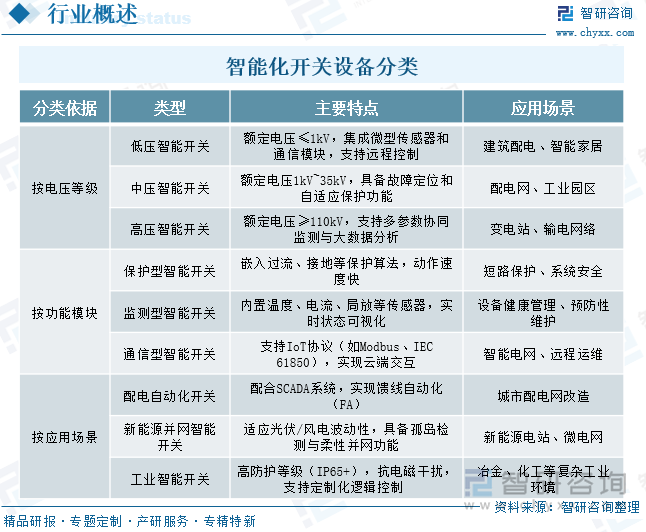
Core Insights - The Chinese smart switch equipment industry is experiencing unprecedented growth opportunities as a core component of the new power system, driven by the integration of modern sensing, digital processing, communication, and intelligent control technologies [1][11] - The market size is projected to reach 132 billion yuan in 2024, with a year-on-year growth of 20%, and is expected to exceed 150 billion yuan by 2025 [1][11] - The industry is evolving towards the third generation of intelligent systems with the deepening application of 5G-A and edge intelligence technologies [1][11] Industry Overview - Smart switch equipment integrates modern sensing, digital processing, communication technologies, and intelligent control algorithms, enhancing the reliability and efficiency of power systems [2][11] - The equipment is categorized by voltage levels (low, medium, high), functionality (protection, monitoring, communication), and application scenarios (distribution automation, renewable energy integration, industrial applications) [3][2] Industry Policies - The smart switch equipment sector is pivotal for the intelligent upgrade of power systems and has been elevated to a key focus in national energy transition strategies under the "dual carbon" initiative [4][5] - Multiple policies have been introduced to accelerate the development of clean, low-carbon, and efficient power systems, providing strategic guidance for the deep application of smart switch equipment [4][5] Industry Value Chain - The industry value chain consists of upstream raw materials and core components, midstream manufacturing focusing on equipment integration and intelligent upgrades, and downstream applications across diverse scenarios [6][11] Market Applications - The smart switch equipment market is diversified, with the power sector holding a 40% share, followed by industrial automation (25%-30%) and smart home applications (20%-25%) [13][11] - The penetration rate of smart technology in the power sector is expected to reach 30% by 2024, corresponding to a market size of approximately 41.7 billion yuan [13][11] Competitive Landscape - The industry features a three-tier competitive structure with foreign companies dominating the high-end market, domestic firms gaining ground in the mid-tier, and emerging players penetrating various application scenarios [15][17] - Domestic companies like Guodian NARI and Pinggao Electric have increased their market share significantly, with Guodian NARI achieving a 28% market share in 2024 [15][17] Development Trends - The industry is moving towards deep technological integration, diversified application scenarios, and global supply chain integration [19][22] - Key trends include the transition from passive control to proactive decision-making, expansion into new application areas, and the establishment of collaborative ecosystems among industry players [19][22]


建设全国统一电力市场体系跨电网交易机制加速推进
news flash· 2025-07-23 00:06
Core Viewpoint - The National Development and Reform Commission and the National Energy Administration have announced the normalization of cross-grid electricity trading this year, aiming to establish a unified national electricity market system [1] Group 1: Policy and Market Structure - A new mechanism will create an "online electricity mall" between the State Grid and the Southern Grid, facilitating the free flow of electricity resources nationwide [1] - The initiative aims to enhance the convenience of green electricity consumption, allowing eastern enterprises to purchase market-based wind and solar power from the west [1] Group 2: Implementation and Impact - The first cross-regional green electricity transaction has been completed, achieving mutual electricity supply and demand between Xinjiang and Guangdong, thereby improving electricity supply security [1]
财经早报:事关人民币汇率、外资增持境内股票等,外汇局发声!可控核聚变国家队来了,逾百亿资本入局
Xin Lang Zheng Quan· 2025-07-22 23:54
Group 1 - The State Administration of Foreign Exchange reported that foreign capital's investment in RMB assets remains stable, with foreign holdings of domestic RMB bonds exceeding $600 billion [2] - In the first half of the year, foreign investors net increased their holdings of domestic stocks and funds by $10.1 billion, reversing a two-year trend of net reductions [2] - The Central Huijin Investment Company significantly increased its holdings in ETFs by over $200 billion in Q2 2025, aligning with policy directions to stabilize market expectations [6] Group 2 - The People's Bank of China reported a year-on-year increase of 7.1% in the total balance of RMB loans, reaching 268.56 trillion yuan by the end of Q2 2025 [3] - The balance of loans to enterprises and institutions in both RMB and foreign currencies reached 182.47 trillion yuan, with a year-on-year growth of 8.6% [3] - Fixed asset loans increased by 7.8% year-on-year, totaling 76.82 trillion yuan, indicating a positive trend in investment [3] Group 3 - The establishment of China Fusion Energy Company aims to advance the commercialization of fusion energy, with significant capital involvement from various state-owned enterprises [7] - The recent surge in industrial commodity futures, including coal and silicon, reflects a strong market response to government policies aimed at reducing overproduction [8] Group 4 - The 2025 Fortune China 500 list revealed that the total revenue of the listed companies was $14.2 trillion, a decrease of approximately 2.7% from the previous year, while net profits increased by about 7% [13] - State Grid Corporation topped the list with a revenue of $548.4 billion, followed by China Petroleum and Sinopec [13]



统一电力市场建设迈出关键步伐
Jing Ji Ri Bao· 2025-07-22 22:07
Core Viewpoint - The establishment of a nationwide unified electricity market system is a crucial task for deepening electricity system reform and building a unified national market, with the recent implementation of a normalized electricity trading mechanism across grid operation areas accelerating this process [1][2]. Group 1: Market Structure and Development - The electricity industry in China has transitioned from a planned electricity system to a market-oriented one, with market transactions expected to exceed 6 trillion kilowatt-hours in 2024, accounting for 63% of total electricity transactions [1]. - The separation of the State Grid and Southern Grid since the 2002 reform has led to a lack of interconnection and a normalized trading mechanism, hindering the optimal allocation of electricity resources nationwide [1][2]. Group 2: Cross-Grid Trading Mechanism - The newly established cross-grid trading mechanism allows for a unified online electricity marketplace, enabling electricity resources to flow freely across the country based on a standardized set of rules [2][3]. - The mechanism facilitates the collection of cross-grid trading demands and ensures precise matching of supply and demand through information exchange between trading centers in Beijing and Guangzhou [3]. Group 3: Green Energy Consumption - The new trading mechanism enhances the convenience of green energy consumption, allowing renewable energy projects to participate as basic trading units, thus promoting the free flow of green electricity between regions [3][4]. - The first cross-regional green electricity transaction was successfully completed in March, demonstrating the practical application of the new trading mechanism [3]. Group 4: Supply and Demand Management - The cross-grid trading mechanism has already shown initial effectiveness, with significant volumes of green electricity traded between regions, particularly during peak demand periods [6]. - The mechanism is expected to improve the utilization of transmission channels and enhance the capacity for renewable energy consumption, thereby providing more flexible supply guarantees [6]. Group 5: Future Development Directions - In 2023, the country plans to implement normalized trading across various timeframes, supporting electricity supply during peak demand periods and exploring long-term green electricity trading agreements [7]. - The ongoing physical interconnection between the State Grid and Southern Grid will further enhance resource optimization capabilities, leading to more frequent and shorter trading cycles [7].