JAC(600418)

Search documents
抢占市场空间,欧拉、星途、江淮汽车等硬核产品亮相广州车展
Nan Fang Du Shi Bao· 2025-11-26 06:42
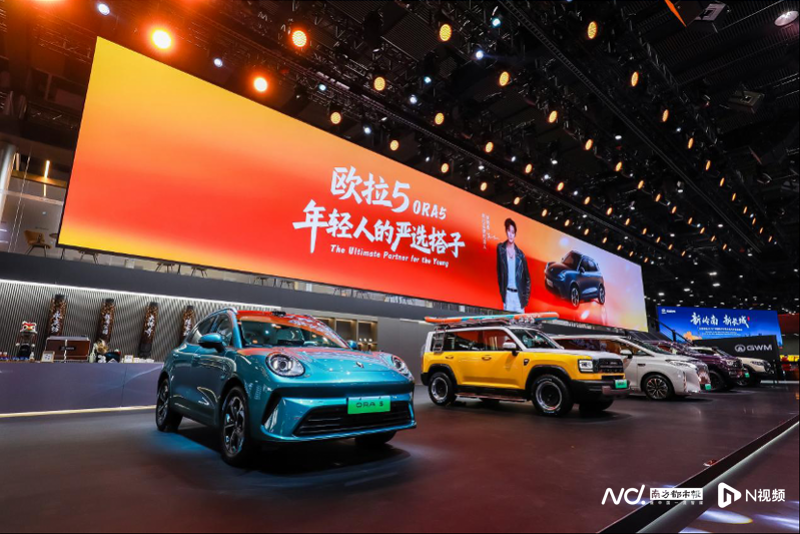
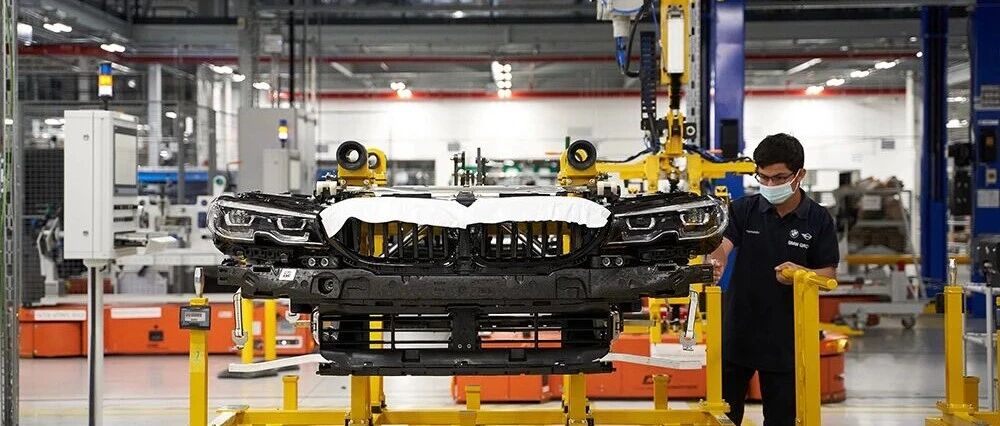
Group 1: Industry Overview - The Chinese electric vehicle (EV) market is entering a "淘汰赛" (elimination round), with lesser-known brands attempting to find opportunities in differentiated segments [1] - The Guangzhou Auto Show serves as a significant observation point for these developments in the EV sector [1] Group 2: Ora 5 Launch and Promotions - Ora 5 has upgraded its pre-sale benefits, increasing the offer from "1000 yuan for 3000 yuan" to "1000 yuan for 5000 yuan," along with additional incentives such as a maximum of 5000 yuan for trade-ins and complimentary features [2] - The pre-sale benefits will remain effective until the launch event of Ora 5, ensuring that all previous orders also receive these upgrades [2] Group 3: Ora 5 Features and Target Market - Ora 5 is equipped with advanced safety features, including the "二代短刀电池" (second-generation short blade battery) and a "master-level chassis" developed by a team from BMW [4] - The vehicle boasts an impressive energy consumption rate of 11.6 kWh per 100 km and features the Coffee Pilot Ultra driver assistance system, which operates without high-precision maps [4] - The brand aims to resonate with young consumers who seek a vehicle that reflects their lifestyle and values [4] Group 4: Jianghuai Automobile's Innovations - Jianghuai Automobile is focusing on high-end and intelligent transformation, showcasing multiple products at the Guangzhou Auto Show, including the 尊界S800 and various prototype vehicles [4][6] - The partnership with Huawei has led to significant advancements in management processes and digital transformation, enhancing R&D efficiency and market responsiveness [6] - The 尊界S800 has received over 18,000 pre-orders, breaking into the luxury sedan market traditionally dominated by international brands [6] Group 5: Starway Automotive's Product Matrix - Starway Automotive presented its new energy product lineup at the Guangzhou Auto Show, including the pre-sale Starway ET5 and the debut of ES HERO and ES7 GT models [7] - The Starway ET5 features the advanced 猎鹰700 intelligent driving system and a high-performance audio system, enhancing the driving experience [9] - Starway Automotive has expanded its market presence globally, achieving over 550,000 cumulative sales, with an average selling price exceeding 400,000 yuan in overseas markets [9]

尊界明年将推6款车,江淮大整合“一切为了尊界”|36氪独家
3 6 Ke· 2025-11-25 13:27
Core Insights - The luxury car brand ZunJie, a collaboration between Huawei and JAC Motors, has successfully entered the luxury market with its first model, the ZunJie S800, priced between 708,000 and 1,018,000 yuan, and plans to launch six additional models next year [1][2][4] - The upcoming models will include both SUV and MPV variants, with a focus on high-end market positioning, aiming to capture a larger share of the luxury vehicle segment [1][6] Model Launch and Market Strategy - ZunJie will introduce two versions of both SUVs and MPVs: standard and long-wheelbase, catering to different consumer needs [1][7] - The ZunJie S800 has already received over 18,000 pre-orders within 100 days of its launch, indicating strong market demand [4][6] - JAC Motors is consolidating its resources by integrating heavy-duty and light-duty truck operations while pausing investments in its other passenger car brands to focus on ZunJie [5][6] Competitive Landscape - The ZunJie S800 is positioned against high-end competitors like the Maybach S-Class, which has delivered approximately 9,000 units in the first ten months of the year [3][4] - The introduction of ZunJie’s new models is expected to create competition with existing high-end models such as the Li Auto MEGA, Zeekr 009, and Toyota Alphard, which may face market share erosion [15][19] Financial Implications - JAC Motors reported a revenue of 30.873 billion yuan in the first three quarters of the year, a decline of 4.14% year-on-year, with a net loss of 1.434 billion yuan, down 329.43% [19] - The anticipated sales from ZunJie, particularly from the 18,000 pre-orders of the S800, could generate over 12 billion yuan in revenue, potentially improving JAC's financial performance in the coming year [19]

江淮汽车申请混合动力汽车尾气处理系统及方法专利,提高尾气处理效率减少尾气污染
Jin Rong Jie· 2025-11-25 06:44
Group 1 - The core viewpoint of the news is that Anhui Jianghuai Automobile Group Co., Ltd. has applied for a patent for a hybrid vehicle exhaust treatment system, which aims to improve exhaust treatment efficiency and reduce pollution [1] Group 2 - Anhui Jianghuai Automobile Group Co., Ltd. was established in 1999 and is located in Hefei City, primarily engaged in the automotive manufacturing industry [2] - The company has a registered capital of 218,400.9791 million RMB and has invested in 47 enterprises, participated in 5,000 bidding projects, and holds 946 trademark records and 5,000 patent records [2] - Additionally, the company possesses 672 administrative licenses [2]
墨西哥蒙特雷:北美“新东莞”?
财富FORTUNE· 2025-11-24 13:07
Core Insights - Monterrey is emerging as a key node in North American supply chains, driven by a shift from "efficiency-first" to "resilience-first" strategies in global supply chains [3][5] - The rise of Monterrey is not about replacing "Made in China" but rather represents a "China Plus" strategy, positioning itself as the "North American Dongguan" [3][5] Geopolitical and Economic Factors - Geopolitical tensions and the COVID-19 pandemic have prompted companies to seek manufacturing bases outside of China, with Mexico surpassing China as the largest source of imports to the U.S. in 2023 [5][6] - U.S. imports from China fell by 20% to $427.2 billion, while imports from Mexico reached $475.6 billion [5] - The USMCA agreement has provided policy certainty for local manufacturing, requiring a 75% North American content ratio for automobiles [5][6] Industrial Ecosystem Development - Monterrey is developing an industrial ecosystem similar to that of Dongguan, focusing on automotive, electronics, and renewable energy sectors [6][8] - Major companies like Tesla are investing significantly in Monterrey, creating a "magnet effect" that attracts other businesses [8][9] Chinese Investment in Monterrey - Chinese companies are increasingly establishing a presence in Monterrey to bypass USMCA barriers, with notable investments from Hisense and Trina Solar [10][11][12] - Estimates suggest that Chinese foreign direct investment (FDI) in Mexico could exceed $10 billion from 2023 to 2025, with a significant portion in Nuevo León, where Monterrey is located [13] Comparative Advantages and Challenges - Monterrey shares similarities with Dongguan, such as industrial clusters and competitive labor costs, but faces unique challenges like infrastructure limitations and water shortages [14][15][16] - The average manufacturing wage in Monterrey is projected to rise from $3.70 in 2023 to around $6.10 by 2025, posing a challenge for companies [16] Future Outlook - The emergence of Monterrey signals a restructuring of global supply chains into major regional hubs, with potential for "three major Dongguans" in North America, Europe, and Asia [18] - Companies must adapt to new risks and manage local relationships, emphasizing the importance of ESG and community engagement [17][19]



江淮汽车携多款智电产品闪耀2025广州车展
Zhong Guo Qi Che Bao Wang· 2025-11-24 10:44
Core Viewpoint - Jianghuai Automobile is showcasing its transformation from traditional manufacturing to a technology-driven enterprise at the 2025 Guangzhou International Auto Show, emphasizing high-end and intelligent upgrades [1] Group 1: Strategic Partnerships and Innovations - The collaboration between Jianghuai Automobile and Huawei has led to the successful launch of the Zun Jie S800, which has received over 18,000 pre-orders, breaking into the luxury sedan market traditionally dominated by international brands [3] - Since 2019, Jianghuai and Huawei have formed a deep strategic partnership, integrating advanced management processes to enhance R&D efficiency and market responsiveness, laying a solid foundation for building a globally competitive high-end brand [5] - Jianghuai is actively embracing Huawei's advanced technologies in smart driving and smart cockpit to explore new intelligent automotive products and experiences [5] Group 2: Product Showcase and Technological Advancements - At the auto show, Jianghuai is presenting multiple models including the Zun Jie S800, DEFINE prototype vehicles, Han Tu PHEV, and Rui Feng RF8 PHEV, highlighting its layout in the smart electric vehicle sector [7] - The DEFINE-S and DEFINE-X are two prototype vehicles that explore the boundaries of the DEFINE platform, setting the groundwork for future product designs [9] - The Han Tu PHEV, built on Jianghuai's proprietary "H-Power" hybrid architecture, is positioned as the world's first high-torque hybrid pickup truck [11] - The Rui Feng RF8 PHEV showcases Jianghuai's commitment to user co-creation, featuring advanced systems and personalized configurations based on user feedback [13] Group 3: Brand Engagement and Cultural Integration - Jianghuai is hosting the JAC DAY event, integrating traditional culture with the auto show, which has been successfully held for four consecutive years, enhancing brand-user interaction and recognition [13][15] - The upcoming events during the auto show include exclusive experiences for the Zun Jie S800 and a fan night, fostering community among global users and celebrating shared stories [15] - Jianghuai aims to continue its transformation towards intelligent connected new energy vehicles while building a unique industrial ecosystem in collaboration with valued users [15]

安徽国企改革板块11月24日涨1.18%,国风新材领涨,主力资金净流入6.71亿元


Sou Hu Cai Jing· 2025-11-24 09:25
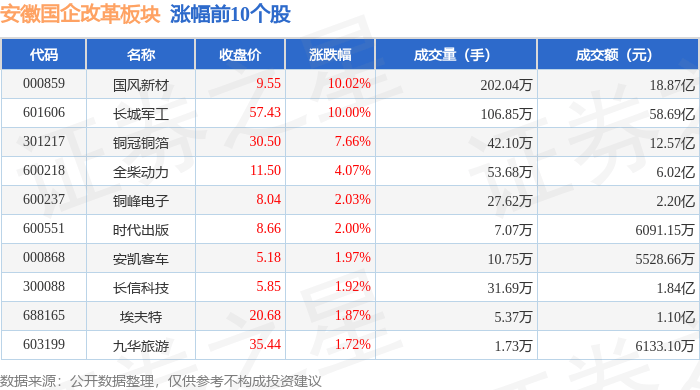
Market Performance - The Anhui state-owned enterprise reform sector increased by 1.18% compared to the previous trading day, with Guofeng New Materials leading the gains [1] - The Shanghai Composite Index closed at 3836.77, up 0.05%, while the Shenzhen Component Index closed at 12585.08, up 0.37% [1] Top Gainers - Guofeng New Materials (000859) closed at 9.55, up 10.02% with a trading volume of 2.0204 million shares and a transaction value of 1.887 billion [1] - Great Wall Military Industry (601606) closed at 57.43, up 10.00% with a trading volume of 1.0685 million shares and a transaction value of 5.869 billion [1] - Tongguan Copper Foil (301217) closed at 30.50, up 7.66% with a trading volume of 421,000 shares and a transaction value of 1.257 billion [1] Top Losers - Hefei Urban Construction (002208) closed at 11.16, down 10.00% with a trading volume of 897,600 shares and a transaction value of 1.023 billion [2] - HeBai Group (000417) closed at 6.51, down 7.53% with a trading volume of 698,000 shares and a transaction value of 460 million [2] - HuaiBei Mining (600985) closed at 12.45, down 1.50% with a trading volume of 139,700 shares and a transaction value of 175 million [2] Capital Flow - The Anhui state-owned enterprise reform sector saw a net inflow of 671 million from main funds, while retail funds experienced a net outflow of 212 million [2] - The main funds showed a significant net inflow in Great Wall Military Industry (601606) amounting to 84.2 million, while retail funds had a net outflow of 38 million [3] - Overall, the sector's capital flow indicates a mixed sentiment among institutional and retail investors [2][3]
商用车板块11月24日涨1.56%,金龙汽车领涨,主力资金净流入1.05亿元
Zheng Xing Xing Ye Ri Bao· 2025-11-24 09:02
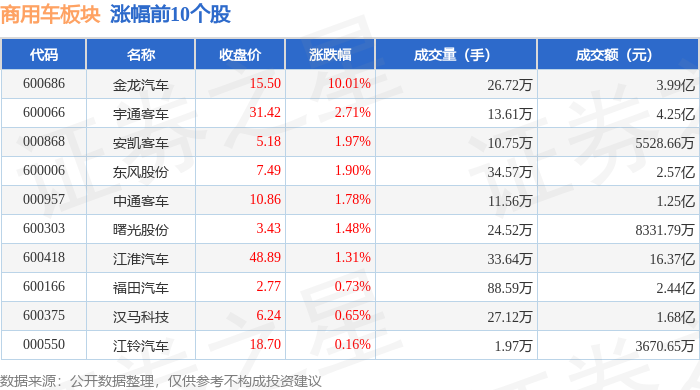
Market Overview - The commercial vehicle sector increased by 1.56% on November 24, with Jinlong Automobile leading the gains [1] - The Shanghai Composite Index closed at 3836.77, up 0.05%, while the Shenzhen Component Index closed at 12585.08, up 0.37% [1] Stock Performance - Jinlong Automobile (600686) closed at 15.50, up 10.01% with a trading volume of 267,200 shares and a turnover of 266.6 million [1] - Yutong Bus (600066) closed at 31.42, up 2.71% with a trading volume of 136,100 shares and a turnover of 4.25 billion [1] - Ankai Bus (000868) closed at 5.18, up 1.97% with a trading volume of 107,500 shares and a turnover of 55.29 million [1] - Dongfeng Motor (600006) closed at 7.49, up 1.90% with a trading volume of 345,700 shares and a turnover of 257 million [1] - Other notable performances include: - JAC Motors (600418) at 48.89, up 1.31% [1] - Foton Motor (600166) at 2.77, up 0.73% [1] Capital Flow - The commercial vehicle sector saw a net inflow of 105 million from institutional investors, while retail investors experienced a net outflow of 80.64 million [2] - The main capital flow details include: - JAC Motors had a net inflow of 181.01 million, accounting for 4.95% of the total [3] - Jinlong Automobile had a net inflow of 39.13 million, accounting for 9.81% [3] - Foton Motor experienced a net outflow of 14.29 million, with a net inflow from retail investors of 9.27 million [3]




满电可合肥直达上海!江淮新能源ES9跨省配送更轻松
第一商用车网· 2025-11-24 08:10
Core Viewpoint - The article emphasizes that battery capacity does not equate to vehicle range, highlighting that the true measure of an electric light truck's range is its energy efficiency and system collaboration capabilities. The Jianghuai ES9-165 electric light truck is presented as a solution for maximizing profitability in the urban logistics market due to its superior range and performance [1][2][4]. Summary by Sections Performance and Range - The Jianghuai ES9-165 electric light truck boasts a C-WTVC working condition range of 500 kilometers, significantly exceeding the average daily transport coverage of typical electric light trucks, thus breaking operational boundaries and accommodating both urban and cross-city transport needs [4]. - The vehicle is equipped with a 165.15 kWh battery from CATL, a liquid cooling system for stable performance in extreme conditions, a three-level regenerative braking system, and a dual-gun fast charging system that charges from 20% to 80% SOC in under 18 minutes, enhancing its operational efficiency [7]. Design and Construction - The ES9-165 features a pure electric platform with a high-strength double-layer beam and a low center of gravity design, which improves stability and safety during operation [11]. - The vehicle is powered by a Bosch motor, delivering a peak power of 167 kW and a torque of 214/420 Nm, allowing it to accelerate from 0 to 50 km/h in just 4.1 seconds and handle a maximum climbing gradient of 30%, making it competitive with traditional diesel light trucks [13]. User Experience and Comfort - The ES9-165 offers an ultra-wide cab space of 2090 mm, comparable to high-end passenger cars, and optional airbag shock-absorbing seats to enhance driving comfort and reduce fatigue during long hours of operation [20]. - The vehicle includes a large touchscreen for entertainment and navigation, along with integrated features like electronic handbrakes and ABS+EPB for improved safety and convenience, catering to the needs of modern operators [22]. Warranty and Cost Efficiency - Jianghuai provides an 8-year/600,000 km warranty on the battery, covering nearly the entire product lifecycle, which alleviates concerns for potential buyers and encourages them to take on more transport orders [15]. - The use of low rolling resistance tires and reinforced leaf springs helps reduce energy consumption and enhances load-carrying capacity, aligning with the goal of maximizing profitability for users [15]. Conclusion - The Jianghuai ES9-165 electric light truck sets a new benchmark in the electric light truck market by addressing industry pain points with its long range, robust performance, and user-friendly features, thus revolutionizing efficiency and experience in urban logistics [24].
江淮汽车涨2.24%,成交额8.69亿元,主力资金净流出1493.39万元
Xin Lang Cai Jing· 2025-11-24 05:25
Core Insights - Jianghuai Automobile's stock price increased by 2.24% on November 24, reaching 49.34 CNY per share, with a total market capitalization of 107.76 billion CNY [1] - The company has seen a year-to-date stock price increase of 31.57%, but has experienced a decline of 0.56% over the last five trading days and 6.54% over the last twenty days [1] - Jianghuai Automobile's main business revenue composition includes commercial vehicles (54.97%), passenger vehicles (25.10%), and other segments [1] Financial Performance - For the period from January to September 2025, Jianghuai Automobile reported a revenue of 30.93 billion CNY, a year-on-year decrease of 4.15%, and a net profit attributable to shareholders of -1.43 billion CNY, a significant decline of 329.43% [2] - The company has distributed a total of 2.9 billion CNY in dividends since its A-share listing, with 45.86 million CNY distributed in the last three years [3] Shareholder Information - As of September 30, 2025, Jianghuai Automobile had 176,400 shareholders, an increase of 24.81% from the previous period, with an average of 12,378 circulating shares per shareholder, a decrease of 19.88% [2] - The second-largest circulating shareholder is Hong Kong Central Clearing Limited, holding 55.49 million shares, which is a decrease of 45.17 million shares from the previous period [3]
新能源汽车指数下跌7.25% 磷酸铁锂平均报价上涨2850元/吨丨行业周报
2 1 Shi Ji Jing Ji Bao Dao· 2025-11-24 04:59
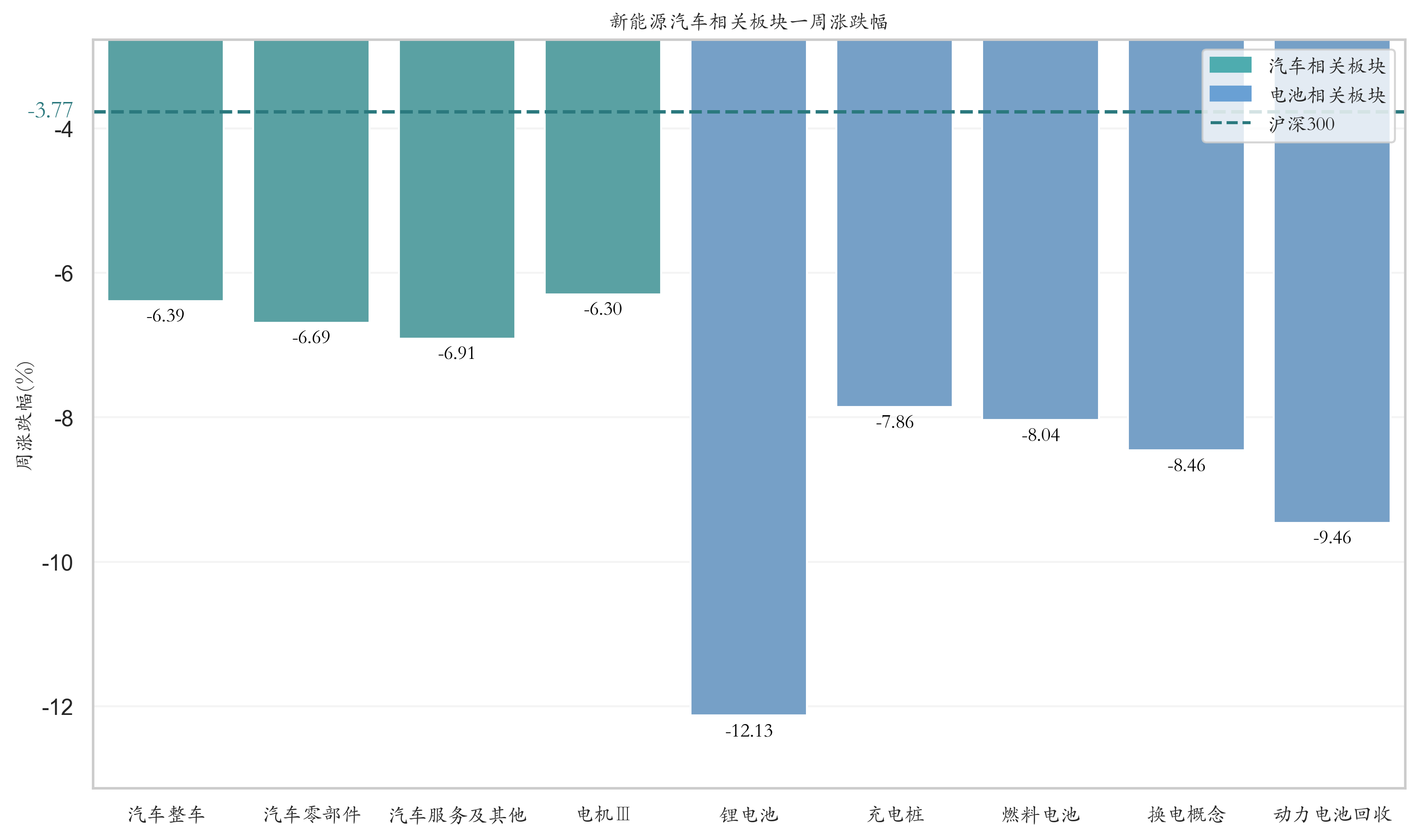
行情回顾 同花顺数据显示,上周(11月17日-11月21日,下同),新能源汽车指数(885431.TI)周内下跌7.25%,跑输沪深300指数3.48%。其中,汽车相关板块中表 现最好的是电机Ⅲ指数(884085.TI),周跌幅为6.30%。新能源车电池相关板块中表现最好的是充电桩指数(885461.TI),周跌幅为7.86%。 1.新能源汽车相关板块一周行情梳理 2.上市公司一周(11月17日-11月21日)行情梳理 新能源整车 | 代码 | 证券名称 | 收盘价(元) | | --- | --- | --- | | 600418.SH | 江淮汽车 | 48.26 | | 601238.SH | 广汽集团 | 7.6 | | 600733.SH | 北汽蓝谷 | 7.66 | | 000625.SZ | 长安汽车 | 11.79 | | 601633.SH | 长城汽车 | 21.62 | | 002594.SZ | 比亚迪 | 92.7 | | 601127.SH | 赛力斯 | 123.4 | | 000572.SZ | 海马汽车 | 9.45 | 电机电控 | 代码 | 证券名称 | 收盘价(元) ...