KWEICHOW MOUTAI(600519)

Search documents
茅台就“抢购外挂”发布声明:本月成功拦截各类异常行为4.26亿次,已收集证据,保留追责权利
Xin Lang Cai Jing· 2026-01-29 12:12
(来源:大象新闻) 1月29日,i茅台平台发布声明: 近日,我们注意到有商家通过网络平台公开售卖所谓i茅台APP"抢购外挂"等软件,有网友晒出非i茅台官方通知的批量成交记 录。以上售卖、使用该类软件的行为,对公平的市场秩序造成了不良社会影响,涉嫌违反《中华人民共和国民法典》《中华人 民共和国网络安全法》《中华人民共和国消费者权益保护法》。消费者使用该类软件存在信息与财产安全风险,请广大消费者 注意提升防范意识,切勿轻信以免造成损失。我们已在收集和固化相关证据,并保留采取法律手段追究相关主体责任的权利, 以维护市场秩序和消费者合法权益。 自2022年3月31日上线以来,i茅台已稳定运行近四年,构建形成了多层级、多策略、成熟的风险防控体系,包括机器行为识 别、风险设备判断、异常行为拦截、团伙风险防控等。2026年1月1日至今,已成功拦截各类异常行为4.26亿次,平台商品交易 过程不存在单一用户批量非常规消费行为成交,不存在多用户集中批量非常规消费行为成交。我们将持之以恒提升技术水平, 不断增强平台的风险防控能力,努力为广大消费者营造公平、有序的消费环境。 感谢大家的关心与支持。 "小茅i茅台"公众号主编 | 彭丹 ...


白酒股“大爆发”!贵州茅台单日涨幅创16个月新高
Guo Ji Jin Rong Bao· 2026-01-29 11:57
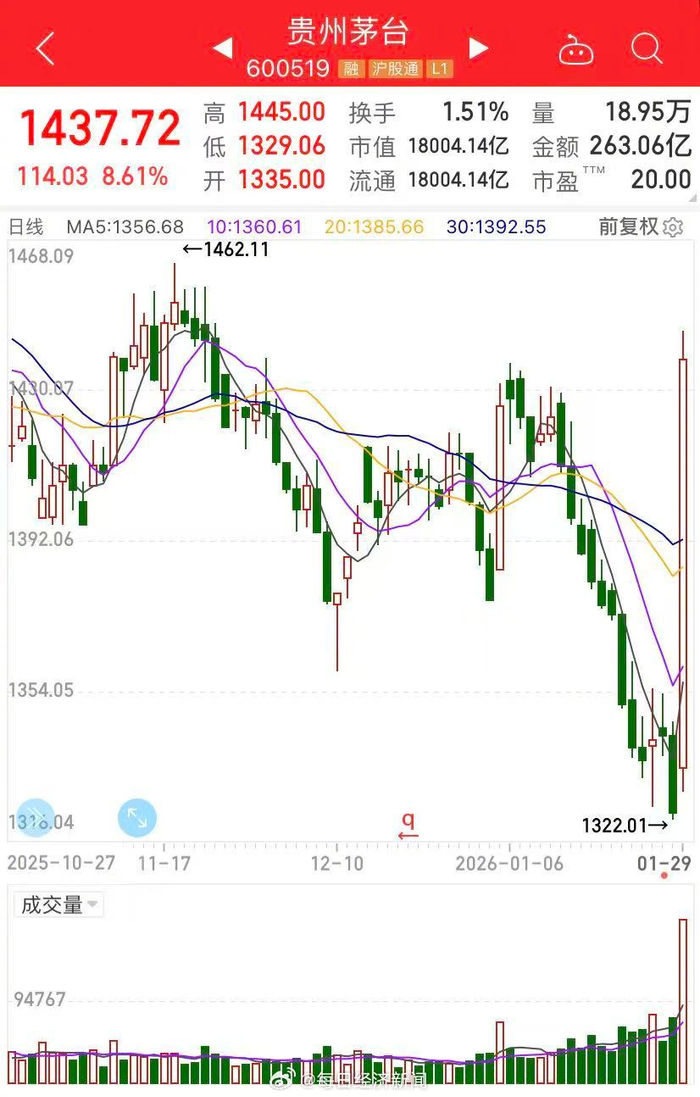
Group 1 - The core point of the news is the sudden surge in the Chinese liquor stock market, particularly the strong performance of Kweichow Moutai, which saw a significant price increase and market capitalization recovery [1] - Kweichow Moutai closed at 1437.72 yuan, up 8.61% from the previous trading day, marking the highest single-day increase in nearly 16 months, with its market value returning to 1.8 trillion yuan [1] - Other liquor companies also experienced substantial gains, with over ten A-share listed liquor firms hitting the daily limit, and Hong Kong-listed liquor companies seeing increases of over 12% [1] Group 2 - The rebound is attributed to the upcoming peak season for liquor consumption and the recovery in the price of Feitian Moutai, which is considered a stabilizing factor for the industry [2] - Recent data shows that the wholesale price of Feitian Moutai has been rising, with the price for the 26-year Feitian Moutai reaching 1610 yuan, and the Moutai zodiac wine increasing by 100 yuan per bottle [2] Group 3 - Despite the recent surge, the liquor industry is still undergoing a deep adjustment, with many institutions predicting a lower revenue and profit growth rate for Kweichow Moutai in 2025, around 5%, below the company's original target of 9% [3] - Several listed liquor companies are beginning to disclose performance forecasts, with terms like "loss" and "reduction" becoming common, indicating significant pressure on smaller firms [3] - Companies like *ST Chuntian and Jinzongzi are expected to report substantial losses, while others like Shui Jing Fang and Yanghe are also forecasting significant declines in revenue and profit due to high inventory levels and slow recovery in traditional business banquet scenarios [3] Group 4 - Recent reports from securities firms suggest that the extended holiday during the upcoming Spring Festival will benefit liquor consumption, with a clear trend of market recovery and stabilization [4]
白酒股逆袭暴涨,“老登”股或再次轮动
Di Yi Cai Jing Zi Xun· 2026-01-29 11:52
2026.01.29 业内人士认为,贵州茅台等暴涨,接下来预计蓝筹股将会再次发力,因为稳定的业绩、较高的分红比 例,预计春节前其他高股息的"老登"股们将会出现轮动行情,包括银行、电力、医药等板块,投资者都 可以重点关注,抓紧春节前投资机会。 奶酪基金投资经理潘俊向第一财经分析, 1月29日白酒板块大幅上涨,催化来自地产预期改善与资金面 回暖,指数ETF成交量回落导致权重抛压缓解,同时批发价格延续回升、线下动销同比正增、回款发货 稳步推进,形成"以价换量"的积极信号,白酒行情持续性需跟踪春节前后价格能否继续回升。 潘俊认为, 在当前低利率及宏观不确定性环境下,高股息策略已从单纯的"防御"属性进化为"攻守兼 备"的底仓配置。在全球降息周期开启的背景下,高股息资产对全球配置型资金具有极强吸引力,资金 买入不仅是看中股息,更是交易中国资产的估值修复。 慧研智投投资顾问李谦对第一财经说,1月29日之前,本轮结构性市场行情呈现明显分化特征。以黄金 为代表的资源类板块及芯片、半导体等科技主线持续获得市场资金青睐,涨幅显著;而高股息板块中的 白酒、银行、电力、医药等领域则表现相对低迷,股价持续走低并创阶段性新低。临近春节,市 ...



A股酒类板块迎久违大涨 茅台重返1400元
Sou Hu Cai Jing· 2026-01-29 11:40
Core Viewpoint - The A-share liquor sector experienced a significant surge on January 29, with major stocks like Gujing Gongjiu, Shanxi Fenjiu, Wuliangye, and Luzhou Laojiao hitting the daily limit, while Kweichow Moutai rose nearly 9% to surpass 1400 yuan [1] Group 1: Market Performance - On January 29, the wholesale price of Feitian Moutai continued to rise, with the 2025 vintage increasing by 20 yuan per bottle to 1620 yuan, and the 2026 vintage also up by 20 yuan to 1610 yuan [3] - The food and beverage sector saw a net inflow of over 16.8 billion yuan from major funds, with Kweichow Moutai and Wuliangye among the top stocks receiving this inflow [3] Group 2: Industry Outlook - According to CITIC Securities, the liquor industry is approaching the peak marketing season for the Spring Festival, with distributors learning from leading companies' experiences in channel and product reforms [3] - The actual sales of liquor during the 2026 Spring Festival are expected to remain stable, supported by various factors such as a longer holiday and improved consumer education [3] - The recent surge in the liquor sector is driven by the upcoming Spring Festival and the stabilization of prices from leading liquor companies, despite previous announcements of reduced or negative earnings from several firms [3]

贵州茅台辟谣参与SpaceX上市A轮融资
21世纪经济报道· 2026-01-29 11:39
1月29日,《21辟谣》注意到,有市场传言称"贵州茅台证实参与SpaceX上市A轮融资"。据上证报,贵州茅台方面回应称,此为"不实信息"。 盘面上,贵州茅台1月29日收盘报1437.72元/股,涨8.61%,总市值突破1.8万亿元。 编辑丨黎雨桐 记者丨朱芷葵 据证券时报此前消息,世界首富埃隆·马斯克正计划将太空探索技术公司(SpaceX)的IPO时间安排在6月中旬——正值罕见的行星连珠现象与 他的生日期间。SpaceX公司计划融资规模高达500亿美元,估值约1.5万亿美元,有望成为历史上规模最大的IPO。 出品丨21财经客户端 21世纪经济报道 浙江一地"全员直升高中"存在四大误读 白银基金明天全日停牌,金饰克价首次破1700元,中国金币集团提示风险 SFC 21君荐读 ...
茅台辟谣参与SpaceX融资传闻
Mei Ri Jing Ji Xin Wen· 2026-01-29 11:33
94767 Boodboom0alla0 截至29日收盘,贵州茅台(600519.SH)股价报收1437.72元/股,当日涨8.61%,总市值突破1.8万亿元。 (上海证券报,德塔) 【#茅台回应参与SpaceX融资传闻#】#茅台辟谣投资马斯克SpaceX# 据上海证券报报道,今日(29 日),有市场传言称"贵州茅台证实参与SpaceX上市A轮融资"。记者对此进行了求证,贵州茅台方面回 应记者称,此为"不实信息"。 ...
中国必选消费品1月价格报告:次高端及以上白酒分化加剧,本期无大众品折扣减小
Haitong Securities International· 2026-01-29 11:28
Investment Rating - The report assigns an "Outperform" rating to multiple companies in the consumer staples sector, including Guizhou Moutai, Wuliangye, Luzhou Laojiao, and others, indicating a positive outlook for these stocks [1]. Core Insights - There is an intensified divergence among mid-to-high-end baijiu products, with no discount contraction observed in food and beverage categories [1]. - The report highlights that the wholesale prices of various baijiu brands have shown stability or slight changes, with some brands experiencing price increases while others remain flat or decrease [3][4][35]. - Discounts on representative products in condiments, liquid milk, and soft drinks have widened compared to the end of December, indicating a shift in pricing strategies [19][32]. Summary by Relevant Sections Baijiu Pricing - Guizhou Moutai's wholesale prices for Feitian (case and single bottle) and Moutai 1935 are reported at 1600, 1580, and 630 yuan respectively, with changes of 0, -10, and -10 yuan compared to last month [35]. - Wuliangye's eighth-generation price is 830 yuan, reflecting a +10 yuan increase from the previous month [35]. - Luzhou Laojiao's Guojiao 1573 remains at 850 yuan, unchanged from last month [35]. Discount Trends - The average discount rate for condiments decreased from 87.1% to 85.0%, while liquid milk discounts fell from 62.8% to 61.4% [19][22]. - In contrast, discounts for beer, infant formula, and convenience foods remained stable, with beer discounts slightly increasing from 80.3% to 80.7% [20][22][32]. Company Ratings - The report lists several companies with an "Outperform" rating, including: - Guizhou Moutai - Wuliangye - Luzhou Laojiao - Qingdao Beer - China Feihe - Others [1].



白酒板块强势反弹,贵州茅台单日大涨8.61%
Huan Qiu Lao Hu Cai Jing· 2026-01-29 11:15
Core Viewpoint - The liquor sector, particularly the "Lao Deng" brands, experienced a significant surge, with Kweichow Moutai rising by 8.61% and achieving a trading volume exceeding 26 billion yuan, indicating a strong recovery in demand and pricing for premium products [1][2] Group 1: Market Performance - On January 29, 2023, Kweichow Moutai's stock price increased by 8.61%, with a trading volume surpassing 26 billion yuan, while its highest single-day increase during the previous "924" market was 9.35% [1] - The price of 25-year-old Feitian Moutai has rebounded, with wholesale prices reported at 1,620 yuan per bottle, an increase of 20 yuan from the previous day, and retail prices for scattered bottles at 1,580 yuan, recovering from a dip below the 1,499 yuan guidance price earlier in the year [1] Group 2: Industry Dynamics - The white liquor industry is currently undergoing a deep adjustment phase, with intensified competition among existing brands. Kweichow Moutai has initiated market-oriented operational strategies to address this situation [2] - The sales model of Kweichow Moutai is transitioning from "self-sale + distribution" to a multi-dimensional collaboration model that includes "self-sale + distribution + agency + consignment," along with a dynamic pricing adjustment mechanism [2] - According to a report by China International Capital Corporation, Kweichow Moutai's recent transformation efforts are expected to strengthen its pricing power and market influence, while also accelerating the industry consolidation process [2] Group 3: Performance Metrics - Despite a decline in sales growth due to market conditions, Kweichow Moutai maintained positive overall growth, achieving total revenue of 130.9 billion yuan in the first three quarters of 2025, a year-on-year increase of 6.32%, and a net profit attributable to shareholders of 64.63 billion yuan, up 6.25% year-on-year [2]
白酒板块大反弹
Tebon Securities· 2026-01-29 11:14
Market Analysis - The A-share market showed significant structural differentiation, with the Shanghai Composite Index fluctuating around 4150 points and closing at 4157.98 points, up 0.16%. The Shenzhen Component Index fell 0.30% to 14300.08 points, and the ChiNext Index dropped 0.57% to 3304.51 points, indicating a mixed performance across the market [3][6] - The beverage sector led the market with a notable increase of 6.74%, while the liquor index surged by 9.93%. Notably, the price of Moutai rose by 20 yuan to 1610 yuan per bottle, suggesting strong sales activity ahead of the Spring Festival [6][8] - The real estate sector also saw a rise of 2.48%, with several companies hitting the daily limit up. Reports indicate that some real estate firms are no longer required to report "three red lines" indicators monthly, hinting at a potential easing of regulatory pressures [6][8] Investment Opportunities - The report suggests that the liquor sector may benefit from improved sales activity before the Spring Festival, while the real estate sector could gain from expectations of regulatory easing. Resource stocks are expected to continue their strong performance due to rising prices and safe-haven demand [8][18] - The report emphasizes a focus on sectors such as photovoltaic (solar energy), commercial aerospace, and precious metals, which are seen as key investment themes in the current market environment [8][17] Commodity Market Insights - The commodity index continued its strong upward trend, with copper prices reaching new historical highs. The Shanghai copper price closed at 109,110 yuan per ton, while LME copper peaked at 14,125 USD per ton [11][12] - Precious metals also experienced significant gains, with gold and silver prices rising sharply, driven by geopolitical uncertainties and a weak US dollar, which enhances the attractiveness of dollar-denominated assets [11][12] Trading Hotspots - Recent hot sectors include AI applications, commercial aerospace, nuclear fusion, quantum technology, brain-computer interfaces, and robotics, all of which are supported by government policies and technological advancements [15][17] - The report highlights the ongoing strong performance of precious metals and industrial metals, suggesting that the momentum may continue in the future [18]
白酒股逆袭暴涨,“老登”股或再次轮动
第一财经· 2026-01-29 11:10
2026.01. 29 本文字数:1155,阅读时长大约2分钟 业内人士认为,贵州茅台等暴涨,接下来预计蓝筹股将会再次发力,因为稳定的业绩、较高的分红比 例,预计春节前其他高股息的"老登"股们将会出现轮动行情,包括银行、电力、医药等板块,投资 者都可以重点关注,抓紧春节前投资机会。 奶酪基金投资经理潘俊向第一财经分析, 1月29日白酒板块大幅上涨,催化来自地产预期改善与资 金面回暖,指数ETF成交量回落导致权重抛压缓解,同时批发价格延续回升、线下动销同比正增、回 款发货稳步推进,形成"以价换量"的积极信号,白酒行情持续性需跟踪春节前后价格能否继续回 升。 作者 | 第一财经 李隽 "白酒'老登'终于硬气一回!"看见1月29日下午贵州茅台(600519.SH)逆袭带领蓝筹股绝地反 击,其他白酒股集体涨停,有私募人士这样对第一财经说。 一度经历"九连阴",累计连跌多个交易日之后,1月29日贵州茅台上涨8.61%,报收1437元,成交 263亿元,相比此前100亿元左右的单日成交大幅放量,收复了近半个月以来的失地;五粮液 (000858.SH)、泸州老窖(000568.SH)等多只白酒股放量涨停。 大盘在明显的风格 ...