
GXED(600617)

Search documents
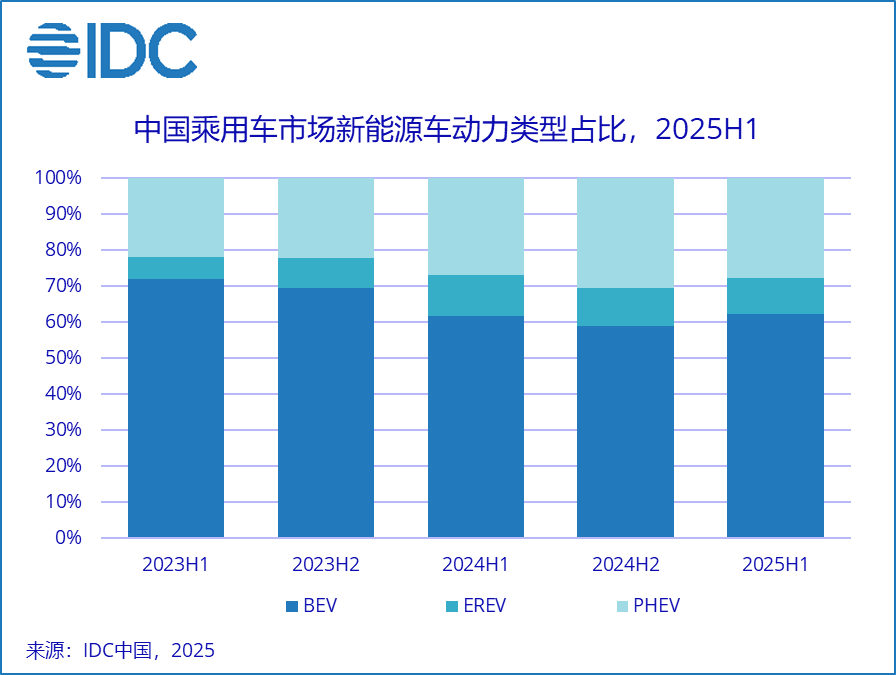
IDC:2025上半年中国新能源车市场规模达到547万台 同比增长26.8%
Zhi Tong Cai Jing· 2025-09-15 05:57
Group 1 - The core viewpoint is that the Chinese new energy vehicle (NEV) market is expected to reach a scale of 5.47 million units in the first half of 2025, representing a year-on-year growth of 26.8% [1] - The market share of plug-in hybrid and range-extended vehicles is stabilizing at 27.6% and 10.6% respectively, while pure electric vehicles continue to grow, with a year-on-year increase of 34.7% in the first half of 2025 [1] Group 2 - The transition from policy-driven to market-driven growth in the NEV sector is heavily influenced by the development of charging infrastructure and battery technology, which are critical for increasing market penetration [2] - The charging infrastructure in China is evolving into a multi-faceted development model characterized by ultra-fast charging, battery swapping, and slow charging, enhancing the efficiency and coverage of the network [2] - Charging speed is a key factor affecting user experience, with advancements in fast-charging technologies (2C, 3C) meeting daily commuting needs, while ultra-fast charging (4C, 5C) alleviates range anxiety and expands the usability of NEVs for long-distance travel [2] Group 3 - Solid-state battery technology is making significant progress and is expected to redefine battery performance within the next 3-5 years, offering improvements in energy density, low-temperature performance, and cycle life [3] - The development of solid-state batteries follows a staged approach, with semi-solid batteries paving the way for full solid-state solutions, catering to diverse energy storage needs across various vehicle segments [3] - The high energy density of solid-state batteries will facilitate the lightweight development of charging infrastructure, enabling rapid deployment of new charging facilities in remote areas [3] Group 4 - The deep integration of intelligence and electrification is emerging as another core driver for accelerating the penetration rate of NEVs, with smart features lowering usage barriers and enabling diverse driving scenarios [4] - Over 90% of new energy vehicles in the Chinese passenger car market are expected to feature OTA (Over-The-Air) functionality by the first half of 2025, enhancing user engagement and innovation in driving scenarios [6] - The rapid advancement of AI technology is reshaping the entire value chain of the passenger car market, transitioning from vertical integration to an open ecosystem, thereby providing continuous growth momentum for the NEV market [6]


中国新能源汽车澳洲受指控,“维修权”究竟该归谁?
Jing Ji Guan Cha Bao· 2025-09-15 00:50
Core Insights - The core issue revolves around the high maintenance costs and insurance fees for electric vehicles (EVs) due to monopolistic practices by manufacturers, which consumers did not anticipate [1][3][4] Group 1: Market Dynamics - Five Chinese EV manufacturers, including BYD and Xpeng, are accused of monopolizing repair services in Australia by delaying and restricting access to independent repair services and diagnostic software [1][5] - The Australian Automotive Service and Repair Authority (AASRA) has reported these practices to the Australian Competition and Consumer Commission (ACCC), which could lead to significant penalties for the companies involved [5][6] Group 2: Consumer Impact - Consumers are facing challenges in accessing affordable and timely repair services, as authorized service centers are often located far away, leading to increased costs and inconvenience [1][2] - The high maintenance costs associated with EVs contradict the initial appeal of lower overall usage costs compared to traditional fuel vehicles [1][3] Group 3: Regulatory Environment - The Australian Motor Vehicle Service and Repair Information Scheme (MVIS) mandates that manufacturers must provide independent repairers with access to essential diagnostic software and technical data, which the accused companies allegedly failed to comply with [5][6] - The ACCC is responsible for enforcing MVIS, with penalties for non-compliance reaching up to AUD 10 million (approximately RMB 47 million) [5] Group 4: Industry Perspectives - Industry experts highlight that the current closed service model of Chinese EV manufacturers is a significant barrier to the development of a competitive aftermarket [3][4] - Concerns about safety and liability in third-party repairs are cited as reasons for manufacturers' reluctance to open their data and services to independent repairers [4][6] Group 5: Future Considerations - The need for a balanced ecosystem that allows for fair competition while ensuring safety standards is emphasized, requiring collaboration among manufacturers, independent repairers, regulatory bodies, and insurance companies [6] - The situation in Australia reflects a broader trend of increasing regulatory scrutiny in the automotive sector, particularly regarding consumer rights and anti-competitive practices [6]

新华社消息丨我国新能源公交车占比达82.7%
Xin Hua Wang· 2025-09-13 04:00
Group 1 - The article discusses the recent developments in the investment banking sector, highlighting the impact of economic fluctuations on market performance [1] - It emphasizes the importance of strategic planning and risk management for companies to navigate the current financial landscape [1] - The report indicates a significant increase in mergers and acquisitions activity, with a notable rise of 25% in deal volume compared to the previous year [1] Group 2 - The article outlines the challenges faced by the industry, including regulatory changes and geopolitical tensions that may affect investment decisions [1] - It mentions the growing trend of digital transformation within investment banks, which is expected to enhance operational efficiency and client engagement [1] - The report also points out the increasing competition from fintech companies, which are disrupting traditional banking models [1]
我国新能源公交车占比达82.7%
Xin Hua Wang· 2025-09-12 15:01
Core Viewpoint - By the end of 2024, China is expected to have 658,000 urban public buses and trolleybuses, with 544,000 being new energy buses, accounting for 82.7% of the total [1] Group 1: Public Transport Statistics - The total length of urban public transport routes will reach 1.75 million kilometers [1] - Urban rail transit operating mileage is approximately 11,000 kilometers, ranking first in the world [1] - Over 200 million people choose green travel methods daily, with 100 million using rail transit for efficient commuting [1] Group 2: Green Travel Initiatives - The 2025 Green Travel Month and Public Transport Week will focus on the theme "Prefer Public Transport, Green Travel" [1] - Activities will include public awareness campaigns, sustainable development themes for urban public transport, and enhancing accessibility for elderly and disabled passengers [1] - The initiative aims to promote safe, civilized, and green travel while caring for drivers and passengers [1]
“金九银十”旺季开启 中国新能源车市迎双线利好
Zhong Guo Xin Wen Wang· 2025-09-12 11:05
Group 1 - The Chinese new energy vehicle (NEV) market is experiencing a dual benefit of policy support and market resonance as the traditional consumption peak season approaches [1][2] - Various regions are launching limited-time subsidies to stimulate consumer demand, such as Shenyang's 50 million yuan subsidy and Chongqing's 100 million yuan budget for vehicle replacement [1] - The national government is reinforcing policy support, including the implementation of a new fiscal subsidy for personal consumption loans related to vehicle purchases [1][3] Group 2 - The "Golden September and Silver October" period is crucial for automakers to boost annual sales, with major brands preparing for this peak season [1][2] - Over 70% of new car launches in September are NEVs, with companies initiating promotional activities to convert market interest into actual orders [2] - Experts predict significant growth in the NEV market during this period, driven by rising consumer confidence and increased travel demand [2][3] Group 3 - The market is supported by ongoing government incentives such as trade-in programs and NEV promotions, while automakers are expected to leverage the second half of the year for sales boosts [3] - The China Automobile Dealers Association forecasts that NEV sales could exceed 13 million units by 2025, indicating strong market potential [3]
(经济观察)“金九银十”旺季开启 中国新能源车市迎双线利好
Zhong Guo Xin Wen Wang· 2025-09-12 10:23
Group 1 - The Chinese new energy vehicle (NEV) market is experiencing a dual benefit of policy support and market resonance as the traditional consumption peak season of "Golden September and Silver October" approaches [1][5] - Various regions are launching limited-time subsidies to stimulate consumer demand, such as Shenyang's 50 million yuan subsidy for NEVs and Chongqing's 100 million yuan budget for vehicle replacement [1][5] - National policies continue to strengthen support for the NEV market, including the implementation of a new fiscal subsidy scheme for personal consumption loans that includes auto loans [1][5] Group 2 - The automotive industry is fully entering the era of new energy and intelligence, with rapid iterations of new technologies and features that enhance consumer purchasing intentions [3] - Analysts predict significant growth in the NEV market during the "Golden September and Silver October" period, driven by steady economic growth, rising consumer confidence, and increased travel demand [5] - The China Automobile Dealers Association forecasts that NEV sales in China could exceed 13 million units by 2025, indicating strong market potential supported by policies and supply upgrades [5]
人民财评:创新驱动,中国新能源汽车奔向未来
Ren Min Wang· 2025-09-12 03:29
Core Viewpoint - China's new energy vehicle (NEV) industry has transitioned from "catching up" to "leading," achieving over 13 million units in production last year, maintaining the world's top position for ten consecutive years, driven by technological innovation and green development principles [1][2]. Group 1: Industry Growth and Achievements - The annual production and sales of NEVs in China have surged from tens of thousands to millions over the past decade, with significant breakthroughs in product performance and convenience, exporting to over 70 countries and regions [1][2]. - The NEV industry has not only achieved a leapfrog development but is also expanding towards intelligent and connected driving, representing a new form of productive force [1][2]. Group 2: Policy Support and Market Demand - Government policies play a crucial role in the high-quality development of the NEV industry, including tax reductions, trade-in subsidies, and a favorable business environment that stimulates market demand and consumer potential [1][2]. - The implementation of various policy measures has provided strong support for the healthy development of the NEV industry [1]. Group 3: Technological Innovation and Infrastructure - Technological innovation is the core driving force behind the NEV industry's development, with companies increasing R&D investments and achieving breakthroughs in key areas such as drive motors, power batteries, and electronic control systems [2]. - As of July this year, China has established the world's largest charging network with 16.696 million charging facilities, alleviating consumer charging anxiety and promoting rapid market growth [2]. Group 4: Future Prospects - With the ongoing promotion of the "dual carbon goals," the market share and scale of the NEV industry are expected to expand further, necessitating improvements in product performance and quality [2]. - The NEV industry is anticipated to not only grow itself but also drive the rapid development of other high-tech industries, contributing to China's goal of becoming a manufacturing powerhouse [3].
“更多见了”“更好开了”“贡献更突出了”,中国新能源汽车产业实现跨越式发展
Hua Xia Shi Bao· 2025-09-12 01:13
Core Insights - The Chinese new energy vehicle (NEV) industry has shown remarkable growth during the "14th Five-Year Plan" period, with production increasing from approximately 1.4 million units in 2020 to around 13 million units in 2024, and sales share rising from 5.4% to 40.9% [2][3][4] - The industry has transitioned from being a "follower" to a "leader" in the global market, with domestic brands gaining market share in Europe and Southeast Asia, supported by a robust supply chain from battery production to intelligent technology [3][4] - Significant improvements in product quality and performance have been achieved, with the average range of pure electric passenger vehicles nearing 500 kilometers, battery costs reduced by 30%, and charging speeds increased by over three times [4][5] Industry Development - The NEV market has expanded significantly, with total consumption expected to exceed 2 trillion yuan in 2024, driving growth across the entire industry chain and contributing to high-quality economic development [4][5] - Despite the successes, challenges remain, such as a shortage of high-performance chips and issues related to irrational competition within the industry [5] Consumer Sentiment - Consumers exhibit a complex attitude towards intelligent driving systems, showing interest but also significant concerns about safety, indicating that safety remains the top priority when considering new technology [6][7] - There is a willingness among consumers to accept data collection for system optimization, but skepticism about the effectiveness of such improvements persists [7][8] Future Outlook - The NEV industry is seen as a landscape filled with opportunities and challenges, where companies must prioritize consumer safety and practical applications while maintaining reasonable costs to succeed in a competitive market [8]
全球媒体聚焦|国际知名智库:“中国新能源发展深刻改变全球能源经济”
Sou Hu Cai Jing· 2025-09-10 14:53
Group 1 - The core viewpoint of the report by Ember is that China's investment in clean energy has become a major factor in determining the global decarbonization process [1] - China produces 60% of the world's wind turbines and 80% of solar panels, significantly lowering costs for other countries [2] - Since 2010, the cost of solar components has decreased by over 90%, with China accounting for three-quarters of global solar manufacturing during this period [2] Group 2 - In the previous year, China's investment in renewable energy capacity reached $625 billion, nearly one-third of the global total, compared to $426 billion from Europe and $409 billion from the United States [3] - The clean energy sector, led by solar panels, batteries, and electric vehicles, has expanded at three times the rate of other industries, contributing $1.9 trillion to China's output [3] - The report highlights that U.S. investments under the Inflation Reduction Act are restricted to domestic projects, while China's investments are fostering clean energy development in other countries [3] Group 3 - The rapid development of China's solar energy industry raises questions about the scale of investment that would exist without China's involvement [5] - Clean energy is expected to create a significant market opportunity [5]

恒生中国引进中东资金助力中国新能源企业“走出去”
Xin Hua Cai Jing· 2025-09-10 14:20
Core Viewpoint - The collaboration between Hang Seng China and Middle Eastern financial institutions, along with JinkoSolar, aims to facilitate cross-border green syndicated loans to support the international development of Chinese enterprises along the Belt and Road Initiative [1] Group 1: Partnership and Collaboration - Hang Seng China signed a memorandum of cooperation for cross-border green syndicated loans with financial institutions from Qatar and Kuwait, as well as JinkoSolar [1] - This project represents a practical case of Hong Kong becoming a super connector for economies along the Belt and Road, showcasing the close collaboration between Hang Seng China and its parent bank [1] Group 2: Strategic Importance - The initiative aims to leverage Hong Kong's unique advantages as an international financial platform to connect Middle Eastern capital with the domestic market [1] - The partnership is expected to support the internationalization of leading renewable energy companies like JinkoSolar, while also providing a reference for green investment and financing cooperation under the Belt and Road framework [1] Group 3: Industry Confidence - JinkoSolar, as a leading player in the global photovoltaic industry, has a broad presence in Belt and Road markets, indicating strong international confidence in China's renewable energy sector [1] - The cross-border green syndicated loan reflects the strong support from Hang Seng Bank and Hang Seng China for JinkoSolar, highlighting their efficiency and professionalism in international syndicate business [1]
