
HAIER SMART HOME(600690)

Search documents
2025年中国家用电器行业政策、发展历程、产业链、产量、经营现状、竞争格局及发展趋势研判:主要产品产量跃居世界前列,行业将进入“领跑”的关键窗口期[图]
Chan Ye Xin Xi Wang· 2025-08-28 01:29
Core Viewpoint - The home appliance industry in China has experienced significant growth, becoming a major global producer and consumer, with a focus on improving living quality and adapting to consumer demands [1][6][12]. Group 1: Industry Overview - Home appliances, referred to as "家电," are essential for modern living, enhancing convenience and comfort [1][6]. - China has become the world's largest producer of home appliances, with a diverse range of products that are reliable and cost-effective [1][6]. - In 2024, the production of major home appliances is projected to increase, with refrigerators at 103.957 million units (up 8.3%), air conditioners at 265.984 million units (up 9.7%), and washing machines at 117.365 million units (up 8.8%) [1][6]. Group 2: Financial Performance - The revenue of large-scale enterprises in the home appliance industry is expected to reach 1,908.676 billion yuan in 2024, an increase of 66.41 billion yuan from 2023 [1][6]. - The total profit for the industry is projected to be 199.355 billion yuan in 2024, an increase of 42.855 billion yuan from 2023 [1][6]. Group 3: Market Dynamics - The air conditioning and refrigerator markets are the largest segments in the home appliance industry, accounting for 23% and 16% of the market, respectively [6][10]. - The industry has undergone several phases, including supportive initiation, controlled expansion, competitive adjustment, and mature growth [4][10]. Group 4: Industry Structure - The home appliance industry has a complete and efficient supply chain, with upstream materials including steel, plastics, and copper, and a focus on new materials like biodegradable plastics [7][8]. - The sales channels have shifted towards online platforms, with significant growth in e-commerce, while offline channels are evolving to provide experiential shopping [7][8]. Group 5: Competitive Landscape - The market concentration is significant, with the top companies holding a substantial share; the first tier of companies accounts for approximately 25%-40% of the market [10][11]. - Major players with revenues exceeding 100 billion yuan include Midea Group, Gree Electric, Haier Smart Home, and Hisense [10][11]. Group 6: Future Trends - The home appliance industry is expected to transition from "catching up" to "keeping pace" and even "leading" in the coming years, driven by technological innovation and evolving consumer needs [12][13].





寒武纪股价一度超贵州茅台,创始人身家突破1700亿元;宗馥莉100%继承宗庆后股份;英伟达第二财季净利润同比增长59%丨邦早报
创业邦· 2025-08-28 00:17
Group 1 - The stock price of Cambrian has surpassed Kweichow Moutai, reaching a peak of 1464.98 yuan per share, with an annual increase of over 120% [3] - The largest shareholder of Cambrian, Chen Tian Shi, holds 28.63% of the shares, with a net worth exceeding 170 billion yuan based on current stock prices [3] Group 2 - Wahaha confirmed that the 29.4% equity directly held by Zong Qinghou has been fully inherited by his daughter, Zong Fuli, and the industrial change registration has been completed [5] - The employee stockholding meeting's buyback occurred in 2018, with no objections raised prior to Zong Qinghou's passing [5] Group 3 - Nvidia reported a net profit of $26.422 billion for Q2 of FY2026, a year-on-year increase of 59%, with revenue of $46.743 billion, reflecting a 56% increase [11] - ByteDance's Q2 revenue reached $48 billion, marking a 25% year-on-year growth [11] Group 4 - Meituan announced plans to eliminate overtime penalties by the end of 2025, aiming to enhance rider experience and streamline complaint processes [11] - Apple is expected to discontinue seven products following the launch of new models, with no official confirmation yet [11] Group 5 - Faraday Future's founder, Jia Yueting, executed a stock purchase plan, acquiring approximately $200,000 worth of common stock [11] - Gree Electric's marketing director criticized Xiaomi's comparison of their products, emphasizing the importance of real technological advancements in manufacturing [11][12][13] Group 6 - Xiaomi's new operating system, Surge OS 3, is set to be released on August 28, focusing on system fluidity and ecosystem collaboration [16] - The new H5 model from Shangjie aims for a monthly sales target of 20,000 units, with plans for two additional models next year [17] Group 7 - The new Xpeng P7 was launched with a starting price of 219,800 yuan, featuring advanced AI capabilities and fast charging technology [22] - DingTalk introduced its first AI hardware, the DingTalk A1, designed for real-time translation and voice recognition [24][25] Group 8 - Zhejiang University and Alibaba launched an AI model for emergency aortic diagnosis, significantly reducing diagnosis time for acute aortic syndrome [27][28] - Xiamen has implemented personal bankruptcy regulations, allowing individuals unable to repay debts to seek reorganization or liquidation [30] Group 9 - Wuhan has over 1,000 AI-related companies, with a digital economy growth target of over 10% annually during the 14th Five-Year Plan [30]






卡泰驰完成战略入股汽车之家 加速构建汽车产业新生态
Zheng Quan Ri Bao Wang· 2025-08-27 13:18
Group 1 - Haier Group's Cartech Holding Company has successfully completed the strategic acquisition of a 43.0% stake in Autohome from Ping An's Yun Chen Capital for approximately $1.8 billion, making it the controlling shareholder of Autohome [1] - Ping An will retain a 5.1% stake in Autohome through Yun Chen Capital and maintain a board seat, continuing as a major shareholder [1] - The acquisition marks a significant milestone in Haier's automotive ecosystem strategy, aiming to enhance user experience across various stages of car ownership through a seamless integration of content, transactions, and services [1] Group 2 - Autohome plans to accelerate the development of an efficient online and offline retail model, leveraging satellite stores and integrating advanced technologies like VR and AI to create a one-stop O2O automotive ecosystem [2] - The collaboration will explore AI applications in content generation, intelligent customer service, and scenario-based services, enhancing the smart connectivity between home and vehicles [2] - Autohome will integrate deeply with Haier's open ecosystem and management model to boost organizational collaboration, user operations, and industry chain integration, aiming for sustainable development and capability enhancement [2] Group 3 - Haier's board member and Autohome's CEO emphasized the importance of user-centric innovation and the addition of Autohome as a key component in building a comprehensive automotive ecosystem [3] - The partnership aims to maximize the professional advantages of both companies to serve millions of car owners and contribute to the innovation and high-quality development of China's automotive industry [3] - The transaction has received all necessary approvals and has met all preconditions for completion [3]
海尔智家跌1.83%,成交额15.91亿元,近5日主力净流入1825.63万
Xin Lang Cai Jing· 2025-08-27 10:46
Core Viewpoint - Haier Smart Home experienced a decline of 1.83% on August 27, with a trading volume of 1.591 billion yuan and a market capitalization of 241.892 billion yuan [1] Company Overview - Haier Group, founded in 1984, has expanded from producing refrigerators to a wide range of sectors including home appliances, IT, logistics, finance, real estate, and biopharmaceuticals, becoming a global leader in providing solutions for a better life [2] - The company holds a 10.2% share of the global retail volume in 2014, maintaining its position as the world's largest home appliance brand for six consecutive years [2] Shareholder Structure - Among the top ten circulating shareholders, Central Huijin Asset Management and China Securities Finance Company are included [3] - The controlling shareholder, Haier Group, has invested in wireless charging technology and has been involved in setting national industry standards for wireless energy transmission [3] Business Operations - Haier Smart Home's main business includes the research, production, and sales of home appliances such as refrigerators, kitchen appliances, air conditioners, washing machines, and smart home solutions [3][7] - The revenue composition is as follows: refrigerators 29.11%, washing machines 22.04%, air conditioners 17.15%, kitchen appliances 14.38%, equipment and channel services 11.33%, water appliances 5.51%, and other businesses 0.49% [7] Financial Performance - For the period from January to March 2025, Haier Smart Home achieved a revenue of 79.118 billion yuan, representing a year-on-year growth of 14.70%, and a net profit attributable to shareholders of 5.487 billion yuan, up 14.95% year-on-year [7] Dividend Distribution - Since its A-share listing, Haier Smart Home has distributed a total of 46.155 billion yuan in dividends, with 21.766 billion yuan distributed in the last three years [8] Institutional Holdings - As of March 31, 2025, the top ten circulating shareholders include Hong Kong Central Clearing Limited, which holds 581 million shares, and several ETFs, with notable reductions in holdings compared to the previous period [9]
海尔旗下卡泰驰宣布完成战略入股汽车之家
Xin Lang Cai Jing· 2025-08-27 10:21
海尔集团公司(海尔集团)旗下卡泰驰控股(Cartech Holding Company)今日正式宣布,成功完成战略 入股汽车之家的交易交割及董事会改组。汽车之家正式成为海尔汽车产业生态的新成员。如此前公告所 述,海尔集团通过旗下卡泰驰控股以总价约18亿美金收购中国平安旗下云辰资本(Yun Chen Capital Cayman)持有的汽车之家约43.0%的股份(基于截至2025年6月30日汽车之家已发行在外股份),成为 汽车之家控股股东。中国平安财产保险股份有限公司(平安产险)将继续作为汽车之家的主要股东之 一,通过云辰资本间接持有在汽车之家约5.1%的股份,并保留一个董事会席位。 ...
白色家电板块8月27日跌1.66%,深康佳A领跌,主力资金净流出6.51亿元
Zheng Xing Xing Ye Ri Bao· 2025-08-27 08:39
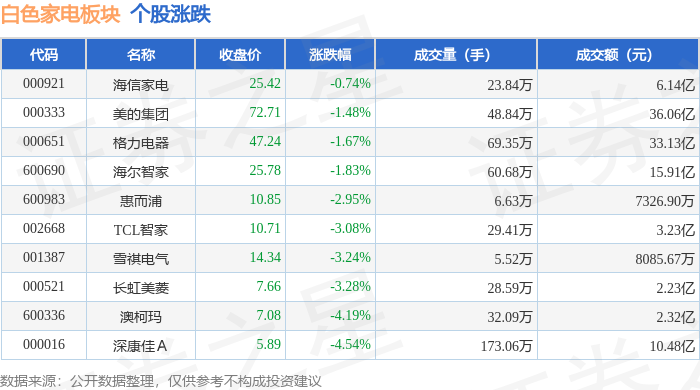
Market Overview - The white goods sector experienced a decline of 1.66% on August 27, with major stocks like Deep Konka leading the drop [1] - The Shanghai Composite Index closed at 3800.35, down 1.76%, while the Shenzhen Component Index closed at 12295.07, down 1.43% [1] Stock Performance - Key stocks in the white goods sector showed the following performance: - Hisense Electric: Closed at 25.42, down 0.74% with a trading volume of 238,400 shares and a turnover of 614 million yuan [1] - Midea Group: Closed at 72.71, down 1.48% with a trading volume of 488,400 shares and a turnover of 3.606 billion yuan [1] - Gree Electric: Closed at 47.24, down 1.67% with a trading volume of 693,500 shares and a turnover of 3.313 billion yuan [1] - Haier Smart Home: Closed at 25.78, down 1.83% with a trading volume of 1,606,800 shares and a turnover of 1.591 billion yuan [1] - Whirlpool: Closed at 10.85, down 2.95% with a trading volume of 66,300 shares and a turnover of 73.269 million yuan [1] - TCL Smart Home: Closed at 10.71, down 3.08% with a trading volume of 294,100 shares and a turnover of 323 million yuan [1] - Snowman Electric: Closed at 14.34, down 3.24% with a trading volume of 55,200 shares and a turnover of 80.857 million yuan [1] - Changhong Meiling: Closed at 7.66, down 3.28% with a trading volume of 285,900 shares and a turnover of 223 million yuan [1] - Aucma: Closed at 7.08, down 4.19% with a trading volume of 320,900 shares and a turnover of 232 million yuan [1] - Deep Konka A: Closed at 5.89, down 4.54% with a trading volume of 1,730,600 shares and a turnover of 1.048 billion yuan [1] Capital Flow - The white goods sector saw a net outflow of 651 million yuan from institutional investors and 182 million yuan from retail investors, while there was a net inflow of 833 million yuan from individual investors [1] - Detailed capital flow for key stocks includes: - Hisense Electric: Net inflow of over 9.994 million yuan from institutional investors, but a net outflow of 26.163 million yuan from retail investors [2] - Snowman Electric: Net outflow of 723,500 yuan from institutional investors, with a net inflow of 519,630 yuan from retail investors [2] - Whirlpool: Net outflow of 3.6414 million yuan from institutional investors, with a net inflow of 391,560 yuan from retail investors [2] - Midea Group: Net outflow of 19.3266 million yuan from institutional investors, with a net inflow of 14 million yuan from retail investors [2] - TCL Smart Home: Net outflow of 22.2918 million yuan from institutional investors, with a net inflow of 1.54657 million yuan from retail investors [2] - Changhong Meiling: Net outflow of 23.8225 million yuan from institutional investors, with a net inflow of 2.21678 million yuan from retail investors [2] - Aucma: Net outflow of 39.0141 million yuan from institutional investors, with a net inflow of 22.5126 million yuan from retail investors [2] - Deep Konka A: Net outflow of 82.9116 million yuan from institutional investors, with a net inflow of 117 million yuan from retail investors [2] - Haier Smart Home: Net outflow of 1.64 million yuan from institutional investors, with a net inflow of 19.1 million yuan from retail investors [2] - Gree Electric: Net outflow of 30.5 million yuan from institutional investors, with a net inflow of 131.3 million yuan from retail investors [2]


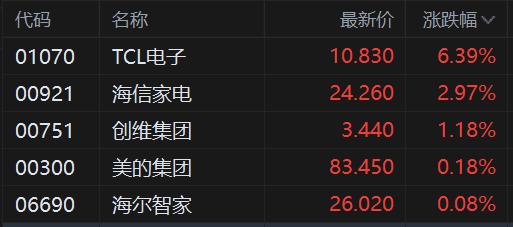
港股异动丨家电股普涨 TCL电子涨超6% 海信家电涨3% 第三波国补来了
Ge Long Hui A P P· 2025-08-27 03:08
Group 1 - The core viewpoint of the article highlights the positive performance of Hong Kong home appliance stocks, driven by government subsidies for appliance upgrades and replacements [1] - TCL Electronics led the gains with an increase of over 6%, followed by Hisense Home Appliances with a 3% rise, and Skyworth Group with an increase of over 1% [1] - The government has initiated a new round of subsidies for appliance purchases, offering up to 20% for first-level energy/water efficiency products and 15% for second-level products, with a significant 30% subsidy for home modification products aimed at elderly care [1] Group 2 - According to Guojin Securities, the outlook for the home appliance sector is mixed: white goods are slightly under pressure, black goods are stable, kitchen and bathroom appliances are stabilizing at the bottom, and vacuum cleaners maintain high demand [1] - Year-to-date, retail sales of home appliances have shown strong growth, supported by domestic subsidies, indicating resilient demand, while emerging market demand is expected to drive export growth [1]
《海尔兄弟》续集2027年春节上线:共100多集,每集10分钟
Qi Lu Wan Bao· 2025-08-27 02:51
据海尔集团消息,8月26日,海尔集团董事局主席、首席执行官周云杰在《海尔兄弟》续集创作发布会上揭晓《海尔兄弟》续集上线时间确定: 2027年春节前后。 (齐鲁晚报·齐鲁壹点客户端编辑 武秀英 综合 新浪科技、北京日报、公开资料) 《海尔兄弟》主要讲述一对由智慧老人所创造的海尔兄弟和他们的朋友,为解决人类面临的灾难和解开无尽的自然之谜而环游世界,最后回到他 们的诞生地太平洋的神奇历险故事。 (豆瓣截图) 他介绍到:"《海尔兄弟》续集分四季100多集,每集10分钟左右。" (图源:豆瓣) 《海尔兄弟》1995年起播放,于2001年完结,共212集。资料显示,《海尔兄弟》是由海尔集团、北京红叶电脑动画制作技术有限公司联合出品的 科普性系列动画片,总计212集,其中前106集于1995年起播放,1998年完结。 ...

《海尔兄弟》续集创作正式启动
Bei Jing Ri Bao Ke Hu Duan· 2025-08-27 02:34
Core Viewpoint - The launch of the sequel to "Haier Brothers" marks a significant cultural event, aiming to create a new model of collective creation for a classic IP, engaging multiple generations and diverse wisdom [2][22]. Group 1: Event Overview - The sequel creation plan was officially announced at a press conference in Beijing, co-hosted by Haier Group and Beijing Broadcasting Television Station [2]. - Key figures in attendance included Xu Tao, Vice Secretary of the Party Group and Editor-in-Chief of Beijing Broadcasting Television Station, and Zhou Yunjie, Chairman and CEO of Haier Group [2]. Group 2: Historical Context - "Haier Brothers," first aired in 1995, is recognized as China's first large-scale educational animated series, blending adventure with rich multidisciplinary knowledge [4]. - The series has become a cultural symbol for the "post-80s" and "post-90s" generations, representing a significant part of their childhood [4]. Group 3: Reasons for the Sequel - Xu Tao highlighted three reasons for creating the sequel: the curiosity about the unknown secrets of Earth, the desire to fulfill individual curiosity while passing on culture and warmth, and Haier's unique blend of scientific and artistic qualities [6]. Group 4: Creative Process - The original creators shared nostalgic memories and valuable materials from the first series, emphasizing the imaginative process behind the adventure scenes [8]. - The sequel's directors discussed advancements in animation technology and changing viewer demands, focusing on how to continue the classic narrative [10]. Group 5: Sequel Features - The sequel will maintain the "science + adventure" core while integrating modern technological advancements to fit the 21st-century scientific context [11]. - The storyline will expand from terrestrial exploration to deep-sea and space adventures, with a planned duration of approximately 10 minutes per episode across four seasons, totaling over 100 episodes [19]. Group 6: Community Engagement - The sequel aims to involve the audience as "co-creators," allowing them to influence story elements and character dialogues, thus transforming viewers into active participants [18]. - Zhou Yunjie emphasized the importance of collective creativity, stating that the sequel is not merely a continuation of the story but a scientific co-creation ecosystem [17]. Group 7: Industry Impact - Experts expressed optimism about the sequel's potential to represent a new model for artistic innovation and industry integration in Chinese animation [20]. - The project is expected to influence the new generation and effectively tell Chinese stories on the global stage [20].

每日报告精选-20250827



GUOTAI HAITONG SECURITIES· 2025-08-27 02:00
Market Performance - Global markets continued to rise last week, with MSCI Global up by 1.5%, MSCI Developed up by 1.5%, and MSCI Emerging up by 1.3%[3] - The US stock market's earnings expectations for 2025 were revised upward, with the S&P 500 EPS forecast increased from 268 to 269[4] Economic Expectations - Global economic expectations were adjusted upward, with the Citigroup Economic Surprise Index for the US rising due to dovish signals from the Fed[4] - The issuance of new special bonds by local governments reached 2392.7 billion CNY, a year-on-year increase of 76.7%[19] Industry Insights - In the home appliance sector, TCL Electronics reported a total revenue of 54.777 billion HKD for H1 2025, a year-on-year increase of 20.4%[15] - The gaming industry saw a record high of 166 domestic game approvals in August, with a total of 1050 approvals in the first eight months of 2025, significantly higher than the previous year's 850[31] Investment Recommendations - In the home appliance sector, recommended stocks include Stone Technology and Ecovacs for their strong performance and growth potential[14] - For the construction industry, low valuation high-dividend companies such as China State Construction and China Railway Construction are recommended due to their expected benefits from PPP policy catalysts[39]