Bank Of Jiangsu(600919)

Search documents
A股上市城商行一季报出炉:北京银行、贵阳银行、厦门银行营收利润均下降
Guan Cha Zhe Wang· 2025-05-03 07:24
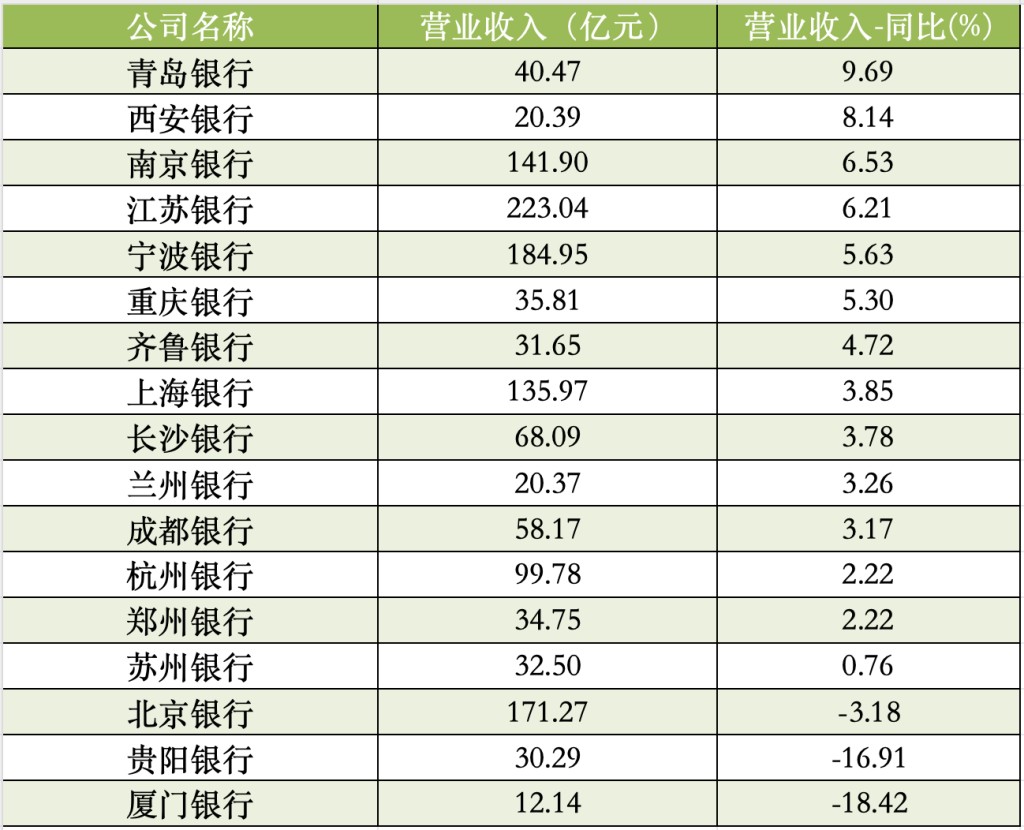
Core Insights - In the first quarter of 2025, 14 out of 17 A-share listed city commercial banks reported positive revenue growth, with an average growth rate of 2.96%, a decline from 5.61% in the same period last year [1][3][6] - The net profit for 14 banks also showed positive growth, averaging 5.49%, down from 7.05% year-on-year [1][6][7] - The asset scale of A-share listed city commercial banks increased by 6.53% compared to the end of the previous year, up from 4.65% year-on-year [2][9] Revenue Performance - Qingdao Bank led the revenue growth with a year-on-year increase of 9.69%, followed by Xi'an Bank (8.14%), Nanjing Bank (6.53%), and Jiangsu Bank (6.21%) [3][5] - Three banks reported negative revenue growth: Beijing Bank (-3.18%), Guiyang Bank (-16.91%), and Xiamen Bank (-18.42%) [4][5] - Jiangsu Bank achieved the highest revenue among the listed banks, totaling 22.304 billion yuan, while Xiamen Bank had the lowest at 1.214 billion yuan [4][5] Net Profit Performance - Hangzhou Bank led in net profit growth with a 17.3% increase, followed by Qilu Bank (16.47%) and Qingdao Bank (16.42%) [7][8] - Negative net profit growth was reported by Beijing Bank (-2.44%), Guiyang Bank (-6.82%), and Xiamen Bank (-14.21%) [7][8] - Jiangsu Bank reported the highest net profit at 9.78 billion yuan, while Xiamen Bank had the lowest at 0.645 billion yuan [7][8] Asset Scale and Quality - As of March 31, 2025, eight A-share listed city commercial banks had asset scales exceeding 1 trillion yuan, with Beijing Bank and Jiangsu Bank surpassing 4 trillion yuan [9][10] - The overall asset quality showed improvement, with seven banks reporting non-performing loan ratios below 1%, the lowest being Chengdu Bank at 0.66% [11][12]





2025年一季报收官:34家上市银行股市赚率估值总览!
雪球· 2025-05-03 02:28
Core Viewpoint - The article discusses the valuation of various banking sectors in China, highlighting that the six major banks and rural commercial banks are generally overvalued, while joint-stock banks and city commercial banks are seen as undervalued [2][4]. Group 1: Market Valuation - The "Market Earnings Ratio" (市赚率) is introduced as a valuation parameter, calculated as Market Price to Earnings Ratio (PE) divided by Return on Equity (ROE), with a specific formula: PR = PE / (ROE / 100) [2][3]. - The average valuation of the six major banks' A-shares has reached above 1.0 PR, indicating overvaluation, while their H-shares average above 0.8 PR [4][5]. - The Postal Savings Bank is noted as the least favored among the six major banks, with a valuation below 1.0 PR in the A-share market [4]. Group 2: Joint-Stock Banks - Joint-stock banks are not generally overvalued, with an average A-share valuation of over 0.9 PR and H-share valuation at 0.8 PR [5][6]. - The disparity in valuation between A-shares and H-shares is highlighted, with examples such as China Merchants Bank showing stronger performance in H-shares compared to A-shares [5]. Group 3: City Commercial Banks - City commercial banks are identified as undervalued, with average A-share valuations around 0.8 PR, and specific banks like Jiangsu Bank and Hangzhou Bank noted as significant value opportunities with valuations of 0.65 PR [7][8]. Group 4: Rural Commercial Banks - The article suggests that rural commercial banks are not as clear-cut in terms of valuation, as they are generally seen as growth banks with lower dividend payout ratios, leading to higher correction coefficients [9][10]. - Only one rural commercial bank, Changshu Bank, is noted to have a valuation below 0.4 PR, indicating limited undervaluation compared to city commercial banks [9][10]. Group 5: Growth Banks - Four banks are identified as growth stocks with improving ROE: Hangzhou Bank, Qilu Bank, Qingdao Bank, and Changshu Bank [11][12]. - The article emphasizes that the valuation of these growth banks may not reflect their potential due to their lower dividend payout ratios [11][12]. Group 6: Market Environment - The article discusses the impact of a low-interest environment on stock valuations, suggesting that while valuations should theoretically rise, the relationship is not strictly inverse [12]. - It is recommended that banks with high valuations should be sold as they rise, particularly in the A-share market above 1.0 PR and H-share market above 0.8 PR [12].




【2025-04-30】晨会纪要
Ping An Securities· 2025-05-01 01:00
Group 1: Investment Rating - The report maintains a "Recommended" rating for the companies analyzed, indicating a positive outlook for their future performance [10][19][33]. Group 2: Core Insights - The active bond fund market shows a slight increase in the number of funds and total assets, with 3,263 funds and a total scale of 7.90 trillion yuan, reflecting a 0.8% and 1.0% increase respectively [7][8]. - The performance of active bond funds in Q1 was influenced by rising government bond yields, with short-term pure bond funds performing particularly well [7][8]. - The report highlights a shift in asset allocation within mixed secondary bond funds, with increased holdings in sectors such as non-ferrous metals, pharmaceuticals, and steel [8][9]. - The medical device company Mindray achieved a revenue of 36.73 billion yuan in 2024, with a year-on-year growth of 5.14%, while its international business grew by 21.28% [10][11]. - Haibo Technology reported a revenue of 8.27 billion yuan in 2024, marking an 18.44% increase, with a significant focus on energy storage systems [15][18]. - The refrigerant manufacturer Sanmei achieved a revenue of 4.04 billion yuan in Q1 2025, reflecting a 26.42% increase, driven by strong demand in the home appliance and automotive sectors [26][27]. Group 3: Summary by Sections Active Bond Funds - As of Q1 2025, the number of active bond funds reached 3,263, with a total scale of 7.90 trillion yuan, and 43 new funds were issued, totaling 783.7 billion yuan [7][8]. - The performance of short-term pure bond funds was notably strong due to rising yields, while mixed bond funds showed volatility [7][8]. Mindray Medical - Mindray's revenue for 2024 was 36.73 billion yuan, with a net profit of 11.67 billion yuan, and a proposed cash dividend of 5.6 yuan per 10 shares [10][11]. - The company anticipates a recovery in domestic business in 2025, with international revenue expected to continue growing [11][12]. Haibo Technology - Haibo's revenue for 2024 was 8.27 billion yuan, with a focus on energy storage systems, which accounted for a significant portion of its revenue [15][18]. - The company has established partnerships with international firms to explore new market opportunities [18]. Sanmei - Sanmei's revenue for 2024 was 4.04 billion yuan, with a significant increase in refrigerant prices due to supply constraints [26][27]. - The company is well-positioned in the market with a leading share in the production of third-generation refrigerants [29]. Huayu Automotive - Huayu reported a revenue of 168.85 billion yuan in 2024, with a slight decline in net profit due to cost pressures [31][32]. - The company is adjusting its customer structure to mitigate risks associated with its largest client, SAIC [32][33].



42家A股上市银行日赚58.58亿元,5家中小银行投资收益翻倍
Hua Xia Shi Bao· 2025-04-30 14:03
Core Insights - Financial investment business is evolving from traditional tools to a new revenue engine for listed banks amid narrowing net interest margins and sluggish profit growth [2][3] - Bond investments are showing strong yield elasticity during the market interest rate decline in 2024, effectively cushioning the impact of declining net interest income on financial statements [2][3] Group 1: Financial Performance - In 2024, 42 listed A-share banks reported a total net profit of 2.14 trillion yuan, averaging daily earnings of approximately 58.58 billion yuan [3] - The total financial investment amount reached 91.41 trillion yuan, generating 512.8 billion yuan in investment income, with over 90% of banks achieving year-on-year positive growth in investment income [3][4] - Among these banks, 37 reported positive growth in investment income, with five small and medium-sized banks achieving over 100% year-on-year growth [3][4] Group 2: Investment Trends - The average proportion of investment income to total revenue for the 42 listed banks increased to 15.61% in 2024, up from 12.33% in 2023 [4] - Nine banks had investment income accounting for over 20% of their revenue, all of which were small and medium-sized banks [4] - Jiangsu Bank, Ningbo Bank, Nanjing Bank, and Beijing Bank reported investment income exceeding 10 billion yuan in 2024 [5] Group 3: Market Dynamics - The preference for bond investments among small and medium-sized banks is attributed to narrowing net interest margins and increased competition [6][7] - The bond market has become a significant source of income for banks, especially for rural commercial banks, which have become active participants in the bond market [6][7] - The overall bond yield trend in 2024 was downward, with the 10-year government bond yield decreasing to 1.68% by December 31, creating favorable conditions for bond investment income growth [7][8] Group 4: Future Outlook - Many banks maintain an optimistic outlook on bond investments for 2025, anticipating continued opportunities in the bond market due to expected fluctuations in bond rates [8]

江苏银行(600919):业绩韧性强,量价支撑净利息高增,资产质量持续改善
ZHONGTAI SECURITIES· 2025-04-30 12:46
Investment Rating - The report maintains a "Buy" rating for Jiangsu Bank [2][3] Core Views - Jiangsu Bank's performance remains robust with a revenue growth of 6.2% year-on-year in Q1 2025, and a net profit growth of 8.2% year-on-year [3][11] - The bank's net interest income increased significantly by 21.9% year-on-year in Q1 2025, supported by a resilient net interest margin [12][14] - Asset quality indicators such as non-performing loan ratio and overdue rates have shown improvement, indicating a positive trend in credit quality [19] Summary by Sections Performance Overview - Jiangsu Bank's Q1 2025 revenue increased by 6.2% compared to the same period in 2024, while net profit rose by 8.2% [11][7] - The bank's net interest margin improved to 1.8%, with a quarter-on-quarter increase of 13 basis points [12][9] - The bank's total loans grew by 13% year-on-year, with corporate loans increasing by 25.9% and retail loans by 10% [14][15] Non-Interest Income - Non-interest income decreased by 23.0% year-on-year in Q1 2025, primarily due to a decline in other non-interest income [18] - However, fee income increased by 21.8% year-on-year, partially offsetting the decline in non-interest income [18] Asset Quality - The non-performing loan ratio improved to 0.86%, down 3 basis points quarter-on-quarter and 5 basis points year-on-year [19] - The bank's provision coverage ratio remains high at 343.51%, despite a slight decrease [19] - The overdue rate decreased to 1.10%, indicating better asset quality management [19]
江苏银行(600919):业绩韧性强;量价支撑净利息高增;资产质量持续改善
Xin Lang Cai Jing· 2025-04-30 12:26
Performance Summary - Jiangsu Bank reported a revenue growth of 6.2% year-on-year for Q1 2025, compared to an annual growth of 8.7% in 2024, while net profit increased by 8.2% year-on-year, against a 10.8% annual growth in 2024 [1] - The bank maintained a high growth in operating performance, with both revenue and profit growing over 5%. The credit growth remained robust, supported by liabilities that bolstered net interest margin resilience, leading to a 21.9% year-on-year increase in net interest income for Q1 2025 [1] - Net interest income also saw a quarter-on-quarter increase of 16.3%, with an annualized net interest margin rising by 13 basis points to 1.8% [1] Asset Quality - The bank's asset quality indicators showed improvement, with a non-performing loan (NPL) ratio of 0.86%, down 3 basis points quarter-on-quarter and 5 basis points year-on-year [3] - The non-performing loan generation rate decreased to 1.03%, down 34 basis points year-on-year and 38 basis points quarter-on-quarter, while the ratio of loans under special attention fell to 1.33% [3] - The overdue loan ratio also improved, decreasing by 1 basis point to 1.11% [3] Loan Growth - In Q1 2025, the bank experienced strong growth in both corporate and retail loans, with total interest-earning assets increasing by 20.6% year-on-year [2] - Corporate loans grew by 25.9% year-on-year, while retail loans saw a 10.0% increase [2] - The bank's interest-bearing liabilities rose by 22.0% year-on-year, with deposits increasing by 16.0% [2] Fee Income - Non-interest income showed a decline of 23.0% year-on-year, primarily due to other non-interest income dragging down overall performance [2] - However, net fee income increased by 21.8% year-on-year, indicating a strong performance in fee-generating activities [2] Investment Outlook - Jiangsu Bank's core competitive advantages include its small and micro business focus, strong corporate business in manufacturing and infrastructure, and retail business scale advantages [4] - The bank's projected price-to-book ratios for 2025, 2026, and 2027 are 0.75X, 0.68X, and 0.61X respectively, with price-to-earnings ratios of 5.55X, 5.21X, and 4.94X [4] - The bank's strong net interest margin trends, quality asset performance, and capital replenishment are expected to support sustained performance [4]
这些板块涨停潮!
Zheng Quan Shi Bao Wang· 2025-04-30 09:42
Market Overview - A-shares exhibited mixed performance with the Shanghai Composite Index experiencing slight fluctuations while the ChiNext and STAR Market indices surged [1] - The Shanghai Composite Index closed down 0.23% at 3279.03 points, while the Shenzhen Component Index rose 0.51% to 9899.82 points, and the ChiNext Index increased by 0.83% to 1948.03 points [1] - The total trading volume across the Shanghai, Shenzhen, and Beijing markets reached 11,933 billion yuan, an increase of over 1,500 billion yuan compared to the previous day [1] Banking Sector Performance - The banking sector faced significant declines, with Huaxia Bank dropping 8.55%, and other major banks like Industrial and Commercial Bank of China, China Construction Bank, and Agricultural Bank of China falling over 3% [2][3] - The first quarter financial results of 42 listed banks showed a total operating income of 1.45 trillion yuan, a year-on-year decrease of 1.72%, and a net profit attributable to shareholders of 563.98 billion yuan, down 1.2% [5] - Huaxia Bank reported a total profit of 6.73 billion yuan for the first quarter, a decline of 15.11% year-on-year, while Xiamen Bank's operating income fell by 18.42% [5] Automotive Industry - The automotive supply chain stocks saw significant gains, with companies like Lingdian Electric Control and Jingjin Electric reaching the daily limit of 20% increase, and others like Slin Group rising over 13% [10] - The Ministry of Industry and Information Technology recently released key points for automotive standardization, emphasizing the need for enhanced standards for intelligent connected vehicles, particularly in driver assistance and autonomous driving [10][12] - The regulatory clarity regarding L2 and L3 levels of autonomous driving is expected to lead to increased resource allocation and investment in the automotive intelligence sector [12] AI Applications - The AI application sector showed strong activity, with stocks like Chuangyi Information and Zhejiang Wenhe rising significantly, and several companies hitting the daily limit [7] - Alibaba's Tongyi Qianwen released a new series of models, showcasing competitive performance against leading models in the industry, indicating a robust development in China's large model industry [8]


长三角城商行座次重排:宁波银行首次超过上海银行 三大业务板块动能切换
2 1 Shi Ji Jing Ji Bao Dao· 2025-04-30 09:38
Core Viewpoint - The financial performance of four major city commercial banks in the Yangtze River Delta—Jiangsu Bank, Shanghai Bank, Ningbo Bank, and Nanjing Bank—has shown varying strengths, with Jiangsu Bank maintaining its leading position while the others have demonstrated notable growth in specific areas [1][2]. Group 1: Financial Performance Overview - As of the end of Q1, Jiangsu Bank leads in total assets at 4.46 trillion yuan, followed by Ningbo Bank at 3.40 trillion yuan, Shanghai Bank at 3.27 trillion yuan, and Nanjing Bank at 2.77 trillion yuan [1]. - For 2024, Jiangsu Bank reported the highest revenue at 808.15 billion yuan, with Ningbo Bank at 666.31 billion yuan, and both Shanghai and Nanjing Banks in the 500 billion yuan range [1]. - Nanjing Bank exhibited the highest revenue growth rate at 11.32%, while Jiangsu and Ningbo Banks maintained over 8% growth [1]. Group 2: Q1 Revenue and Profit Analysis - In Q1, revenue rankings shifted, with Jiangsu Bank at 223.04 billion yuan, Ningbo Bank at 184.95 billion yuan, Nanjing Bank at 141.90 billion yuan, and Shanghai Bank at 135.97 billion yuan [2]. - Jiangsu Bank's net profit for the previous year was the highest at 333.06 billion yuan, with a year-on-year growth of 10.97% [2]. - In Q1, Jiangsu Bank's net profit surpassed 100 billion yuan, reaching 100.92 billion yuan, followed by Ningbo Bank at 74.56 billion yuan [2]. Group 3: Revenue Sources and Trends - The three main revenue sources for banks—net interest income, net fee and commission income, and net investment income—are under pressure due to declining interest rates and changing wealth management demands [3]. - Ningbo Bank showed a significant increase in net interest income growth, with a 2024 growth rate of 17.32%, while Jiangsu Bank's growth was 6.29% [3]. - Jiangsu Bank's net interest income as a percentage of revenue is 69.24%, while Ningbo Bank leads at 72.03% [4]. Group 4: Fee and Commission Income - Jiangsu Bank is the only bank showing a positive growth trend in fee and commission income for 2024, with a growth rate of 3.29% [4]. - Other banks, including Ningbo and Shanghai Banks, experienced declines in fee income, although the rate of decline has slowed [5]. Group 5: Investment Income Insights - Investment income for Jiangsu and Ningbo Banks saw a significant decrease compared to the previous year, with Jiangsu Bank's investment income rising slightly to 22.78% of revenue [6]. - In Q1, Nanjing Bank's fee and commission income surged by 18.001%, becoming the highest among the four banks [7]. Group 6: Net Interest Margin and Cost of Liabilities - As of Q1, Jiangsu Bank had the highest net interest margin at 1.82%, while Shanghai Bank had the lowest at 1.16% [8]. - The banks are facing challenges with narrowing interest margins due to declining benchmark rates and rising liability costs [8][9]. Group 7: Loan Growth and Strategy - Jiangsu and Ningbo Banks increased corporate loan growth significantly, with growth rates of 28.59% and 24.13%, respectively [9]. - Nanjing Bank has also focused on increasing high-interest personal loans, achieving significant growth in consumer loans [10].

关注的一些银行24年年报数据整理
雪球· 2025-04-30 08:44
以下文章来源于躺师傅的投资世界 ,作者躺师傅 躺师傅的投资世界 . 格施好学徒,佛系收息人~ 风险提示:本文所提到的观点仅代表个人的意见,所涉及标的不作推荐,据此买卖,风险自负。 作者: 躺红利摊转债 来源:雪球 银行板块的年报陆陆续续都出完了 , 今天有空就来做个数据整理 , 现在整个银行板块数量也挺 多 , 为减少工作量 , 就从国有行 、 股份行和城商行中各选四家具有代表性的银行做一个数据 对比吧~ 一 、 整体业绩概览 | 营收(亿) | | 同比 | 净利润(亿) | 同比 | 风险加权资 | 同比 | 24年 | | --- | --- | --- | --- | --- | --- | --- | --- | | | | | | | 产(亿) | | 浅幅 | | 工商银行 8218.03 | | -2.52% | 3658. 63 | 0. 51% | 257108. 55 | 4. 34% | 52. 30% | | 建设银行 7501.51 | | -2.54% | 3355. 77 | 0. 88% | 218545. 90 | -2. 42% | 42. 44% | | 农业银行 71 ...



稳中求进、质效并升:江苏银行擦亮普惠为民底色
Sou Hu Cai Jing· 2025-04-30 02:33
Core Viewpoint - The banking industry is undergoing significant differentiation and transformation, with increasing market competition. Jiangsu Bank has demonstrated strong performance amidst challenges, achieving high-quality development through its commitment to "finance for the people" and enhancing financial services [2][4]. Financial Performance - Jiangsu Bank reported a Q1 2025 operating income of 22.304 billion yuan, a year-on-year increase of 6.21% - The net profit attributable to shareholders was 9.78 billion yuan, up 8.16% year-on-year - Basic earnings per share reached 0.53 yuan, reflecting a growth of 17.78% [2][4] - As of the end of Q1 2025, the bank's non-performing loan ratio was 0.86%, the lowest since its listing, with a provision coverage ratio of 343.51% [4][5] Asset Growth - Jiangsu Bank's total assets surpassed 4 trillion yuan, reaching 4.46 trillion yuan, marking a significant milestone in its development - Total deposits amounted to 2.42 trillion yuan, a growth of 14.21% compared to the end of the previous year - Total loans reached 2.26 trillion yuan, with a year-on-year increase of 7.96% [3][4] Revenue Structure - The bank's interest income for Q1 2025 was 16.592 billion yuan, a year-on-year increase of 21.94%, accounting for 74.38% of total revenue - Non-interest income, including net fees and commissions, reached 1.65 billion yuan, up 21.77%, representing 7.4% of total revenue [4] Innovation and Support for SMEs - Jiangsu Bank has focused on enhancing financial services for small and medium-sized enterprises (SMEs) and technology innovation, establishing an "innovation ecosystem accelerator" - The bank has developed a tiered service system for technology financing and has actively engaged with local enterprises to support their growth [6][7] - As of the end of 2024, the bank's technology loan balance was 232.6 billion yuan, with a growth rate of 22.8% [7] Inclusive Finance Initiatives - Jiangsu Bank has prioritized inclusive finance, directing resources towards small and micro enterprises, and has implemented various initiatives to alleviate financing difficulties for these businesses - The bank's inclusive small and micro loan balance reached 210.5 billion yuan, a year-on-year increase of 21.36% [8][9] Retail Banking Strategy - The bank aims to expand its retail business and wealth management services, with a focus on customer needs and a comprehensive service approach - Retail deposits reached 822.9 billion yuan, growing 16.21% year-on-year, while retail loans amounted to 674.8 billion yuan, up 3.40% [10][11]